Categories
Science

Past “Fermi’s Paradox” XIII: The Ocean Worlds Speculation

Welcome back to our Fermi Paradox series, where we take a look at possible resolutions to Enrico Fermi’s famous question, “Where Is Everybody?” Today, we examine the possibility that the reason for the Great Silence is that many planets out there are just too watery!

In 1950, Italian-American physicist Enrico Fermi sat down to lunch with some of his colleagues at the Los Alamos National Laboratory, where he had worked five years prior as part of the Manhattan Project. According to various accounts, the conversation turned to aliens and the recent spate of UFOs. Into this, Fermi issued a statement that would go down in the annals of history: “Where is everybody?

This became the basis of the Fermi Paradox, which refers to the disparity between high probability estimates for the existence of extraterrestrial intelligence (ETI) and the apparent lack of evidence. Since Fermi’s time, there have been several proposed resolutions to his question, which include the possibility that Oceans Worlds (and not rocky planets) might be the best candidates for finding life.

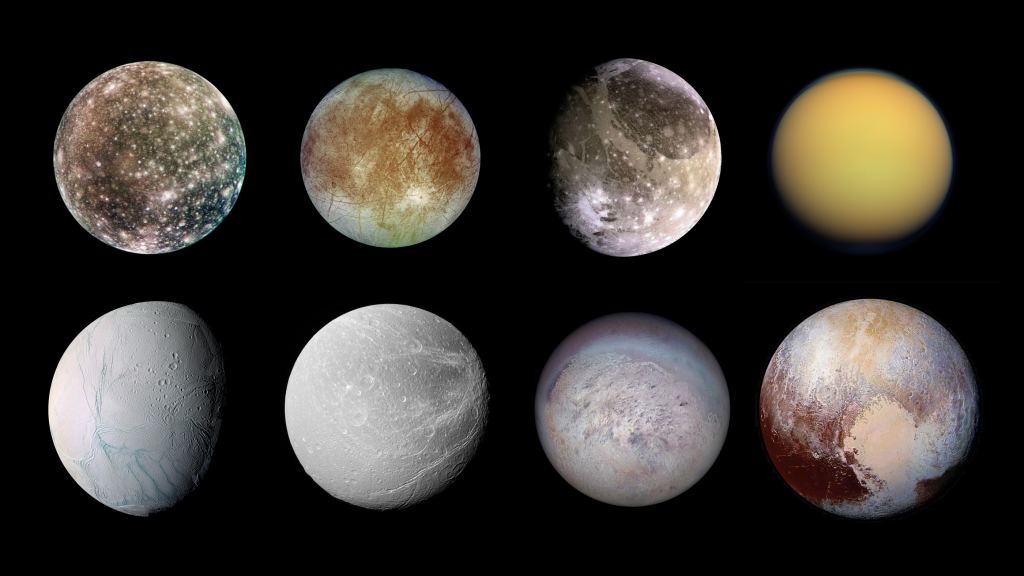
The term “Ocean World” (not to be confused with “Waterworld“) refers to astronomical bodies that have icy surfaces and interior oceans. Within the outer Solar System, there are multiple moons that fit this description, including Jupiter’s moons Europa, Ganymede, Callisto, Saturn’s moons Enceladus, Titan, Dione, Mimas, Neptune’s Triton, and maybe even Pluto, Ceres, and some of the larger Kuiper Belt Objects.

Astronomers hypothesize that chloride salts bubble up from the icy moon’s global liquid ocean and reach the frozen surface where they are bombarded with sulfur from volcanoes on Jupiter’s largest moon, Io. Credit: Keck Observatory.

Copernican vs. Anthropic

Related to this hypothesis is the ongoing debate between proponents of the Copernican Principle and the Anthropic Principle. The former states that if something is randomly-sampled, it is likely to be representative of the majority rather than being rare or unique. In the realm of astronomy and cosmology (where it is called the Cosmological Principle), it argues that Earth-like planets (and terrestrial life) are common in our Universe.

The Anthropic Principle essentially argues the opposite of the Cosmological Principle and holds that observations made of the Universe are entirely dependent on its laws being conducive to life. As David Brin would describe it in the context of the Fermi debate:

“The philosophical counter to the principle of mediocrity is the ‘Anthropic Principle,’ which proposes that it is possible, even in a great and diverse Universe, for an observer to witness a special place and time, especially if the special attribute is required for there to be an observer in the first place… Uniqueness advocates see nothing wrong with the proposal that the intelligent life we see on Earth is rare.”

In Rock or in Ice?

One of the main questions that keeps coming up during the whole Fermi debate is “are we looking in the right places?” When it comes right down to it, the Search for Extraterrestrial Intelligence (SETI) is plagued by a frame of reference problem. To put it succinctly, the only planet we know that is capable of supporting life (as we know it) is Earth and the only technologically-advanced species that we know of is ourselves.

Material from Europa’s ocean that ends up on the surface will be bombarded by radiation, possibly destroying any biosignatures, or chemical signs that could imply the presence of life. Credit: NASA/JPL-Caltech

Ergo, when searching for potentially-habitable exoplanets, astronomers are confined to looking for “Earth-like” planets (which is something of a loaded term). What that boils down to is terrestrial planets (rocky) that have dense atmospheres and are warm enough to have flowing water on their surfaces. Certain biosignatures such as oxygen gas, carbon dioxide, methane, and other chemicals we associate with life are looked for as well.

However, there is a growing chorus within the scientific community that holds this view to be both limited and limiting. To illustrate, there’s the search for life that is going on right now in the Solar System, which is almost entirely focused on Mars. But past the Frost Line, the theoretical boundary in the Solar System beyond which volatiles can exist in solid form, there are icy moons that might harbor life in their interiors.

Origin

In 1979, the Voyager 1 and 2 missions passed through the Jovian system and took detailed photos of Europa’s surface. These photos are what led scientists to consider the possibility that this icy moon might have an interior ocean. Since then, the evidence for this has mounted considerably and, combined with data indicating the presence of surface plumes, has bolstered the case for there being life inside.

The discovery of similar conditions on other Jovian moons, several of Saturn’s moons, and other icy bodies that orbit gas giants or in the Kuiper Belt have led many in the scientific community to speculate that these bodies could be the most promising place to look for life beyond Earth. In recent years, this argument has been extended by astronomers and astrobiologists to the interstellar realm.

Europa During Voyager 2 Closest Approach. Credit: NASA/JPL

One such person is Dr. Lynnae C. Quick, a NASA planetary scientist and a member of the Dawn, Europa Clipper, and Dragonfly science teams. She is also a member of the NASA Solar System Exploration Research Virtual Institute‘s (SSERVI) Toolbox for Research and Exploration (TREX) science team, NASA’s Roadmaps to Ocean Worlds (ROW), and the Outer Planets Assessment Group‘s (OPAG) Steering Committee.

As she explained in a recent NASA press release (dated June 18th):

“Plumes of water erupt from Europa and Enceladus, so we can tell that these bodies have subsurface oceans beneath their ice shells, and they have energy that drives the plumes, which are two requirements for life as we know it. So if we’re thinking about these places as being possibly habitable, maybe bigger versions of them in other planetary systems are habitable too.”

“If we see that a planet’s density is lower than Earth’s, that’s an indication that there might be more water there and not as much rock and iron. But if a planet’s surface temperature is less than 32 degrees Fahrenheit (0 degrees Celsius), where water is frozen, then we have an icy ocean world, and the densities for those planets are even lower.”

The goals of the ROW group were spelled out during a presentation titled “Exploration Pathways for Europa after initial In-Situ Analyses for Biosignatures,” which was made on Feb. 27th, 2017, at the NASA-hosted “Planetary Science Vision 2050 Workshop.” They include searching for biosignatures on Europa, analysis of near-subsurface material and depth estimates of its ocean, and characterizing surface/subsurface properties.

Jupiter’s icy moon Europa. Credits: NASA/Jet Propulsion Laboratory, SETI Institute

As Kevin Peter Hand – the Deputy Chief Scientist for Solar System Exploration at NASA’s Jet Propulsion Laboratory – explained during the course of the presentation, these three goals are intertwined:

“Were biosignatures to be found in the surface material, direct access to, and exploration of, Europa’s ocean and liquid water environments would be a high priority goal for the astrobiological investigation of our Solar System. Europa’s ocean would harbor the potential for the study of an extant ecosystem, likely representing a second, independent origin of life in our own solar system. Subsequent exploration would require robotic vehicles and instrumentation capable of accessing the habitable liquid water regions in Europa to enable the study of the ecosystem and organisms.”

Similar arguments were made by Manasvi Lingam and Abraham Loeb, two researchers from the Harvard Smithsonian Center for Astrophysics (CfA) and the Institute for Theory and Computation (ITC) at Harvard University. In a 2018 study, titled “Subsurface Exolife,” the two challenged traditional notions of habitability using the icy moons of Jupiter, Saturn, and other gas giants as examples.

As Prof. Loeb summarized this case for Universe Today via email back in Dec. of 2017, stating:

“The conventional notion of planetary habitability is the habitable zone (HZ), namely the concept that the “planet” must be situated at the right distance from the star such that it may be capable of having liquid water on its surface. However, this definition assumes that life is: (a) surface-based, (b) on a planet orbiting a star, and (c) based on liquid water (as the solvent) and carbon compounds. In contrast, our work relaxes assumptions (a) and (b), although we still retain (c).”

Scientists recently determined that a certain strain of Earth bacteria could thrive under conditions found on Enceladus. Credit: NASA/JPL/Space Science Institute

Possible Resolution?

Alan Stern, the Associate Vice President of the Southwest Research Institute (SwRI) and the Principle Investigator of the NASA New Horizons mission, suggested that this could even a possible resolution to the Fermi Paradox. During the Habitable Worlds 2017 Workshop hosted by NASA’s Nexus for Exoplanet System Science (NExSS), he conducted a presentation titled “An Answer to Fermi’s Paradox In the Prevalence of Ocean Worlds?”

Central to Stern’s presentation was the hypothesis that the great majority of planets in our galaxy that have given rise to life and civilizations are interior ocean worlds. Due to their icy crusts, these civilizations would be unable to communicate with other planets using methods we might recognize (like radio transmitters). But seeing as how these civilians would be aquatic, it’s unlikely they would rely on technologies similar to our own.

These arguments are reminiscent of what Charles Lineweaver of the Australian National University argued in his 2007 paper, “Paleontological Tests: Human-like Intelligence is not a Convergent Feature of Evolution.” In this paper, Lineweaver drew upon his many years of teaching about the Drake Equation to make the case for non-convergent evolution, stating that intermediate stages do not necessarily produce “inevitable” outcomes.

Citing conversations he had with Drake, Carl Sagan, and Simon Conway-Morris, he asserted that this is a common assumption in SETI research:

“What Drake, Sagan, and Conway-Morris have done is interpret correlated parallel moves in evolution as if they were unconstrained by shared evolution but highly constrained by a universal selection pressure towards intelligence that could be extrapolated to extraterrestrials.”

Artist’s impression of a habitable exoplanet orbiting a red dwarf star. The habitability of the planets of red dwarf stars is conjectural (Credit ESO/M. Kornmesser public domain)

Similarly, Lineweaver showed how creatures with high Encephalization Quotients (E.Q.) – the ratio of brain weight to an exponent of body weight – will not inevitably develop technology or attempt to engage in interstellar communications:

“The most intelligent protostome is probably the octopus. After 600 million years of independent evolution and despite their big brains, octopi do not seem to be on the verge of building radio telescopes. The dolphinoidea evolved a large E.Q. between ~60 million years ago and ~20 million years ago (Marino et al 2004). Thus, dolphins have had ~20 million years to build a radio telescope and have not done so.

This strongly suggests that high E.Q. may be a necessary, but is not a sufficient condition for the construction of radio telescopes. Thus, even if there were a universal trend toward high E.Q., the link between high E.Q. and the ability to build a radio telescope is not clear. If you live underwater and have no hands, no matter how high your E.Q., you may not be able to build, or be interested in building, a radio telescope.”

This argument certainly applies as far as the Ocean Worlds Hypothesis is concerned. In the end, it could be that intelligent life is not rare at all, but that it’s simply unable to communicate with us.

Artist’s conception of a cryovolcanic eruption on Europa. Credit: Justice Blaine Wainwright

Implications and Criticism

The immediate and obvious implication of this hypothesis are that all of our current SETI efforts (which rely on searching for radio transmission in the cosmos) will not succeed. If life is statistically more likely to emerge on icy bodies with interior oceans at their core-mantle boundary, then finding evidence of this life will require a much more active approach.

In the coming years, NASA plans to send an orbiter to Europa (the Europa Clipper mission) which will analyze the moon’s surface in the hopes of learning more about its composition, monitor plume activity, and look for biosignatures. The data obtained by this mission will also inform possible future missions to the surface, such as NASA’s proposed Europa Lander.

This mission would examine the surface of Europa for biomarkers, most likely from a spot adjacent to an active plume. There have even been multiple proposals made over the past few decades for a robotic submarine that would investigate Europa’s interior ocean. Similar proposals have been made for exploring Enceladus and other Ocean Worlds.

In all cases, this presents serious ethical considerations. Whereas it is natural to want to get a closer look at Ocean Worlds in our Solar System to determine if there is life within them, the prospect of sending missions to explore them directly would threaten any life there. Such is the paradox of planetary protections, where the search for life entails the risk of contaminating and endangering it.

In terms of drawbacks, the Ocean Worlds hypothesis raises the all-important Copernican Principle (aka. Cosmological Principle). If most life in the Universe is to be found inside icy planets and moons, then planet Earth, terrestrial life, and humanity are atypical and are in a unique and advantageous position to observe the cosmos – which is consistent with the Anthropic Principle.

What’s more, it implies an imperative or even a duty for humanity to seek out life if it wants to make contact. Otherwise, the Fermi Paradox will endure because other life forms are unable to contact us. But if in so doing, we run the risk of contaminating and destroying any life we find, are we not better off letting it endure? All good questions, and one which help to frame the ethical questions that searching for extraterrestrial life raises.

These questions absolutely must be addressed before humanity starts sending robotic missions to Europa and other “Ocean Worlds.” If these are the only places we’re likely to find extraterrestial life in our Solar System or the Universe at large, perhaps it would be best to explore them from orbit or just leave them alone entirely. Luckily for us, it will be many years before a Europa submarine (or similar missions) would even be on the table.

Also, a number of next-generation telescopes will become operational this decade (like the James Webb and Nancy Grace Roman Space Telescope) that will gather a great deal more information on potentially-habitable exoplanets. So in addition to having time to discuss the ethical considerations thoroughly, we will also be able to place tighter constraints one where life could be found in the coming years.

In the meantime, be sure to check out this cool infographic about the Ocean Worlds in our Solar System, courtesy of NASA JPL Infographics:

Diagram of the Ocean Worlds in our Solar System. Credit: Kim Orr/solarsystem.nasa.gov

We have written many interesting articles about the Fermi Paradox, the Drake Equation, and the Search for Extraterrestrial Intelligence (SETI) here at Universe Today.

Here’s Where Are The Aliens? How The ‘Great Filter’ Could Affect Tech Advances In Space, Why Finding Alien Life Would Be Bad. The Great Filter, How Could We Find Aliens? The Search for Extraterrestrial Intelligence (SETI), and Fraser and John Michael Godier Debate the Fermi Paradox.

Want to calculate the number of extraterrestrial species in our galaxy? Head on over to the Alien Civilization Calculator!

And be sure to check out the rest of our Beyond Fermi’s Paradox series:

Astronomy Cast has some interesting episodes on the subject. Here’s Episode 24: The Fermi Paradox: Where Are All the Aliens?, Episode 110: The Search for Extraterrestrial Intelligence, Episode 168: Enrico Fermi, Episode 273: Solutions to the Fermi Paradox.

Sources:

  • Brin, G.D. “The Great Silence – the Controversy Concerning Extraterrestrial Intelligent Life.” Quarterly Journal of the Royal Astronomical Society, Vol. 24, No.3 (1983)
  • Lineweaver, C. “Paleontological Tests: Human-like Intelligence is not a Convergent Feature of Evolution.” From Fossils to Astrobiology (2007)
  • Stern, A. S. “An Answer to Fermi’s Paradox In the Prevalence of Ocean Worlds?” American Astronomical Society, Division of Planetary Sciences (DPS) meeting (2017)
  • Zeng, L. (et al.) “Growth Model Interpretation of Planet Size Distribution.” Proceedings of the Royal Astronomical Society (2019)
  • Nisr, C. (et al.) “Large H2O solubility in dense silica and its implications for the interiors of water-rich planets.” Proceedings of the Royal Astronomical Society (2020)
  • Quick, L. (et al.) “Forecasting Rates of Volcanic Activity on Terrestrial Exoplanets and Implications for Cryovolcanic Activity on Extrasolar Ocean Worlds.” Publications of the Astronomical Society of the Pacific, Vol. 132, No. 1014 (2020)

Like this:

Like Loading…

Categories
Technology

Greatest Cyber ​​Week Drone Offers 2020: DJI and Parrot Gross sales

Now is the time of year to find the best bargains on electronics of all kinds. Cyber ​​Week offers discount everything from computers to smartwatches. This is a great time to buy what you’ve always wanted to buy but never seem to enjoy. Or when you buy Christmas gifts, you can give that special someone a great gift at a great price. One category that you should definitely check out is drones, as these once exclusive technologies are now cheaper than ever. Whether you want to get aerial photography of an area or an event, or just want to have fun with friends or family while flying a drone outdoors, you can find tons of Cyber ​​Week drone deals today.

Best Deals on Cyber ​​Week Drones

How to choose a drone during Cyber ​​Week

There are tons of different types, brands, and prices of drones. How do you know which one to choose? When choosing the best drone for your needs, consider factors such as video resolution and frames per second, additional features like video stabilization and obstacle avoidance, and the weight of the drone. More high-end drones not only record better quality videos, but are also easier to control in the air thanks to intelligent environmental sensors and more precise inputs. This is especially important on days with wind and bad weather, as it is more difficult to control a drone in these conditions. So think about what you want to use your drone for and whether you are at the mercy of the weather when you fly your new drone.

Weight is also an important factor as drones weighing more than 250 grams must be registered if you want to fly them in the US. So drones like the original DJI Mavic Mini and the newer DJI Mini 2 weigh just 249 grams, both of which are great choices for those who want to start flying right away and don’t want to worry about paperwork. If you are looking for the best video quality for professional productions, a high-end model like the DJI Mavic 2 Pro or even the DJI Mavic Air 2 offers features such as environment detection, autonomous tracking of a subject, exceptionally solid build quality, responsive controls and an excellent camera . Of course, all of these features aren’t cheap, so high-end drones are expensive!

There are tons of affordable drone pilot options for beginners too. Brands like Snaptain have many inexpensive entry-level drones under $ 200, and you can find inexpensive models from well-respected brands like Potensic too. The Potensic T25 or Snaptain SP650 are two examples of affordable drones that still allow you to enjoy the fun of flying and record videos in 1080p quality. This makes them perfect for home and leisure use.

Should you buy a drone during Cyber ​​Week?

For all bargain hunters, Cyber ​​Week is the last big sales event of the year where you get the best drones at the highest discount on the market. If you don’t take advantage of these Cyber ​​Week offers, the next time you’ll see discounts as good as 2021. There is no better time to start purchasing these Cyber ​​Week drone deals than today.

Are drone deals too good to be true?

The old axiom “if something seems too good to be true, it probably is” always applies to sales like Cyber ​​Week. Retailers like to take advantage of these events to clear their shelves of stale inventory, so a hot Cyber ​​Week drone deal you noticed earlier may be out of date by today’s standards and not have the features you really want in 2020 The excitement about the sale (or pressure tactics like countdown timers and limited availability warnings) can improve your judgment. Feel free to add the item to your cart, but do take a look around and compare prices first before hitting the checkout button.

It is also a good idea to do your research by reading guides like this before shopping for Cyber ​​Week drone deals. So you already have a good idea of ​​what you want, what features to look for, and what is actually a really great bargain. This will help you set a budget to stick to while also providing you with the information you need to prevent you from making a purchase that may later disappoint you.

We strive to help our readers find the best deals on quality products and services, and we carefully and independently select what we cover. The prices, details and availability of the products and offers in this post are subject to change at any time. Make sure they are still valid before making a purchase.

Digital Trends can earn commissions on products purchased through our links, which supports the work we do for our readers.

Editor’s recommendations


Categories
Entertainment

Superstar Recreation Face: Anthony Anderson Brings Out His Interior Stripper

Anthony Anderson and his mother Doris Bowman take mother-son bonding to a whole new level in the brand new episode of Celebrity Game Face Tonight.

In this sneak peek clip the Kevin Hart-hosted E! Show that the black-haired actor is preparing to play a certain type of guessing game. Although the topic changes each round, the competition remains the same: one partner must lead the other (blindfolded) to do different activities that match the topic. Then the team whose blindfolded competitor successfully guesses most of the activities wins.

Much to the amusement of his competitors, Anthony’s assigned theme is “Things You Do in a Strip Club”. Even better? He will play with his mother.

As soon as the game starts Stephen “Twitch” Boss and Allison Holker, along with Rachael Harris and Kevin GessayI can’t help but laugh as Anthony tries to get Doris to do things like “let it rain”.

Categories
Technology

eight homes with secret passages

A home can be more than you think. If you look behind a bookshelf, under a trapdoor, or down a dark staircase, more property may be lurking around you. Secret rooms and passages that were part of the home from the start, or savvy additions that were later added by inspired homeowners.

From underground wine cellars to Batcave-like garages, homeowners design living spaces with tons of hidden nooks and crannies to ensure a quick getaway – or to simply take their home to the next level. Below are some of the more innovative hidden rooms from around the world.

DA Studio architects and artist Richard Woods created the four-story Rainbow House in central London. With transforming furniture, revolving rooms, and a lively spiral staircase that spans four floors and shows the full range of colors, this home is a sight to behold. However, one of the real gems in the Rainbow House is the secret passage built right into the floor of the master suite. With this hidden door and an attached slide, people can quickly move from the bedroom to the lounge below.

Simple walls and doors are boring. Why not spice up your living room and add a rotating wall? This black metal frame and plywood wall transforms the living room into a kitchen, revealing the home’s television. The faceted panels can also be used separately and to separate two individual rooms.

Do you love wine but can’t find a new place in your home to store your collection? UK based Spiral Cellars can solve this problem for you. The company is known for its dynamic wine cellars, like this subterranean beauty installed on your first floor.

Do you need to escape for a quiet time after dinner to ponder and ponder (and digest)? This stunning Jefferson, New York home has a secret door on the ground floor of the kitchen that leads to another part of the home.

Sometimes what’s behind a bookshelf is even better than what’s on the shelves. For example, a spacious wine cellar sits behind a bookcase in this beautiful home in Tacoma, Washington. It definitely comes in handy when you’re diving into a Danielle Steele novel.

This country style home is fairytale and is located on a hill in rural Maine. A hidden passageway is behind a bookcase that is in the turquoise common room, which allows quick access to a secret bathroom. Talk about a great escape.

We thought a house like this only existed in The Dark Knight films. This home was built along the lines of the legendary superhero pad and has underground parking that is accessible from the home’s tennis court. With lit lights on the ceiling and gray tiles on the floor, any average Joe will instantly feel like Batman.

Creative Home Engineering architectural firm specialize in a range of custom hidden doors for your home. The company is showing one of its electronic models at the nine-second mark in the video above. With the push of a button, a staircase is raised, giving individuals access to a hidden lounge.

Editor’s recommendations


Categories
Technology

A easy information to Redis and caching with NodeJS

In the past few years, Redis has been widely used in a Node.js application stack. Although the most popular use case is caching, Redis has many other use cases where you can take advantage of the lightning-fast in-memory database.

In this tutorial, we are going to give you a brief introduction to Redis. We’ll also be using Redis to create a simple cache for a node application to see how this affects performance.

What is redis

Redis is an open source data structure store (BSD licensed) in storage used as a database, cache and message broker.

You can think of a No-SQL database in which data is stored as key-value pairs in system memory. Redis also supports the storage of hard disk-persistent data if required.

Redis supports saving Multiple data structures and data types, including strings, lists, hashes, sets, and sorted sets. Supported data structures offer Redis the versatility for many use cases.

Redis is best for situations where data needs to be retrieved and delivered to the client in no time.

Redis use cases

One of the most popular use cases for Redis is caching.

What is caching?

Caching is the process of storing copies of data in caches so that applications can access and retrieve data more quickly. The goal of caching is to make data access faster than a database or remote server could allow. This is especially true for expensive (temporary) operations.

As a back-end developer, it is our job to meet customer requirements as quickly as possible. Sometimes queries require multiple operations like getting data from a database, doing calculations, getting additional data from other services, and so on, which affect our performance.

This is where caching stands out because we can process the data once, store it in a cache, and later retrieve it directly from the cache without having to perform all these expensive operations. We would then update the cache periodically so that users can see updated information.

[Read: Why AI is the future of home security]

Caching & Redis

Because Redis is an in-memory database, its data access operations are faster than any other disk-mounted database. This makes Redis the perfect choice for caching. Key-value data storage is another plus as it makes storing and retrieving data a lot easier.

This tutorial shows you how to do caching with Redis and Node.js.

Redis for real-time analysis

Redis promises data processing operations of less than a millisecond. This makes Redis a perfect candidate for applications based on real-time data analysis.

For example, you can use Redis to store user identities and their transaction details when implementing a real-time fraud detection service. Redis even offers an AI-assisted faster transaction scoring system and faster statistical models to better handle this use case.

Other real-time analytics use cases include real-time inventory management systems and game leaderboards.

Redis for session management

If your application uses sessions to track authenticated users and manage user-specific data, Redis is perfect as a Canister. Using Redis could greatly improve the system’s performance while also making it easier to process user data, including login information, recent activity, and even a cart-like system.

Redis as a queue

With Redis, you can queue application tasks that are taking a long time to complete. You can implement first-in, first-out (FIDO) queues or create deferred queues to delay the implementation of tasks until a predetermined time.

Caching with Node and Redis

Now let’s start with the main focus of this tutorial: Using Redis for Caching in a NodeJS Application.

Caching with Redis is pretty easy. When we receive a user request for a route that has caching enabled, we first check whether the requested data is already in the cache. If so, we can quickly pull data from Redis and send the response.

However, if the data is not cached, what we call cache miss, then we must first get the data from the database or external API and send it to the client. We also make sure that the data we retrieve is cached so that the next time we receive the same request, we can simply send the cached data to the user faster.

After you have a clear idea of ​​what we’re going to do, let’s start implementing.

Install Redis

If you haven’t already, you’ll need to install Redis for this tutorial.

You can download the binaries and easily compile them using the commands below.

Ping the server to make sure the Redis server is running without problems redis-cli.

When you receive In response, the Redis server is running successfully.

read this official quick guide to get a better idea when something goes wrong.

Build the NodeJS application

Basic setting

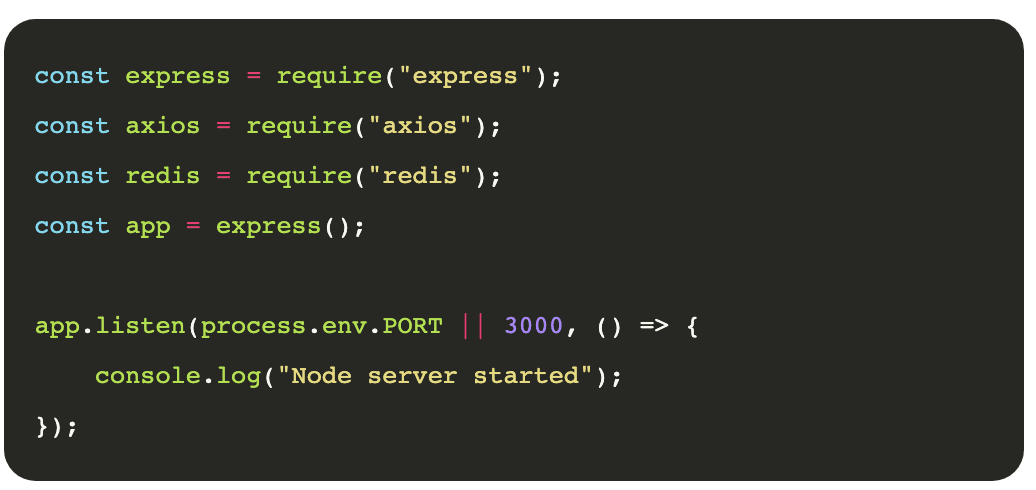
Set up the initial boilerplate for the Node application as follows.

Notice how we use two additional packages named Axios and to repeat. to repeat is the standard Redis client for Node. We use Axios to get data from an external API for this tutorial.

Before going any further, make sure you install these two packages using npm.

Get data from the external API

We’ll use that GitHub Jobs API to get data on programming jobs available in different locations around the world.

You can pass a search term for the job you are looking for to the API and get a number of available jobs in JSON format. An example request to the API looks like this.

POSTMAN – GitHub Jobs API Results

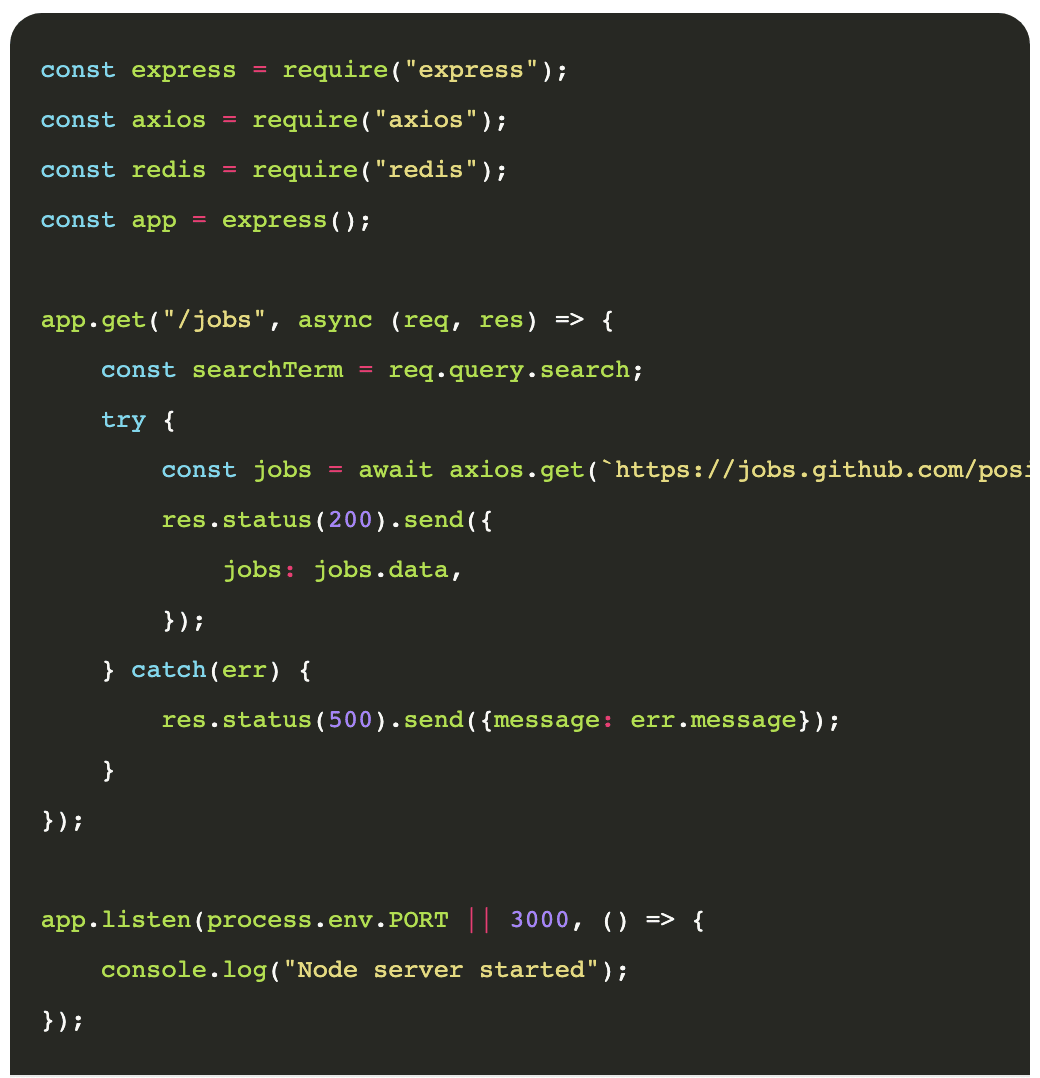
In our node application we define a route with the name / jobs, which gets job data from the above API and sends it back to the client.

Here we use Axios to send a GET request to the GitHub Jobs API with the search term specified by the user.

Let’s see how the route works now with Postman.

POSTMAN – Our API results

Cache the results

Now let’s see how we can use caching to improve application performance.

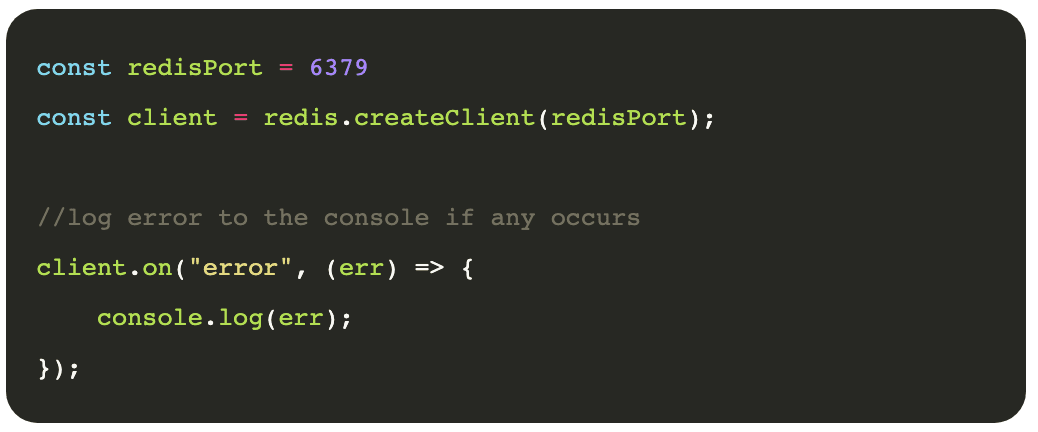
First, we need to connect to the Redis server through our application. For this task we will use the installed Redis package.

The Redis server listens on port 6379 by default, so we’re passing the port number to connect to Redis and create a client.

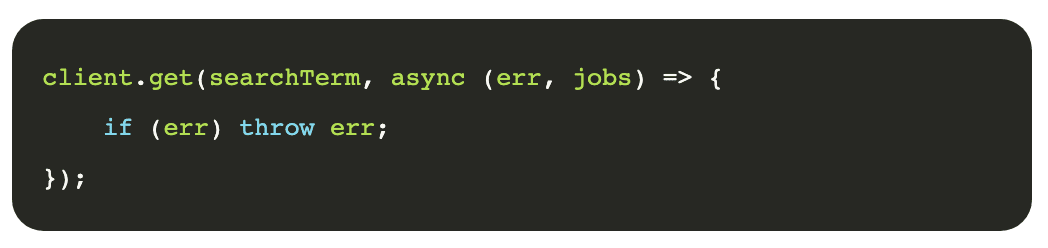
Then implement the logic to store and retrieve data from the cache.

What’s going on here?

When we receive a client request to route / jobs, the search term with the query parameters of the request is sent first.

Then we try to get the requested data from the cache, bypassing the search term that we use as the key when storing data in the cache. Since the Redis package doesn’t have native support for Promises, we need to pass a callback to process the data that is being retrieved.

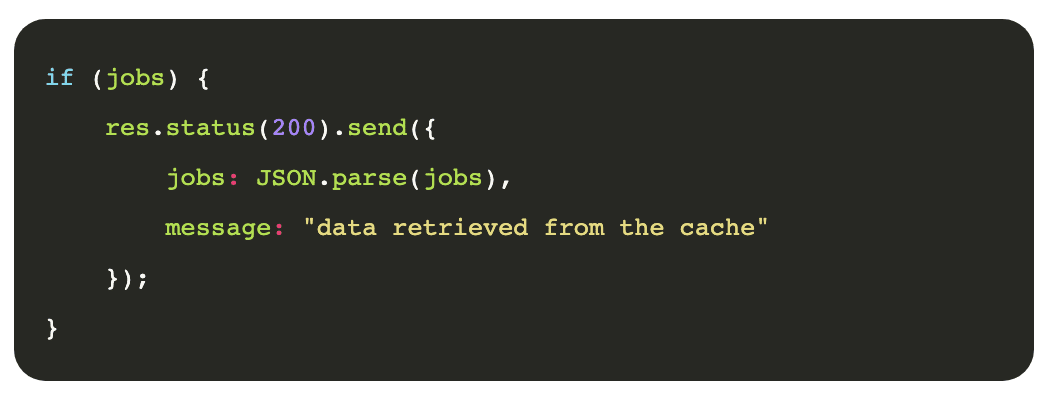
If the value returned by Redis is non-zero, it means the related data is in the cache, so it’s easy to return that data in the response. Just make sure to reset the string to JSON.

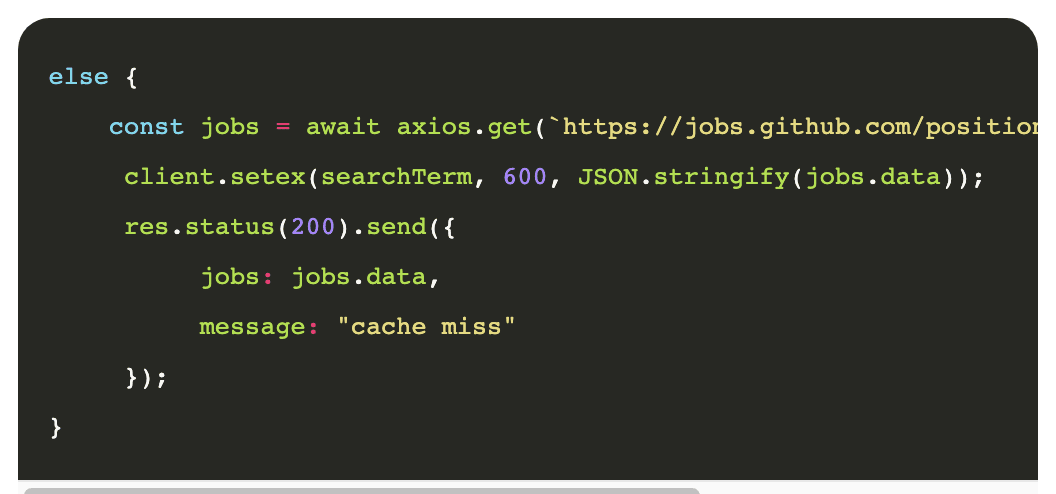
If the returned value was zero, we need to send a request to the external API to get relevant data.

When we get the data from the API, we store it in Redis before sending it back so that the next time we send the same request to the node server, it can respond with cached data rather than requesting it from the API.

Notice how we use that Setex Function for storing data in the cache. Use of Setex Function specific instead of the regular to adjust Function we can set an expiration time for the stored key-value pair. Since we are setting a value for the expiration time, Redis will automatically remove this key-value pair from the cache when the elapsed time has expired.

Complete source code

That’s it. We created a simple cache for our application. It wasn’t that hard, was it?

Moment of truth: time comparison

We will see how using a cache affects the performance of our app. I used Postman to send requests to the server and measure request completion time.

performance

The first time you send a request to the server with a new search term, the application will take longer to respond (over 7 seconds) as the data must be fetched from the external API. The second time you make the same request, the server will respond more quickly because the results are already in the cache.

The request is completed within 10 ms. This is a huge increase in performance over the application we saw before without a cache.

Summary

In this tutorial, we gave you a brief introduction to Redis and used it to create a simple cache for a Node.js application. Now you can use Redis to cache frequently queried data in your application for a significant increase in performance.

You can also explore how you can leverage the best of Redis’ features in other use cases as well.

This items was originally published on Live code stream by Juan Cruz Martinez (Twitter: @bajcmartinez), Founder and publisher of Live Code Stream, entrepreneur, developer, author, speaker and maker of things.

Live code stream is also available as a free weekly newsletter. Sign up for updates on everything related to programming, AI and computer science in general.

Read on: About Time! Toyota is finally announcing a fully electric vehicle

Categories
Science

Fauci: “We entered the pandemic due to local weather change”

Fauci drops his mask. Maybe he thought there were no cameras watching

Guest essay by Eric Worrall

Apparently, smallpox, polio, malaria, typhoid, scarlet fever and the Black Death were the weak products of the world before the pandemic, before global warming made things worse.

How climate change ushers in a new era of pandemic

A warming world expands the spectrum of deadly diseases and risks an explosion of new zoonotic pathogens such as bats, mosquitoes and ticks

BY JEFF GOODELL
DECEMBER 7, 2020 7:00 AM ET

Jennifer Jones spent most of her summer at home, like so many of us, to avoid the plague. Jones, 45, lives in Tavernier, a parish in the Florida Keys south of Key Largo, and spent a lot of time in her yard playing around with plants. At some point a mosquito landed on her. This is not uncommon in Florida, and Jones doesn’t particularly remember that mosquito bite. But there was no garden mosquito in the garden. It was Aedes aegypti, an exquisitely designed killing machine that is one of the deadliest animals in human history. After a count, Half of the people who have ever lived have been killed by mosquito-borne pathogens. Aedes aegypti, who first came to North America on slave ships in the 17th century, can carry a whole arsenal of dangerous diseases, from yellow fever to Zika.

The Covid-19 pandemic is often compared to the 1918 influenza, which killed at least 50 million people worldwide. But it may be seen more closely as a preview of what’s to come. “We have entered a pandemic era,” wrote Dr. Anthony Fauci of the National Institute for Allergies and Infectious Diseases in a recent article co-authored with NIAID colleague David Morens. The paper cites HIV / AIDS, which has killed at least 37 million people to date, as well as “unprecedented pandemic explosions” over the past decade. It’s a deadly list, starting with H1N1 swine flu in 2009, Chikungunya in 2014, and Zika in 2015. Ebola fever has been burning across much of Africa for six years. In addition, seven different coronaviruses are known that can infect humans. SARS-CoV was transmitted from an animal host, likely a civet, in 2002–03 and caused a near-pandemic before disappearing. The Middle East Respiratory Syndrome Coronavirus (MERS) jumped from camels to people in 2012, but never found a way to spread efficiently among people and quickly died out. Now we have SARS-CoV-2, the virus that causes Covid-19.

The reasons for this new era of pandemics are complex, but as Fauci and Morens point out, One of the main drivers is the climate crisis, which is shaking up the natural world and rewriting disease algorithms on the planet. The thawing of permafrost in the Arctic releases pathogens that have not seen daylight for tens of thousands of years. The vibrio bacterium that causes cholera, a diarrheal disease that hit cities like London and New York in the 19th century and still kills tens of thousands each year, thrives in warmer water. Vibrio vulnificus, an even more deadly strain of the same bacteria, while rare, has been increasingly detected in bays and estuaries on the east coast, particularly near Chesapeake Bay. Vibrio vulnificus can cause severe stomach pain when you eat shellfish (in rare cases this can be fatal). However, if the bacterium gets into a cut or wound, it becomes a carnivorous horror, killing one in five people who come in contact with it.

Read more: https://www.rollingstone.com/culture/culture-features/climate-change-risks-infectious-diseases-covid-19-ebola-dengue-1098923/

I really wish the greens would stop lying the lie that mosquitoes and mosquito-borne diseases need a warm climate to thrive.

In the depths of the Little Ice Age, malaria was an endemic killer in Northern Europe. It didn’t matter that the northern summers of the Little Ice Age were short and that the climate was freezing for most of the year. All the malaria mosquitoes needed was a few weeks of warm enough weather in summer to breed and infest the far north with deadly pathogens.

Mosquitoes are still a problem in the far north. Anyone who thinks mosquitoes are in short supply in the Arctic due to the cold climate should try a visit in late spring / early summer. Some of the fertile mosquito clouds that thrive in cold climates can carry malaria and other dangerous pathogens.

As for the impact of global warming on Covid-19, there is strong evidence that Covid-19 prefers cold, dry winter weather. According to the University of Sydney, high humidity pulls Covid-19 virions out of the air, which drastically reduces the risk of transmission.

… Professor Ward said that there are biological reasons why moisture plays a role in airborne virus transmission.

“When the humidity is lower, the air is drier and the aerosols get smaller,” he said. “When you sneeze and cough, these smaller infectious aerosols can float longer in the air. That increases exposure to other people. When the air is humid and the aerosols are larger and heavier, they will fall and hit surfaces faster. “…

Read more: https://www.sydney.edu.au/news-opinion/news/2020/06/02/winter-time-could-be-covid-19-time.html

If we want to get rid of Covid-19 and reduce our risk of exposure to all airborne respiratory virus infections, including those yet to be discovered. We need more hot, humid weather.

Bring global warming.

Like this:

To like Loading…

Categories
Technology

The very best robotic garden mowers for 2020

Mowing your lawn can be a therapeutic hobby, but it can also be a nightmare if you don’t find the time (or willpower) to start that old drawstring mower. Fortunately, for those of us willing to part with a few bucks, there are now robotic lawnmowers that take the time and pain out of seasonal lawn maintenance. A battery-powered, solid robo-mower can learn to cut your lawn inside and out, quickly, quietly and according to a schedule you have created.

We review the best robotic lawn mowers of 2020 with their top features. For our list, we consider the quality of services in some categories, such as: B. Noise level, automatic sensors and adjustability of the blades.

Worx WR140

This Worx model shows a strong understanding of what the average buyer needs from a reliable robotic lawnmower. First, they need a reasonable price: a lot of people interested in a robotic lawnmower don’t want to spend thousands of dollars, especially if they’re not sure how exactly it will work. Second, buyers are looking for bots that can handle relatively small spaces very neatly. The WR140 meets these requirements because it’s a sub $ 1,000 mower that does a really good job on lawns no larger than a quarter acre.

The mower is designed to follow a schedule based on the information you provide in the app about your lawn. Light layers are cut that do not have to be emptied or collected. If necessary, you can still adjust the cutting height. The “Cut to Edge” design helps the knives mow as close to the lawn’s edges as possible so you don’t get those pesky stragglers on the flower beds, and there’s a handy warning feature to notify you when your mower leaves the lawn Space that indicates a performance problem or that someone is tampering with the device (every good robotic lawnmower should have this feature).

Not the most powerful bot at 20V, but it has the features a lawn owner needs, including auto battery charging and the ability to climb 20 degree hills. The sensors keep it from colliding with anything surprising, and you can also use included magnetic strips to surround certain items to help the bot avoid that area. All in all that Worx WR140 is a great mower bot for first-time bot cutters.

Robomow RS630


We tested the Robomow RS630 a few years ago and it is still one of the leading robotic lawnmowers, although the price is a bit high. For larger and more complex yards, however, you’ll need a little more lawnmowers than the Worx above. The Robomow RS630 can handle yards up to three quarters of an acre and sloped yards up to 20 degrees, making this unit ideal for most yard types. It also has a rain sensor to prevent mowing in bad weather and automatic charging when the mower is low on power.

With an operational decibel range of up to 78 dB, the Robomow RS630 is certainly louder than the Husqvarna Automower 450X (our next recommendation), but significantly quieter than the average lawnmower.

Husqvarna Automower 450X


The Husqvarna Automower 450X covers most lawns – up to 1.25 hectares. While other models on this list have softer lines and warmer, matte color schemes, the Automower 450X has a glossier RoboCop 2 construction and looks downright menacing in your front yard.

As with the other models, you must “fence” the area around your lawn and garden before you start mowing. However, you can also customize the map of your farm through the app to mark additional zones to avoid. This is necessary for trenches or rougher areas where the mower may have difficulty traction.

You can set mowing times over the course of a specific month so that the model can trim as regularly or as minimally as desired. Regular mowing minimizes clippings and ensures a cleaner garden.

Perhaps the best feature, however, is its quiet operation. Rated at just 58 decibels, the Husqvarna Automower 450X is about as loud as an air conditioner. If you really wanted to, you could probably get away with mowing in the middle of the night without waking the neighbors.

Honda Miimo HRM520


It’s really no surprise that Honda – the company that brought us Asimo – was one of the pioneering manufacturers of robotic lawn care. Overall, the Miimo HRM520 is one of our most popular offers on the market with its 3-quarter acre mowing capacity and an impressive mowing ability of up to 25 degrees.

With the HRM520 app, you can adjust the cutting height, start or stop the device and manage a calendar from your smartphone. This model uses an innovative “continuous cutting system” in which the machine cuts your lawn about an inch several times a week. Honda says this promotes better growth and overall health for the farm compared to infrequent and larger cuts.

These routine lawn sections also adapt to the seasonal variations in grass growth. Whenever thicker sections of grass are detected, it adapts quickly to allow for more accurate cuts. The Honda Miimo HRM520’s three landscape sensors enable it to detect and avoid potential obstacles.

Husqvarna 115H Connect

Husqvarna 115H Connect

The Husqvarna 315X is versatile, providing lawn maintenance for properties with half an acre or less, slopes of 22 degrees or less, and grass heights of 2.4 inches or less. The battery is charged for one hour and ten minutes and can be controlled via a smartphone app. Another great benefit of this mower is the LCD panel which allows you to adjust the controls as needed.

Command technology is the premier feature that makes the Husqvarna 115H Connect one of the best voice command technologies out there. A big advantage for voice command lovers is that this mower can be easily connected to Google Assistant and Alexa. With your commands you can start, stop, park, set how long the mower runs, pause and much more.

Are you looking for more lawn tools? We have found the best lawn sprinklers, weed killers and leaf blowers for your garden.

Editor’s recommendations


Categories
Sport

Lance Lynn commerce notes: White Sox now have a Massive Three; Rangers can dream on weapons

The Rangers and White Sox reminded everyone that the MLB’s winter meetings are underway by agreeing to a late night trade Monday. Texas will reportedly supply right-hander Lance Lynn to the White Sox in exchange for pitchers Dane Dunning and Avery Weems.

The deal is still pending, according to The Athletic and other outlets. Neither team announced the move early Tuesday.

WINTER MEETING 2020: Five things we want to see

Lynn, 33, will reunite with new White Sox manager Tony La Russa, despite the last time they worked together almost a decade ago. Lynn joined the Cardinals in 2011, La Russa’s final season as manager of St. Louis. He has since grown into an effective innings eater and has played a prominent role for Texas over the past two seasons.

Sporting News rated the trade for both clubs.

White Sox: B +

Chicago is ready to get great value for money with this rental. Lynn will earn $ 30 million ($ 10 million average annual value for luxury tax purposes) in the final season of a three-year contract, according to the baseball prospectus. For the first two years, he beat his deal with an ERA of 3.57 (140 ERA +), a FIP of 3.43, and 10.3 K / 9 in 292 1/3 innings. He led the majors in 2020 with 84 innings in 13 starts (6.46 innings per start).

Lynn gives the Win-Now Sox a Big Three in their rotation with Lucas Giolito and Dallas Keuchel. This group will look ominous on an October streak when they’re all healthy for the postseason. And Lynn has been healthy since returning from surgery on Tommy John in 2015. He made 33, 29, and 33 starts in the past three full seasons and took a regular turn in the 60-game 2020 campaign.

Chicago needs Lynn to be permanent aside from other off-season moves as the current rear end of the rotation has issues. Dylan Cease was inconsistent and Reynaldo Lopez was bad last year. Michael Kopech missed two full seasons after his own TJ operation. Dunning would have been part of filling the puzzle.

Rangers: B.

Welcome back to Arlington, Chris Young. It is unknown how much the new Texas general manager was involved in this deal, but he only got two pitchers to dream of.

Dunning, who will turn 26 on December 20, made his MLB debut last August and has been uneven over seven starts. The right-handed man managed a 3.97 ERA (3.99 FIP) but stalled in his last two games (eight were earned over seven frames). He “opened” the crucial game 3 of the Wild Card Series in Chicago against the A’s, which only lasted two-thirds of an inning due to an ultra-fast hook by former manager Rick Renteria. The White Sox used nine pitchers in that competition before losing 6-4.

As the Rangers rebuild / payroll picks up pace, Dunning is expected to begin spring training on the rotation mix. Kyle Gibson and Jordan Lyles are the top two starters in Texas with Lynn in the picture, and then it’s Kolby Allard, Wes Benjamin and Kyle Cody on MLB.com’s depth map.

Weems, 23, is not ready to apply for a job in a big league. He hasn’t put himself above the rookie ball, despite dominating at that level in 2019 after being drafted by the University of Arizona in the sixth round of Chicago. The left-hander averaged 11.0 K / 9 in 60 1/3 innings and scored an ERA of 2.09. Weems wasn’t invited to the White Sox summer camp and wasn’t one of the 30 best prospects according to the MLB Pipeline. (Dunning came fifth.)

Texas could / should have treated Lynn as of the deadline last summer when the teams got an extra month of start from him. It took until December to redeem that large chip for two long-term pieces. The Rangers seem to have made a decent return, but how much better could it have been in August?

Categories
Health

The US must be a Covid catastrophe mindset for 2 months

The intensive care unit and the pulmonologist Dr. Vin Gupta told CNBC that for the next two months in the US, everyone should be in a “disaster mindset” as Covid-19 cases explode across the country.

“Doctors in the reserves, US Air Force reserves, we haven’t used all of our skills, we should use those resources – military, National Guard, as you call them, emergency ID cards for anyone properly trained in critical care,” Professor at the institute for University of Washington health metrics and assessment said Monday evening. “We need all hands on deck here.”

According to the Covid Tracking Project, there were 102,148 people in hospitals across the country with coronavirus as of Monday. New Mexico hospitals have reached the point where they may need to start rationing care. The state is likely to be the first to fill all beds in the intensive care unit during the pandemic. Now they are overloaded. Per Covid, the fourth highest in the nation, there are more than 43 people per 100,000 in the hospital, according to the Covid Tracking Project.

Gupta told The News with Shepard Smith that care rationing was actually spreading to other regions across the country. “This is a fact of life, and one of the reasons we believe that by the end of February about 500,000 Americans will lose their lives because we take care of the care and people can’t get the care they need.” the magnitude they need considering how out of control this pandemic is. “

The Institute of Health Metrics and Evaluation modeling projects project 538,893 deaths from Covid-19 by April 1.

To save life, governors are using hospitalization and ICU capacity as key metrics to set new restrictions.

On Monday, Democratic New York Governor Andrew Cuomo announced that parts of the state would close when hospitals are 90% full. He also said indoor dining in New York City may close soon.

At least 33 million people in California are regionally locked after ICU capacity fell below 15% in some regions. California Democratic Governor Gavin Newsom said the appointment would take at least three weeks.

Gupta, an NBC medical worker, described what he called “common sense” of encouraging people not to travel by bus or plane, minimizing gatherings and stopping eating indoors. “Unfortunately, I think these are the parameters that we have to adhere to,” he said. “Do I think they are draconian? I think they are common sense and I think if we can stick with these things we will be able to mitigate the transmission until vaccines are used in the near future.”

Pleading with Americans to wear three-layer masks everywhere in public, Gupta added that there was “compelling data” for people 55 and older that suggest wearing the extra layer of face shield with a three-layer blue mask be safer.

Categories
Technology

When an exploit turns into a murals

Subscribe to this bi-weekly newsletter here!

Welcome to the latest edition of Pardon The Intrusion, TNW’s bi-weekly newsletter in which we explore the wild world of security.

Google Project zeroThe elite team of insect hunters does not need an introduction.

The white hat hackers were good at finding something Bug in Android and iOS, but that’s impressive new disclosure by Ian Beer beats everything that came before.

Beer spent six months of his lockdown single-handedly devising a method that would allow iPhones to be remotely hijacked. This shows that with just one Raspberry Pi, commercially available WiFi adapters that cost a total of $ 100 and a few lines of code available are possible for a remote attacker too Take full control from any iPhone nearby.

What’s more impressive is that multiple vulnerabilities don’t have to be chained together to fully control an iPhone, Beer explained in a 30,000 word magnum opus.

The exploit “uses a single memory corruption vulnerability to compromise the flagship iPhone 11 Pro,” allowing a villain to “view all photos, read all email, copy all private messages, and monitor everything that happens” [the device] Real time.”

The bugs Beer discovered while developing this chain of exploits were all fixed before iOS 13.5 was released earlier this year.

But, as Beer wrote in his post, the takeaway here should be: “A person working alone in their bedroom has been able to develop a skill that allows them to seriously become iPhone users they’ve come in close contact with endanger. “

Patrick Wardle, a senior security researcher at Jamf, described Beer’s Lockdown Project as “Artwork. ”

What’s the trend in terms of security?

Google News app for Android, Facebook patched a critical problem in its Messenger app for Android, which could allow an attacker to eavesdrop on callers, and Twitter was introduced Support for two-factor authentication with physical security keys.

  • In a big win for privacy and security, Google has announced that it will expand its messaging app for Android to include end-to-end encryption, starting with one-on-one calls between users of the app. [Google]
  • Swiss lawmakers raised concerns after reports that a country-based encryption company called Omnisec was allegedly used as a Trojan horse by US and German intelligence agencies to spy on governments around the world. [AFP]
  • Facebook has patched a critical problem in his messenger app for Android, which could have allowed a hacker to call you and listen before you answered the call. It’s similar to a security flaw in FaceTime that Apple quickly fixed last year. [Google Project Zero]
  • Researchers at the University of Leuven in Belgium found flaws in the keyless entry system of the Tesla Model X, which would have allowed attackers to steal the car within minutes. This is the third such attack on Tesla’s key chain. [IMEC]
  • Symantec researchers engaged Chinese threat actor APT10 (also known as Stone Panda and Cicada) for a year to steal sensitive data from numerous Japanese companies and their subsidiaries. [Symantec]
  • T.The hacking group known as APT32 or OceanLotus has set up a new MacOS backdoor that gives attackers a window into the compromised computer, allowing them to search and steal confidential information and confidential business documents. [Trend Micro]
  • Security engineer and bug hunter Ashar Javed is on the lookout for 365 security holes in Microsoft Office 365. [Vice]
  • North Korean hackers attempted to destroy UK drug maker AstraZeneca’s systems using LinkedIn and WhatsApp to send out bogus job postings containing malware as national threat actors continue to target health organizations working on COVID-19 vaccine research. [Reuters]
  • Just like that Pitfalls of privacy The Australian Inspector General for Intelligence and Security (IGIS) found that the country’s espionage agencies “randomly” collected data from the country’s COVIDSafe contact tracking app for the first six months of operation. However, the data has not been decrypted, accessed or used. [iTnews]
  • Scientists at Israel’s Ben Gurion University in the Negev described a new form of “cyber biological attack” that could allow a malicious actor to compromise a biologist’s computer in order to inject pathogenic substrings into DNA sequences and deliver dangerous viruses and toxins develop. [ZDNet / ESET]
  • Twitter added support for two-factor authentication using hardware security keys. [Twitter]
  • The last 14 days of data breaches, leaks and ransomware: Advantech, Belden, Embraer, Spotify, US fertilityand the personal data of 16 million Brazilian COVID-19 patients.

Data point

According to cybersecurity firm Kaspersky’s IT Threat Evolution Report For the third quarter of 2020, cyber criminals are resorting to the spread of malware containing the names of popular streaming platforms to trick users into downloading.


“Typically, backdoors and other Trojans are downloaded when users try to gain access in an unofficial way – by buying discounted accounts, getting a ‘hack’ to keep their free trial running, or trying on a free subscription to access. “

Between January 2019 and April 8, 2020, Trojans made up 47.23% of all malware camouflaged under the names of popular streaming platforms.

That’s it. I’ll see you all in two weeks. Stay safe!

Delighted x TNW (enthusiastic[at]the next web[dot]With)

Read Next: How to Set Your Google Photos Pictures as Live Wallpaper for Android