Maryland Governor Larry Hogan will hold a press conference on November 17th in Annapolis, MD to discuss COVID-19 concerns.
Bill O’Leary | The Washington Post | Getty Images
Maryland has reported a case of the new, highly transmittable variant of Covid-19, which was first found in South Africa. This is the third case discovered in the United States, Governor Larry Hogan announced on Saturday.
The case involves an adult resident who lives in the Baltimore area and has not taken any international travel in the past. Maryland health officials and the United States Centers for Disease Control and Prevention have confirmed this.
“We strongly encourage Marylanders to exercise particular caution to limit the additional risk of transmission associated with this variant,” said Hogan. “Please continue to practice normal health and safety precautions, including wearing masks, regular hand washing, and physical distancing.”
The first two U.S. cases of the South African variant, known as B.1.351, were identified in South Carolina on January 28. Other variants found in the US come from the UK and Brazil.
The variants do not appear to cause more serious illness or an increased risk of death, but are considered highly contagious. Health officials are particularly concerned about variant B.1.351 as preliminary research suggests that vaccines may be less effective at controlling it.
President Joe Biden signed a travel ban last week on most non-US citizens who recently entered South Africa and re-introduced travel restrictions on non-US citizens from the UK and Brazil.
According to data from Johns Hopkins University, the virus has infected more than 25.9 million people and killed at least 436,000 people in the United States since the pandemic began.
According to multiple sources – including NASA, NOAA, the Berkeley Earth Research Group and the Met Office Hadley Center (UK) – global temperatures in recent years have been some of the hottest ever recorded. This is the direct result of anthropogenic factors such as overpopulation, urbanization, deforestation and increased greenhouse gas emissions (such as carbon dioxide and methane).
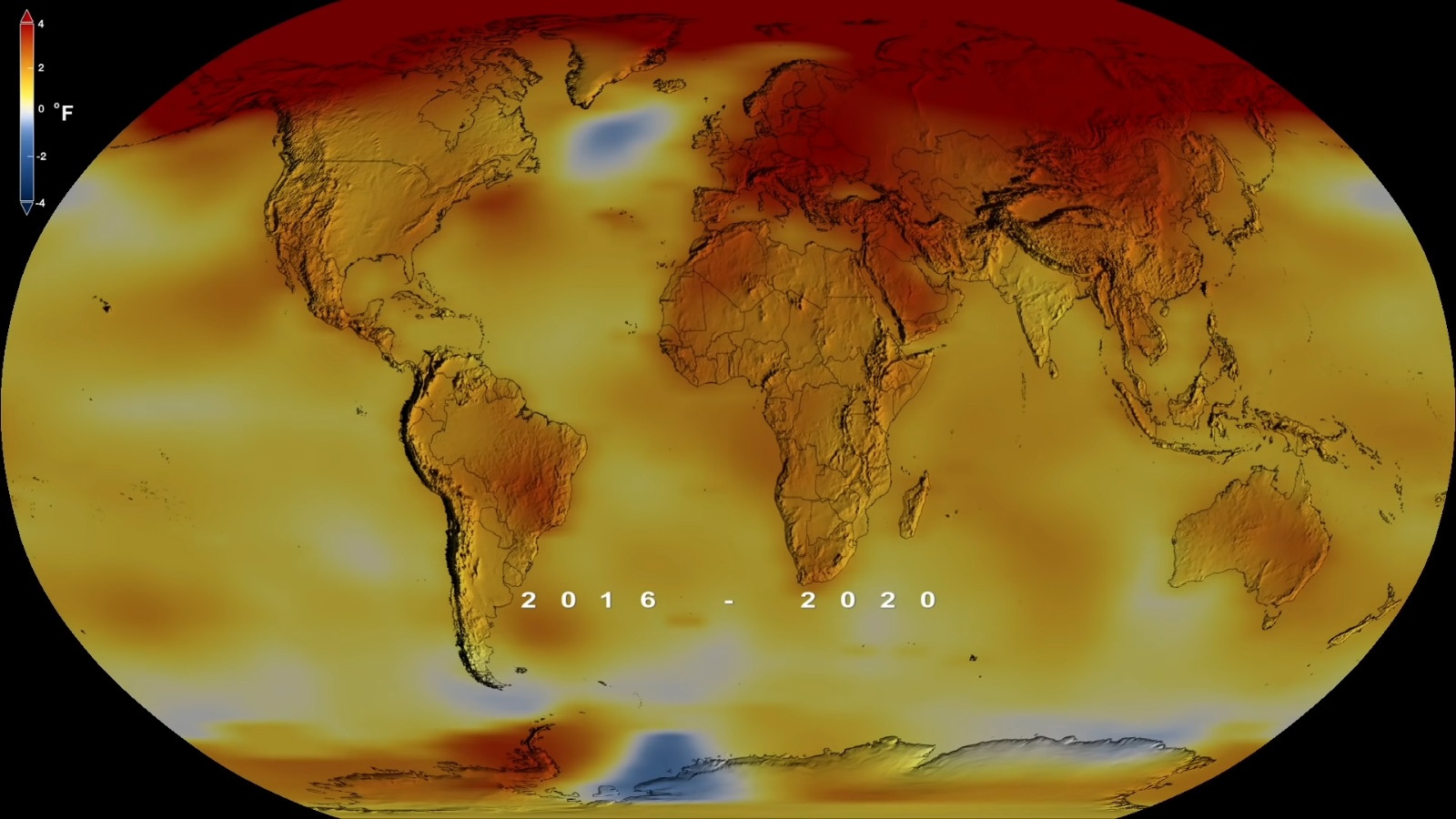
According to a press release recently released by NASA, 2020 was the hottest year on record in terms of global temperatures – effectively tied to 2016 (the previous record holder). The publication includes a dramatic video showing the average rise in temperature since 1880 and the ecological crises that have only occurred in the past year. This is another warning of how human agency affects the very systems we rely on for our continued survival.
Overall, the Earth’s average temperature has risen by more than 1.2 ° C since the 1880s. According to NASA’s Goddard Institute for Space Studies (GISS) temperature analysis – known as GISTEMP – the average global temperature for 2020 was 1.02 ° C (1.84 ° F) warmer than the 1951-1980 baseline. This is in line with the long-term warming trend and places 2020 just before 2016, effectively tying the two for the warmest year in existence.
This analysis combines surface and sea temperature measurements from more than 26,000 weather stations and thousands of ship and buoy based instruments. Together with an algorithm that corrects for the different distance from temperature stations and urban warming effects, the end result is an estimate of the global mean temperatures from a base period from 1951 to 1980 – with an error rate of 0.05 ° C and a confidence level of 95%.
Cause for concern
As GISS Director Gavin Schmidt explained, annual records are nowhere near as long-term trends that have been worrying:
“The past seven years have been the warmest in seven, reflecting the continuing and dramatic warming trend. Whether a year is a record or not doesn’t really matter – the most important things are long-term trends. With these trends and the increasing human impact on the climate, we must expect records to continue to be broken. “
Global temperatures are a critical indicator of how our climate is changing over time due to the impact humanity has on the natural environment. Their mean increase over time has led to phenomena such as decreasing ice cover, rising sea levels, disappearance of water tables and drought, forest fires, persistent heat waves, increased storm activity, disease outbreaks and species extinctions.
A separate, independent analysis by the National Oceanic and Atmospheric Administration (NOAA) concluded that 2020 was the second warmest year on their record, after 2016. NOAA scientists use much of the same raw temperature data in their analysis but have a different baseline period (1901-2000) and methodology. Also, unlike NASA, NOAA does not derive temperatures in polar regions without observations, which is a large part of the difference between NASA and NOAA records.
Annual temperature anomalies (1880-2019) as recorded by NASA, NOAA, the Berkeley Earth Research Group, and the Met Office Hadley Center. Credits: NASA GISS / Gavin Schmidt
Understanding long-term climate trends is not only important to educate the public about climate change and develop solutions. This is also of crucial importance for developing crisis strategies and adapting to changing environmental conditions. This can mean growing various crops, managing water resources, and preparing for extreme weather events.
Annual trends
While the long-term trend was consistent (with the increase overall), different events will contribute to the average temperatures in a given year. Two events took place for 2020 that limited the amount of sunlight reaching the earth’s surface. The first was the Australian bushfires, which raged for months, scorching 46 million acres of land, releasing smoke and particles that were over 30 km high in the atmosphere.
This event limited the amount of sunlight reaching the lower atmosphere and likely caused a slight cooling. The second factor was the COVID-19 pandemic, which resulted in significant reductions in air pollution in certain parts of the world, bringing more sunlight to the surface (thus warming it). At the same time, the cumulative CO2 concentrations continued to increase this year and to maintain the long-term trend.
Thanks to a number of environmental factors, temperatures also vary from year to year. The largest single product is usually the El Nino-Southern Oscillation (ENSO), a naturally occurring cycle in which heat is exchanged between the ocean and the atmosphere in the central and eastern Pacific. This allows warm water and air to move from the western Pacific to the Americas, and reduces the swelling of cooler, nutrient-rich water from below.
Carbon dioxide in the earth’s atmosphere when half of global warming emissions are not absorbed. Photo credit: NASA / JPL / GSFC
This year the ENSO ended with a cool phase, but started with a slightly warm phase, which overall led to a slight increase in the average temperatures. Schmidt said:
“The previous record year 2016 was significantly boosted by a strong El Nino. The lack of similar support from El Nino this year is evidence that the background climate is continuing to warm due to greenhouse gases. “
Regional deviations
It is also important to realize that the GISS data represents surface temperatures that have been averaged over the entire planet over the entire year. This means that regional weather patterns have an impact and that the temperature deviations in 2020 were different depending on the location. This also means that certain parts of the world will warm faster than others in the long run.
For example, the GISTEMP analysis shows that the Arctic has warmed three times faster than the rest of the world in the past 30 years, which has resulted in a higher proportion of melting sea ice. The minimum area of sea ice in the Arctic is currently decreasing by around 13% annually, resulting in the region reflecting less and the ocean absorbing more sunshine.
This is the reason for “Arctic Reinforcement,” where the oceans absorb more sunlight and temperatures continue to rise, leading to even greater melting, sea level rise, loss of permafrost in the Arctic Circle and more intense Arctic forest fires. It is therefore important to understand that a global average increase of just a few degrees does not mean that the warming trend does not matter.
For more information about NASA’s full surface temperature dataset and the methodology they use, visit NASA’s GISS Surface Temperature Anaylsis website.
ESPN MLB Insider Author of “The Arm: In the Billion Dollar Secret of the Most Valuable Goods in Sports”
The St. Louis Cardinals are closing a deal to acquire third star baseman Nolan Arenado of the Colorado Rockies, a blockbuster that still needs various approvals but is expected to be completed in the coming days, sources confirmed to ESPN on Friday .
The complicated deal took months of discussion and gained momentum in recent weeks as the Rockies pledged to send around $ 50 million for part of the six years and $ 199 million for Arenado’s contract.
1 relatives
If closed, the deal would include several adjustments to Arenado’s contract, including an additional $ 15 million guaranteed year, an additional opt-out clause, and a reinstatement of the no-trade clause, which he has to waive to complete the trade.
Since a significant amount of money would be moved, the deal must be approved by Major League Baseball. Similarly, the MLB Players Association has to sign the contract as Arenado is expected to put money on hold and change his contract.
If the deal played through to the finish line, the Cardinals would significantly bolster their status as a favorite in the National League Central, the Rockies would trade their franchisee for just two years for a deal that should keep him in their uniform until 2026, and Arenado would leave the only team he played for – and one he sought a deal with after believing he’d done a bad job building around it.
The 29-year-old Arenado won a gold glove in each of his eight seasons in Colorado, during which he became one of the best baseball players. Prior to the 2019 season, he signed an eight-year $ 260 million extension with the Rockies, which he drafted in 2009 and pledged to become perennial competitor.
The team struggled almost immediately, frustrating Arenado, and clearing their way to St. Louis for a deal that tried to trade for him prior to the 2020 season and eventually succeeded a year later. The return for the Rocky Mountains is not expected to be significant as pitcher Austin Gomber has little prospect among the players discussed.
In Arenado, the Cardinals receive a diamond addition to first baseman Paul Goldschmidt, another experienced right-hander that they acquired through retailers. The market for Arenado was not entirely robust as there was still a lot of money left on its deal. The Cardinals and Rockies haggled for months before reaching an agreement on Friday night.
The Cardinals banned longtime starter Adam Wainwright on Thursday on a $ 8 million deal, and longtime catcher Yadier Molina has announced in recent days that he is likely to return to the Cardinals, especially if they could acquire Arenado.
The Rockies wanted to both escape the huge commitment to Arenado and avoid the possibility of him triggering the opt-out clause in his contract that follows the upcoming season. As part of a restructured deal – in which Arenado would also defer money – he will receive another opt-out after 2022, tackle a seventh year in 2026, guarantee himself $ 214 million during this time and his No. – Maintain trade clause.
Colorado welcomed Gomber, a 27-year-old left-handed man who had played an excellent swing role last season. Several perspectives were discussed, according to The Athletic, who first reported on the deal. While the hard-hitting first baseman Luken Baker’s name has been reported as part of the potential prospectus package, it is not expected to be included in the deal, a source told ESPN.
With Colorado paying a significant portion of Arenado’s future salary, St. Louis will pay him about $ 25 million a year, increasing his payroll to around $ 160 million.
Arenado, a five-time All-Star, battled with a 0.253 hit with eight homers during the shortened 2020 season before missing the final nine games with a bruise on his left shoulder. The downward year came after hitting a career best of 0.315 in 2019 with 41 homers and 118 RBIs.
After trading with Troy Tulowitzki, Arenado became the linchpin of the Rocky Mountains, leading them to a wild card for 2018. His extension might have kept him in Colorado for the rest of his career, but his relationship with general manager Jeff Bridich was bad and Arenado clearly wanted to get off this winter.
In December, Rockies manager Bud Black downplayed rumors that Arenado and Shortstop Trevor Story were trading and said, “I expect they will be with us on opening day.”
Arenado won’t be. And if Colorado can’t get a renewal deal with its all-star shortstop, Story could be on the move at some point this season too, as the Rockies may not want to lose him through a free agency in the winter of 2021. 22nd
Khloe Kardashian is another Kardashian who wears her “stripes” with pride.
On Saturday January 30th, the 36-year-old kept up with the Kardashians star and the 2-year-old’s mom True Thompson posted a photo of herself on the beach on her Instagram page, wearing a black bikini and sporty sand all over her body, as well as her stretch marks. The picture was recently taken with her family while on a tropical vacation.
“I love my stripes,” wrote Khloe, repeating similar comments from her sister Kourtney Kardashian wrote about her own body after posting a photo of her own stretch marks in 2019.
Her sister Kim Kardashian replied to Khloe’s post, writing “It’s the waist for me” with a clapping emoji. Khloe wrote back, “You taught me all the angles.”
Khloe’s bikini photo, showing a flat stomach, comes days after a teaser was released for the upcoming final season of Keeping Up With the Kardashians, telling her boyfriend and True’s dad: Tristan Thompson“I feel like it is time to have another child.”
If the upcoming COP26 climate conference in November does not make progress on the way to a global carbon pricing system, the EU will impose a carbon limit tax. However, there is no practical way to make such a levy work. A CO2 tax at the EU border would be a choice for EU exporters between fraud with carbon carousels or ruin.
Why the EU’s proposed CO2 border tax is an important test for global action against climate change
January 29, 2021, 1.39 a.m. AEDT Neil Kellard
Dean, Professor of Finance, Essex Business School, University of Essex
…
The current price for a greenhouse gas allowance is around EUR 33 per tonne, a price that is already well above the average over the life of the ETS. In order to achieve the EU climate protection targets, however, this price must be closer to EUR 40 by 2030 and EUR 250 by 2050. Given the significant cost of either paying for allowances or investing in small amounts for EU companies, non-EU based companies have a significant competitive advantage if they are not faced with similar regulatory controls in their own countries.
For this reason, the European Commission, the executive branch of the EU, plans to submit its CO2 limit levy in June 2021 as part of its Green Deal planning. Frans Timmermans, the first Vice-President of the European Commission, recently highlighted the following:
“It’s a question of our industry’s survival. So if others are not moving in the same direction, then we must protect the European Union from distortions of competition and from the risk of carbon leakage. “
Why do I say a carbon tax on exporters is a choice between carbon carousel scam or ruin?
Professor Kellard only mentions the impact of the levy on imports into the EU. But how would the levy affect EU exports?
If EU producers pay a massive carbon price for their inputs, they are crammed – they cannot compete with global producers who do not pay the same price of carbon.
What if the EU panics and tries to give a discount on high carbon exports to keep its export industry from collapsing? In this scenario, they open the door to carousel fraud.
Carousel fraud fraudulently changes the customs description of goods to take advantage of various tax and discount systems. It is a carousel because the same container of goods is imported and exported repeatedly. The only thing that changes is the customs declaration, which is completely fraudulent on at least one leg of the journey.
Even without the possibilities that a CO2 border tax would offer criminals, a CO2 border tax would do nothing to prevent the exit of CO2 emissions and industries from the EU.
Unless the levy was prohibitively high and high enough to start a trade war, it would still make more sense to build the manufacturing center outside the EU, pay the border tax on export to the EU, but keep the costs low and remain competitive if export somewhere else.
For decades, we’ve been trying to develop artificial intelligence in our own image. And at every step of the way, we’ve managed to create machines that can perform marvelous feats and at the same time make surprisingly dumb mistakes.
After six decades of research and development, aligning AI systems with our goals, intents, and values continues to remain an elusive objective. Every major field of AI seems to solve part of the problem of replicating human intelligence while leaving out holes in critical areas. And these holes become problematic when we apply current AI technology to areas where we expect intelligent agents to act with the rationality and logic we expect from humans.
In his latest book,The Alignment Problem: Machine Learning and Human Values, programmer and researcher Brian Christian discusses the challenges of making sure our AI models capture “our norms and values, understand what we mean or intend, and, above all, do what we want.” This is an issue that has become increasingly urgent in recent years, asmachine learning has found its way into many fields and applications where making wrong decisions can havedisastrous consequences.
As Christian describes: “As machine-learning systems grow not just increasingly pervasive but increasingly powerful, we will find ourselves more and more often in the position of the ‘sorcerer’s apprentice’: we conjure a force, autonomous but totally compliant, give it a set of instructions, then scramble like mad to stop it once we realize our instructions are imprecise or incomplete—lest we get, in some clever, horrible way, precisely what we asked for.”
InThe Alignment Problem,Christian provides a thorough depiction of the current state of artificial intelligence and how we got here. He also discusses what’s missing in different approaches to creating AI.
Here are some key takeaways from the book.
Machine learning: Mapping inputs to outputs
In the earlier decades of AI research,symbolic systemsmade remarkable inroads in solving complicated problems that required logical reasoning. Yet they were terrible at simple tasks that every human learns at a young age, such as detecting objects, people, voices, and sounds. They also didn’t scale well and required a lot of manual effort to create the rules and knowledge that defined their behavior.
More recently, growing interest in machine learning and deep learning have helped advancecomputer vision, speech recognition, andnatural language processing, the very fields that symbolic AI struggled at. Machine learning algorithms scale well with the availability of data and compute resources, which is largely why they’ve become so popular in the past decade.
But despite their remarkable achievements, machine learning algorithms are at their core complex mathematical functions that map observations to outcomes. Therefore, they’re as good as their data and they start to break as the data they face in the world starts to deviate from examples they’ve seen during training.
InThe Alignment Problem, Christian goes through many examples where machine learning algorithms have caused embarrassing and damaging failures. A popular example is a Google Photos classification algorithm thattagged dark-skinned people as gorillas. The problem was not with the AI algorithm but with the training data. Had Google trained the model on more examples of people with dark skin, it could have avoided the disaster.
“The problem, of course, with a system that can, in theory, learn just about anything from a set of examples is that it finds itself, then, at the mercy of the examples from which it’s taught,” Christian writes.
What’s worse is that machine learning models can’t tell right from wrong and make moral decisions. Whatever problem exists in a machine learning model’s training data will be reflected in the model’s behavior, often in nuanced and inconspicuous ways. For instance, in 2018, Amazon shut down a machine learning tool used in making hiring decisions because its decisions were biased against women. Obviously, none of the AI’s creators wanted the model to select candidates based on their gender. In this case, the model, which was trained on the company’s historical hiring data, reflected problems within Amazon itself.
This is just one of the several cases where a machine learning model has picked up biases that existed in its training data and amplified them in its own unique ways. It is also a warning against trusting machine learning models that are trained on data we blindly collect from our own past behavior.
“Modeling the world as it is is one thing. But as soon as you beginusingthat model, you arechangingthe world, in ways large and small. There is a broad assumption underlying many machine-learning models that the model itself will notchangethe reality it’s modeling. In almost all cases, this is false,” Christian writes. “Indeed, uncareful deployment of these models might produce a feedback loop from which recovery becomes ever more difficult or requires ever greater interventions.”
[Read: How this company leveraged AI to become the Netflix of Finland]
Human intelligence has a lot to do with gathering data, finding patterns, and turning those patterns into actions. But while we usually try to simplify intelligent decision-making into a small set of inputs and outputs, the challenges of machine learning show that our assumptions about data and machine learning often turn out to be false.
“We need to consider critically… not only where we get our training data but where we get the labels that will function in the system as a stand-in for ground truth. Often the ground truth is not the ground truth,” Christian warns.
Reinforcement learning: maximizing rewards
Reinforcement learning has helped researchers create AI that achieves remarkable feats such as beating champions at complicated video games.
Another branch of AI that has gained much traction in the past decade isreinforcement learning, a subset of machine learning in which the model is given the rules of a problem space and a reward function. The model is then left to explore the space for itself and find ways to maximize its rewards.
“Reinforcement learning… offers us a powerful, and perhaps even universal, definition of what intelligenceis,” Christian writes. “If intelligence is, as computer scientist John McCarthy famously said, ‘the computational part of the ability to achieve goals in the world,’ then reinforcement learning offers a strikingly general toolbox for doing so. Indeed it is likely that its core principles were stumbled into by evolution time and again—and it is likely that they will form the bedrock of whatever artificial intelligence the twenty-first century has in store.”
Reinforcement learning is behind great scientific achievements such as AI systems that have mastered Atari games, Go, StarCraft 2, and DOTA 2. It has also found many uses in robotics. But each of those achievements also proves that purely pursuing external rewards is not exactly how intelligence works.
For one thing, reinforcement learning models require massive amounts of training cycles to obtain simple results. For this very reason, research in this field has been limited to a few labs that are backed byvery wealthy companies. Reinforcement learning systems are also very rigid. For instance, a reinforcement learning model that plays StarCraft 2 at championship level won’t be able to play another game with similar mechanics. Reinforcement learning agents also tend to get stuck in meaningless loops that maximize a simple reward at the expense of long-term goals. An example is this boat-racing AI that has managed to hack its environment by continuously collecting bonus items without considering the greater goal of winning the race.
“Unplugging the hardwired external rewards may be a necessary part of building truly general AI: because life, unlike an Atari game, emphatically does not come pre-labeled with real-time feedback on how good or bad each of our actions is,” Christian writes. “We have parents and teachers, sure, who can correct our spelling and pronunciation and, occasionally, our behavior. But this hardly covers a fraction of what we do and say and think, and the authorities in our life do not always agree. Moreover, it is one of the central rites of passage of the human condition that we must learn to make these judgments by our own lights and for ourselves.”
Christian also suggests that while reinforcement learning starts with rewards and develops behavior that maximizes those rewards, the reverse is perhaps even more interesting and critical: “Given the behavior, we want from our machines, how do we structure the environment’s rewards to bring that behavior about? How do we get what we want when it iswewho sit in the back of the audience, in the critic’s chair—wewho administer the food pellets, or their digital equivalent?”
Should AI imitate humans?
InThe Alignment Problem, Christian also discusses the implications of developing AI agents that learn through pure imitation of human actions. An example is self-driving cars that learn by observing how humans drive.
Imitation can do wonders, especially in problems where the rules and labels are not clear-cut. But again, imitation paints an incomplete picture of the intelligence puzzle. We humans learn a lot through imitation and rote learning, especially at a young age. But imitation is but one of several mechanisms we use to develop intelligent behavior. As we observe the behavior of others, we also adapt our own version of that behavior that is aligned with our own limits, intents, goals, needs, and values.
“If someone is fundamentally faster or stronger or differently sized than you, or quicker-thinking than you could ever be, mimicking their actions to perfection may still not work,” Christian writes. “Indeed, it may be catastrophic. You’ll do what youwould do if you were them. But you’re not them. And what you do is not whattheywould do if they wereyou.”
In other cases, AI systems use imitation to observe and predict our behavior and try to assist us. But this too presents a challenge. AI systems are not bound by the same constraints and limits as we are, and they often misinterpret our intentions and what’s good for us. Instead of protecting us against our bad habits,they amplify themand they push us toward acquiring the bad habits of others. And they’re becoming pervasive in every aspect of our lives.
“Our digital butlers are watching closely,” Christian writes. “They see our private as well as our public lives, our best and worst selves, without necessarily knowing which is which or making a distinction at all. They, by and large, reside in a kind of uncanny valley of sophistication: able to infer sophisticated models of our desires from our behavior, but unable to be taught, and disinclined to cooperate. They’re thinking hard about what we are going to do next, about how they might make their next commission, but they don’t seem to understand what we want, much less who we hope to become.”
What comes next?
Advances in machine learning show how far we’ve come toward the goal of creating thinking machines. But the challenges of machine learning and the alignment problem also remind us of how much more we have to learn before we can createhuman-level intelligence.
AI scientists and researchers are exploringseveraldifferentwaysto overcome these hurdles and create AI systems that can benefit humanity without causing harm. Until then, we’ll have to tread carefully and beware of how much credit we assign to systems that mimic human intelligence on the surface.
“One of the most dangerous things one can do in machine learning—and otherwise—is to find a model that is reasonably good, declare victory, and henceforth begin to confuse the map with the territory,” Christian warns.
This article was originally published by Ben Dickson on TechTalks, a publication that examines trends in technology, how they affect the way we live and do business, and the problems they solve. But we also discuss the evil side of technology, the darker implications of new tech and what we need to look out for. You can read the original article here.
Russell Westbrook and Rajon Rondo were yelled at for the first time since Westbrook’s brother Rondo’s brother on Friday during a playoff game last year. Things between them became irritable again.
The seasoned guards, who now play for teams other than those represented in the Orlando bubble, first had words in the first half of Wizards-Hawks in Washington and were classified as technical fouls.
The hostility peaked in the fourth quarter when a frustrated Westbrook encountered Rondo in an attempt to rebound. That move earned Westbrook a second technical and an early exit from a game that the Wizards eventually lost.
“I mean, honestly it’s more up to me. I can’t afford to bend down to anyone’s level,” Westbrook told reporters after the game, according to NBC Sports Washington. “That’s not my character or who I am. I have to be better regardless of trash talk and what is being said.”
Rondo was thrown out for a second technical foul five minutes from time while he was on the bench. The reason was unclear.
The obvious move is to link at least the first incident to what happened in the Western Conference semifinals last September. When Rondos Lakers completed Westbrook’s Rockets in Game 5 of the series, Westbrook became engaged to Rondo’s brother William after a free throw from LeBron James. William Rondo sat in the court and twittered in Westbrook, as did Rajon Rondo.
“Guys at the game, you should shut up and watch the game,” Westbrook told reporters after the game. “Those are the rules, especially when you have families and people here. … Because [Rajon] Rondo talked s – he decided that he wanted to get in too. It’s okay. Everything is good. I get it. He wanted to record for his brother. I don’t know what, but that’s it. “
The Washington Post reported that arena security led William Rondo out of the arena.
Rajon Rondo came in to defend his brother in his comments after Game 5.
“He didn’t do anything crazy,” said Rondo. “He called the man ‘garbage’. Fans do what fans do. He’s my brother first. He didn’t do anything disrespectful.”
This article has been updated with Westbrook’s comments and Rondo’s expulsion. Material from Jordan Greer and Stats Perform News was used in this report.
Moderna has asked the U.S. Food and Drug Administration for permission to fill their Covid-19 vaccine bottles with up to five additional doses to help clear a manufacturing bottleneck, according to a person familiar with the matter.
The change would allow Moderna to fill 15 cans into vials of the same size, now cleared for 10, which eases the pressure on the manufacturing process known as filling / finishing, said the person who refused to named because the application is not public yet.
The availability of Covid-19 vaccines has caused frustration since their approval in the US in mid-December. While the pace of administration has increased to an average of more than 1 million a day, the limited supply has hampered states’ ability to operate mass vaccination centers. By Friday, the US had distributed 49.2 million doses and 27.9 million had been given, according to the Centers for Disease Control and Prevention.
“We have problems making these mRNA vaccines,” said Dr. Paul Offit, director of the Vaccine Education Center and a physician at Philadelphia Children’s Hospital. “We have up to 1.2 million doses a day when we need 3 million doses a day.”
The FDA declined to comment and asked questions to the company. Moderna did not immediately respond to a request for comment.
The move from Moderna came after Pfizer requested and received a change in emergency approval from the FDA to specify that the Covid-19 vaccine bottles contain six doses instead of five after pharmacists determined that it had a bonus dose the correct syringes could be extracted. Pfizer then said it would ship fewer vials to the US, but the same number of doses specified in its contracts.
Moderna vials have also been found to contain a bonus dose, but a policy change is being sought to add volume to the vials.
The bottleneck is not the vials themselves, but the manufacturing capacity to fill the vials. The manufacturing filling / finishing process must be performed under aseptic conditions to ensure contamination does not occur and the capacity is high.
Companies have begun to form manufacturing partnerships that focus on this step in the process to increase production. Novartis announced on Friday that it has signed an initial vial fill agreement for BioNTech, Pfizer’s partner in Europe, for the Covid-19 vaccine.
“We expect this to be the first in a series of such agreements,” said Steffen Lang, head of technical operations at Novartis.
Mars is often referred to as “Earth’s twin” because of the similarities between the two planets. In fact, Mars is the second most habitable planet in the solar system after Earth. However, ongoing studies have shown that our two planets had more in common at one time. In fact, a recent study found that Gale Crater was exposed to conditions similar to Iceland today.
The Curiosity Rover has been exploring Gale Crater since 2012 in search of clues as to what conditions were like there about 3 billion years ago (when Mars was warmer and wetter). After comparing the evidence gathered by Curiosity with locations on earth, a team at Rice University concluded that Iceland’s basalt terrain and cool temperatures are the closest to ancient Mars.
The study was led by postdoctoral fellow Michael Thorpe, a Mars Sample Return Scientist at NASA’s Johnson Space Center (JSC). He was joined by Prof. Kirsten Siebach from Rice University (and member of the science and operations team for Mars the Perseverance and the Curiosity Rover), Prof. Joel Hurowitz, Associate Professor of Geology at Stony Brook University and Research Associate at Jet Propulsion NASA Laboratory.
Curiosity image showing sedimentary rocks at Gale Crater, which was likely formed more than 3 billion years ago. Photo credit: NASA
For their study, the team examined data that Curiosity had collected since landing in Gale Crater in 2012, which provides insights into the chemical and physical states of sedimentary deposits that have formed in the presence of water. By comparing the chemistry of these mudstone samples with similar formations on Earth, they were able to reconstruct what the conditions were like in front of the crater where the sediment erosion occurred.
Although the crater is known to once contained a standing lake, the climatic conditions that led to its formation are still the subject of scientific debate. While some theorize that Mars was warm and wet about 3 billion years ago (and rivers and lakes were common), others think that it was cold and dry and that glaciers and snow were common.
After reviewing the evidence, Thorpe and his team found that temperature played the largest role in the formation of mudstone from sediments deposited by ancient streams and weathered by the climate. As Thorpe stated in a Rice University press release:
“Instead, sedimentary rocks in Gale Crater describe a climate that is likely to lie between these two scenarios. The old climate was likely cold, but it also appears to have sustained liquid water in lakes for extended periods of time.
“On earth, the sedimentary rock record matures fantastically with the help of chemical weathering over time. However, on Mars, we see very young minerals in the mudstones that are older than any sedimentary rocks on Earth, suggesting that weathering was limited. “
Artist’s impression of what the “lake” at Gale Crater on Mars might have looked like millions of years ago. Credit and Copyright: Kevin Gill
For comparison, the team conducted direct studies of basalt formations in Iceland and Idaho, and consulted studies of similar sediments from different climates around the world – from Antarctica to Hawaii – that are known to vary significantly in conditions. They then performed a comparative analysis using the standard geological tool known as the chemical index of change (CIA).
This method enables geologists to infer past climatic conditions from the chemical and physical weathering of a sample. In the end, they found Iceland’s basalt terrain and cool weather best suited to the bottom of Gale Crater and Mount Sharp. The similarity between formations on Mars over 3 billion years old and sediments found in Icelandic today in rivers and lakes actually came as a surprise to the team.
In fact, the similarity is only possible because rocks on Mars have seen so little weathering (and are therefore so well preserved) for 3 billion years. Siebach, who will act as operator of the Perseverance rover after touchdown in February:
“In this study, the earth provided us with an excellent laboratory in which we could examine the effects of various climate variables on weathering at different locations. The average annual temperature had the greatest impact on the rock types in Gale Crater. The climatic zones on earth allowed us to calibrate our thermometer to measure the temperature on ancient Mars. “
“When water flows through rocks to erode and weather them, it dissolves the most soluble chemical components of the minerals that make up the rocks. On Mars we have seen that only a small fraction of the elements that dissolve most rapidly are lost from the mud compared to volcanic rocks, even though the mud is the smallest grain size and usually the most weathered. “
A river-fed sediment plain in Iceland is similar to what could have fed the Mars storm crater more than 3 billion years ago. Photo credit: Michael Thorpe
These results limit the average annual temperature change on Mars when Gale Crater was still home to a lake. Had it been warmer, more water-soluble elements in the sediment deposits would have been washed away. This is in stark contrast to today’s conditions at Gale Crater, where Curiosity recorded temperatures of 90 to 0 ° C (130 to 32 ° F) over a Martian year (687 Earth days).
The results also show that the climate has changed over time as river processes (flowing water) continued to deposit sediment in the crater – from Antarctic conditions to more Icelandic conditions. While this study focused on mudstone deposits in the lowest and oldest parts of the crater, other studies looking at other areas have shown similar results.
In short, all of these studies indicate that the Martian climate likely fluctuated and became drier over time. In parallel, according to Siebach, climate change (especially in Iceland) could shift to where the best places on earth are to study past and present conditions on Mars:
“This study offers a way of interpreting this trend more quantitatively compared to climates and environments that we know well on Earth today. Similar techniques could be used by Perseverance to understand the ancient climate around the landing site at Jezero Crater. “
Orbital image of the Jezero crater with its fossil river delta. Photo credit: NASA / JPL / JHUAPL / MSSS / BROWN UNIVERSITY
This research was made possible by support from NASA’s Solar System Workings program, which awarded Thorpe a postdoctoral fellowship from NASA, and the David E. King Field Work Award from Stony Brook University. The study “Source to Sink Terrestrial Analogs for the Paleoenvironment of Gale Crater, Mars” was recently published in JGR Planets, a journal of the American Geological Union (AGU).
Roommate, Ari Fletcher is no stranger to being in the middle of celebrity beef … and her most recent incident surrounds JT of the City Girls. After famous hairdresser Arrogant Tae posted photos of JT’s hair that he had styled, Ari left a comment under the photo, which many found an extreme shadow – but she just cleared up the rumors.
While there are a ton of celebrity hairdressers out there, many of the new school’s social media influencers, IG models, and rappers use the same small circle of which Arrogant Tae is the ring’s leader. Ari Fletcher has been known in the past for being quite territorial when it comes to Tae doing other people’s hair besides hers – which is why her recent Instagram comment rubbed many wrong.
After Tae posted the photos of JT’s hair that he recently killed, Ari commented below the photo, “I wish you had put so much energy into my hair for my big day.”
It didn’t take long for the comment to go viral, causing Ari to hop on Twitter, clearing the air, claiming she didn’t delete it after the backlash:
“I didn’t delete s ** t Tae from my son because he didn’t want to see you doing a ** dirty. I try to share and conquer myself and my b ** ch JT. You will go to hell. “
In the meantime, JT has never commented publicly on the whole drama, and since it seems like everything is going well between her and Ari, she may not have to.
Would you like tea right in your inbox? Visit us at 917-722-8057 or click here to join!