8:50 AM ET
-
Mechelle VoepelESPN.com
Close
Mechelle Voepel covers the WNBA, women’s college basketball, and other college sports for espnW. Voepel began covering women’s basketball in 1984, and has been with ESPN since 1996.
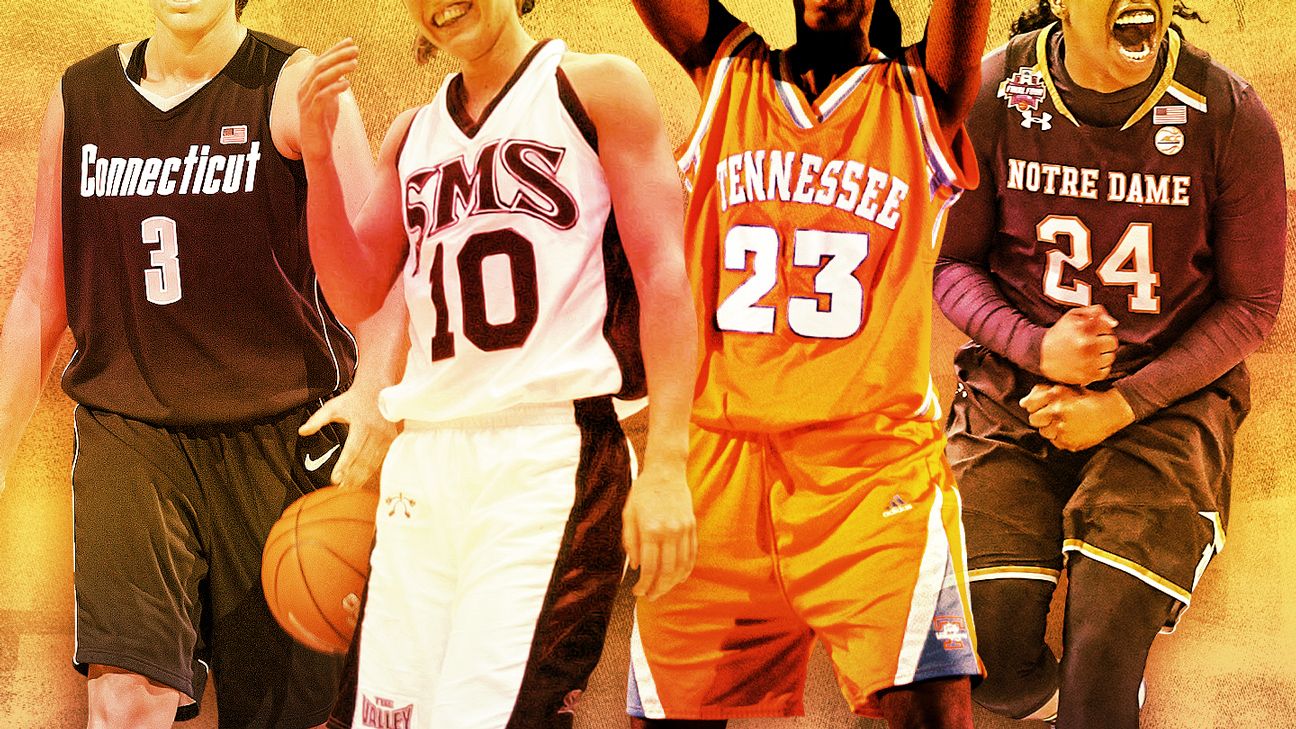
Sometimes, players pick specific jersey numbers, and they are even superstitious about it. Other times, they just stick with what is given to them. Either way, their numbers become part of their identity.
As we await the 2021 NCAA women’s basketball tournament Sweet 16 starting Saturday, here’s some numerology, of sorts: a look at the best players at each of the 37 jersey numbers allowed in college hoops, from the AIAW and NCAA eras.
While there were various types of women’s basketball teams and competitions throughout the 20th century, the modern college game as we know it dates to the late 1960s. The first AIAW tournament was in 1972. In 1982, both the NCAA and AIAW had tournaments, but it was just the NCAA from then on.
There are separate national record books for those who spent all or most of their careers in either the AIAW or NCAA, but individual schools generally combine both in their records. References made here to All-Americans are specifically those on the Women’s Basketball Coaches Association’s yearly 10-member teams, which began in 1974-75.
Some very good players missed this list because there was so much competition at their jersey number. Even current players made the grade — denoted by (*).
Jump to:
00 | 0 | 1 | 2 | 3 | 4 | 5 | 10 | 11 | 12 | 13 | 14 | 15 | 20 | 21 | 22 | 23 | 24 | 25 | 30 | 31 | 32 | 33 | 34 | 35 | 40 | 41 | 42 | 43 | 44 | 45 | 50 | 51 | 52 | 53 | 54 | 55
00. Ruth Riley, Notre Dame (1997-2001)
See also: *Naz Hillmon, Michigan 2018-present; Shawntinice Polk, Arizona 2002-05; Michelle Snow, Tennessee (1998-2002); Tracy Reid, North Carolina (1994-98); La’Keshia Frett, Georgia (1993-97); Sylvia Crawley, North Carolina (1990-94).
It’s not really a widely used number, but its biggest success is with post players. Coach Muffet McGraw got lost in the cornfields trying to find Riley’s tiny town in Indiana during recruiting. But the 6-foot-5 center found her way to South Bend, Indiana, leading the Irish to their first NCAA title in 2001 as the Final Four’s most outstanding player. She was WNBA Finals MVP in 2003 for Detroit and won Olympic gold in 2004. Crawley, part of the Tar Heels’ 1994 NCAA title team, and Snow also were centers, and both could dunk. Polk, another center, died from a blood clot at age 22 a few months before her senior season. Reid, a wing, helped North Carolina win three ACC tournament titles and was the WNBA’s first Rookie of the Year in 1998.
Hillmon, a junior forward, is the current Big Ten player of the year and is Michigan’s first Associated Press All-American. Her mother, Na’Sheema Hillmon, wore No. 4 at Vanderbilt in the 1990s.
Ruth Riley led Notre Dame to its first NCAA championship in 2001. Jamie Schwaberow/NCAA Photos via Getty Images
0. Odyssey Sims, Baylor (2010-2014)
See also: *Rennia Davis, Tennessee 2017-21; Satou Sabally, Oregon (2017-20); Mikayla Pivec, Oregon State (2016-20); Chantel Osahor, Washington (2013-17); Olympia Scott, Stanford (1994-98).
Zero has been used more in recent years. It fit well for players such as Sims, Scott and Osahor whose first or last names started with the letter “O,” and for Sabally and Pivec, whose schools did. Sims, a guard now with the Atlanta Dream, combined with center Brittney Griner to help lead Baylor to a 40-0 championship season in 2012. As a senior in 2014, Sims averaged 28.5 PPG. Sabally helped Oregon to its first Women’s Final Four in 2019, and was the No. 2 pick by Dallas in the 2020 WNBA draft. Davis is expected to be a WNBA first-round draft pick this year.
1. Crystal Langhorne, Maryland (2004-08)
2 Related
See also: *Dana Evans, Louisville 2017-21; Tori Jankoska, Michigan State (2013-17); Alexis Peterson, Syracuse (2013-17); Rachel Banham, Minnesota (2011-16); Elizabeth Williams, Duke (2011-15); A’dia Mathies, Kentucky (2009-13); Shavonte Zellous, Pittsburgh (2005-09); Katie Gearlds, Purdue (2003-07); Mistie Bass, Duke (2002-06).
Langhorne, a forward/center, is second to Alyssa Thomas at Maryland in career points (2,247) and rebounds (1,229) and is first in career field goal percentage (65.2). She led Maryland in scoring (17.2) and rebounding (8.6) in its 2006 national championship season. After a 13-season WNBA career, winning two titles with the Seattle Storm, she recently retired.
Banham (3,093) is one of 13 women in the NCAA era to score at least 3,000 points, and the guard’s 60-point performance in 2016 is tied with Long Beach State’s Cindy Brown (1987) for the Division I single-game scoring record. Evans is the reigning two-time ACC player of the year and is expected to be a first-round WNBA draft pick.
2. Jayne Appel, Stanford (2006-10)
See also: *Aari McDonald, Arizona (2017-21); Morgan William, Mississippi State (2014-18); Louella Tomlinson, St. Mary’s (2007-11); Erlana Larkins, North Carolina (2003-07); Tamara James, Miami (2002-06); Temeka Johnson, LSU (2001-05).
From the 6-4 center Appel to the 5-2 guard William, the deuces have had some big NCAA tournament moments. Appel led the Cardinal to the Final Four three times, and her 46 points in the 2009 Elite Eight is Stanford’s single-game high. William hit the overtime jump shot that beat UConn in the 2017 national semifinals, ending the Huskies’ 111-game winning streak, and also helped Mississippi State reach the 2018 NCAA final. She’s the Bulldogs’ career leader in free throw percentage (84.7).
Larkins went to the 2006 and ’07 Final Fours with UNC. Fellow forward Tomlinson (663) is second in Division I history to Baylor’s Brittney Griner in total blocked shots, and leads in blocks per game career average (5.3). McDonald is the current Pac-12 player of the year and is expected to be a WNBA first-round draft pick.
A sophomore on UConn’s 2002 championship team, Diana Taurasi then led the Huskies to titles in ’03 and ’04. AP Photo/Bob Child
3. Diana Taurasi, UConn (2000-04)
See also: Chennedy Carter, Texas A&M (2017-20); Jordin Canada, UCLA (2014-18); Kelsey Mitchell, Ohio State (2014-18); Courtney Paris, Oklahoma (2005-09); Candace Parker, Tennessee (2004-08); Nicole Ohlde, Kansas State (2000-04); Marie Ferdinand, LSU (1997-01); Shalonda Enis, Alabama (1995-97); Michelle Marciniak, Tennessee (1993-96); Sheila Ethridge, Louisiana Tech (1987-91); Andrea Congreaves, Mercer (1989-93).
Now we’re talking about the big leagues of numbers, with two superstars who were each twice named Final Four most outstanding player and are still playing in the WNBA. UConn coach Geno Auriemma thought Taurasi, a guard, could be the Babe Ruth of women’s hoops, thus she wore No. 3 and won three NCAA championships. With the Phoenix Mercury, she has three WNBA titles and four Olympic gold medals. Parker, a forward/center who is now with the Chicago Sky, opted for No. 3 as an Allen Iverson fan, and led Tennessee to the 2007 and ’08 national championships. She won the 2016 WNBA title with Los Angeles and has two Olympic golds.
Paris, a center, is the Division I leader in total rebounds with 2,034. Mitchell, a guard with the Indiana Fever, is second in NCAA career points (3,402).
4. Skylar Diggins, Notre Dame (2009-13)
See also: Moriah Jefferson, UConn (2012-16); Tayler Hill, Ohio State (2009-13); Candice Dupree, Temple (2002-06); Kim Smith, Utah (2002-06); Janel McCarville, Minnesota (2001-05); Stacy Frese, Iowa State (1996-2000); Rosemary Kosiorek, West Virginia (1989-92); Penny Toler, Long Beach State (1986-89); Jasmina Perazic, Maryland (1979-83).
The Irish won a national championship in 2001, but hometown hero Diggins of South Bend really brought a swagger and confidence — and three Final Four appearances — that further elevated Notre Dame. Diggins, now with the Phoenix Mercury, is second at Notre Dame in points (2,357), third in assists (745) and first in steals (381). Jefferson, now with the Dallas Wings, was part of four national championship teams at UConn, and is the school’s all-time assists leader (659).
5. Teresa Edwards, Georgia (1982-86)
See also: Crystal Dangerfield, UConn (2016-20); Jackie Young, Notre Dame (2016-19); Essence Carson, Rutgers (2004-08); Ukari Figgs, Purdue (1995-99); Kisha Ford, Georgia Tech (1993-97); Bettye Fiscus, Arkansas (1981-85); Angela Turner, Louisiana Tech (1978-82).
Tough call between Turner and Edwards that could go either way. Edwards had the more decorated overall career, playing in five Olympics — the first while still in college in 1984 — and winning four gold medals. She averaged 15.5 PPG and 5.1 APG at Georgia, going to the Final Four in 1983 and ’85. But Turner (14.8 PPG, 7.0 RPG) was a key part of a Louisiana Tech juggernaut that won national championships in the AIAW in 1981 and the NCAA in 1982, and she also went to two other Final Fours. Figgs was most outstanding player of the 1999 Final Four when Purdue won its championship.
10. Sue Bird, UConn (1998-2002)
See also: *Rhyne Howard, Kentucky (2018-present); Megan Gustafson, Iowa (2015-19); Kelsey Plum, Washington (2013-17); Lindsey Harding, Duke (2002-07); Andrea Riley, Oklahoma State (2006-10); Jackie Stiles, Missouri State (1997-2001); Dominique Canty, Alabama (1995-99); Murriel Page, Florida (1994-98); Christy Smith, Arkansas (1994-98); Jamila Wideman, Stanford (1993-97); Saudia Roundtree, Georgia (1994-96); Pokey Chatman, LSU (1987-91); Jennifer Azzi (1986-90); Nancy Lieberman, Old Dominion (1976-80).
This is the greatest guard number in college women’s hoops history. Two posts (Gustafson and Page) got in, but 10 is celebration of perimeter prowess and has more Wade Trophy winners (five, with six awards) than any number: Lieberman (twice), Azzi, Bird, Stiles and Plum. Two-time NCAA champion Bird has four WNBA titles, four Olympic gold medals, and is still playing at 40. Lieberman won two AIAW titles and has the nation’s top point guard award named after her. The Nos. 1 and 3 Division I career scoring leaders are Plum (3,527) and Stiles (3,393). Azzi, the 1990 Final Four most outstanding player, led Stanford to its first NCAA title.
One of many talented players to wear No. 11, Elena Delle Donne scored more than 3,000 points at Delaware. G Fiume/Maryland Terrapins/Getty Images
11. Teresa Weatherspoon, Louisiana Tech (1984-88)
See also: Brianna Turner, Notre Dame (2014-19); Natalie Achonwa, Notre Dame (2010-14); Elena Delle Donne, Delaware (2009-2013); Amber Harris, Xavier (2005-11); Candice Wiggins, (2004-08); Andrea Nagy, Florida International (1991-95); Donna Holt, Virginia (1984-88); Leslie Nichols, Kentucky (1982-86); Georgeann Wells, West Virginia (1982-86); Paula McGee, USC (1980-84); Anita Ortega, UCLA (1974-79).
This diverse group includes one of the best point guards, one of the most prolific scorers and the first dunker. Weatherspoon had 958 assists and 411 steals — both program records — in guiding Louisiana Tech to two Final Fours, winning the 1988 NCAA title and Wade Trophy. Weatherspoon played eight seasons in the WNBA, making one of the league’s most famous shots in the 1999 Finals, and is now an NBA assistant with the Pelicans.
Delle Donne traded NCAA title pursuit — having signed with UConn, then changed her mind — for following her heart. She stayed home to be near her disabled sister, and became a Delaware legend and ranks ninth on the Division I scoring list (3,039). Now with the Washington Mystics, she has been a two-time MVP in the WNBA.
Wiggins, a four-time WBCA All-American and 2008 Wade winner, has Stanford’s highest career scoring average (19.2 PPG) and re-ignited the program with a 2008 Final Four trip. Welles was the first woman to dunk in a college game on Dec. 21, 1984, and is West Virginia’s career leader in blocked shots (436).
12. Carol Blazejowski, Montclair State (1974-78)
See also: Chelsea Gray, Duke (2010-14); Ivory Latta, North Carolina (2003-07); Katryna Gaither, Notre Dame (1993-97); Angela Aycock, Kansas (1991-95); Deanna Tate, Maryland (1985-89); Brantley Southers, South Carolina (1981-86); Val Still, Kentucky (1979-83); Denise Curry, UCLA (1977-81); Theresa Shank, Immaculata (1970-74).
The Blaze scored 3,199 points, while Curry had 3,198. In 1978, Blazejowski — who went on to be longtime general manager of the WNBA’s New York Liberty — won the first Wade Trophy. But Curry’s Bruins beat Blazejowski’s team in the AIAW semifinals on the way to the ’78 national championship. Both were three-time All-Americans. Shank led the Mighty Macs to three consecutive AIAW titles in 1972-74. Under her married name, Theresa Grentz, she also won the final AIAW championship in 1982 as head coach at Rutgers. Latta led North Carolina to the 2006 and ’07 Final Fours.
13. Chiney Ogwumike, Stanford (2010-14)
See also: Nina Davis, Baylor (2013-17); Danielle Robinson, Oklahoma (2007-11); Kelly Mazzante, Penn State (2000-04); Guiliana Mendiola, Washington (2000-04); Lindsay Whalen, Minnesota (2000-04); Maylana Martin, UCLA (1996-2000); Martha Parker, South Carolina (1985-89); Medina Dixon, Old Dominion (1981-85); Jill Rankin, Wayland Baptist/Tennessee (1976-80).
Current Los Angeles Sparks forward/center Ogwumike, Stanford’s career leader in points (2,737) and rebounds (1,567), went to the Final Four three times, was a three-time All-American and was the 2014 WNBA No. 1 draft pick. Robinson, who’s with the Indiana Fever, was on Oklahoma’s Final Four teams in 2009 and 2010. Minnesota native Whalen led the Gophers to their only Final Four, in 2004, then won four WNBA titles for the Minnesota Lynx. She’s now head coach at her alma mater.
Nicole Powell, one of the greatest players in Pac-12 history, tallied six triple-doubles in her Cardinal career. Stephen Dunn/Getty Images
14. Nicole Powell, Stanford (2000-04)
See also: Kayla Pedersen, Stanford (2007-11); Alexis Hornbuckle, Tennessee (2004-08); Deanna Nolan, Georgia (1997-2001); Cindy Blodgett, Maine (1994-98); Tina Thompson, USC (1993-97); Shannon Johnson, South Carolina (1992-96); Mary Ostrowski, Tennessee (1980-84); Julie Gross, LSU (1976-80).
Three of the Pac-12’s greatest are in this group, led by three-time All-American guard/forward Powell, who is in the top five at Stanford in scoring (17.3 PPG), rebounding (9.6 RPG) and assists (577). She also has six of the eight triple-doubles in Stanford history. Nobody played more minutes (4,762) for the Cardinal than Pedersen, who went to four Final Fours and is second at Stanford in career rebounding (1,266).
Surprisingly, Thompson never got WBCA first-team All-American honors, despite averaging 19.7 points and 10.2 rebounds in her USC career. Her greatest glory came as a pro: The forward was the No. 1 pick in the 1997 WNBA draft, won four championships with the Houston Comets and two Olympic gold medals and averaged 15.1 PPG in a 17-year WNBA career. Blodgett, a Maine legend who had horror author Stephen King among her fans, is 13th on the NCAA Division I scoring list (3,005 points).
15. Ann Meyers, UCLA (1974-78)
See also: Lauren Cox, Baylor (2016-20); Teaira McCowan, Mississippi State (2015-19); Kia Vaughn, Rutgers (2005-09); Laura Harper, Maryland (2004-08); Tan White, Mississippi State (2001-05); Jia Perkins, Texas Tech (2000-04); Asjha Jones, UConn (1998-2002); Shelly Pennefather, Villanova (1983-87); Annette Smith, Texas (1981-86); Tracey Claxton, Kansas/Old Dominion (1980-85); LaTaunya Pollard, Long Beach State (1979-83); Maree Jackson, LSU (1976-78).
Meyers — who averaged 17.4 points, 8.4 rebounds, 6.5 assists and 4.8 steals as a four-time All-American — led UCLA to the 1978 AIAW championship and won silver for Team USA in the first Olympic women’s basketball competition in 1976. The WBCA’s shooting guard award is named after her.
Pollard, the 1983 Wade Trophy winner, is Long Beach State’s career scoring leader at 3,001 points. Claxton was the most outstanding player of the 1985 Final Four for champion Old Dominion. Pennefather won the 1987 Wade Trophy, then went on to be a cloistered nun. Jackson is the mother of three-time WNBA MVP Lauren Jackson, but was a great player in her own right. In just two seasons at LSU, she compiled 1,852 points (26.5 PPG) and 1,032 rebounds (14.7 RPG). McCowan, key to Mississippi State’s 2017 and ’18 Final Four teams, is the Bulldogs’ career rebounding leader (1,502) and is now with the Indiana Fever.
Sabrina Ionescu had 26 triple-doubles at Oregon, the NCAA record for men and women. AP Photo/Chris Pietsch
20. Sabrina Ionescu, Oregon (2016-20)
See also: Brittney Sykes, Syracuse (2012-17); Briann January, Arizona State (2005-09); Renee Montgomery, UConn (2005-09); Kristi Toliver, Maryland (2005-09); Camille Little, North Carolina (2003-07); Alana Beard, Duke (2000-04); Shameka Christon, Arkansas (2000-04); Kara Lawson, Tennessee (1999-2003); LaNeishea Caufield, Oklahoma (1998-2002); Niesa Johnson, Alabama (1991-95); Shelley Sheetz, Colorado (1991-95); Rehema Stephens, UCLA (1989-92); Fran Harris, Texas (1982-86); Pam Leake, North Carolina (1982-86); Kim Mulkey, Louisiana Tech (1980-84); Carolyn Bush, Wayland Baptist (1973-75).
The 20s are very popular numbers, and Ionescu was one of the most popular college players. With an NCAA-record 26 triple-doubles, she is the only Division I player, women’s or men’s, to hit the 2K/1K/1K mark with 2,562 points, 1,040 rebounds and 1,091 assists. She led the Ducks to their first Final Four in 2019, and Pac-12 tournament titles in 2018 and 2020. Oregon would have been one of the favorites for the 2020 NCAA tournament had it not been canceled by the COVID-19 pandemic. Ionescu was the No. 1 pick in the 2020 WNBA draft by the New York Liberty.
As with No. 10, guards dominate No. 20. Three from the Class of 2009 went on to win WNBA championships: January, Montgomery and Toliver; the latter two also won NCAA titles. Beard won the 2004 Wade Trophy and went to two Final Fours with Duke, then had a 14-season WNBA career. Mulkey played for Louisiana Tech’s AIAW and NCAA championship teams in 1981 and ’82, was an assistant coach on the Lady Techsters’ 1988 NCAA title team, and has won three NCAA titles as head coach at Baylor.
Harris is one of the outliers at this number as a forward; she was Texas’ leading scorer in 1985-86, when the 34-0 Longhorns won their national championship. Little, also a forward, went to two Final Fours with the Tar Heels and played 13 seasons in the WNBA.
21. Jennifer Rizzotti, UConn (1992-96)
See also: Kalani Brown, Baylor (2015-19); Bridget Carleton, Iowa State (2015-19); Courtney Vandersloot, Gonzaga (2007-11); Chantelle Anderson, Vanderbilt (1999-2003); Stacey Dales, Oklahoma (1997-2002); Semeka Randall, Tennessee (1997-2001); Ticha Penicheiro, Old Dominion (1994-98); DeLisha Milton, Florida (1993-97); Beth Morgan, Notre Dame (1993-97); Krista Kirkland, Texas Tech (1989-93); Susan Robinson, Penn State (1988-92); Kim Pehlke, Western Kentucky (1988-92); Carolyn Jones, Auburn (1988-91); Clemette Haskins, Western Kentucky (1983-87); Rhonda Windham, Southern Cal (1982-87); Joyce Walker, LSU (1980-84); Theresa Huff, Wisconsin (1979-83); Cathy Parson, West Virginia (1979-83); Adrian Mitchell, Kansas (1975-79).
Point guards stand out here: Rizzotti helped lead UConn to its first NCAA championship in 1995, and returned to the Final Four in 1996. She’s third on UConn’s career assists list (637) and scored 1,540 points. Vandersloot had the highest season total of assists in Division I history (367, 10.2 per game) in leading Gonzaga to the 2011 Elite Eight. In 2020, the Chicago Sky guard became the first WNBA player to average 10.0 assists per season. Like Vandersloot (1,118), Penicheiro (939) and Dales (764) are also their school’s assist leaders. Penicheiro also became one of the most prolific in assists in the WNBA, too, with 2,600 in a 15- season career.
There are also some high-level scorers at this number. LSU’s Walker, (2,906), West Virginia’s Parson (2,115) and Vanderbilt’s Anderson (2,604) are all their school’s career scoring leaders.
Sheryl Swoopes scored 47 points in the 1993 NCAA final, a championship-game record that still stands. AP Photo/Amy Sancetta
22. Sheryl Swoopes, Texas Tech (1991-93)
See also: A’ja Wilson, South Carolina (2014-18); Jerica Coley, Florida International (2010-2014); Amy Jaeschke, Northwestern (2007-11); Alysha Clark, Belmont/Middle Tennessee (2005-10); Monica Wright, Virginia (2006-10); Matee Ajavon, Rutgers (2004-08); Stephanie White, Purdue (1995-99); Lisa Branch, Texas A&M (1992-96); MaChelle Joseph, Purdue (1988-92); Jennifer Gillom, Ole Miss (1982-86); Pam Gant, Louisiana Tech (1981-85); Anne Donovan, Old Dominion (1979-83); Holly Warlick, Tennessee (1976-80).
It’s mostly a guard number, but was also worn by famed center Donovan. Swoopes spent just two seasons at Texas Tech after junior college, but became one of Division I’s most iconic players. Her 47 points in the 1993 NCAA final is still the championship game record, as is her 177 total points in a single tournament (in five games, as the field didn’t expand to 64 until 1994). Swoopes won four WNBA titles with the Houston Comets, three WNBA MVP awards and three Olympic gold medals.
Wilson led the Gamecocks to their first national championship (2017) and four SEC tournament titles. Coley is seventh on the NCAA Division I scoring list (3,107). Two of Purdue’s best guards, White (1999 national champion) and Joseph (the school’s all-time scoring leader at 2,405), both wore 22.
Chamique Holdsclaw helped lead the Lady Vols to three NCAA titles in the mid to late ’90s. David E. Klutho/Sports Illustrated via Getty Images
23. Chamique Holdsclaw, Tennessee (1995-99)
See also: Bria Holmes, West Virginia (2012-16); Aerial Powers, Michigan State (2012-16); Kaleena Mosqueda-Lewis, UConn (2011-15); Shoni Schimmel, Louisville (2010-14); Danielle Adams, Texas A&M (2009-11); Maya Moore, UConn (2007-11); Kelsey Griffin, Nebraska (2005-10); Kelly Miller, Georgia (1997-2001); Georgia Schweitzer, Duke (1997-2001); Nikki McCray, Tennessee (1991-95); Charlotte Smith, North Carolina (1991-95); Katy Steding, Stanford (1986-90); Clinette Jordan, Oklahoma State (1985-89); Sue Wicks, Rutgers (1984-88); Tammy Jackson, Florida (1981-85); Nell Fortner, Texas (1977-81); Bernadette Locke, Georgia (1979-81); Suzie Snider Eppers, Baylor (1973-77).
Moore (3,036) and Holdsclaw (3,025) rank 10th and 11th on the NCAA Division I’s 3,000-point list and are two of the greatest players of all time. The edge here goes to Holdsclaw, who won three NCAA titles to Moore’s two. In a WNBA list of jersey numbers, the top spot at 23 would go to Moore, who won four titles with the Minnesota Lynx. Holdsclaw, who averaged 8.8 rebounds in her career, is also one of two players — USC’s Cheryl Miller is the other — who led her team in scoring as a freshman in a national championship season.
Smith hit one of the most famous shots in basketball history: a 3-pointer with seven-tenths of a second left to beat Louisiana Tech 60-59 in the 1994 NCAA final. She also holds the NCAA championship game record for rebounds (23).
Schweitzer led Duke to its first Final Four in 1999. Adams was the most outstanding player of the 2011 Final Four when Texas A&M won its championship. Snider Eppers is Baylor’s career scoring leader (3,861), which puts her fifth on the AIAW all-time list.
Dawn Staley led Virginia to three consecutive Final Four appearances and is the only player to be named Final Four most outstanding player from a team that didn’t win a title. Getty Images
24. Dawn Staley, Virginia (1988-92)
See also: Napheesa Collier, UConn (2015-19); Arike Ogunbowale, Notre Dame (2015-19); Aleighsa Welch, South Carolina (2011-15); DeWanna Bonner, Auburn (2005-09); Armintie Price, Ole Miss (2003-07); Tamika Catchings, Tennessee (1997-2001); Edwina Brown, Texas (1996-2000); Kristin Folkl, Stanford (1994-98); Cornelia Gayden, LSU (1991-95); Natalie Williams, UCLA (1990-94); Dawn Staley, Virginia (1988-92); Kerry Bascom, UConn (1987-91); Lorri Johnson, Pittsburgh (1987-91); Clarissa Davis, Texas (1986-89); Adrienne Goodson, Old Dominion (1984-88); Chris Moreland, Duke (1984-88); Molly McGuire, Oklahoma (1979-83); Bev Smith, Oregon (1978-82); Linda Waggoner, Texas (1976-80); Marianne Crawford Stanley, Immaculata (1972-76).
It’s quite a battle here for the top spot among guards Staley and Ogunbowale and forward Catchings. Staley, a three-time All-American like Catchings, had 2,135 points, 729 assists and 454 steals, was a two-time national player of the year and led Virginia to three Final Four appearances. She is the only Final Four most outstanding player from a losing team (1991). Her pro career included three Olympic gold medals, and she won the 2017 NCAA title as head coach at South Carolina.
Catchings helped the Lady Vols win the 1998 national championship and make the 2000 NCAA final. She’s fourth on Tennessee’s career points list (2,113) and sixth in rebounding (1,004) despite a torn ACL limiting her to 17 of the Lady Vols’ 34 games her senior season. She went on to a luminous pro career, winning the 2012 WNBA title with Indiana and four gold medals with the U.S. Olympic team.
Ogunbowale is Notre Dame’s career scoring leader (2,626 points) and hit two shots heard ’round the world in the 2018 Final Four to beat UConn in the semifinals and Mississippi State in the final. She wore No. 2 as a freshman, but changed to 24 the rest of her Notre Dame career and now with the Dallas Wings. She led the WNBA in scoring average (22.7) in 2020.
Folkl and Williams are two of the greatest athletes in NCAA history as All-Americans in basketball and volleyball, and both played in the WNBA. Bonner, now with the Connecticut Sun, is Auburn’s career leader in points (2,162) and is second in rebounds (1,047), and won two WNBA titles in Phoenix. Davis was the most outstanding player of the 1986 Final Four for Texas.
Play ESPN Women’s Tournament Challenge for free!
Brackets open on Monday night – create or join groups now to play with your friends!Play Now
25. Alyssa Thomas, Maryland (2010-14)
See also: Asia Durr, Louisville (2015-19); Makayla Epps, Kentucky (2013-17); Tiffany Mitchell, South Carolina (2012-16); Marissa Coleman, Maryland (2004-09); Monique Currie, Duke (2001-06); Cappie Pondexter, Rutgers (2001-06); Svetlana Abrosimova, UConn (1997-2001); Becky Hammon, Colorado State (1995-99); Debra Williams, Louisiana Tech (1992-96); Merlakia Jones, Florida (1991-95); Ruthie Bolton, Auburn (1985-89); Vicky Bullett, Maryland (1985-89); Andrea Lloyd, Texas (1983-87); Franthea Price, Iowa (1986-90).
A particularly special number at Maryland, as three of the greatest Terps — Thomas, Coleman and Bullett — wore 25. Three-time All-American forward Thomas, who plays with the WNBA’s Connecticut Sun, is Maryland’s career leader in points (2,356) and rebounds (1,235) and led the Terps to the 2014 Final Four. Coleman, who’s third in scoring at Maryland (2,205), was on the Terps’ 2006 national championship team. And Bullett led Maryland to the 1989 Final Four.
Lloyd was on Texas’ 1986 NCAA title team. Hammon, Colorado State’s all-time scoring leader (2,740), went undrafted by the WNBA in 1999, but had a 16-season career and is now an NBA assistant coach with the Spurs. A fan favorite at UConn, Abrosimova was a three-time All-American who helped the Huskies to the 2000 NCAA title but had her senior season cut short by a foot injury. She went on to play 10 seasons in the WNBA, winning a championship with Seattle in 2010. Pondexter and Currie were second and third in the 2006 WNBA draft and had long pro careers, with Pondexter winning two titles with Phoenix. Durr, who is with the New York Liberty, is second on Louisville’s all-time points list (2,485) and was two-time ACC player of the year.
Like UConn’s Breanna Stewart, Stanford’s Nneka Ogwumike played in four Final Fours. Ezra Shaw/Getty Images
30. Breanna Stewart, UConn 2012-16)
See also: Nneka Ogwumike, Stanford (2008-12); Helen Darling, Penn State (1996-2000); Amanda Wilson, Louisiana Tech (1995-99); Adia Barnes, Arizona (1994-98); Kate Starbird, Stanford (1993-97); Katie Smith, Ohio State (1992-96); Heather Burge, Virginia (1989-93); Tia Paschal, Florida State (1989-93); Bridgette Gordon, Tennessee (1985-89); Michelle Edwards, Iowa (1984-88); Maurtice Ivy, Nebraska (1984-88); Pam McGee, USC (1980-84).
No one will out-do Stewart, who was Final Four most outstanding player four times in leading UConn to four championships. She averaged 17.6 points and 7.8 rebounds in her Huskies career. Now with the Seattle Storm, she has won the WNBA’s MVP award, two league titles and an Olympic gold medal while still just 26 years old. Tennessee’s Gordon (1989 Final Four MOP) and USC’s McGee each won two NCAA titles.
Ogwumike won a WNBA MVP award in leading the Los Angeles Sparks to the 2016 title, and she went to four Final Fours with Stanford while averaging 17.2 points and 8.5 rebounds. Starbird is in Stanford’s top 10 in points (2,215), assists (437), and steals (252) and led the Cardinal to three Final Fours. Burge teamed with twin sister Heidi on Virginia’s three Final Four teams. Smith, a three-time Olympic gold medalist who won two WNBA titles, led Ohio State to its only Final Four in 1993.
Cheryl Miller, flanked by Paula McGee, left, and Pamela McGee, right, and USC cut down the championship nets in 1984. Peter Read Miller /Sports Illustrated via Getty Images
31. Cheryl Miller, USC (1982-86)
See also: Kristine Anigwe, Cal (2015-19); Stefanie Dolson (UConn, 2010-14); Tina Charles, UConn (2006-10); Wendy Palmer, Virginia (1992-96); Clara Jackson, Ole Miss (1990-94); Lynette Woodard, Kansas (1977-81).
There are so many players of whom you wonder “What could have been?” if the WNBA had existed in their primes. Naismith Hall of Fame marvels Miller and Woodard top the list. Miller led USC to the 1983 and ’84 NCAA titles, and the ’86 Final Four. She and Tennessee’s Chamique Holdsclaw are the only freshmen in the NCAA era to lead a team in scoring in a national championship season. Miller was a 6-2 forward who excelled at everything, averaging 23.6 points, 12.0 rebounds, 3.2 assists, 3.6 steals and 2.5 blocked shots. She suffered a knee injury not long after her college career ended and went into broadcasting. Might her path have been different if she could have rehabbed knowing she had a U.S. pro league to play in? She has coached in the WNBA and collegiately.
Woodard, a 6-foot guard, is the AIAW’s career scoring leader (3,649), and like Miller, did it all: averaging 26.3 points, 12.5 rebounds, 3.1 assists and 3.8 steals for the Jayhawks. She won 1984 Olympic gold and played overseas. In 1985, she became the first woman to play for the Harlem Globetrotters. Woodard was able to play — starting a couple months before turning 38 years old — in the WNBA’s first two seasons, 1997 with Cleveland and ’98 with Detroit, appearing in 55 games overall.
Charles and Dolson each won two NCAA titles while at UConn, and are currently in the WNBA.
32. Katrina McClain, Georgia (1983-87)
See also: Shatori Walker-Kimbrough, Maryland (2013-17); Jewell Loyd, Notre Dame (2012-15); Nikki Blue, UCLA (2002-06); Cheryl Ford, Louisiana Tech (1999-2003); LaToya Thomas, Mississippi State (1999-2003); Swin Cash, UConn (1998-2002); Angie Welle, Iowa State (1999-2002); Katie Douglas, Purdue (1997-2001); Stacey Lovelace, Purdue (1992-96); Tammi Reiss, Virginia (1988-92); Daedra Charles, Tennessee (1988-91); Andrea Stinson, NC State (1988-91); Nikita Lowry, Ohio State (1985-89); Cherie Nelson, Southern Cal (1985-89); Suzie McConnell, Penn State (1984-88); Lillie Mason, Western Kentucky (1981-86); Kym Hampton, Arizona State (1980-84); Cindy Noble, Tennessee (1978-81).
A two-time All-American, McClain is third on Georgia’s career points list (2,195), second in rebounding (1,193) and first in field-goal percentage (62.0). In the postseason, she was even more accurate: McClain holds the record for NCAA tournament career field-goal percentage (minimum 10 games played) at 71.4 percent (60 of 84) in 12 games. She helped Georgia get to the 1985 NCAA final, and as a U.S. Olympian won two gold medals and a bronze. The WBCA’s power forward award is named after her.
Penn State’s McConnell is the Division I leader in career assists (1,307). Charles won two NCAA titles with Tennessee, and Cash (who wore 23 her freshman year) did the same at UConn. Douglas helped Purdue win its 1999 NCAA title and make the 2001 final. Notre Dame’s Loyd and Virginia’s Reiss each made it to three consecutive Final Fours. Cash (three times), Loyd (twice) and Douglas are also WNBA champions; Loyd is still playing for Seattle. Thomas, the 2003 WNBA No. 1 draft pick, was a four-time All-American and Mississippi State’s career scoring leader (2,981), while Welle is tops on Iowa State’s scoring (2,149) and rebounding (1,209) lists.
33. Seimone Augustus, LSU (2002-06)
See also: Katie Lou Samuelson, UConn (2015-19); Natasha Howard, Florida State (2010-14); Maggie Lucas, Penn State (2010-14); Tiffany Jackson, Texas (2003-07); Sophia Young, Baylor (2002-06); Tanisha Wright, Penn State (2001-05); Shea Ralph, UConn (1996-2001); Tamecka Dixon, Kansas (1993-97); Clarisse Machanguana, Old Dominion (1994-97); Jamelle Elliott, UConn (1992-96); Lisa Leslie, USC (1990-94); Sarah Behn, Boston College, 1989-93; Valorie Whiteside, Appalachian State (1984-88); Kamie Ethridge, Texas (1982-86); Wanda Ford, Drake (1982-86); Joni Davis, Missouri (1981-85); Debbie Lytle, Maryland (1979-83); Carol Menken, Oregon State (1978-81).
Two of the top 33s — Augustus and Leslie — were hometown heroes in college. Augustus stayed in Baton Rouge, Louisiana, to lead LSU to its first Final Four in 2004, starting the program’s streak of five national semifinal appearances in a row. The guard is second at LSU in scoring (2,702 points), was a three-time All-American and twice won the Wade Trophy. As a pro, she won four WNBA titles with the Minnesota Lynx and three Olympic gold medals; she’s currently with the Los Angeles Sparks.
Leslie is from greater Los Angeles, where she played collegiately with USC, and in the WNBA with the Sparks. The center is much better known for her professional number — 9 — which she wore in winning two WNBA titles, three WNBA MVP awards and four Olympic gold medals. As No. 33 for USC, she averaged 20.1 points, 10.1 rebounds and 2.7 blocks.
Ethridge was the point guard who in 1986 guided Texas to the NCAA title and won the Wade Trophy. Ford is second in Division I history in total rebounds (1,815) but first in rebounding average (15.5 RPG). Ralph was the Final Four’s most outstanding player in 2000 for UConn’s title team, and is a Huskies assistant now along with Elliott, a 1995 national champion.
Bill Frakes/Sports Illustrated via Getty Images
34. Sylvia Fowles, LSU (2004-08)
See also: Victoria Dunlap, Kentucky (2007-11); Tasha Humphrey, Georgia (2004-08); Tamika Williams, UConn (1998-2002); Phylesha Whaley, Oklahoma (1996-2000); Heidi Gillingham, Vanderbilt (1990-94); Tonya Sampson, North Carolina (1990-94); Maggie Davis Stinnett, Baylor (1986-91); Sonja Henning, Stanford (1987-91); Becky Jackson, Auburn (1980-84).
Fowles is one of the most dominant centers in women’s hoops history, going to four Final Fours. A two-time All-American, she averaged 15.5 points and 10.9 rebounds at LSU, where she’s the career leader in rebounds (1,570) and blocks (321). Fowles has won two WNBA titles with the Minnesota Lynx, was league MVP in 2017 and has three Olympic gold medals.
Fowles is 6-6, but Gillingham — who led Vanderbilt to its only Final Four in 1993 — is one of the tallest women to ever play at 6-10. Williams won two NCAA titles at UConn. Henning is Stanford’s career leader in assists (757) and led the Cardinal with 21 points in their 1990 NCAA final victory. Jackson is Auburn’s career leader in rebounds (1,118) and field goal percentage (60.2), and second in points (2,068).
35. Angel McCoughtry, Louisville (2005-09)
See also: *Charli Collier, Texas (2018-21); Victoria Vivians, Mississippi State (2014-18); Jonquel Jones, George Washington (2012-16); Jordan Hooper, Nebraska (2010-14); Coco Miller, Georgia (1997-2001); Tamicha Jackson, Louisiana Tech (1996-2000).
This is the least popular jersey number in the 30s, but it has a superstar player attached to it who turned her program into a national contender. McCoughtry is Louisville’s career leader in points (2,779), rebounds (1,261) and steals (481). The guard/forward led the Cardinals to their first Final Four in 2009, when she was the WNBA’s No. 1 draft pick. She has played in three WNBA Finals with Atlanta, one with current team Las Vegas and has won two Olympic gold medals.
Vivians also hugely impacted her program, helping Mississippi State to its first Final Four in 2017, and again in 2018. She is second in Bulldog history with 2,527 points, and currently plays for the Indiana Fever in the WNBA. Collier, who is leaving Texas after three seasons, could be the top pick in the 2021 WNBA draft.
40. Nancy Dunkle, Cal State Fullerton (1973-77)
See also: Kayla Alexander, Syracuse (2009-13); Shekinna Stricklen, Tennessee (2008-12); Tere Williams, Virginia Tech 1997-2001; Tajama Abraham, George Washington 1993-97; Joy Holmes, Purdue (1987-91); Genia Miller, Cal State Fullerton (1987-91); Wendy Scholtens, Vanderbilt (1987-91); Nora Lewis, Louisiana Tech (1985-89); Rosie Walker, Stephen F. Austin (1978-80).
The two greatest players in Cal State Fullerton history were centers who wore 40. Dunkle (1,519 points, 729 rebounds) was a three-time All-American who won a silver medal with the 1976 Olympic team. Miller, a 1991 All-American, is the Titans’ career leader in points (2,415), rebounds (1,162) and blocks (428).
Walker was a two-time All-American who made the 1980 Olympic team that didn’t compete in the U.S.-boycotted Moscow Games. Lewis played for Louisiana Tech’s 1988 NCAA title team. Scholtens is Vanderbilt’s career leader in rebounds (1,272) and is second in scoring (2,602). Stricklen, who’s now with the Atlanta Dream, finished her Tennessee career eighth in points (1,882) playing on coach Pat Summitt’s last team.
41. Pam Kelly, Louisiana Tech (1978-82)
See also: Alaina Coates, South Carolina (2013-17); Stacy Stephens, Texas 2000-04; Jolene Anderson, Wisconsin (2004-08); Jessie Stomski, Wisconsin (1998-2002).
It’s not a popular number, but a superstar represents it: Louisiana Tech legend Kelly, a forward, was a three-time All-American, and is first in scoring (2,979) and rebounding (1,511) for the program. A teammate four years with Angela Turner, Kelly won the 1981 AIAW and 1982 NCAA titles and went to two other Final Fours.
Coates was part of the 2017 Gamecock national championship team and also went to the 2015 Final Four. Stephens led the Longhorns to the 2003 Final Four. Anderson and Stomski rank first and third, respectively, on Wisconsin’s career scoring list.
Brittney Griner, who helped lead Baylor to a 40-0 record during its 2012 national championship season, is the NCAA leader in blocked shots. AAron Ontiveroz/The Denver Post via Getty Images
42. Brittney Griner, Baylor (2009-13)
See also: Jantel Lavender, Ohio State (2007-11); Nikki Teasley, North Carolina (1997-2002); Nykesha Sales, (UConn, 1994-98); Carol Ann Shudlick, Minnesota (1990-94); Linda Burgess, Alabama (1990-92); Patricia Hoskins, Mississippi Valley State (1985-89); Renee Kelly, Missouri (1983-87); Barbara Kennedy, Clemson (1978-82); Peggie Gillom, Ole Miss (1976-80); Inge Nissen, Old Dominion (1976-80).
Griner has been a game-changer on both ends, a premier center who can dunk and protect the rim. She is the NCAA Division I leader in blocked shots (748) and fourth in points (3,283). Griner led Baylor to a 40-0 championship season in 2012 when she was the Final Four’s most outstanding player. A two-time Wade Trophy winner and three-time All-American, Griner was the No. 1 WNBA draft pick in 2013. She won the WNBA title with Phoenix in 2014 and an Olympic gold medal in 2016.
Hoskins is fifth on the NCAA’s list of career points (3,122) and fourth in rebounds (1,662). Lavender, currently with the Indiana Fever in the WNBA, averaged 20.7 points and 10.7 rebounds at Ohio State, where she was a four-time Big Ten player of the year. Nissen starred for ODU’s two AIAW championship teams in 1979 and ’80.
43. Venus Lacy, Louisiana Tech (1987-90)
See also: Alison Bales, Duke (2003-07); Ann Strother, UConn (2002-06); Shyra Ely (2001-05); Tasha Pointer, Rutgers (1997-2001); Alicia Thompson, Texas Tech (1994-98); Vicki Hall, Texas (1988-93); Eugenia Connor, Ole Miss (1981-85); Linda Page, NC State (1981-85); Sue Galkantas, Florida State (1980-84).
Lacy spent one season at Old Dominion, then transferred to Louisiana Tech and won the 1988 national championship. Despite playing just three seasons at Louisiana Tech, she is fourth in program history in scoring (2,004) and rebounding (1,125) and was on the 1996 Olympic team.
Galkantas is Florida State’s career scoring leader (2,323) and is second in rebounds (1,006).
44. Cynthia Cooper, USC
See also: Ruth Hamblin, Oregon State (2012-16); Chasity Melvin, NC State (1994-98); Barb Franke, Wisconsin (1991-96); Tracey Hall, Ohio State (1984-88); Erica Westbrooks, Louisiana Tech (1984-88); Renee Dennis, Virginia Tech; 1983-87; Cassandra Crumpton, Alabama (1982-84); Carolyn Thompson, Texas Tech (1980-84); Cindy Brognon, Mercer/Tennessee (1976-79); Retha Swindell, Texas (1975-79); Tara Heiss, Maryland (1974-78); Patricia Roberts, Tennessee (1976-77).
Cooper, a guard, was a key component but overshadowed at USC by teammates like Cheryl Miller and twins Pam and Paula McGee. Yet Cooper went on to have the greatest pro career of any of the players on USC’s 1983 and ’84 NCAA championship teams. She had 1,559 points, 381 assists and 256 steals at USC, won Olympic gold in 1988 and bronze in ’92, and is one of four USC women’s players in the Naismith Hall of Fame. Like fellow USC Hall of Famer Lisa Leslie, Cooper is better known for her WNBA number: 14. A longtime star overseas in Italy, Cooper entered the WNBA at age 34 and led the Houston Comets to the league’s first four championships in 1997-2000. A two-time WNBA MVP, she has gone on to coach in the WNBA and collegiately, including at her alma mater, and is currently at Texas Southern.
Melvin is in the top five in points (2,042) and rebounds (1,020) for NC State, and led the Wolfpack to their only Final Four in 1998. Westbrooks was Final Four MVP for 1988 NCAA champion Louisiana Tech. Brognon is second on the AIAW’s all-time scoring list (3,204).
45. Lusia Harris, Delta State (1973-77)
See also: Borislava Hristova, Washington State (2015-20); Noelle Quinn, UCLA (2003-07); Jocelyn Penn, South Carolina (1998-2003); Janet Harris, Georgia (1981-85); June Olkowski, Rutgers (1978-82).
Two great players named Harris — unrelated — are tops at this number. Lusia Harris, a center from Mississippi, was the driving force for the Delta State dynasty of the 1970s. She played for legendary coach Margaret Wade, for whom the Wade Trophy is named, and won the AIAW championship in 1975, ’76 and ’77. She was the tournament’s most valuable player three times and a three-time All-American, averaging 25.9 points and 14.5 rebounds in her career. She won silver with the U.S. team in the first Olympic women’s basketball competition in 1976. Harris was selected in the seventh round of the 1977 NBA draft by New Orleans (137th pick) but declined to try out for the team.
Janet Harris, a three-time All-American post player from Chicago, led Georgia to two Final Fours and is the program’s all-time leader in points (2,641) and rebounds (1,396). Olkowski helped Rutgers win the last AIAW title in 1982.
50. Rebecca Lobo, UConn (1991-95)
See also: Jessica Davenport, Ohio State (2003-07); Sandora Irvin, TCU (2001-05); Shereka Wright, Purdue (2000-04); Tangela Smith, Iowa (1994-98); Delmonica DeHorney, Arkansas (1987-91); Vickie Orr, Auburn (1985-89); Anucha Browne, Northwestern (1981-85); Kris Kirchner, Rutgers (1980-81); Genia Beasley, NC State (1976-80).
Lobo, a center, starred for the UConn team that changed the sport, winning the 1995 NCAA title to start what is now an 11-championship dynasty. Browne is Northwestern’s career scoring leader (2,307) and averaged 30.5 points her senior season. Beasley is the Wolfpack’s career leader in points (2,367) and rebounds (1,245). Kirchner starred her first three seasons at Maryland wearing No. 53; she transferred to Rutgers and became an All-American wearing No. 50.
51. Janice Lawrence, Louisiana Tech (1980-84)
See also: Jessica Breland, North Carolina (2006-2011); Sydney Colson, Texas A&M (2007-11); Latasha Byears, DePaul (1994-96); Karen Jennings, Nebraska (1989-93); Christy Winters, Maryland (1986-90).
The most outstanding player at the first NCAA Women’s Final Four in 1982, Lawrence scored 20 points in the national championship game victory. The center is second in scoring (2,403) and fifth in rebounding (1,097) in Louisiana Tech’s vast cast of stars, and she won Olympic gold in 1984.
Jennings is the most decorated Nebraska player, winning the 1993 Wade Trophy and Big Eight player of the year honors twice. Breland overcame cancer, which forced her to redshirt a season at North Carolina, and she is still playing in the WNBA. So is Colson, who helped Texas A&M win its 2011 NCAA title.
Val Whiting won two national championships and played in three Final Fours for Stanford. Damian Strohmeyer/Sports Illustrated via Getty Images
52. Val Whiting, Stanford (1989-93)
See also: Kara Wolters, UConn (1993-97); Tyasha Harris, South Carolina (2016-20); Cinietra Henderson, Texas (1989-93); Liz Shimek, Michigan State (2002-06).
Whiting, a center, played for both Stanford national championship teams, and went to three Final Fours. She is sixth in both career points (2,077) and rebounds (1,134) for the Cardinal. Wolters, also a center, was on UConn’s 1995 NCAA title team, and Harris was the point guard for the Gamecocks’ 2017 national championship squad. Shimek helped the Spartans make their only Final Four appearance, in 2005.
53. Cindy Brown, Long Beach State (1983-87)
See also: Kendra Wecker, Kansas State (2001-05); Jayme Olson, Iowa State (1994-98); Dana Johnson, Tennessee (1991-95); Sheila Foster, South Carolina (1978-82); Valerie Walker, Cheyney (1978-82).
Brown, a forward/center, was a two-time All-American who led the 49ers to their first Final Four appearance in 1987; her 60-point performance in February of that year is tied for the Division I single-game record with Minnesota’s Rachel Banham (2016). Walker, a forward who also was a two-time All-American, led Cheyney — then coached by C. Vivian Stringer — to the first NCAA championship game in 1982.
54. Plenette Pierson, Texas Tech (1999-03)
See also: Toni Foster, Iowa (1989-93); Terry Dorner, Rutgers (1980-82).
Sorry, 54, but you’re the number with the least star power. The two programs with the most titles, UConn and Tennessee, have never even had a player wear 54. Pierson wore it compiling 1,602 points and 787 rebounds at Texas Tech, and kept it early in her 15-season WNBA career. The forward switched to 23, 33 and 22 the rest of the way, winning two championships in Detroit and one in Minnesota. Foster led Iowa in scoring and rebounding for three seasons, culminating in the program’s lone Final Four trip her senior year of 1993. Dorner was the Scarlet Knights’ leading scorer on their 1981-82 AIAW championship team.
55. Vickie Johnson, Louisiana Tech (1992-1996)
See also: Nicky Anosike, Tennessee (2004-08); Tammy Sutton-Brown, Rutgers (1997-2001); Michi Atkins, Texas Tech (1992-96); Sheri Sam, Vanderbilt (1992-96); Lorri Bauman, Drake (1980-84).
Johnson, now head coach of the Dallas Wings after a 13-season WNBA playing career, was a two-time All-American who is sixth in scoring (1,960) at Louisiana Tech. The guard had a double-double in the 1994 national championship game that the Lady Techsters lost on a buzzer-beater. Bauman is sixth in Division I career scoring with 3,115 points, and her 50-point game in the inaugural NCAA tournament in 1982 is still the single-game tournament record. Anosike won two NCAA titles with Tennessee.