Categories
Technology

6 indicators you’ve outgrown your job

We all know that feeling of nervous excitement on the first day of a new job. There’s so much potential ahead of you: to grow, to learn, to be part of a workplace, to make new friends. 

But not every job is supposed to last forever, and some have a shorter timespan than others. In recent years, we saw what was called the “great resignation”, but sometimes you just get the sense that you’ve done all you can in a role, and it’s time to move on. So how can you tell if you’re at that point? Here are some signs that can guide you.

1. Lack of excitement

No one bounds into their office like Tigger every day. But there should always be projects, teamwork and future goals in your role that get you excited. Maybe it’s your work with one client in particular that keeps you motivated, or knowing you’re part of a team working for a common purpose. 

When there’s nothing in work you feel any excitement about, nothing in the future that lights a fire under you, and no potential work that you feel would be invigorating, then it’s time to ask if you’ve achieved all you can in your current role. 

2. Feeling stagnant

Catch up on our conference talks

Watch videos of our past talks for free with TNW All Access →

Feeling stagnant, like there’s just nothing left to learn in your role? This can be a sign you’ve outgrown where you are. 

Like a plant, workers need to be nurtured. But if a plant’s roots are bursting out of the pot, then it’s time for them to move to somewhere bigger, which can give them space to grow. 

Otherwise, they won’t keep growing and blossoming at the pace they once were. It’s hard to leave a role where you’re part of the team — but by changing things up, you’ll learn a lot about yourself and your capabilities in the process. 

3. Challenge-free zone

The right role challenges you to a level you enjoy being challenged. For some, that means a high-pressure day’s work fielding calls, requests and demands. For others, the challenge is minimal — but it’s enough to help them know they’re growing. 

When you can’t find any challenges left in your working day (or week, month, or year) it can be a sign you’ve outgrown where you are. Without challenges, your learning will slow down. 

It’s scary to think of leaping into a brand new role, which will undoubtedly bring challenges by the bucketload early on, but you’ll also be opening the door to discovering what you’re made of.  

4. Jealous of others

When a friend announces they have a new role, do you start to feel a bit jealous? Jealousy and envy can point us towards what we truly desire in our work lives, offering us the opportunity to daydream about trying something fresh. 

These emotions can also help when looking for new roles: which ones would you feel envious about if you knew someone else ultimately got them? Maybe that someone should be you.

5. No room for progress

When you’ve reached as far as you can literally go in your workplace, it’s time to ask: do I want to progress further, and can I do that elsewhere? 

Even if you’re not the CEO, you might find that there’s no room for immediate progression — not unless your manager takes early retirement, or they create a new role for you. If neither of those is possible, your best bet for progression is to look further afield.

6. Feeling undervalued

You might enjoy your job, but do you feel your workplace values you? If you’re starting to feel undervalued, or like your work just doesn’t have impact, it may be because you’ve outgrown where you are. 

Conversely, is it you who isn’t invested in the job? If your investment is low, it could be time for someone with fresh ideas to step up, and for you to move somewhere new.


Thinking you might have outgrown your workplace? Here are three roles currently hiring on the House of Talent Job Board.

DevOps Engineer, Metaverse, Improbable, London

Future-focused DevOps Engineers will be very interested in this role at British metaverse technology company Improbable. It includes heavy involvement in creating development processes, C1 pipelines and workflows focused on game engines and their components, and can even be worked remotely, in office or in a hybrid fashion. Find out more here. 

M&A Business Strategy Consultant, Accenture, Amsterdam 

This M&A Business Strategy Consultant role is for a person who wants to serve clients across industries and geographies, taking part in projects in both the pre-deal and post-deal phases. The ideal hire will work with consultants in Strategy & Consulting, and be willing to travel in Europe. For more on this role, see here.

Senior Software Engineer, Fashion Store, Zalando, Berlin

Retail company Zalando is looking for a Senior Software Engineer to work on its platform which enables fashion brands to run advertising campaigns. This is a role that will involve collaborating with the team and “shaping the future of fashion advertising”, says the company. Find the full details here.

Visit the House of Talent Job Board for more roles that are currently hiring

Categories
Health

Here is what AI-powered physician’s visits are like

Chances are that during your doctor’s appointments these days, your physician is laser focused on typing notes into a computer while talking with you. They do that to get the clinical information into the electronic health record.

But what if artificial intelligence took the notes for them?

Doctors and medical professionals who’ve adopted the technology are finding AI-powered visits can save time and help fight burnout.

“I think 40% to 60% of clinicians are, you know, identifying with feeling burnt out. And we are facing this huge shortage and physicians in the U.S. you know, by 2025, I think they estimate [a] 90,000-physician shortage in the U.S. alone. And so, we need to combat that administrative burden,” said Dr. Julie O’Connor, physician solutions consultant at Microsoft’s Nuance division.

Nuance developed DAX Express, a generative AI-powered clinical documentation app that creates those critical doctor’s notes — instantly.

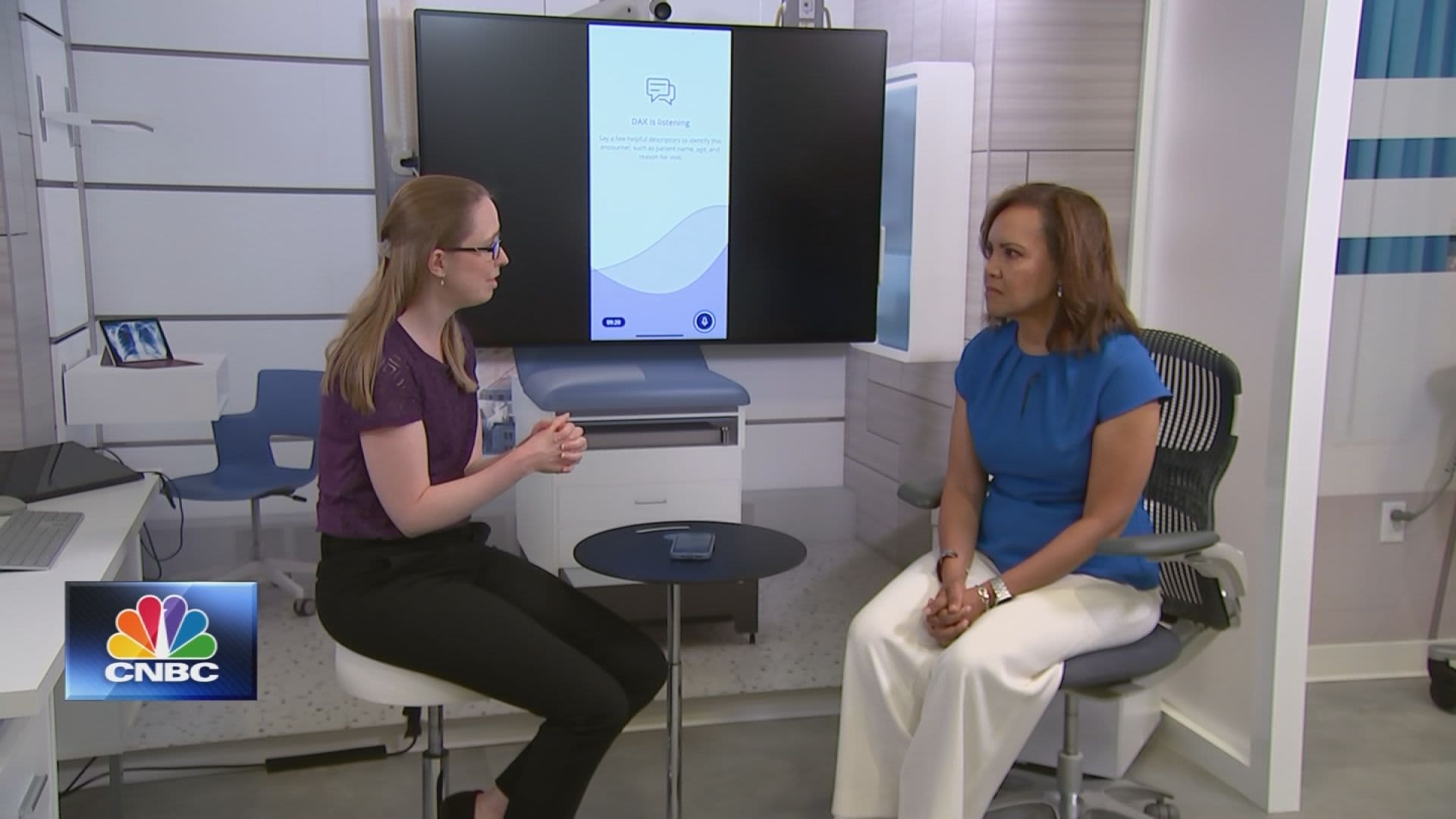
I sat down with Dr. O’Connor at Microsoft’s demonstration center for a simulated doctor’s appointment. I talked to her about my real issues with plantar fasciitis.

She ran DAX Express to record our interaction and one minute after she pressed stop on the recording, the app had typed up a full medical documentation that would go into a medical record.

This wasn’t just a transcription. It focused on the pertinent medical issues and left out the chit chat. It did miss one of her recommendations, that I should get an X-ray, but she easily added it back in.

From a patient perspective, I have to admit it was refreshing to talk to a doctor who wasn’t typing into a PC, and then to get a record that really captured what I was saying.

I found it a positive experience, especially if could help relieve my doctor and her staff from some of the drudge work.

— CNBC’s Jodi Gralnick contributed to this report.

Categories
Technology

What comes after Webb? NASA’s next-generation planet-hunting telescope

NASA

When it comes to building enormous, complex space telescopes, agencies like NASA have to plan far in advance. Even though the James Webb Space Telescope only launched recently, astronomers are already busy thinking about what will come after Webb — and they’ve got ambitious plans.

The big plan for the next decades of astronomy research is to find habitable planets, and maybe even to search for signs of life beyond Earth. That’s the lofty goal of the Habitable Worlds Observatory, a space telescope currently in the planning phase that is aimed at discovering 25 Earth-like planets around sun-like stars.

We spoke to two of the scientists working on plans for this next-generation space telescope to find out more.

The power of direct imaging

One of the big challenges in finding habitable planets beyond our solar system is this: We can rarely actually see these far-off planets directly, because planets are so small and dim compared to stars. So to identify an exoplanet, astronomers generally infer its existence due to its effects on its host star. Currently, tools like the Hubble or James Webb space telescopes most often look for dips in a star’s brightness when a planet passes in front of it, called a transit, or they look for a wobble of the star caused by the gravity of the planet, called the radial velocity method.

This is a multigenerational, probably multi-century endeavor that we’re on.”

Those methods give us clues, but to really understand exoplanets in depth, we need to be able to image them directly. Current telescopes are rarely able to do this because it requires such a high level of precision, but scientists are already planning out a next generation of space telescopes that will be able to take images of exoplanets.

NASA's Nancy Grace Roman space telescope will launch in 2027.

The next big space telescope to be launched is the Nancy Grace Roman Space Telescope, scheduled to launch in 2027. It will perform a survey of the sky to estimate how many habitable exoplanets are out there. After that comes the Habitable World Observatory, a planned space telescope that will directly image Earth-like exoplanets around sun-like stars and which should launch around 2040. This will be the best chance we’ll have to date of discovering habitable Earth-like worlds where we could search for evidence of life beyond Earth.

Choosing the right wavelength

If you’ve followed the news about the James Webb Space Telescope, you’ve likely heard that it looks in the infrared part of the electromagnetic spectrum. That’s essential for its goal of studying the earliest galaxies, as it allows scientists to see galaxies with high levels of redshift. Infrared is also useful for looking through clouds of dust and seeing structures that would otherwise be hidden.

The plan for the Habitable Worlds Observatory, however, is to look in the optical and ultraviolet wavelengths. These wavelengths are useful for identifying the signatures of specific atoms such as hydrogen or oxygen, so we can point our instruments toward a planet and learn what its atmosphere is composed of. 

There are all sorts of options for what particular atoms or compounds we could look for, but oxygen is the leading choice right now for what is called a biomarker, or a clue that indicates the potential presence of life. Spotting oxygen on a distant planet may be a sign that it warrants further inspection.

“There’s no perfect biomarker signature,” said David Sing of Johns Hopkins University, as we could also look for atoms like methane, and there’s always the possibility of a false positive, “but oxygen is a really important one.” 

Oxygen also gives off a very strong signal, which makes it relatively easier to detect. In particular, ozone — which is a variation of oxygen with three atoms bound together — has a very strong signature in the ultraviolet wavelength. Think about how the ozone layer on Earth protects us from the ultraviolet radiation from the sun, and you can see how scientists could infer the presence of ozone on a distant planet if they saw a particular wavelength of ultraviolet light being blocked.

How to build an optical/UV telescope

With its focus on optical and ultraviolet wavelengths, the Habitable Worlds Observatory will be more similar to the Hubble Space Telescope than the James Webb Space Telescope. And that brings some advantages in terms of how you build a telescope.

Infrared telescopes like Webb are very sensitive to temperature (because when things get hot, they give off infrared radiation). So to work accurately, Webb needs to be cooled to extremely low operating temperatures of just a few Kelvin for some instruments. That makes the telescope more complex and expensive to build, as it requires a cryogenic cooling system.

For a telescope like the Habitable Worlds Observatory, that kind of extreme cooling isn’t necessary, which helps to keep the costs down.

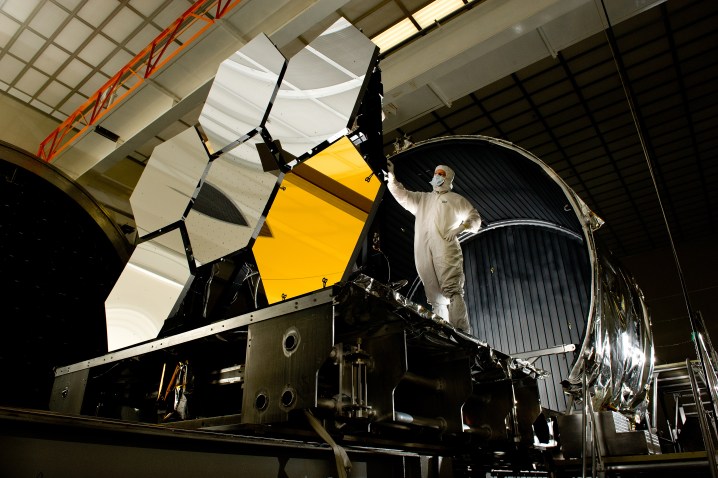
The James Webb Space Telescope used gold-coated mirrors for reflecting infrared radiation.NASA

Another key difference between infrared telescopes like Webb and optical/ultraviolet telescopes like the Habitable Worlds Observatory is the mirror. Webb’s primary mirror is coated with gold, which reflects infrared light very well. But an optical/ultraviolet telescope has a mirror coated with silver, which is more efficient at reflecting those wavelengths.

New technologies for a new decade

In some ways, we already know exactly what sorts of instruments will be required to look for habitable worlds, as these are updates to existing instruments rather than entirely new concepts.

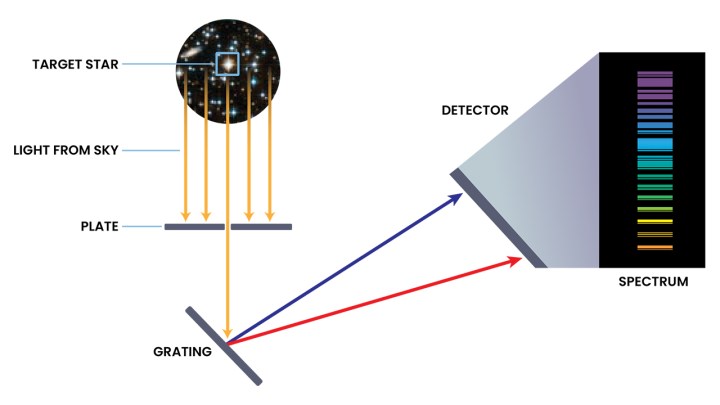
For example, the instruments on Habitable Worlds will be somewhat similar to those on James Webb or Hubble, as they will consist of cameras and spectrographs. The cameras will be used to look for exoplanets in other star systems, and once a planet has been identified, it can be studied in more depth using the spectrographs. Spectrographs work by splitting incoming light into different wavelengths, to see which wavelengths have been absorbed. That tells you what the object that you’re looking at is composed of — and that’s how you can see whether an exoplanet has an atmosphere, and what that atmosphere is made of.

A NASA illustration shows how light from a star is reflected into a detector.NASA

Refining these instruments and making them more accurate is not a trivial endeavor. In addition to direct detection, the next generation of space telescopes will also use techniques like radial velocity for identifying exoplanets. And more accurate spectrographs will enable techniques like extreme precision radial velocity, which allows more accurate measurements of the masses of exoplanets orbiting sun-like stars. 

But more theoretical advances are required as well. One major factor required to improve our understanding of exoplanets, for example, is improving our understanding of stars. Stars can become brighter or dimmer for all sorts of reasons, and we need to be able to model this more accurately if we want to determine whether a variation is caused by the presence of an exoplanet, or is due to variation of the star.

Hunting for habitability

Even with a brand-new telescope equipped with brand-new technology, however, it won’t be a simple matter to find life beyond our solar system. That’s because habitability is a complex concept that requires more than just identifying an Earth-like planet orbiting a sun-like star.

“A planet that looks like it’s about the right brightness to be an Earth-sized planet, that has a roughly circular orbit in what we would call the habitable zone, shows some evidence for water vapor, maybe some oxygen, there’s no inner giant planet that has stirred things up, the star isn’t too active — that’s the kind of system we’re hoping to find as a candidate for a potentially habitable planet,” Scott Gaudi of the Ohio State University said.

An artist's depiction shows TOI 700 e, an Earth-like world.NASA

But as tempting as it is to imagine a scenario where we build this telescope, find a habitable planet, then immediately detect life, that’s not how this will work, Gaudi said.

To properly search for habitable exoplanets, “we really have to get the whole context, which means studying the other planets in the systems, the debris disks, studying the stars,” Gaudi said. “That’s what’s really going to help us understand whether or not these planets are truly habitable.”

There’s a temptation to imagine that “we’re going to build the Habitable Worlds Observatory, we’re going to find life, and we’re done,” Gaudi said, but “it’s not going to work that way. If we’re lucky, we’re going to find one or two, maybe three, systems that look pretty promising. And then we’re going to have to build something even bigger and better.” 

A multigenerational endeavor

Even if we’re able to find the ideal-looking system with a potentially habitable Earth-like world, then the next step would be to look at even more advanced factors, such as how much of the planet is covered by oceans and how much is land mass. Searching for life isn’t something that is going to be solved any time soon, but scientists are now laying the groundwork for Habitable Worlds Observatory to take on the next part of the job in 20 years’ time.

That’s similar to the way that planning for the James Webb Space Telescope began around 2000, and scientists today are just starting to be able to use this tool for discovery.

“Several decades ago, I was just a young student. But I’ve reaped the rewards of all that hard work that people did at the time,” Sing said. “And that generation of scientists felt that way because people did it for them with the Hubble Space Telescope. So there’s this legacy where you’re reaping the rewards of what senior scientists did 20 years ago. And you want to make sure that legacy will continue 20 years from now.”

The Hubble Space Telescope launches in 1990.NASA

Because wondering whether life could exist beyond Earth is one of the most profound questions facing science today, and it won’t be solved quickly. The Habitable Worlds Observatory is the next step on that journey, but it won’t be the end point.

“This is a multigenerational, probably multi-century endeavor that we’re on,” Gaudi said. “And I think that we should be optimistic about that process, but we should also be humble.”

Editors’ Recommendations


Categories
Science

Curiosity Needed to Route Round a 23-Diploma Slope to Attain a Fascinating Discipline of Craters

It’s hard to believe, but Mars Curiosity Rover has been on Mars doing its thing for 11 years. And, so what’s it doing to celebrate? Heading up a hill, making one of its toughest climbs ever.

The “little rover that could” recently faced a particularly rough spot in its journey up Mount Sharp. That’s a 5 km tall mountain in the center of Gale Crater, where Curiosity landed in 2012. The path hasn’t been an easy one. The latest portion of the trip challenged the rover with a steep 23-degree incline, wheel-sized rocks, and slippery sand pits. According its controllers, it’s been a rough few months. But, the rover has made it through, so far.

“If you’ve ever tried running up a sand dune on a beach—and that’s essentially what we were doing—you know it’s hard, but there were boulders in there as well,” said Amy Hale, one of Curiosity’s drivers at NASA’s Jet Propulsion Laboratory.

Remove All Ads on Universe Today

Join our Patreon for as little as $3!

Get the ad-free experience for life

A view of Curiosity’s tracks (via its Navcam) as it made its way through a particularly difficult sandy slope in the Jau region on Mars’s Mount Sharp. Credit: NASA/JPL-Caltech

On the Road to Jau

The Jau region is one “pit stop” on the road up Mount Sharp. It’s pitted with dozens of small craters. Mission scientists don’t get to see that many craters all at once, so it was a great place to study them. However, getting to Jau posed dangers the mission drivers had to plan around. Hale and other “rover planners” write hundreds of lines of code to command the rover each day. They examine images from the rover to look for hazards that might stop or slow it down. Everyone keeps an eye out for sand pits or other obstacles, too.

Drivers then work with mission scientists to figure out what the next moves will be. They send revised code to Mars overnight so the rover can implement it the next day. That’s what happened with the traverse to Jau. Curiosity wasn’t in any danger while getting there, but drivers had to contend with sudden events when the rover would stop due to something unforeseen. They called those “faults” and there were plenty of them along the way to Jau.

At one point, the rover drivers and scientists programmed a detour to help the rover avoid some troublesome terrain. That added a few weeks on the journey. “It felt great to finally get over the ridge and see that amazing vista,” Schoelen said. “I get to look at images of Mars all day long, so I really get a sense of the landscape. I often feel like I’m standing right there next to Curiosity, looking back at how far it has climbed.”

The route Curiosity has taken so far on its trip to Jau, on the slopes of Mount Sharp. Each dot shows a place where the rover stopped. Credit: NASA/JPL-Caltech/USGS-Flagstaff/University of Arizona 

Exploring Jau

Jau region is a crater cluster slopes of Mount Sharp. At least one crater is filled with sand and broken rock slabs pave the area. Interestingly, the Jau area, like all of the Mount Sharp region, was once populated by lakes, rivers, and streams. Then, the climate changed and shaped the Mars we see today. Curiosity is sampling the rocks and other materials here to help scientists understand what that early environment was like. It finds strong evidence for water and waves on ancient Mars.

In Jau, the rocks and sand were likely part of the sediments laid down in the past. It’s also likely that some of those sands were deposited by the action of the Martian winds. The crater cluster probably formed when a meteor broke up in the atmosphere and showered the surface with fragments of the original. Now, planetary scientists want to know if the salt-enriched surface terrain had an effect on the way those craters formed and eroded after the impact.

Mount Sharp (its official name is Aeolis Mons), is actually the central peak of an impact crater. Its made up of layers of eroded sedimentary rock laid down before the crater formed. Other layers of material in the crater could have come from later lake deposits. Scientists estimate that some of those layers got deposited at least 3 to 3.5 billion years ago. Now they want to know if that lake could have hosted some form of life in those ancient times.

For More Information

NASA’s Curiosity Rover Faces Its Toughest Climb Yet on Mars
About Mount Sharp

Like this:

Like Loading…

Categories
Sport

US Girls’s World Cup exit evaluate: Andonovski, accidents, extra

  • Jeff Carlisle

    Close

    Jeff Carlisle

    U.S. soccer correspondent

      Jeff Carlisle covers MLS and the U.S. national team for ESPN FC.
  • Caitlin Murray

    Close

    Caitlin Murray

    ESPN

      Caitlin Murray is a general editor for ESPN.com. She has reported on and written about soccer for The New York Times, The Guardian, Yahoo Sports, Fox Sports, the Associated Press, and others.

      She authored a book about the history of the U.S. women’s national team called “The National Team: The Inside Story of the Women Who Changed Soccer,” which made “best of” lists in Vanity Fair, The Financial Times, NPR and The Los Angeles Times. On Twitter and Instagram, she’s @caitlinmurr.

Aug 7, 2023, 12:11 PM ET

MELBOURNE, Australia — The reign of the U.S. women’s national team as Women’s World Cup champions is officially over, as a millimeter was all that separated a Lina Hurtig penalty shootout tally for Sweden from an Alyssa Naeher save. You have to go back 12 years, when Japan defeated the U.S. in the 2011 Women’s World Cup final, to find the last time the U.S. was eliminated from a World Cup. This time, it marked the earliest exit from a World Cup in the program’s history.

In some ways, the end of the U.S. team’s two-tournament run as World Cup winners was a shock, coming as it did on the night when the Americans delivered by far their best performance of the tournament. But in other ways, the defeat was a long time coming, with cracks in the U.S. team’s dominance evident even before the Women’s World Cup.

Here are the factors that contributed to the USWNT’s demise.

The USWNT had too many injuries

The U.S. wasn’t the only country to encounter injuries — England was without four key players, and France had several out — so the U.S. can’t cite injuries alone for its exit. But the USWNT would have had a stronger team if its players had been healthier.

Mal Swanson, Catarina Macario, Becky Sauerbrunn and Samantha Mewis all were missed as probable starters. Before Swanson’s injury, she had accounted for most of the USWNT’s goals on her own. Had she been at the World Cup, she could’ve made a difference for this team, which collectively struggled to put balls in the back of the net. — Carlisle

The U.S. players didn’t look their best all World Cup long, and it finally cost them in Sunday’s round-of-16 elimination against Sweden. Quinn Rooney/Getty Images

Andonovski picked the wrong roster and lineups

The injuries and roster issues are intertwined to a degree. While the defense performed well despite Sauerbrunn’s absence, the ripple effect meant that Julie Ertz wasn’t available in midfield. From there, Vlatko Andonovski had limited options, though some of his decisions were perplexing, even without the injury impact.

– Women’s World Cup: Landing page | Schedule | Rosters | News
– Stream on ESPN+: LaLiga, Bundesliga, more (U.S.)

The front line seemed filled with redundant parts, as Sophia Smith, Trinity Rodman and Lynn Williams possessed a lot of the same traits, namely a desire to run at defenses. Megan Rapinoe’s presence as a pure crosser of the ball made sense, but there were no other options when it became clear she was out of form.

Probably the biggest lineup-decision problem was the construction of the midfield. Once Ertz moved to the back line, Andonovski decided to play Andi Sullivan as a lone holding midfielder despite having doubts about Sullivan’s suitability for the role, and having experimented with a double pivot earlier in the year. The U.S. midfield struggled mightily against the Netherlands and Portugal, and the performance against Sweden was the best of the tournament in large part because of the double pivot.

Editor’s Picks

2 Related

It more or less confirmed that this setup should have been used earlier in the tournament, and that Andonovski should have called in the personnel to do it reliably. — Carlisle

Poor in-game management from Andonovski

The USWNT could’ve given itself an easier path than Sweden in the round of 16. All the Americans needed to do was beat the Netherlands, but Andonovski’s subs (or lack thereof) seemed to help ensure the draw.

After Lindsey Horan’s second-half equalizer, the USWNT had momentum and the Netherlands players were losing steam. A sub could’ve sealed it. But Andonovski opted to bring in none, a decision that was widely criticized.

Against Sweden in the round of 16, a tight game that went into extra time, the only sub he brought on to make an impact was Rapinoe, whose touch was off all night. As the Swedes struggled to keep chasing the very direct Americans, Andonovski opted not to go to his bench, which could have taken advantage of all the running Sweden had to do and the physical toll that took. — Murray

The youth pipeline isn’t producing the right players

Anyone who has followed the youth national teams knew this day would come. The USWNT’s under-20 team did not get out of the group stage at both the 2022 and 2018 U-20 Women’s World Cups. The U-17 USWNT did get out of the group in 2022, only to be eliminated in its first knockout game, and previously crashed out of its groups in 2018 and 2014.

If the U.S. isn’t producing the best young players, it won’t produce the best senior players. The young players who made this World Cup roster — the likes of Smith and Rodman — are potent, but one-dimensional, forwards. Injured forward Macario, who brings flair and creativity, developed her game in Brazil before moving to the United States.

You also have to question the role of scouting when it comes to which players break through. Injured forward Swanson, a player known for her pace and athleticism, first caught the attention of the youth national team at 13. Rose Lavelle — arguably the most creative player the USWNT has other than the injured Macario — didn’t earn her first youth call-up until she was almost 18.

For U.S. Soccer to have the best, most technically gifted and creative players available at the senior level, it needs to find these players at the youth level and bring them all the way through to the senior side. — Murray

play

1:13

Alex Morgan ‘not planning’ retirement after World Cup exit

Alex Morgan says she has no immediate plans to retire after the USWNT was eliminated from the World Cup by Sweden.

USWNT lacked chemistry and couldn’t finish

Before the 2019 Women’s World Cup began, some of the players took to calling their teammates their “22 best friends.” During the tournament, the players said they spent tons of time together, and still chose to hang out even when they didn’t have to. They went to cat cafés and made the most of their downtime.

This USWNT in 2023 was all business — perhaps to a fault. Lindsey Horan and Lynn Williams said before their round-of-16 match that the players agreed they wanted to play with more joy, but it’s hard to force that. In New Zealand, the American players didn’t seem to do much fun or bonding. When asked how they spent their downtime, they said recovery and meals were their main activities when not training.

On the field, they looked tight and as though they were trying to force something to happen. Despite an expected goals (xG) through four games of around nine goals, they managed four. They created chances, but the individual chances were mostly not good enough, and when they were good enough, the players couldn’t finish.

STREAM ESPN FC DAILY ON ESPN+

Dan Thomas is joined by Craig Burley, Shaka Hislop and others to bring you the latest highlights and debate the biggest storylines. Stream on ESPN+ (U.S. only).

It’s hard to say how or why a team gets the yips in front of goal, but this version of the USWNT certainly lacked the sauciness and the fun-loving flair of past teams. The players desperately wanted to score and to put in good performances, but that approach might have been their undoing. — Murray

The USWNT was too overconfident

There’s no reason to believe the USWNT players showed up expecting to cruise through the beginning stages of the World Cup — but if they had, could you blame them?

Fresh off winning back-to-back World Cups against a backdrop of global dominance since the USWNT launched in 1985, the thought of the team struggling through the group stage seemed almost inconceivable. The optics of players doing podcasts and sponsored content during the tournament, or wearing designer suits to their matches, probably didn’t help the perception that they expected a leisurely start to the tournament.

While this could have been a factor — did players prepare the way they needed to? Did they have the right mentality in games? — we’ll never know. The players worked and ran relentlessly during games, trying their hardest to score and either getting unlucky or lacking quality.

The goals never came, nor did the possession play, passing or the other elements needed to win a World Cup, but it certainly wasn’t for a lack of effort. — Murray

The team was caught between two generations

The influx of youth into the national team was a factor, but it had to be done. The team’s poor performances at the Tokyo Olympics demanded change, with injuries accelerating this trend. But this is also something that happens within every cycle and shouldn’t cause a team to implode — certainly not a team with such potential and history as the U.S. women.

After the 2015 Women’s World Cup triumph, we witnessed the retirements of Lauren Holiday, Christie Rampone and Abby Wambach, while Carli Lloyd took on a reduced role. Granted, Rampone and Wambach were no longer full-time starters, but it points to the fact that ushering players out is a constant for a national team program.

An argument can be made that Andonovski should have done this sooner, but the impulse to give the 2019 World Cup winners the chance to repeat their feat at the Olympics was powerful. — Carlisle

The global gap has closed

This is a factor that has been impacting U.S. performances for a while. The rest of the world is catching up in terms of the caliber of player, as well as their fitness. The question posed by Netherlands manager Andries Jonker about “What is left of [the USWNT’s] superiority” beyond fitness proved prophetic — the answer was “not much.”

Up and down the competition, we saw established sides struggle against up-and-coming opponents. One need look no further than Portugal for an example of a country whose clubs have invested more in their women’s teams and then seen a corresponding increase in performance at international level. In a 0-0 draw to close the group stage, Portugal was the better team on the ball.

Then consider the group-stage exits of women’s soccer powerhouses Germany, Brazil and Canada because these teams all failed to beat lower-ranked teams. Whatever you’re feeling about the U.S., it’s indisputable that the gap has well and truly closed. — Carlisle

Categories
Entertainment

Ne-Yo Apologizes for “Offensive” Feedback on Gender Id

Ne-Yo is walking back his recent comments on gender identity.

“After much reflection, I’d like to express my deepest apologies to anyone that I may have hurt with my comments on parenting and gender identity,” he wrote in a statement shared to Twitter on Aug. 6. “I’ve always been an advocate for love and inclusivity in the LGBTQI+ community, so I understand how my comments could’ve been interpreted as insensitive and offensive.” 

And the “Closer” singer acknowledged he has more to learn.

“Gender identity is nuanced and I can honestly admit that I plan to better educate myself on the topic, so I can approach future conversations with more empathy,” the Grammy winner added. “At the end of the day, I lead with love and support everyone’s freedom of expression and pursuit of happiness.”

The apology comes days after Ne-Yo made the remarks during an interview.

Categories
Science

Prices Starting to Change the Internet Zero Debate within the UK • Watts Up With That?

From the MANHATTAN CONTRARIAN

Francis Menton

I have long said that when the costs of fossil fuel suppression policies start to hit home to average consumers, the whole climate alarm movement will become politically toxic, and will fade away.

So far in the U.S. we haven’t seen much movement in this direction. The red states are mostly alert to the issue of the costs of Net Zero, and want no part of fossil fuel suppression. The blue states have inflicted some substantial early costs on themselves (up to about doubling the cost of electricity in the case of California) without the voters having yet gotten too upset. At the federal level, the misnamed “Inflation Reduction Act” passes out hundreds of billions of dollars worth of handouts and subsidies to hide the cost of fossil fuel suppression from the public. It could be several more years before blue state voters figure out how they are getting fleeced.

But in Europe, and particularly in the UK, there are serious signs of shifting political winds. The Global Warming Policy Foundation is the UK’s leading think tank opposing Net Zero energy policies; and as a board member of its U.S. affiliate American Friends of the GWPF, I have a ringside seat to observe the shift.

In Europe, ever since the issue became political, there has been a near-unanimous all-party consensus in favor of fossil fuel suppression as a way to control “climate change.” You might think that some large party of the right or center-right in some country would speak up to say that these policies will impoverish us without having any noticeable effect on global climate. But for many years, that has not occurred.

In the UK, the logical party to be the home of climate realism would be the Conservative party. The Conservatives have been the governing party in the UK since all the way back to 2010. They led the way to the vote for Brexit in 2016, and to concluding the UK’s departure from the EU in 2020. But throughout their now 13 years running the government, the Conservatives have been very much on board with the program of “saving the planet” through fossil fuel suppression. In 2019, during the time Theresa May was Prime Minister, the UK parliament passed into law a binding requirement for “Net Zero” emissions by 2050. May’s successor Boris Johnson, who had made noises of being a climate skeptic before becoming Prime Minister, proved to be even more zealous than May in pursuing the Net Zero goal during his three years in office (2019 – 2022).

Current Prime Minister Rishi Sunak took office last October. Along the way to the top, he had pledged fealty to the Net Zero goal, but without giving many clues as to whether he was a zealous versus half-hearted proponent.

The UK’s road to Net Zero has so far included all the usual elements of the program: closing coal-fired power stations, building large numbers of on-shore and off-shore wind turbines, building large numbers of solar panels (despite the UK being in high north latitudes and being famously cloudy), banning “fracking” for oil and natural gas (despite having a large shale formation under foot), restricting further drilling in the North Sea, and so forth.

A somewhat unique feature of the UK fossil fuel suppression regime appears to have been the catalyst to set off the recent political shift. As far back as 2008 the government of London had initiated what they called a “Low Emissions Zone” in the central areas, with restrictions on the emissions of various sorts of vehicles entering the area, and financial charges for those driving in based on emissions levels. The standards gradually tightened over the years, and in 2020 the Mayor instituted what was now called the “Ultra Low Emissions Zone” in the central areas.

Having gotten away with this so far, the London government announced earlier this year that the ULEZ would be extended beyond the central areas to all London boroughs as of August 29. Most significantly, this would mean that essentially everybody entering this extended area in a gasoline or diesel powered motor vehicle would be charged 12.5 pounds per day — about $15, not an insignificant amount of money.

On July 20 a by-election was held for a seat in Parliament for the district known as Uxbridge and South Ruislip. This was the seat previously held by none other than ex-PM Boris Johnson, who had decided to resign since it wouldn’t be much fun hanging around in Parliament not being PM any more. With the Tories doing poorly in the polls, it was thought that they would be highly unlikely to hold this seat. But the Uxbridge and South Ruislip seat is in the outer ring of London boroughs about to become part of the ULEZ. The Conservative candidate came out against expanding the ULEZ, and the by-election turned into essentially a one-issue referendum on that subject. The Conservative candidate narrowly won.

Suddenly, opposing a policy initiative being sold as “for the climate” had proved to be a political winner. Meanwhile, the UK had also experienced a large spike in household energy costs last fall and spring (although the price of natural gas has eased somewhat since). And thus in the last week we see a flurry of policy initiatives from PM Sunak and his ministers, running counter to the Net Zero program, with enthusiastic support at least among the Tory grassroots. From the Telegraph, August 4, “Rishi Sunak’s popularity surges as he toughens Net Zero stance”:

In the aftermath of the vote [in Uxbridge and South Ruislip], Mr Sunak declared that he was on motorists’ side as he asked the Department for Transport to carry out a review of low-traffic neighbourhoods across the country. On Monday, he announced the Government was granting hundreds of new licences for North Sea oil and gas exploration.

Other parts of the UK’s Net Zero program include a requirement for 22% of motor vehicle sales to be EVs by next year, and a ban on new gasoline-powered cars by 2030. From the Sun, August 2:

Net Zero Secretary Grant Shapps was yesterday forced to admit the National Grid is hopelessly underpowered for the challenge of charging up millions more electric vehicles. And Business Secretary Kemi Badenoch is warning — along with car manufacturers — that an arbitrary requirement for 22 per cent of all car sales to be electric by NEXT YEAR is risking jobs and investment. . . . [A]s ex-Cabinet minister Jacob Rees-Mogg argues, if the PM were to back The Sun and put the brakes on net zero as part of his 2024 election manifesto, it would be popular with voters. And it could well get him back on the road to victory.

We’ve been waiting a long time for this. Finally, it’s a start.

Like this:

Like Loading…

Categories
Health

Toddler RSV shot wins CDC backing, paving approach for fall availability

A RSV-infected child receives treatment, as RS-Virus infections spread among children at Missio children’s clinic Moenchberg, in Wuerzburg, Germany, December 2, 2022. 

Heiko Becker | Reuters

The first shot that protects all infants against respiratory syncytial virus, or RSV, won the backing of the Centers for Disease Control and Prevention on Thursday.

RSV is the leading cause of hospitalization among infants in the U.S. The shot, branded under the name Beyfortus, provides families with a simple option to protect their babies during the respiratory virus season.

related investing news

The CDC’s panel of independent advisors unanimously recommended AstraZeneca and Sanofi‘s shot, also called nirsevimab, after reviewing the data in an hourslong meeting Thursday afternoon.

CDC Director Dr. Mandy Cohen accepted the advisors’ recommendation Thursday evening. She called on families to take advantage of the new drug.

“As we head into respiratory virus season this fall, it’s important to use these new tools available to help prevent severe RSV illness,” Cohen said. 

“I encourage parents of infants to talk to their pediatricians about this new immunization and the importance of preventing severe RSV,” she said. 

The CDC said Beyfortus should be available this fall. AstraZeneca and Sanofi are prepared to roll the shot out before RSV season and do not foresee any challenges meeting demand, a Sanofi spokesperson said.

Dr. Sarah Long, a CDC panel member, described Beyfortus as a milestone. 

“This is the very first antibody protection against a remarkably remaining burden of disease in children,” said Long, a professor of pediatrics at Drexel University. 

“Parents should be very, very much relieved that they won’t have to be concerned about the likelihood that their child could be hospitalized with RSV disease,” she said.

Most insurance plans will be required to cover the shot at no cost to consumers due to requirements under the Affordable Care Act. The shot has a list price of $495. 

Though Long described the shot as a breakthrough, she said the CDC panel is “extremely disappointed” by the price set by Sanofi and AstraZeneca.

It could potentially take months for some insurance plans to update their policies to comply with the requirement. 

The CDC advisors also voted unanimously to include the shot in the federal Vaccines for Children Program, which provides shots to kids whose families are struggling financially. The program provides immunizations to about half of the nation’s children.

Beyfortus works like a vaccine, but the shot is considered a drug, not a vaccine, because it is an antibody injection. Vaccines prepare the body’s immune system to release antibodies that fight viruses, while Beyfortus injects these antibodies directly into the bloodstream.

Infants younger than 8 months entering their first RSV season would receive one dose. Kids 8 to 19 months who face an increased risk from the virus would receive another dose in their second RSV season. 

CNBC Health & Science

Read CNBC’s latest health coverage:

Another option, called palivizumab, is already on the market but it is primarily used for pre-term babies and those with congenital heart and lung conditions. It is also more difficult to administer because infants have to receive a shot monthly during RSV season.

Beyfortus, on the other hand, is broadly available for all infants regardless of whether they have a health condition. It is also administered as a single dose to protect babies during the entire RSV season.

Beyfortus was up to 75% effective at preventing lower respiratory tract infections that required medical attention among infants and 78% effective at preventing hospitalization, according to an FDA review.

The FDA did not identify any safety issues when it reviewed Beyfortus. Some monoclonal antibodies have been associated with allergic reactions and skin rashes.

RSV kills nearly 100 infants every year, according to a study published in the medical journal JAMA Network Open in 2022. It is also the leading cause of hospitalization among children less than a year old, according to a study published in the Journal of Infectious Diseases.

Children’s hospitals were overwhelmed last year by a surge of RSV infections at the same time that flu and Covid were also circulating.

The wave of illness strained hospitals so much that they called on the Biden administration to declare a public health emergency in response. The White House ultimately did not declare one.

Categories
Technology

France’s AFP sues Twitter over non-payments for displaying information

A bad week for Elon Musk just got even worse. After enduring a scandal over Tesla’s driving ranges, a risible rebrand of Twitter, and a divisive feud with hate-speech researchers, Musk discovered yet another powerful enemy: Agence France-Presse (AFP).

The French news agency announced on Wednesday that it’s suing X — Musk’s new name for Twitter — over alleged non-payments for displaying AFP content.

The case stems from EU copyright reforms that became French law in 2019. Under the legislation, online platforms must remunerate publishers for distributing their content.

The rules have proven controversial. Media outlets argue that their news provides engagement and ad revenue without sufficient compensation. But the platforms note that they’re already driving traffic to the publishers.

The <3 of EU tech

The latest rumblings from the EU tech scene, a story from our wise ol’ founder Boris, and some questionable AI art. It’s free, every week, in your inbox. Sign up now!

Unsurprisingly, AFP is a staunch advocate for the requirements. The agency — the world’s oldest news service — claims X has refused to even discuss payments for content distributions. 

The newswire announced on Wednesday that it’s filed a lawsuit in Paris over the dispute. According to AFP, the lawsuit aims to determine how much money is owed. 

“This move is aimed at compelling Twitter, in accordance with the law, to provide all the necessary elements required for assessing the remuneration owed to AFP under the neighbouring rights legislation,”  the company said in a statement.

Inevitability, Musk denounced the accusations in a tweet.

“This is bizarre,” he said. “They want us to pay *them* for traffic to their site where they make advertising revenue and we don’t!?”

This is bizarre. They want us to pay *them* for traffic to their site where they make advertising revenue and we don’t!?

— Elon Musk (@elonmusk) August 3, 2023

Despite Musk’s criticisms, AFP has pledged to continue using legal means to get compensation for content.

Whatever the outcome, it’s created another headache for the world’s richest man.

Categories
Sport

Julie Ertz retires from USWNT responsibility after World Cup heartbreak

  • Jeff Carlisle, U.S. soccer correspondentAug 6, 2023, 12:26 PM ET

    Close

      Jeff Carlisle covers MLS and the U.S. national team for ESPN FC.

United States women’s national team defender Julie Ertz announced her retirement from international soccer following Sunday’s heartbreaking defeat to Sweden in the Women’s World Cup round of 16.

Ertz was part of a USWNT defense that recorded its third shutout of the tournament, and while the Americans dominated the 0-0 match for long stretches, they fell 5-4 on penalties, marking their earliest exit from a Women’s World Cup in the team’s history. Afterward, Ertz indicated the match would be her last for the U.S.

– Stream on ESPN+: LaLiga, Bundesliga, more (U.S.)

“Unfortunately this is my last time in this crest,” she told ESPN’s Alexis Nunes in a postmatch interview.

Ertz made a sensational comeback to professional soccer earlier this year after giving birth to her son, Madden, last August. She first suited up for the U.S. in a pair of friendlies against Ireland back in April, and shortly thereafter signed with NWSL side Angel City. She then made enough progress to be named to the U.S. World Cup roster in June.

Initially, it was expected that Ertz would play as a holding midfielder. But when U.S. captain Becky Sauerbrunn sustained a foot injury that kept her out of the World Cup, manager Vlatko Andonovski moved Ertz to center-back, a role she filled during the U.S. team’s run to the 2015 World Cup.

Ertz went on to strike up a hugely effective partnership alongside Naomi Girma, with the U.S. conceding just one goal in four matches. She lauded the growth of the team’s young players, a group that includes Girma.

Julie Ertz said in postmatch interviews that she will no longer play for the USWNT. Brad Smith/USSF/Getty Images for USSF

“The future is in absolutely great hands,” Ertz said. “You know, sometimes you learn the most from your failures, which sucks. But it’s part of my career as well.”

Ertz then fought back tears as she indicated she wouldn’t be playing for the U.S. again, and added, “I’m so excited for [the USWNT] in the future.”

Barring a change of heart, Ertz will finish her international career with 122 appearances for the U.S., scoring 20 goals. Ertz was part of two World Cup-winning sides in 2015 and 2019.