The Biden administration on Tuesday unveiled the first 10 prescription drugs that will be subject to price negotiations between manufacturers and Medicare, kicking off a controversial process that aims to make costly medications more affordable for older Americans.
President Joe Biden’s Inflation Reduction Act, which passed in a party-line vote last year, gave Medicare the power to directly hash out drug prices with manufacturers for the first time in the federal program’s nearly 60-year history. The agreed-upon prices for the first round of drugs are scheduled to go into effect in 2026.
Here are the 10 drugs subject to the initial talksthis year:
Eliquis, made by Bristol-Myers Squibb, is used to prevent blood clotting, to reduce the risk of stroke.
Jardiance, made by Boehringer Ingelheim, is used to lower blood sugar for people with Type 2 diabetes.
Xarelto, made by Johnson & Johnson, is used to prevent blood clotting, to reduce the risk of stroke.
Januvia, made by Merck, is used to lower blood sugar for people with Type 2 diabetes.
Farxiga, made by AstraZeneca, is used to treat Type 2 diabetes.
Entresto, made by Novartis, is used to treat certain types of heart failure.
Enbrel, made by Amgen, is used to treat rheumatoid arthritis.
Imbruvica, made by AbbVie, is used to treat different types of blood cancers.
Stelara, made by Janssen, is used to treat Crohn’s disease.
Fiasp and NovoLog, insulins made by Novo Nordisk.
The Medicare negotiations are the centerpiece of the Biden administration’s efforts to rein in the rising cost of medications in the U.S. Some Democrats in Congress and consumer advocates have long pushed for the change, as many seniors around the country struggle to afford care.
But the pharmaceutical industry views the process as a threat to its revenue growth, profits and drug innovation. Drugmakers such as Merck and Johnson & Johnson and their supporters aim to derail the negotiations, filing at least eight lawsuits in recent months seeking to declare the policy unconstitutional.
The drugs listed Tuesday are among the top 50 with the highest spending for Medicare Part D, which covers prescription medications that seniors fill at retail pharmacies.
The 10 medicines accounted for $50.5 billion, or about 20%, of total Part D prescription drug costs from June 1, 2022, to May 31, 2023, according to the Centers for Medicare and Medicaid Services, or CMS.
The drugs have been on the market for at least seven years without generic competitors, or 11 years in the case of biological products such as vaccines.
In 2022 alone, 9 million seniors spent $3.4 billion out-of-pocket on the 10 drugs, a senior Biden administration official told reporters Tuesday during a call.
Medicare covers roughly 66 million people in the U.S., and 50.5 million patients are currently enrolled in Part D plans, according to health policy research organization KFF.
What happens next
Drugmakers have to sign agreements to join the negotiations by Oct. 1. CMS will then make an initial price offer to manufacturers in February 2024, and those companies have a month to accept or make a counteroffer.
The negotiations will end in August 2024, with agreed-upon prices published on Sept. 1, 2024. The reduced prices won’t go into effect until January 2026.
If a drugmaker declines to negotiate, it must either pay an excise tax of up to 95% of its medication’s U.S. sales or pull all of its products from the Medicare and Medicaid markets.
The pharmaceutical industry contends that the penalty can be as high as 1,900% of a drug’s daily revenues.
After the initial round of talks, CMS can negotiate prices for another 15 drugs for 2027 and an additional 15 in 2028. The number rises to 20 negotiated medications a year starting in 2029 and beyond.
“I think it’s incredibly important to keep in mind that the negotiation process is cumulative,” said Leigh Purvis, a prescription drug policy principal with AARP Public Policy Institute. “We could have as many as 60 drugs negotiated by 2029.”
CMS will only select Medicare Part D drugs for the medicines covered by the first two years of negotiations. It will add more specialized drugs covered by Medicare Part B, which are typically administered by doctors, in 2028.
The drug price talks are expected to save Medicare an estimated $98.5 billion over a decade, according to the Congressional Budget Office.
The negotiations are also expected to save money for people enrolled in Medicare, who take an average of four to five prescription drugs a month and increasingly face out-of-pocket costs that many struggle to afford.
Nearly 10% of Medicare enrollees ages 65 and older, and 20% of those under 65, report challenges in affording drugs, a senior administration official said Tuesday.
Drugmakers’ legal challenges
Merck, Johnson & Johnson, Bristol-Myers Squibb and Astellas Pharma are among the companies suing to halt the negotiation process. The industry’s biggest lobbying group, PhRMA, and the U.S. Chamber of Commerce have filed their own lawsuits.
The suits make similar and overlapping claims that Medicare negotiations are unconstitutional.
The companies argue that the talks would force drugmakers to sell their medicines at huge discounts, below market rates. They assert this violates the Fifth Amendment, which requires the government to pay reasonable compensation for private property taken for public use.
The suits also argue that the process violates drugmakers’ free speech rights under the First Amendment, essentially forcing companies to agree that Medicare is negotiating a fair price.
They also contend that the talks violate the Eighth Amendment by levying an excessive fine if drugmakers refuse to engage in the process.
The suits are scattered in federal courts around the U.S. Legal experts say the pharmaceutical industry hopes to obtain conflicting rulings from federal appellate courts, which could fast-track the issue to the Supreme Court.
Some drugmakers have confirmed their intention to bring their legal battle to the nation’s highest court.
“As we look forward, we’re going to take this to the fullest, which means we’ll take it through District Court and, if need be, into Circuit Court and ultimately to the Supreme Court,” Merck CEO Robert Davis said during an earnings call earlier this month. “So, really that’s the strategy.”
Meanwhile, the Biden administration has vowed to fight the legal challenges.
Biden and his top health officials have embraced the lawsuits as evidence that they’re making progress in the fight to cut drug prices.
“Big Pharma doesn’t want this to happen, so they’re suing us to block us from negotiating lower prices so they can pad their profits,” the president said in a speech at the White House in July. “But we’re going to see this through. We’re going to keep standing up to Big Pharma.”
How much Medicare spends on the drugs
Among the 10 drugs listed, for the period from June 1, 2022, to May 31, 2023, Medicare Part D spent the most on Eliquis, at $16.5 billion, according to a CMS fact sheet.
The plan also spent roughly $7 billion on Jardiance, $6 billion on Xarelto, $4 billion on Januvia and $3.2 billion on Farxiga during that same time period, the fact sheet said. Spending for Entresto, Enbrel, Imbruvica, Stelara and the two insulins came in at more than $2.5 billion each.
In the calendar year 2022, more than 3.5 million enrollees used Eliquis and paid $441 out-of-pocket on average for the blood thinner, according to a separate fact sheet, from the Department of Health and Human Services’ Office of the Assistant Secretary for Planning and Evaluation, or ASPE.
Roughly 1.3 million enrollees used Jardiance in 2022, paying $290 out-of-pocket on average, the ASPE fact sheet said. About 1.3 million beneficiaries used Xarelto and paid $451 out-of-pocket on average.
Far fewer enrollees used Imbruvica and Stelara in the same year, at 22,000 and 20,000, respectively, according to the ASPE fact sheet. But enrollees paid the most out-of-pocket for those drugs: $5,247 for Imbruvica and $2,058 for Stelara on average, the ASPE fact sheet said.
Meanwhile, 763,000 enrollees used Novo Nordisk’s two insulin products in 2022 and paid $121 out-of-pocket on average, according to the ASPE fact sheet.
A handful of drugs on the list came as a surprise, including Farxiga and Stelara. Wall Street analysts and health policy researchers had been expecting other names, such as Eli Lilly’s diabetes drug Trulicity or Xtandi, a rheumatoid arthritis medication from Astellas Pharma.
A senior administration official said the list likely diverged from predictions due to changes in Medicare Part D spending.
“Data may now have fallen lower on the list because utilization may have dropped off in the last year or other drugs may have become more common,” the official said during the call.
A recent study published in Nature examines how mud cracks observed on Mars by NASA’s Curiosity rover could provide insight into how life on the Red Planet could have formed in its ancient past. On Earth, mud cracks have traditionally been linked to cycles of wet and dry environments that assisted in developing the complex processes responsible for microbial life to take hold. This study was conducted by an international team of researchers and holds the potential to help scientists better understand the geological and chemical processes that might have existed in Mars’ ancient past, up to billions of years ago.
“This is the first tangible evidence we’ve seen that the ancient climate of Mars had such regular, Earth-like wet-dry cycles,” said Dr. William Rapin, who is a CNRS Research Scientist at IRAP (Institut de Recherche en Astrophysique et Planétologie), and lead author of the study. “But even more important is that wet-dry cycles are helpful – maybe even required – for the molecular evolution that could lead to life.”
For the study, the team analyzed images of mud cracks obtained from NASA’s Mars Curiosity rover, currently traversing Gale Crater on Mars, between sols 3154 to 3156 (June 20-22, 2021) when it was drilling in a rock nicknamed “Pontours”. The images reveal distinct T- and hexagonal-shaped cracks within the surface, which is indicative of many cycles of wet and dry conditions that once existed in this region. Wet conditions, such as flowing rivers or lakes, are responsible for producing the mud, but when that same mud dries out, it compresses and cracks, resulting in the broken surface we see today. For context on sols, one Martian sol equals one day on Mars, which is just under 40 minutes longer than one day on Earth.
Remove All Ads on Universe Today
Join our Patreon for as little as $3!
Get the ad-free experience for life
Zoomed in portion of the panorama image obtained by the Curiosity rover’s Mastcam at the rock target “Pontours” which unveils hexagonal patterns (red outlines in the same image, right) that propose these mud cracks were produced over a multitude of wet-dry cycles occurring over many years. (Credit: NASA/JPL-Caltech/MSSS/IRAP)
“These exciting observations of mature mud cracks are allowing us to fill in some of the missing history of water on Mars,” said Dr. Nina Lanza, who is principal investigator of the ChemCam instrument onboard NASA’s Curiosity rover, and a co-author on the study. “How did Mars go from a warm, wet planet to the cold, dry place we know today? These mud cracks show us that transitional time, when liquid water was less abundant but still active on the Martian surface.”
The study’s findings indicate that these cracks are indicative of a transition of minerals, notably smectite clays to sulfate-bearing strata, which potentially indicates that Mars experienced an Earth-like environment during the Noachian-Hesperian transition, or 3.8 to 3.6 billion years ago. On Earth, smectite clays and sulfate-bearing strata are typically associated with aqueous environments. Also, like Earth, the Red Planet’s geologic history is divided into time periods from oldest to youngest, with those time periods being the Pre-Noachian, Noachian, Hesperian, and Amazonian and each lasting approximately from 4.5 to 4.1 billion years ago, 4.1 to 3.7 billion years ago, 3.7 to 2.9 billion years ago, and 2.9 billion years ago to the present, respectively.
A panorama image taken by NASA’s Curiosity Mars rover shows a rock target nicknamed “Pontours” where researchers identified preserved, ancient mud cracks hypothesized to have shaped throughout lengthy cycles of wet and dry environments over many years. These cycles are hypothesized to support conditions where life could form. (Credit: NASA/JPL-Caltech/MSSS/IRAP)
While Mars is presently an extremely cold and dry planet that’s inhospitable for life as we know it, scientific evidence suggests things were much different billions of years ago when it first formed. This was when liquid water flowed into lakes, rivers, and oceans while volcanoes spewed gases to keep the atmosphere thick enough for this liquid water to keep cascading across the surface. Auroras danced across the sky from the solar wind interacting with the Red Planet’s magnetic field, much like we see on Earth today. But while these Earth-like conditions might have led to microbial life forming on Mars, these conditions weren’t meant to last.
Artist illustration of an ancient ocean on Mars, which researchers have hypothesized contained more water than Earth’s Arctic Ocean and that the Red Planet has lost almost 90 percent of that water to space. (Credit: NASA/GSFC)
Over millions of years, the interior of Mars began to cool due to its small size—half of Earth—resulting in the decreasing temperature of its molten liquid outer core which gradually reduced its geological and magnetic influence on the Red Planet. The volcanoes stopped spewing gases and the magnetic field dissipated, taking the auroras with it. Along with this, protection from the solar wind was also lost, resulting in the latter slowly stripping the planet’s atmosphere, leading to evaporation of all liquid water. In the end, Mars is the barren world we see today, without a drop of liquid water on its surface.
What new discoveries will scientists make about Mars and its ancient past in the coming years and decades? Only time will tell, and this is why we science!
These days, Jessica Simpson‘s family life is less of a public affair.
After all, the pop star-turned-fashion designer has temporary relocated from paparazzi-filled Hollywood to the much quieter city of Nashville with husband Eric Johnson and kids Maxwell Drew, 11, Ace Knute, 10, and Birdie Mae, 4. While Jessica isn’t completely ready to part ways with the West Coast—renting a home in the Tennessee capital for the summer—she exclusively told E! News chief correspondent Keltie Knight that the change in scenery has been much welcomed.
“Being in Nashville, even my kids are like, ‘You laugh the whole time. You’re so happy,'” she revealed during a recent PetSafe event in Los Angeles to celebrate National Dog Day. “It’s because I’m not on guard. I’m with a lot of like-minded people. It’s not about the celebrities—it’s really about the music and the heart and the conversation.”
In fact, being a renter has been “a hilarious experience,” according to the 43-year-old.
Brian Windhorst, ESPN Senior WriterAug 28, 2023, 10:38 AM ET
Close
ESPN.com NBA writer since 2010
Covered Cleveland Cavs for seven years
Author of two books
MANILA, Philippines — When coach Steve Kerr came to practice Sunday and saw some of his Team USA players were a little frustrated after a 27-point win, he smiled. The first FIBA World Cup lesson had landed.
That mood carried into Monday night, when the U.S. played a more focused, cleaner and overall better game in beating Greece 109-81 to move to 2-0 in the event. The win assures the U.S. will move on to the second round after its last pool play game Wednesday against Jordan.
“Really good effort from our guys,” Kerr said. “Our thought process every game is to wear the opponent down. We’re just trying to stay solid on every possession and really put pressure on the opponent.”
That didn’t always happen in the opener against New Zealand. The Americans won easily but were the less physical and less prepared team for a good chunk of the game. That is the sort of bad habit that portended trouble for the national team in the past.
Editor’s Picks
1 Related
Those worries were pushed off against the Greeks, who are empirically the toughest opponent the U.S. will face in pool play, even if they’re not as potent without the injured Giannis Antetokounmpo.
Jalen Brunson, who had been just so-so over the past few games, emerged seeking to set a tone as his captain status demands. He was looking for his shot, barking at the referees and generally showing fire that he hoped would be contagious. Brunson made all five of his shots and finished with 13 points in a bounce-back effort for the Team USA starters who had been outplayed over the previous two games.
“For us it’s all about feel and how we just need to attack the game as soon as we step on that court,” Brunson said. “We’re still growing, we’re still learning and we still have a lot of time to get better.”
After great performances in the warmup games, U.S. scoring ace Anthony Edwards shot 1-of-6 to start Monday’s contest but shook it off and found his stride as the night wore on, finishing with 13 points.
Overall, the starters were better than they were in the past few outings but still the lesser unit. Kerr often groups his substitutes, and the difference in effectiveness between the first and second teams remains obvious.
In the first half, the U.S. starters outscored Greece by two points. The second unit, led again by the inspired play of Austin Reaves, was plus-11. That cushion made the second half comfortable, and the starters got some momentum by extending the lead in the third quarter.
Reaves was drawing fouls, thrilling the crowd with breakaway dunks and even talking trash on his way to 15 points, 5 rebounds and 6 assists.
But he was only part of the success, as Tyrese Haliburton and Paolo Banchero were terrific on defense, battling the bigger Greeks in the post and piling up stops. Haliburton blocked two shots and Banchero, who continues to get minutes at backup center, refused to yield in the post.
“With the talent that we have 1-through-12 regardless of who it is, we like our chances against anybody,” Reaves said. “The first unit wears down the opponents so quick because of the type of basketball that we play — fast, physical defense. So every time we get in the game, that’s our goal is to turn the intensity up and try to wear out teams.”
Josh Hart, who played some of his most effective minutes with the team thus far, and Cameron Johnson were part of some swarming defensive spurts with the “backups.”
“Josh is just a winner. People ask what position does he play? He just, he plays winner,” Kerr said. “At one point [assistant coach Erik Spoelstra] turned to me and said, ‘Some people get 50/50 balls. He gets the 30/70 balls.’ I thought that was really well said.”
Center Georgios Papagiannis, a 2016 lottery pick of the Phoenix Suns, scored 17 points to lead Greece.
Australian shipbuilder Incat Tasmania has selected two Nordic companies to provide the battery and propulsion technology for the world’s largest electric ship, as the industry looks to charter a course toward greener voyages.
Incat is currently constructing the 130-metre-long battery-electric vessel at its factory on the island of Tasmania, off the coast of Australia. It is building the vessel for South American shipowner Buquebús.
Once the ship launches, scheduled for some time in 2025, it will ferry up to 2,100 passengers and 225 vehicles on a route between Argentina and Uruguay.
Finland’s Wärtsilä will provide the electric motors and water jet propulsion systems for the ferry, while Norway’s Corvus Energy will supply the energy storage system (ESS). At over 40MWh, the batteries will be four times larger than any battery ever installed on a ship anywhere in the world.
Pictured here, the electric ship is currently under construction at Incat’s factory in Tasmania. Credit: Incat Tasmania
Catch up on our conference talks
Watch videos of our past talks for free with TNW All Access →
The ESS is, according to Corvus, only made possible through the company’s newest high-density batteries specially developed for lightweight ships. The battery system will in turn power the electric motors that drive the vessel’s eight waterjets.
“What brings all this together is the energy management system, which is the brains of the system,” explains Paul Kohle, vice president at Wärtsila. “That has software that optimises the overall operation and operating profile of the vessel and supports the vessel’s crew in terms of the displays.”
The hope is that the unique design of the ship’s propulsion system will open up new markets, “including crossing the English Channel on zero emissions,” said Halvard Hauso, commercial director at Corvus Energy.
Corvus Energy has designed a type of high-density battery specifically for lightweight ships. Credit: Corvus Energy
“This groundbreaking project marks a turning point in the maritime industry’s effort to transition towards greener means of transportation,” said Hauso. “It redefines the future of ferry operations worldwide and paves the way for other large, zero-emission vessels.”
Elsewhere, similar attempts to decarbonise the shipping industry are underway. Norway is considered to be leading the charge on electric ships globally, with over 60 electric ferries in operation, out of its total fleet of 200. Aside from batteries, other solutions include installing giant sails to cut fuel consumption and even reinventing the pirate ship.
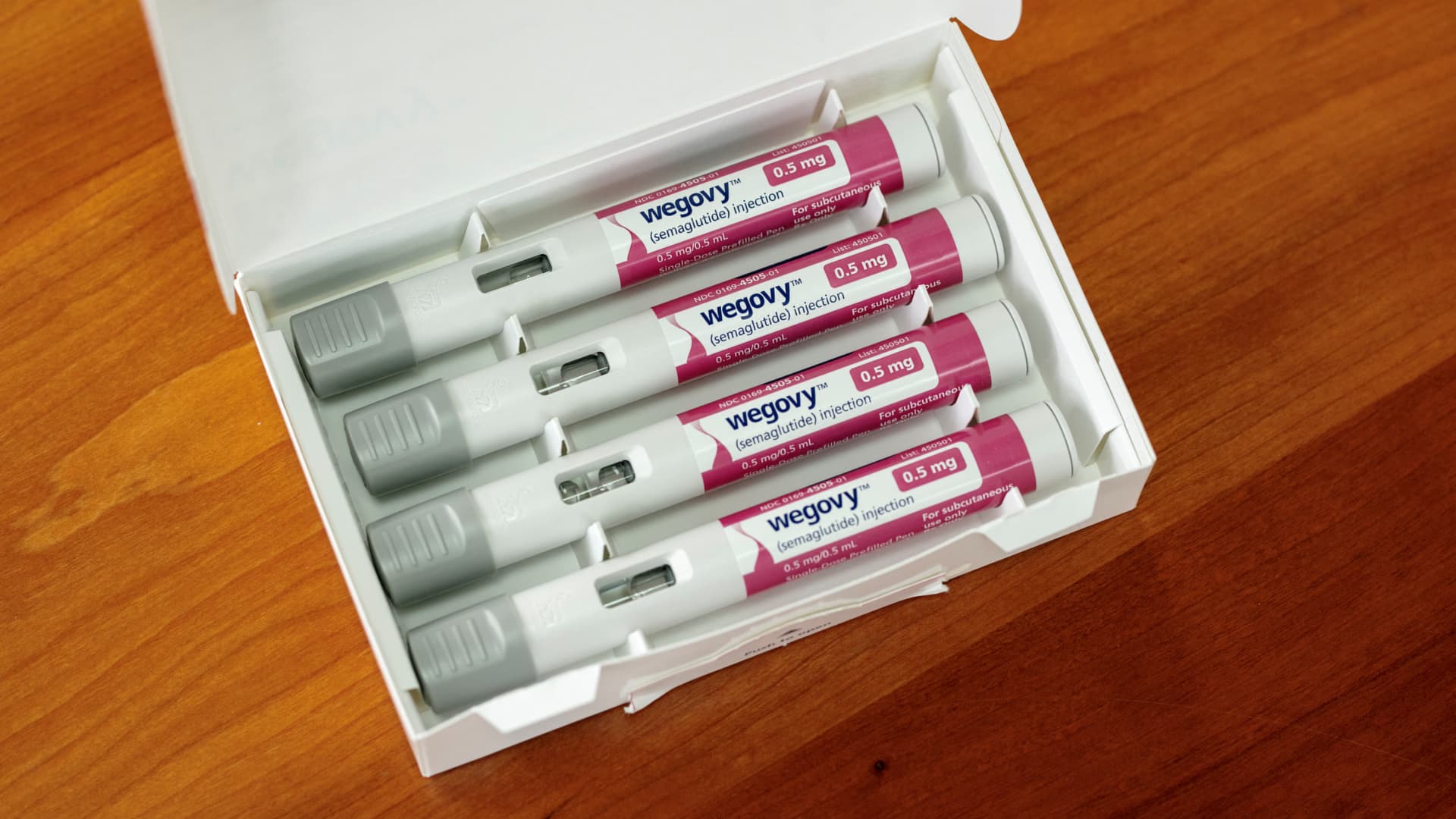
A selection of injector pens for the Wegovy weight loss drug are shown in this photo illustration in Chicago, Illinois, March 31, 2023.
Jim Vondruska | Reuters
Wegovy, the popular weight loss drug from Novo Nordisk, significantly reduced symptoms of a common type of heart failure in patients with obesity, according to a late-stage clinical trial released Friday.
Wegovy helped alleviate symptoms like shortness of breath, fatigue, swelling in the legs and irregular heart beat. It also resulted in lower blood pressure and reductions in inflammation – two important markers of heart health.
The results add to Wegovy’s growing list of potential health benefits beyond shedding unwanted pounds. That could potentially lead to expanded use of the drug and increased coverage by insurers. The results also complement the groundbreaking trial data Novo Nordisk released earlier this month, which found that Wegovy slashed the risk of serious heart-related problems by 20%.
“We look forward to working closely with the clinical community and regulators to help realise this potential over the coming months,” Martin Lange, Novo Nordisk’s head of development, said in a release. He was referring to the heart health benefits observed in both trials.
The new study on 529 obese patients focused on a heart condition known as preserved ejection fraction, or HFpEF – a condition that comprises roughly half of all heart failure cases in the U.S. and occurs when the heart’s lower chamber pumps less blood than the body needs.
An estimated 2.5 million people in the U.S. have that condition and more than 80% of those patients also have obesity.
The study, published in the New England Journal of Medicine, found that Wegovy led to a nearly 17-point improvement on a 100-point scale that’s used to assess symptoms of HFpEF.
By comparison, patients who received a placebo had a 9-point improvement.
Wegovy also led to improvements in physical limitations: Patients who took the drug were able to walk further in six minutes than those in the placebo group.
Those on Wegovy also lost about 13% of their body weight, compared with 2.6% for those on a placebo, over the course of the year-long trial.
There were fewer serious safety events in patients who took Wegovy compared with those who took the placebo. But more patients stopped taking Wegovy because of gastrointestinal issues, which are commonly observed with other weight loss drugs.
CNBC Health & Science
Read CNBC’s latest health coverage:
One limitation of the trial was its lack of diversity: 96% of the participants were white.
Wegovy and Novo Nordisk’s diabetes drug Ozempic sparked a weight loss industry gold rush last year for helping patients lose unwanted weight. They are part of a class of drugs called GLP-1 agonists, which mimic a hormone produced in the gut to suppress a person’s appetite.
But Novo Nordisk is grappling with supply constraints that have led to shortages of both drugs.
There are also recent reports of patients who had suicidal and self-harm thoughts after taking Wegovy and other weight loss drugs, which raised questions about the unintended and potentially life-threatening side effects of the treatments
The Week That Was: 2023-08-26 (August 26, 2023) Brought to You by SEPP (www.SEPP.org) The Science and Environmental Policy Project
Quote of the Week: “In plain words, Chaos was the law of nature; Order was the dream of man.”– Henry Adams
Number of the Week: 1 million tons v. 37 billion tonnes.
THIS WEEK:
By Ken Haapala, President, Science and Environmental Policy Project (SEPP)
Scope: This TWTW will focus on three topics. The first topic is why Steven Koonin who was appointed by President Obama as Chief Scientist at the Department of Energy became a climate science skeptic. In an understandable, low-key interview Koonin explains what separates him from so many who assert that science is the basis for claiming carbon dioxide (CO2) emissions are causing dangerous global warming.
The second and third topics explain problems in the General Climate Models, or General Circulation Models, for long-term projections, or forecasts. In making projections, the internal errors increase to the extent that errors dominate the projections and what is being projected, such as “global temperature,” is lost in the error. Roy Spencer explains how this occurs with the conservation of energy and mass, concepts that must be maintained in any long-term climate forecasts. However they are not maintained.
Further, Patrick Frank explains how, in making forecasts to, say 2100, the errors are so huge that the forecasts are totally engulfed with errors and become meaningless. Nevertheless, the UN Intergovernmental Panel on Climate Change (IPCC) and its followers ignore these errors, and thus make their claims scientifically meaningless.
*********************
Making of a Sceptic: Former chief scientist at the Department of Energy and former Provost at Cal Tech, Steven Koonin was interviewed by Peter Robinson, the Murdoch Distinguished Policy Fellow at the Hoover Institution. The YouTube interview provided Koonin’s illuminating journey to climate science skepticism. Much of it covered his book Unsettled: What Climate Science Tells Us, What It Doesn’t, and Why It Matters, which was covered in TWTW. However, the interview is an excellent low-key explanation of what is wrong with current climate science. Thankfully, Ron Clutz provided an excellent transcript, parts of which are cited below, in which, PR stands for Peter Robinson and SK for Steve Koonin. The transcript is unedited, thus not polished.
PR: In Unsettled you write of a 2014 workshop for the American Physical Society, which means it’s you and a bunch of other people who I cannot even begin to follow. Serious professional scientists such as you and several colleagues were asked to subject current climate science to a stress test: to push it, to prod, to test it to see how good it was. From Unsettled I’m quoting you now Steve:
“I’m a scientist; I work to understand the world through measurements and observations. I came away from the workshop not only surprised but shaken by the realization that climate science was far less mature than I had supposed.”
Let’s start with the end of that. What had you supposed?
SK: Well, I had supposed that humans were warming the globe; carbon dioxide was accumulating in the atmosphere causing all kinds of trouble, melting ice caps, warming oceans and so on. And the data didn’t support a lot of that. And the projections of what would happen in the future relied on models that were, let’s say, shaky at best.
PR: All right. Former Senator John Kerry is now President Biden’s special Envoy for climate. Let me quote from John Kerry in a 2021 address to the UN Security Council:
“Net zero emissions by 2050 or earlier is the only way that science tells us we can limit this planet’s warming to 1.5 degrees Celsius. Why is that so crucial? Because overwhelming evidence tells us that anything more will have catastrophic implications. We are Marching forward in what is tantamount to a mutual suicide pact.”
Overwhelming evidence science tells us. What’s wrong with that?
SK: Well, you should look at the actual science which I suspect that Ambassador Kerry has not done. The UN puts out assessment reports every five or six years. Those are by the IPCC the Intergovernmental Panel for Climate Change and are meant to survey, assess, and summarize the state of our knowledge about the climate. The most recent one came out about a year ago in 2022, the previous one in 2014 or so.
Those reports are massive to read; the latest one is three thousand pages, and it took 300 scientists a couple years to write. And you really need to be a scientist to understand them. I have a background in theoretical physics, I can understand this stuff. But still it took me a couple years to really understand what goes on. Now Ambassador Kerry and other politicians certainly have not done that.
Likely he’s getting his information from the summary for policy makers, or more likely for an even further boiled down version. And as you boil down the good assessment into the summary, into more condensed versions, there’s plenty of room for mischief. That Mischief is evident when you compare what comes out the end of that game of telephone with what the actual science really is.
PR: All right: what we know and what we don’t. Let’s start with what we know. I’m quoting you again Steve from Unsettled “Not everything you’ve heard about climate science is wrong.” In particular you grant in this book two of the central premises or conclusions of climate science that the Press is always telling us about. here’s one and again I’m going to quote you:
“Surely we can all agree that the globe has gotten warmer over the last several decades.”
SK: No debunking. In fact, it’s gotten warmer over the last four centuries. Now that’s a different assertion, but it’s equally supported by the assessment reports. We’ll have to come back to that because the time scale is important. It’s one thing to say this about in my own lifetime the climate of the surface of this planet, and it’s an entirely different thing to say beginning 150 years before this nation was founded temperatures began to rise.
PR: Yes, it’s a different statement but it’s equally true and has some bearing on the warming that we’ve seen over the last century. Here’s the premise that you do grant. Again I’m going to quote Unsettled.
“There is no question that our emission of greenhouse gases, in particular CO2, is exerting a warming influence on the planet. We’re pumping CO2 into the atmosphere; CO2 is a greenhouse gas it must be having some effect of course.”
Absolutely, that’s as far as you’re willing to go. But then you say so actually those are pretty two benign premises that you grant: the Earth has been warming and it’s been warming for a long time. CO2 is a greenhouse gas, and it must be having some effect. It’s coming from human activities and it’s coming from Humanity, mostly fossil fuels. Now on to what we don’t know okay again from Unsettled:
“Even though human influences could have serious consequences for the climate, they are small in relation to the climate system as a whole. That sets a very high bar for projecting the consequences of human influences.”
That is so counter to the general understanding that informs the headlines, particularly this hot summer we’ve had. So, explain that.
SK: Human influences as described in the IPCC are a one percent effect on the radiation flow–the flow of heat radiation and sunlight in the atmosphere. That means your understanding had better be at the one percent level or better if you’re going to predict how the climate system is going to respond. And the one percent makes sense because the changes in temperature we’re talking about are three degrees Kelvin, whereas the average temperature of the earth is about 300 degrees Kelvin.
PR: So human influences are a one percent effect on a complicated chaotic multi-scale system for which we have poor observations. You seem be quite relaxed about the original science
SK: The underlying science is expressed in the data and expressed in the research literature: the journals, the research papers that people produce, the conference proceedings, and so on. The IPCC takes those and assesses and summarizes them, and in general it does a pretty good job at that level. And there’s not going to be much politics in that, although they might quibble among themselves about adjectives and adverbs; “this is extremely certain”, or this is “unlikely” or “highly unlikely” and so on. But by and large it’s pretty good; this is done by fellow Professionals in a professional manner.
Now things begin to go wrong. The next step is because nobody who isn’t deeply in the field is going to read all that stuff. Therefore, there is a formal process to create a “summary for policy makers,” which is initially drafted by the governments — not by the scientists! Well, of course it’s not all of them, there’s some subcommittee to do the ‘summary for policy makers’; and that gets drafted and passed by the scientists for comment. In the end, it’s the governments who have approved the ‘summary for policy makers’ line-by-line; and that’s where the disconnect happens.
For the disconnect, I’ll give you an example: Look at the most recent report, where the ‘summary for policy makers’ is talking about deaths from extreme heat — incremental deaths — and it says that extreme heat or heat waves have contributed to ‘mortality,’ and that’s a true statement. But they forgot to tell you that the warming of the planet decreases the incidence of extreme cold events. And since nine times as many people around the globe die from extreme cold than from extreme heat, the warming from the planet has actually cut the number of deaths from extreme temperatures by a lot. That’s not in there at all!
So, the statement was completely factual, but factually incomplete in a way meant to alarm, not to inform.
And then John Kerry stands up and gives a speech. Maybe he read the SPM I don’t know, or his staff read it and probably some of their talking points. And so, you get Kerry saying that you get the Secretary General of the UN Gutierrez saying, we’re on a highway to climate hell with our foot on the accelerator. But they’re Preposterous of course, even by the IPCC reports they’re Preposterous. The climate scientists are negligent for not speaking up and saying that’s not okay.
PR: Another one of the things going wrong, you write about in a way that I have never seen anyone write about: computer models. I have never seen anybody make computer models interesting. So, congratulations Steve! You did something special as far as I know in the entire Corpus of English language.
Here I’m going to quote from a piece you published in the Wall Street Journal not long ago:
“Projections of future climate and weather events rely on models demonstrably unfit for the purpose.”
SK: Well, to make a projection of future climate you need to build this big, complicated computer model which is really one of the grand computational challenges of all time.
This is not something I wrote [about in] a textbook in the 1980s when the first PCs came out about how to do modeling on computers with physics. I do know what I’m talking about okay. And then you have to feed into the model what you think future emissions are going to be and the IPCC has five or six different scenarios, High emissions, low emissions. If you take a particular scenario and feed it into the roughly 50 different models that exist that are developed by groups around the world
So, Caltech has a model, Harvard has a model, yeah Oxford. But the Chinese have several models, the Russians and so on. When you feed the same scenario into those different models you get a range of answers. The range is as big as the change you’re trying to describe itself. And we can go into the reasons why there is that uncertainty, and in the latest generation of models about 40 percent of them were deemed to be too sensitive to be of much use.
Too sensitive meaning that when you add the carbon dioxide in, and the temperature goes up too fast compared to what we’ve seen already. So that’s really disheartening the world’s best models are trying as hard as they can, and they get it very wrong at least 40 percent of the time.
This is not only my assessment. You can look at papers published by Tim Palmer and Bjorn Stevens who are serious modelers in the consensus. And their own phrases are that these models are not fit for purpose. at least at the regional or more detailed Global level.
PR: Quoting Unsettled again, and this is one of the most astonishing passages in the book. Writing about the effects of the increases in computing power over the years:
“Having better tools and information to work with should make the models more accurate and more in line with each other. This has not happened. The spread in results among different computer models is increasing.”
This one you’re going to have to explain to me. As our modeling power, as our processing power increases, we should be closing in on reliable conclusions and yet they seem to be receding faster than we can approach them. if I got that correct that’s right how can that be
SK: Because as the models become more sophisticated that means either you made the boxes a little bit smaller in the model the grid boxes so there are more of them, or you made more sophisticated your description.
The whole globe is sort of divided into 10 million slabs really. The average size of a grid box in the current generation is 100 kilometers 60 miles okay and within that 60 miles there’s a lot that goes on that we can’t describe explicitly in the computer because clouds are maybe five kilometers big, and rain happens here and not there within the grid box we can’t describe all that.
One day we’ll be able to, but not really very soon and let me explain why. The current grid boxes are 100 kilometers so you might say well why not make them 10. well suddenly the number of boxes has gone up by a hundred okay so you need a hundred times more powerful computer but it’s worse than that because the time steps have to be smaller also because things shouldn’t move more than a grid box in one time step and so the processing power actually goes up as the cube of the grid size and so if you want to go from 100 kilometers to 10 kilometers that’s a factor of 10. the processing power required goes up by a factor of a thousand and it’s going to be a long time before we get a computer that’s a thousand times more powerful than what we have.”
The interview continues with Koonin using parts of the core of the Science section (Working Group I) of the IPCC Sixth Assessment Report to refute many recent claims concerning climate change. The interview concludes with:
“PR: According to a Harris poll in January 2022 a little over a year and a half ago now 84% of teenagers in the United States agree with both of the two following statements. they agree with:
♦ Climate change will impact everyone in my generation through Global political instability.
♦ If we don’t address climate change today it will be too late for future Generations making some parts of the planet unlivable.
John Kerry, Al Gore, Greta Thunberg and on and on, and countless voices warning that climate change represents a genuine danger to life on the planet. And now millions of Young Americans are really scared. Surely this has some role to play in what we see the suicidal ideation and the increasing unhappiness.
SK: I’m sure there are all kinds of social factors but surely this is part of what’s going on. There are two immoralities here. One is the immoral treatment of the developing World which we talked about. The other immorality is scaring the bejesus out of the younger generation. And it’s doubly dangerous because it’s mostly in the west and not in China or India. I’ve tried. I go out and talk in universities and of course the audiences I talk to tend to be quantitative and factually driven. So, the minds get opened up if the eyes get opened up.
I think in the US the problem will eventually solve itself because the route we are headed down is starting to impact people’s daily lives. Electricity is getting more expensive, [and] you won’t be able to buy an internal combustion car in 10 or 15 years. If you’re here in California, people are going to say wait a second, as they already are in Europe, in UK, Germany, France. And I think there will be a falling down to Earth of all of this at some point and we will get more sensible.
PR: Let’s say your audience now is not a colleague of yours but is an 18- to 24-year-old American pretty bright, maybe in college maybe not, but bright. Reads newspapers or at least reads them online. Speaking to that person an American kid or young adult: Do they need to be scared?
SK: No absolutely not. I would quote that 1900 to now [plant life] flourishing as an example. And I would say, you probably believe that hurricanes are getting worse, and then point them to the IPCC line. And say you know you were misinformed about that by the media, don’t you think that there are other things about which you’ve been misinformed. You can read the book and find out many of them, and then go ask your climate friends how come it says one thing in the IPCC report but you’re telling me something else.”
In his transcript, Ron Clutz provides many useful graphs and cartoons. The interview is an exceptional resource for intelligent young people without technical backgrounds. See links under Challenging the Orthodoxy, Defending the Orthodoxy, and several TWTWs from April to June 2021.
*********************
Error Over Time: One of the major problems in long-term models is that errors propagate, that is they spread. Multiple errors do not diminish or cancel each other out, as many climate advocates seem to believe. In his post “Climate models do not conserve mass or energy,” Roy Spencer states it well:
One of the most fundamental requirements of any physics-based model of climate change is that it must conserve mass and energy. This is partly why I (along with Danny Braswell and John Christy) have been using simple 1-dimensional climate models that have simplified calculations and where conservation is not a problem.
Changes in the global energy budget associated with increasing atmospheric CO2 are small, roughly 1% of the average radiative energy fluxes in and out of the climate system. So, you would think that climate models are sufficiently carefully constructed so that, without any global radiative energy imbalance imposed on them (no “external forcing”), that they would not produce any temperature change.
It turns out, this isn’t true.
Back in 2014 our 1D model paper showed evidence that CMIP3 models don’t conserve energy, as evidenced by the wide range of deep-ocean warming (and even cooling) that occurred in those models despite the imposed positive energy imbalance the models were forced with to mimic the effects of increasing atmospheric CO2.
Now, I just stumbled upon a paper from 2021 (Irving et al., “A Mass and Energy Conservation Analysis of Drift in the CMIP6 Ensemble)” which describes significant problems in the latest (CMIP5 and CMIP6) models regarding not only energy conservation in the ocean but also at the top-of-atmosphere (TOA, thus affecting global warming rates) and even the water vapor budget of the atmosphere (which represents the largest component of the global greenhouse effect).
These represent potentially serious problems when it comes to our reliance on climate models to guide energy policy. It boggles my mind that conservation of mass and energy were not requirements of all models before their results were released decades ago. [Boldface in original]
One possible source of problems are the model “numerics” … the mathematical formulas (often “finite-difference” formulas) used to compute changes in all quantities between grid points in the horizontal, levels in the vertical, and from one time step to the next. Miniscule errors in these calculations can accumulate over time, especially if physically impossible negative mass values are set to zero, causing “leakage” of mass. We don’t worry about such things in weather forecast models that are run for only days or weeks. But climate models are run for decades or hundreds of years of model time, and tiny errors (if they don’t average out to zero) can accumulate over time.
The paper Spencer refers to is titled “A Mass and Energy Conservation Analysis of Drift in the CMIP6 Ensemble.” The abstract begins with:
“Coupled climate models are prone to ‘drift’ (long-term unforced trends in state variables) due to incomplete spin up and nonclosure of the global mass and energy budgets. Here we assess model drift and the associated conservation of energy, mass, and salt in CMIP6 and CMIP5 models. For most models, drift in globally integrated ocean mass and heat content represents a small but nonnegligible fraction of recent historical trends, while drift in atmospheric water vapor is negligible. Model drift tends to be much larger in time-integrated ocean heat and freshwater flux, net top-of-the-atmosphere radiation (netTOA) and moisture flux into the atmosphere (evaporation minus precipitation), indicating a substantial leakage of mass and energy in the simulated climate system. Most models are able to achieve approximate energy budget closure after drift is removed, but ocean mass budget closure eludes a number of models even after dedrifting and none achieve closure of the atmospheric moisture budget.”
Western governments are making energy policy decisions based on long-term results from global climate models that have increasing internal error over time. Spencer has a more complete explanation of the problem. See links under Challenging the Orthodoxy.
*********************
Propagation of Error: The July 1 TWTW discussed a simplified version of a recent article by Patrick Frank in Sensors explaining problems involved in using General Climate Models in making long-term forecasts of temperature and other climate features. As noted by Kenneth Richards of the blog, No Tricks Zone, some climate advocates objected, and Frank demolished them. Now we have a clear low-key interview of Frank by Tom Nelson and the slides that Frank used are available. Some of the key points raised by Frank are: [any errors are from TWTW]
“Uncertainty of the thermal content of the atmosphere is many time greater than the ‘forcing.’ You cannot make predictions. You cannot tell what the forcing is doing to climate. In AR6, the uncertainty of thermal content is 83 times the [predicted] greenhouse forcing.
What is the error of forcing in the thermal uncertainty. The models propagate the model error, resulting in an enormous uncertainty. In CMIP6, by 2100 the uncertainty bar is 16 C. So large, we have no idea what the temp will be. Models have no physical meaning at all. All projections are lost in the uncertainty of the models. Emulates the modeled climate. [This is shown in Slide # 4 of the slides, “The Projections are Physically Meaningless, The Information Content is Zero.”]
Climate sensitivity emerges from how the models are constructed. All are tuned to reproduce the 20th century trends. Once they go beyond that, they spray out. [This is one procedure that upset Koonin in the 2014 conference cited above. The modelers do not adhere to the changes they made to reproduce 20th century trends.]
These are anomalies, changes in temperature, not actual temperature. No one knows what the errors are.
Problem of modeling the climate, either leap to the theory and then model it. But the Theory is lacking. There is no theory of clouds. The whole hydrology cycle, including phase change, has not been described in physics.
Most of energy is held in oceans, so oceans control climate. Oceans are modeled as the thermohaline currents. We cannot measure the current, it cannot be measured. Ocean current problems are not being studied; thus, climate energy state cannot be solved. No research effort to understand the climate, just add computers to get the wrong answers faster. Models cannot re-produce the climate; great computers produce convincing nonsense.
Climate is a bunch of oscillating patterns beating against each other swapping energy. Big changes in climate without forcings. We cannot see what clouds do with precision.
Younger Drays cannot be explained. DO [Dansgaard-Oeschger] Events are not explained. Up 10 C in a century, then slowly down. Why? They dwarf what is going on now. We live in a stable climate.
Everything going on now can be natural.”
Frank then goes into the problems of the surface-air temperatures used by the IPCC which was discussed previously. His concluding slide states:
“What We Know About Future and Measured Global Average Surface Air Temperature
• About future global surface air temperature: Nothing.
• About Climate models:
• cannot simulate present air temperature.
• cannot predict future air temperature.
• cannot resolve the effect of GHG emissions.
• cannot detect, attribute or project the impact, if any, of human fossil fuel emissions.
• About measured global surface air temperature: A little.
• The climate has probably warmed since 1900.
• The rate of warming is unknown.
• The magnitude of warming is unknown.
• No evidence of any unprecedented change.
• Not discussed: prior to 1900, the entire surface air temperature record is unreliable.
CO2 climatology lives on false precision.
CO2 climatologists are not trained to evaluate the reliability of their own models and data.
The UN IPCC claim of human-caused climate change has no basis in science.
Colloquially: The UN IPCC and the CO2 climatologists don’t know what they’re talking about.
There is no climate crisis in evidence.”
Interestingly, at the end Frank cites a 2003 paper by Willie Soon and Sallie Baliunas. “Proxy climatic and environmental changes of the past 1000 years” for prompting him to study the problem, rather than accept the IPCC claims. Unfortunately, Baliunas was overcome by the bitter criticism by IPCC supporters and withdrew from the controversy. Willie Soon still soldiers on. See links under Challenging the Orthodoxy.
*********************
Number of the Week: 1 million tons v. 37 billion tonnes. An article on carbon dioxide removal in the Wall Street Journal highlighted how Washington is using the Infrastructure Act in fighting inflation. Key parts stated:
If funded and completed, the two carbon-removal hubs would remove roughly 1 million metric tons of carbon dioxide from the atmosphere annually and store it underground.
“The Energy Department is also trying to spur a feasible business model for the industry by pledging to pay $35 million for carbon that the companies remove from the air. These are the same type of carbon-credit purchases that Microsoft and JPMorgan Chase have made recently to kick-start the industry. That funding also isn’t limited to direct-air capture, potentially boosting other promising approaches.”
Direct-air capture will have a crucial role in helping the world reach its climate goals, [Occidental Chief Executive Vicki] Hollub said in a written statement, adding that her company’s selection shows that it has the technology and project expertise to neutralize carbon emissions.
The carbon-removal hubs were funded in the 2021 infrastructure law. The companies have to contribute funds equivalent to the government grants and would be responsible for any cost overruns. The Energy Department will soon award billions of dollars for hydrogen hubs using more infrastructure-law funding, another step to jump-start a critical climate sector.
Carbon removal has become increasingly popular for businesses because it provides certainty that companies are helping the climate, though many consumers remain hesitant.
“’There’s no illusion that the taxpayers rose as one and asked for a direct-air capture program,’ said the Energy Department’s [David] Crane,” [undersecretary for infrastructure].
In 2021, China alone produced about 11.5 billion [metric] tonnes while the world produced 37.1 billion tonnes. Assuming the program is successful, if it costs Washington $35 million to spur companies to remove one million US tons, and one metric tonne is 1.1 US tons, how much will it cost to remove 40,700 times that? Should the US public pay for it? See link under Carbon Schemes, Article # 3, and https://ourworldindata.org/co2-emissions
Commentary: Is the Sun Rising?
New Scientist: How worried should we be about climate change?
By David Whitehouse, Net Zero Watch, Aug 23, 2023
“Unsurprisingly, important data and factors are omitted from the article. Nowhere does it mention observations that show that more heat from the Sun is being retained. There has been an increase of 0.3 W/m2 since 2019 as the Sun surges to its current solar maximum.”
Climategate Continued
How Science is Done These Days
By Tony Thomas, Quadrant Online, Aug 22, 2023
Censorship
Stuff you’re not allowed to know #1: Hurricanes
By John Robeson, Climate Discussion Nexus, Aug 23, 2023
Challenging the Orthodoxy — NIPCC
Climate Change Reconsidered II: Physical Science
Idso, Carter, and Singer, Lead Authors/Editors, Nongovernmental International Panel on Climate Change (NIPCC), 2013
From Editor’s summary: “The authors argue that this increase in fire may have resulted from climate change–induced warming and drying in conjunction with increasing impacts of humans in the system. —Sacha Vignieri”
[SEPP Comment: So, human activity ended the Ice Age?]
Questioning the Orthodoxy
As the Earth boils
By John Robeson, Climate Discussion Nexus, Aug 23, 2023
“But it’s not a conspiracy or a scam. These manipulations are happening, and being shared credulously, because activist scientists and activist journalists are sure what they purport to show is real, not because they’re sure it’s not. And it’s a lot more subtle than switching back from metric to the supposedly absurd Fahrenheit in order to get from two to three digits, which is also going on.”
[SEPP Comment: Speculating when imaginary “tipping points” will occur is like speculating how far from land can a ship sail before falling off the edge of the earth.]
1.5 Degrees Of Climate Fabrication
By I & I Editorial Board, Aug 24, 2023
“The rock-solid, undeniable fact is that it’s impossible to make long-term climate predictions, because our climate is ever changing and volatile. It says so in the Third Assessment Report from the U.N.’s Intergovernmental Panel on Climate Change:
“’The climate system is a coupled non-linear chaotic system, and therefore the long-term prediction of future climate states is not possible.’”
German Scientists: Global Warming A “Corrupt”, Fear-Mongering Scheme “Headed By Super-Rich”
By P Gosselin, No Tricks Zone, Aug 23, 2023
“German Profs. Dr. Klaus-Dieter Döhler, a natural scientist and environmentalist, and Josef Kowatsch, a nature conservationist, have published an essay at EIKE alleging ‘scientific corruption and waste of taxes’ Germany in the corrupt business model that is ‘climate science.’”
Manufactured Climate Consensus Deemed False By Climate Scientist – ‘The Time For Debate Has Ended’
From Poverty to Moon Landing: How Coal Propelled Indian Economy
By Vijay Jayaraj, CO2 Coalition, Aug 23, 2023
“During the fiscal year ending March 2022, coal-generated electricity accounted for 72% of all electricity consumed by the country’s 1.3 billion people. In 2022-2023, this rose to 73%.”
[SEPP Comment: Percent of population with access to electricity from about 50% in 1995 to 99% today, largely thanks to coal.]
Iran, Saudi Arabia, UEA and other invited to join BRICS group
By Paul Homewood, Not a Lot of People Know That, Aug 25, 2023
Science, Policy, and Evidence
Devastating wildfires caught Hawaii underprepared for ‘preventable disaster’
“’Over the last few years, the wildfire risk there has increased more quickly than then our ability to raise awareness throughout the population,’ wildland fire consultant Pat Durland, who is also a board member Hawaiʻi Wildfire Management Organization, told The Hill.”
Reproduced by Ron Clutz: https://rclutz.com/2023/08/24/why-climate-models-cant-be-right/
“I quickly realized that the goal of the project, to forecast accurately the temperature long-term, was impossible because small errors in data inputs could result in huge forecasts errors. Equally important was that errors compounded so quickly that it caused the error ranges to explode.”
Measurement Issues — Surface
4 More Temperature Reconstructions Fail To Support The ‘Unprecedented’ Global Warming Narrative
By Kenneth Richard, No Tricks Zone, Aug 21, 2023
Link to one paper: Temperature variability over Dokriani glacier region, Western Himalaya, India
By Tanupriya Rastogi, et al., Affiliated with Wadia Institute of Himalayan Geology, Quaternary International, June 2023
“The 21-year running mean of the temperature record showed 1978–1998 CE as the coldest period followed by 1925–1945 CE, and 1890–1910 CE as the warmest period followed by 1946–1966 CE over the entire time series.”
Changing Weather
Heat Of 1936 vs. 2023
By Tony Heller, His Blog, Aug 23, 2023
Changing Climate
On the origin of extreme climatic events
By John Robeson, Climate Discussion Nexus, Aug 23, 2023
From the CO2Science archive:
Changing Cryosphere – Land / Sea Ice
Arctic “Amplification” Not What You Think
By Ron Clutz, Science Matters, Aug 19, 2023
Climate Emergency At The Poles
By Tony Heller, His Blog, Aug 23, 2023
Million Year Decades
By Tony Heller, His Blog, Aug 24, 2023
Text: https://realclimatescience.com/
[SEPP Comment: Video exposing absurd long-term extrapolation about Antarctic ice.]
Changing Earth
So about that underwater volcano
By John Robeson, Climate Discussion Nexus, Aug 23, 2023
Lowering Standards
Fact Checking The Met Office’s Fact Checks
By Paul Homewood, Not a Lot of People Know That, Aug 25, 2023
“This particular sentence sums up the Met Office’s motivation:
“’There are certain areas that are regularly questioned and unfortunately some of this scepticism can deflect attention away from important issues such as the need to reduce greenhouse gas emissions’.
“What they are in effect saying is that, in their minds, climate change is too important a topic to allow inconvenient facts to get in the way.”
Betty–The Storm That Never Was
By Paul Homewood, Not a Lot of People Know That, Aug 20, 2023
“But Gentle Breeze Betty does not have quite the same ring to it!”
Communicating Better to the Public – Use Yellow (Green) Journalism?
Bloomberg’s Wildfire Denial
By Paul Homewood, Not a Lot of People Know That, Aug 25, 2023
Hawildfires
By John Robeson, Climate Discussion Nexus, Aug 23, 2023
“In the old days we’d say the connections were ‘unknown’, now they’re ‘yet to be determined’ and, for good measure, ‘likely to increase’. As in verdict first, trial after. And if they go down instead, they’ll find a way to pin that on CO2 too.”
L A Times Hypes “Green China” the World’s Champ of Global Coal Use & CO2 Emissions While Demanding U.S. Declare a “Climate Emergency”
By Larry Hamlin, WUWT, Aug 23, 2023
So about that heat
By John Robeson, Climate Discussion Nexus, Aug 23, 2023
“Even the once-sober Times hollered in an email that ‘Charon ‘heat storm’ continues to sweep across southern Europe, sparking power cuts and threatening record high temperatures’. One day you’re naming heatwaves. The next you’re renaming them ‘heat storms.’”
Hurricane Hilary Unprecedented? The BBC Would Like You To Think So
By Paul Homewood, Not a Lot of People Know That, Aug 21, 2023
[SEPP Comment: Unprecedented ignorance of weather history.]
Communicating Better to the Public – Make things up.
Climate change doubled chances of conditions that fueled record wildfire season in Canada: research
Over 300 “low emission” surveillance cameras stolen or damaged in London since April
By Jo Nova, Her Blog, Aug 19, 2023
Sales of old fossil cars are booming in Ultra Low Emission London…
By Jo Nova, Her Blog, Aug 25, 2023
“The much hated Ultra Low Emission Zone (ULEZ) starts on August 29th and people driving petrol cars older than 2006 or diesel cars from before 2015 are likely to end up paying £12.50 every day just to drive in London. Vintage cars older than 40 years are exempt.”
“To be fair, these figures reflect little if any of the massive subsidies brought forth by the big federal green energy bill (“Inflation Reduction Act” [sic]), which was signed a year ago on August 16, 2022, and is just getting cranked up. Will those subsidies move this needle at all? You would think that they couldn’t help moving the needle at least a little. But my own prediction is that the percent of primary energy from fossil fuels will decrease only minimally.”
Carnage of Child Labor and Ecological Destruction “Elsewhere” acceptable to Wealthy Countries
By Ron Stein, The Heartland Institute, Aug 19, 2023
“Green Breakdown: The Coming Renewable Energy Failure”
By Steve Goreham, Master Resource, Aug 22, 2023
Green Jobs
A planlike object
By John Robeson, Climate Discussion Nexus, Aug 23, 2023
Link to plan (dream): Clean Electricity Regulations
Clean, affordable and reliable electricity
By Staff, Environment and natural resources, Government of Canada, Accessed Aug 23, 2023
“A sample from Fresno, for example, saw 16 parts per trillion of PFOA and 29 parts per trillion of PFOS — 4 and 7.25 times the proposed regulatory level from the EPA.”
Plant-based straws touted as eco-friendly may contain toxic ‘forever chemicals’
Link to paper: Assessment of poly- and perfluoroalkyl substances (PFAS) in commercially available drinking straws using targeted and suspect screening approaches
By Pauline Boisacqa, et al., Food Additives & Contaminants, Aug 24, 2023
“PFAS were detected in almost all paper-based straws, with highly variable concentrations between brands, ranging from < LOQ to 7.15 ng/g.”
“In bamboo straws, PFAS were detected in the range < LOQ to 3.47 ng/g in four out of five brands. In glass straws two brands showed concentrations above the LOQ, ranging from < LOQ to 6.65 ng/g, while the concentrations for the other brands were found to be below the LOQ.”
“Limits of Quantification (LOQs”
[SEPP Comment: A nanogram (ng) is one-billionth of a gram. Imagine how lethal chopsticks must be and how many millions of Chinese die from using them!]
Ceiling fan efficiency rule draws ire of House Republicans
“According to the Energy Department, the rule as applied to standard residential ceiling fans would cut fan-related electricity costs by about 40 percent relative to the least efficient fans currently available.”
[SEPP Comment: Rather than focus on providing reliable energy from an alternative to fossil fuels, Washington energy “experts” are regulating energy use by consumer products.]
[SEPP Comment: DOE banning of incandescent light bulbs and the Boston mayor banning new construction on public buildings using fossil fuels are examples of petty despotism.]
Energy Issues – Australia
Aussie Government Intergenerational Report 2023: We’ll All Live Longer and Be Richer in the Age of Climate Crisis
By Eric Worrall, WUWT, Aug 24, 2023
Suddenly Australia needs $1.5 Trillion dollars on Energy “Moonshot” quest for global weather control
By Jo Nova, Her Blog, Aug 22, 2023
Expert “Everyone knows Australia will miss” the NetZero target — only 4 renewables projects approved in last Quarter
By Jo Nova, Her Blog, Aug 24, 2023
Energy Issues — US
Alleged Climate Activism Among Energy Commissioners Spurs Court Order and Congressional Inquiries
By Kevin Mooney, Real Clear Energy, August 21, 2023
“President Biden admitted it: The Inflation Reduction Act (IRA) has little to do with inflation. ‘It has less to do with reducing inflation than it does providing for alternatives that generate economic growth,’ Biden said last week, as his Administration prepared to mark the one-year anniversary of the landmark spending bill.”
Biden’s Multi-Billion Dollar Carbon Capture Gamble
By Charles Rotter, WUWT, Aug 20, 2023
“Energy Secretary Jennifer Granholm describes the technology as “’essentially a giant vacuum that can suck decades of old carbon pollution straight out of the sky.’”
California Dreaming
Net Zero In California
By Tony Heller, His Blog, Aug 23, 2023
California Tried but Failed to Have an Extreme Weather Disaster
By Kip Hansen, WUWT, Aug 22, 2023
Supernatural Warnings Come to California
By Duggan Flanakin, Real Clear Energy, Aug 24, 2023
A Return to the Age of Sailing Ships: Nostalgia or Nonsense?
About the BBC article “Pioneering wind-powered cargo ship sets sail” by Tom Singleton.
By Charles Rotter, WUWT, Aug 22, 2023
NASA’s running a mental ward?! Kimberley Miner: ‘I’m a NASA climate scientist. Here’s how I’m handling climate grief’ – ‘I already have five scientist friends with severe, emergent health challenges’
By Marc Morano, Climate Depot, Aug 17, 2023
Link to paper: I’m a climate scientist. Here’s how I’m handling climate grief
Researchers must find personal ways to cope with impending losses — one way is by taking small solutions-oriented actions, says Kimberley R. Miner.
Canada’s oil-rich province of Alberta has become the latest jurisdiction to push back against renewable-energy initiatives, declaring a seven-month moratorium on new wind and solar projects.
The pause put in place by the province’s conservative government has provoked criticism from members of the renewables industry, which says the move threatens to undermine a fast-growing sector that has been contributing a growing share of energy to Alberta’s power grid.
Alberta, which is home to Canada’s oil sands, the fourth-largest oil reserve in the world, announced earlier this month that it would pause until Feb. 29, 2024, approvals of any renewable-energy projects that produce over 1 megawatt of power. Alberta wants to study how the projects affect the power grid, their impact on the environment and what the government called “Alberta’s pristine viewscapes.” The government also wants to consider end-of-life rules for solar farms and windmill projects.
The action has effectively put at risk 80 projects worth roughly $15 billion, said Vittoria Bellissimo, president and chief executive of the Canadian Renewable Energy Association, an industry group.
“We are concerned and disappointed,” she said. More than 75% of all renewable projects built in Canada last year were in Alberta, adding about 1,391 megawatts of power to the provincial grid, she said.
Alberta’s actions complicate a broader push by Canadian Prime Minister Justin Trudeau’s government to lower carbon emissions from Canada’s electricity grid. The government in Alberta has called draft regulations from Ottawa that would require the Canadian electricity grid to be carbon-neutral by 2035 unconstitutional.
The confrontation is the latest spat between Trudeau’s Liberal government and Alberta’s conservative leadership, which has sparred with Ottawa on energy policy and Covid vaccine mandates.
Alberta’s move mirrors efforts in the U.S. Renewable projects in states such as Kansas and Iowa have encountered resistance from local municipalities and state governments, which have cited the effect of solar and wind farm projects on small communities.
The article concludes with other politicians claiming that oil rich Alberta is missing a huge economic opportunity by ignoring government subsidies for wind and solar.
******************
2. Industrial Policy Follies: Solar-Power Edition
The contradictions of subsidies and tariffs pile up, as taxpayers lose.
“Bidenomics is fast becoming a study in the contortions of industrial policy. Consider the Commerce Department’s decision late last week to slap tariffs on solar imports from Southeast Asia, raising the costs of U.S. solar-energy projects that the White House says are the vital future of U.S. energy.
After a 17-month investigation, Commerce concluded that five Chinese solar manufacturers were circumventing U.S. anti-dumping tariffs by doing minor assembly of solar components in Vietnam, Thailand and Cambodia for export. The costs for U.S. solar-power developers will rise with the new tariffs, which will run as high as 254%.”
The article discusses how the solar industry is objecting to these tariffs and concludes:
“The solar follies reveal the contradictions of the Biden Administration’s industrial policy. Its labor, climate and anti-China agendas conflict in their combination of subsidies, mandates, bans and taxes. Subsidies lead to tariffs, which lead to more subsidies as government becomes the allocator of capital and decides which companies win or lose. The biggest losers, as usual, will be American taxpayers.”
******************
3. How Oil and Tech Giants Came to Rule a Vital Climate Industry
Generous government support helps carbon removal play a crucial role in neutralizing emissions
SZA has finally unveiled the music video for “Snooze,” and the beloved bop’s visuals feature Justin Bieber as one of the R&B singer’s love interests!
RELATED: SZA Declares ‘Industry Pressure’ Did NOT Influence Her Decision To Get Plastic Surgery
Justin Bieber Starred As One Of SZA’s “Snooze” Boy Toys
The official “Snooze” music video premiered on Friday (Aug. 25).
The stunning visuals showed SZA’s character galivanting through various scenes with different love interests, including one portrayed by Justin Bieber.
Along with a couple of other recurring men, the video included a scene of SZA’s character cozying up to a robot wearing a backward baseball cap.
In typical SZA fashion, the ending of the music video featured an unreleased track, giving fans a lil’ something extra to cherish and look forward to.
Fans React To The SZA–Justin Bieber Crossover: “Hailey Beiber Stronger Than Me”
Once fans got a peek at the music video for “Snooze,” they went NUTS over SZA and Justin Bieber, appearing side by side.
JUSTIN BIEBER X SZA IS IMMINENT pic.twitter.com/WaG4H9AGFa
— c 🍓 (@doin2much_) August 25, 2023
JUSTIN AND SZA????? WHAT pic.twitter.com/U7SJphWQLE
— s. (@beliebinteam) August 25, 2023
JUSTIN BIEBER AND SZA OMG HELLO??????? pic.twitter.com/jLUpuvZH7C
— Valentina (@vvaalb) August 25, 2023
Humorously, one fan exclaimed, “WHY ARE JUSTIN AND SZA FULL ON F**KIN IN SNOOZE OMG ?!!”
WHY ARE JUSTIN AND SZA FULL ON F*CKIN IN SNOOZE OMG ?!! pic.twitter.com/i9gJLGGLGC
— noah (@inmabloodline) August 25, 2023
Another user suggested that the beloved celebs should’ve taken things a step further in the music video.
Justin and Sza should’ve kissed idc
— ᴹᴵᴹᴵ’ˢ ☈ᴱᴵᴳᴺ ᵂᴼᴺᵀ ᴸᴱ☥ ᵁᴾ (@TheMimiReign) August 25, 2023
As a result of how people were here for the SZA’s Justin Bieber cameo, some proceeded to bring Hailey Bieber into the conversation. Oop!
hold on SZA & Justin Bieber ??? Hailey Bieber stronger than me
— Mavsss (@maveli555) August 25, 2023
sza and justin lookin a lil TEW good together in that video sawree hailey… pic.twitter.com/1mslDF8XDO
hailey bieber is so strong ! 😭🤚🏼 i would’ve been crying and throwing up seeing how good my man looked with sza
— nubia (@itgirlnubia) August 25, 2023
Hailey bieber somewhere shaking in her boots cause I know JB wanted to touch sza booty
— rebecca (@bbexyyy) August 25, 2023
Monica & The Game Also Got People Chirpin’ With Their Recent Production: “Momma At Work!”
While on the subject of celebrities sparking some chatter by way of a steamy cameo, we have to mention Monica and The Game.
As The Shade Room reported, Monica shared some promo back in late June for a single called “Letters.” She specifically uploaded a clip from the song’s music video, which featured Monica and The Game posing in a bathtub.
This sparked TONS of chatter, but the most memorable comment came from Romelo Hill, Monica’s 15-year-old son. He remarked, “Yo what is this?”
In turn, Monica laughingly remarked, “It’s like a movie!! Momma at work!”
RELATED: Welcome To The Good Life: Recalling Noteworthy Kanye West Music Videos Over The Years
Ten milligram tablets of the hyperactivity drug, Adderall, made by Shire Plc.
Jb Reed | Bloomberg | Getty Images
It’s been 10 months since the Food and Drug Administration first announced a nationwide shortage of Adderall — one of the most widely used medications for attention deficit hyperactivity disorder — and the supply strain could potentially worsen in the months ahead.
While some supply issues have improved, many Americans are still struggling to find and fill prescriptions for the drug and other medications for ADHD that they often rely on to stay focused and complete daily tasks.
Drug-shortage experts told CNBC that it’s extremely difficult to forecast how much longer the shortages will last because of the lack of transparency in the pharmaceutical industry — and some are concerned about market conditions as children, who are commonly affected by ADHD, head back to school.
“Unfortunately, we might see the shortage worsen. We are heading into back-to-school time, so I am worried about it worsening as we go into that season,” Erin Fox, a pharmacist at the University of Utah and leading expert on U.S. drug shortages, told CNBC.
Adderall is one of more than 300 drugs in short supply in the U.S. as of June, according to a list from the American Society of Health-System Pharmacists, which represents pharmacists in a variety of health-care settings. That list also includes Adderall alternatives like methylphenidate, which is commonly known under the brand names Ritalin or Concerta.
Adderall and alternative ADHD medications apart from other drugs are Schedule 2 controlled substances.
That means the federal government regulates how those drugs are made, prescribed and dispensed because they’ve been deemed to have a high potential for abuse and could potentially lead to severe psychological or physical dependence. The designation also means that patients need to get new prescriptions for those drugs every one to three months.
Millions of Americans in the U.S. use the drugs to help them concentrate, control their impulses and manage their schoolwork, employment or relationships with others. ADHD is usually diagnosed in childhood and often lasts into adulthood.
An estimated 6 million children have been diagnosed with ADHD, and 60% were being treated with medication as of 2016, according to the Centers for Disease Control and Prevention. Meanwhile, around 8 million adults have been diagnosed with the condition, but only about a quarter of that number are getting treatment for it.
Back-to-school supply strain
Many children and young adults with ADHD often take the summer off medication and primarily rely on it during the school year. That could lead to even more demand in the months ahead that may not be met.
Historically, prescriptions for ADHD medications increase as the school semester starts around the U.S. — and “there is no indication this year will be different,” according to David Margraf, a pharmaceutical research scientist at the University of Minnesota’s Center for Infectious Disease Research and Policy.
Some drugmakers have said they expect to resupply a few ADHD products in August or September, according to an FDA database on shortages. But Margraf said “we need to be cautiously optimistic” because drugmakers don’t disclose exact numbers of how much stock they’ll have available by then.
30mg tablets of Shire Plc’s Adderall XR.
Jb Reed | Bloomberg | Getty Images
That reflects a bigger issue with the ongoing shortages. It’s nearly impossible to know when they will end — or what exactly can be done to resolve them — because of the lack of transparency in the pharmaceutical industry.
“Very little factual information is out there. I think this is one of the biggest issues,” says Ozlem Ergun, a mechanical- and industrial-engineering professor at Northeastern University and an expert in pharmaceutical supply chains. “When you don’t have transparency or information sharing, how can you understand and resolve a problem that is complex?”
“This really, really hurts the users and the hospitals and the health-care system. They have pretty much no vision of what the future looks like,” Ergun added.
Teva Pharmaceuticals, Amneal Pharmaceuticals, Novartis’s planned spinoff Sandoz and Purdue Pharma subsidiary Rhodes Pharmaceuticals, which all manufacture drugs targeting ADHD, don’t need to publicly share information about where they manufacture medications, how much of them they make, where ingredients are sourced and their overall production capacities.
And the Drug Enforcement Administration — the federal agency that regulates controlled substances — shares little information about the production quotas it sets for each manufacturer of Adderall and other ADHD medications.
The DEA specifically limits the amount of raw ingredients, such as amphetamine, a drugmaker can get to manufacture those drugs.
“We don’t have the quota amount that each company is given. And we also don’t have the amount that each company is actually producing and if they’re meeting those quotas,” said Fox of the University of Utah. “There’s no way to understand which company maybe isn’t doing the job and which companies are, so we just don’t know exactly what’s going on.”
Production limitations
Ending the shortages of Adderall and other ADHD medications is no easy task.
“It’s not as simple as a free market where you just boost up production and meet demand,” said Michael Ganio, the senior director of pharmacy practice at the American Society of Health-System Pharmacists.
Many manufacturing plants operate at or near capacity and create multiple drug products. That means increasing the production of one drug could potentially require reducing production — and potentially impacting supply — of another drug, according to Ergun.
“In general, it is difficult to increase the manufacturing capacity for a drug,” she said. “There isn’t much unutilized capacity anywhere.”
It’s even harder to scale up the production of tightly controlled ADHD medications.
Drugmakers can request for the DEA to increase their production quotas if necessary, but it takes “a lot of push” for the agency to actually approve that, according to Margraf.
And even if the DEA does approve a quote change, it could take months to do so: “It’s not just flipping a switch and boosting your output by 20%,” ASHP’s Ganio said.
Members of the Drug Enforcement Administration raided two homes side-by-side, in an assumed illegal marijuana operation, on January 31, 2019 in Commerce City, Colorado.
RJ Sangosti | MediaNews Group | The Denver Post via Getty Images
Some drugmakers have suggested that DEA quotas are contributing to the ADHD medication shortages or making it harder to alleviate them. That includes Aytu BioPharma, which makes an ADHD drug that used to be in shortage.
In a CNBC op-ed in February, Aytu CEO Josh Disbrow said the DEA could potentially cause widespread drug shortages if it underestimates demand and fails to increase quotas in a “timely manner in response to new information.”
However, the DEA and FDA pointed to a different problem in a joint letter released earlier this month.
The agencies said an internal analysis found that drugmakers fell 30% short of meeting the full quota for amphetamine medications in 2022, leaving about 1 billion potential drug doses on the table. They added that there’s a “similar trend” occurring this year.
The DEA and FDA said they called on manufacturers to confirm they are working to increase production to meet their allotted quotas.
“There’s obviously a lot of finger-pointing going on here between the agencies and manufacturers,” Fox said.
Surging demand for Adderall
The shortages of Adderall and generic versions of the drug kicked off last August, when major manufacturers reported that their medications were on back-order.
Manufacturers are required to notify the FDA of a shortage, but not the cause of the interruption. However, the FDA pointed to “ongoing intermittent manufacturing delays” at Teva when it first announced the Adderall shortage.
Teva previously said the manufacturing slowdown was partly tied to a labor shortage, which was quickly resolved. Teva did not immediately respond to CNBC’s request for comment about the state of its Adderall manufacturing.
A surge in demand for Adderall and other ADHD medications seems to have played a significant role, too.
U.S. prescriptions for Adderall rocketed to 41.4 million in 2021, a more than 10% increase from 2020, according to IQVIA, a health industry analytics firm.
One possible factor sending demand up, according to experts, was the increased use of telehealth services during the Covid public health emergency that may have allowed for more relaxed prescribing standards for ADHD medications.
The pandemic also created a perfect storm of distractions — such as the shift to remote work and a thrum of anxiety, stress and grief over the uncertainty of Covid — that may have exacerbated some ADHD patients’ symptoms or convinced more people that they have the condition, prompting them to seek treatment.
The increased demand for Adderall amid shortages of the drug likely resulted in a domino effect, too, with health-care providers and patients being driven to turn to alternative medications, triggering shortages of those drugs as well.
Lindsey Thiry is a national NFL reporter for ESPN. She joined ESPN in 2018 to cover the Los Angeles Rams after two years of covering them for the Los Angeles Times, and has also covered the Chargers for ESPN. She previously covered the Atlanta Falcons. You can follow her on Twitter/X @LindseyThiry.
The NFL wraps up its three-week preseason slate on Sunday before an 11-day countdown to kickoff the 2023 season.
As expected through more than four weeks of training camp and preseason contests, most quarterback battles have been decided, while a few contract situations continue to loom.
We saw some teams provide full previews of what to expect this season as they marched out their starting lineups in exhibition contests, while other teams remain somewhat of a mystery as they reserved their stars for joint practices only.
The regular season kicks off Thursday, Sept. 7 when the defending Super Bowl champion Kansas City Chiefs play host to the Detroit Lions, and Week 1 will wrap up with a Monday Night Football matchup with the defending AFC East champion Buffalo Bills traveling to play the New York Jets.
Here are six things we learned during the nearly completed preseason:
play
0:47
How the Cowboys-49ers Trey Lance trade came to be
Jeremy Fowler details the trade that sends former No. 3 pick Trey Lance from the 49ers to the Cowboys.
Clarity in quarterback competitions
It comes as no surprise in San Francisco that quarterback Brock Purdy retains the starting job after propelling the 49ers to the NFC Championship Game last season; the 2022 seventh-round pick only needed to prove his recovery from offseason right elbow surgery.
What was surprising, however, was the Niners naming sixth-year pro Sam Darnold as Purdy’s backup over Trey Lance — the Niners’ 2021 third-overall pick who they moved up to get after trading three first-round picks and a third-round pick to the Miami Dolphins.
About 48 hours after learning he was the third quarterback on the roster, Lance was traded to the Dallas Cowboys in exchange for a fourth-round pick.
“Really hard day,” Niners general manager John Lynch told the local CBS broadcast during a preseason finale hours after trading Lance, who played eight games for the Niners, the fewest games played by a top-five pick for the franchise he debuted with in the Common Draft Era (since 1967). “We took a shot and it didn’t work out. We own that and we take accountability for that.”
It will be interesting to monitor what Lance’s arrival means for Cowboys starter Dak Prescott and the future of the position in Dallas.
“Didn’t cross my mind, period, about an impact here regarding Dak,” Cowboys owner and general manager Jerry Jones said Saturday.
Baker Mayfield won the starting QB job in Tampa Bay, in what might be his final chance to be a starting NFL signal-caller. Photo by Cliff Welch/Icon Sportswire
In Tampa Bay, Baker Mayfield won the battle over Kyle Trask to succeed seven-time Super Bowl champion Tom Brady. After previous stints with the Cleveland Browns and Carolina Panthers, this will be the third consecutive Week 1 that Mayfield starts for a different team, which is tied with five other quarterbacks for the longest streak in NFL history.
In Washington, with a new era set to begin under the Josh Harris ownership group, the Commanders will roll with 2022 fifth-round pick Sam Howell, who won the job over eighth-year pro Jacoby Brissett. Howell is one of 12 quarterbacks to start for Washington since 2017, when Kirk Cousins last played there and was the last Commanders quarterback to start every game in a season.
And in Indianapolis, the Colts named rookie first-round pick Anthony Richardson, the fourth-overall selection, their starter over Gardner Minshew. With the 21-year-old Richardson starting, it becomes the eighth consecutive season opener where Indianapolis has had a different starting quarterback, which is tied for the second-longest such streak since quarterback starts were first tracked in 1950 and the Bears’ run of nine straight years from 1998-2006.
play
0:56
Why Matt Bowen is making the case for Aaron Rodgers
Matt Bowen voices support for fantasy managers to select Aaron Rodgers as their quarterback.
Jury’s out on new Packers/Jets QBs
In a preseason finale against the New York Giants at MetLife Stadium, Aaron Rodgers made his Jets debut as fans cheered.
Entering his 19th season, Rodgers played two quick series. His first resulted in a stalled five-play drive that saw the Jets punt, and in his second, Rodgers led a four-play, 52-yard drive that was capped with a 14-yard pass to receiver Garrett Wilson for a touchdown.
As for the concerns Jets coach Robert Saleh raised during a lively team meeting featured on HBO’s “Hard Knocks,” protection did not appear an issue with Rodgers under center as he was pressured on one of eight dropbacks according to NFL Next Gen Stats.
Top fantasy football stories from
Get access to articles to help you win your league: • Field’s favorites for the season » • Cheat sheet: Draft tips, sleepers » • Players to avoid: Do Not Draft list » • ‘Do draft’ list: Undervalued players » • Ultimate draft board: Picks by round » More fantasy football content »
Meanwhile in Rodgers’ former home of Green Bay, his Packers’ successor Jordan Love performed well in three preseason appearances, throwing a touchdown pass in each contest without an interception and had 193 passing yards with a 64% completion percentage (21 of 33).
The 2020 first-round pick, who has started one regular-season game for the Packers, now has his eyes set on his debut as the team’s full-time starter.
“I don’t think anything’s caught me by surprise,” Love told reporters. “My main thing is just focusing on day by day, just taking it one day at a time. Don’t look too far ahead. Don’t be looking in the past. Just take it day by day and keep growing.”
The rise of the joint practice
Joint practices continue to gain popularity as a preferred method of competition over preseason games for many teams during training camp.
This year, 27 teams scheduled joint workouts (although the Houston Texans and New Orleans Saints mutually opted to cancel theirs, as did the Tennessee Titans and New England Patriots) and 11 teams participated in joint practices against multiple preseason opponents.
When asked by local reporters if they get more out of the combined workouts than preseason games, Rams coach Sean McVay didn’t hesitate to answer “yes.”
Editor’s Picks
2 Related
“The best part about the joint practices is you get an opportunity to go against a different team, different schemes, different nuances relative to scheme,” said McVay, who in 2018 became a preseason trend-setter when he opted not to play any starters in preseason matchups before advancing to the Super Bowl. “All those types of things and you get it in more controlled settings.”
Teams like the controlled atmosphere of joint practices, the ability to script plays and work on certain areas of the game, like extra work in the red zone. And, especially with the quarterbacks being off limits to contact, it helps control the injury risk.
However, not all programs subscribe to joint practices or sitting established starters in the preseason.
“It’s difficult to box without sparring,” Steelers coach Mike Tomlin told reporters after a preseason finale that featured starters. “Preseason is an opportunity for us to spar and sharpen our swords for the battle.”
play
1:59
Why Mike Tannenbaum doesn’t expect a Jonathan Taylor trade to happen
Dan Orlovsky and Mike Tannenbaum break down the trade value for Jonathan Taylor and all of the factors that go into it happening.
Contract drama looms large
While the 49ers have figured out their quarterback plan, another situation is looming in San Francisco.
Defending NFL Defensive Player of the Year Nick Bosa has been holding out of training camp while his representation negotiates what is anticipated to be a record-breaking contract extension.
Negotiations have reportedly been amicable but there is a growing urgency to get a deal done and get Bosa with the team ahead of Week 1.
“I don’t like the situation,” Lynch told KNBR in San Francisco. “Since our tenure here we haven’t had a holdout anywhere toward this magnitude, so not something I’m comfortable with.”
And there’s a similar situation that’s been brewing in Kansas City, where defensive tackle Chris Jones also has been holding out of camp, and recently hinted on social media that he’s willing to miss games up until Week 8 this season, which would cost him about $1.1 million per paycheck, because he “can afford it.”
Best of NFL Nation
• Joe Burrow masters art of setback • 3 Bills questions before cutdown day • Titans’ Landry ready for big return • Packers’ Clifford earns Love’s trust • Will Seattle turn to undrafted rookie WR? • Denver’s McLaughlin doing the work
Jones indicated this on X, formerly known as Twitter, as he replied to fan comments on the social media platform. He also posted a photo that read, “If it’s out of your hands, it deserves freedom from your mind also.”
Both defensive players are attempting to chase down the contract of Rams defensive lineman Aaron Donald, who earns an average of $31.7 million per season.
Entering the final season of his five-year contract, Bosa is scheduled to earn $17.85 million and in the final season of a four-year deal, Jones is scheduled to earn $19.5 million.
And while running backs around the league have begrudgingly forged ahead despite expressing disappointment, if not anger, regarding their contract situations, in Indianapolis, the saga with running back Jonathan Taylor roars on.
The Colts have granted Taylor permission to seek a trade until Tuesday, but so far have yet to reach a deal.
Indy is reportedly looking for a first-round draft pick or a collection of picks that equate to one, but according to ESPN Stats & Information research, there isn’t much recent precedent for a running back to be traded in exchange for a first-round selection: It’s been nearly a decade since a running back was dealt for a first-rounder (when the 2013 Colts sent their 2014 first-round pick to the Browns for Trent Richardson).
According to ESPN’s Stephen Holder, six teams have reached out about Taylor, and two have made offers, including the Miami Dolphins.
Coaches finding new ways to help assistants
NFL coaches are continuing to explore ways to help elevate assistant coaches during exhibition games.
In recent seasons, several coaches have empowered non-playcalling coordinators or assistants to call plays in preseason contests.
But this year, Titans coach Mike Vrabel went a step further and had assistant head coach/defensive line coach Terrell Williams step in as acting head coach in the days ahead of and during a preseason matchup against the Chicago Bears.
“Mike Vrabel deserves a lot of credit,” Williams told local reporters. “Hopefully more coaches will give assistant coaches opportunities to do this because there’s nothing better than actually getting the experience.”
play
1:06
Bryce Young vs. C.J. Stroud: Who’ll have a better rookie fantasy season?
Field Yates compares Bryce Young and C.J. Stroud ahead of their respective first fantasy NFL seasons.
First-round rookie quarterback report
Top overall pick Bryce Young is quickly finding out in Carolina how important a supporting cast is to success in the NFL — namely, an offensive line.
Working behind a line that struggled with protection, especially in the first two games, Young’s preseason saw many challenges, but the rookie improved in each appearance.
In his preseason finale, Young went 7 of 12 for 73 yards and a touchdown, averaging 6.1 yards per attempt with a 103.8 passer rating. Compare that to his combined performances in Week 1 and 2, which amounted to him also completing 7 of 12 pass attempts for an average of 4.7 yards per attempt and a passer rating of 70.1, and it’s fair to say the rookie is headed in a positive direction.
“He was sharp and productive and made plays and showed even more playmaking ability with his feet,” Panthers coach Frank Reich told reporters.
In Houston, first-year coach DeMeco Ryans has yet to name a starter as he watches Texans’ second-overall pick C.J. Stroud compete with two-year starter Davis Mills.
Stroud, who starred at Ohio State, has improved throughout the preseason, though the sample size has been small. In Week 1, Stroud completed 2-of-4 passes for 13 yards with an interception. In Week 2, he went 7-of-12 for 60 yards.





 Corvus Energy has designed a type of high-density battery specifically for lightweight ships. Credit: Corvus Energy