Categories
Entertainment

Rihanna Makes ‘Enormous’ Donation To Disabled & Homeless Veterans

It seems nothing can hold Rihanna back from her philanthropic efforts — not even recently giving birth to a second child. As The Shade Room previously reported, the singer and A$AP Rocky welcomed their second son on August 3rd.

RELATED: Family Of 4! Rihanna & A$AP Rocky Reportedly Welcomed Their Second Child Together

More Details Regarding Rihanna’s Reported Donation To Los Angeles Veterans

According to a report published Thursday by Page Six, the 35-year-old mother of two recently contacted the Always For The People Foundation. Additionally, the singer “made a huge” donation order with the 501(c)3 non-profit organization for disabled and displaced veterans in Los Angeles.

According to the group’s official Instagram account, the organization “advocates for victims of systemic injustice” and homeless and disabled Veterans.

Page Six adds that Rihanna contacted the organization’s founder, Sennett Devermont. Devermont then “distributed hundreds of hygiene kits, socks, clothes, sleeping bags, food, 50-plus pairs of shoes, toilet paper, dog food” to the veterans on the singer’s behalf.

Furthermore, in a recent Instagram post, the organization thanked Rihanna, along with some other donors, for their donations.

“Was a beautiful day today serving those who’ve served us. Every freedom and every rights I passionately believe in sharing and exercising are thanks to our Veterans. The music, the apps, the movies, capitalism, and so much more is because of the sacrifice few have made for many to benefit from. We can’t forget them. And I’m so honored and thankful to give back to them with thanks to all the donors and helpers @badgalriri…”

Devermont can be seen in the video handing out supplies and receiving thanks from veterans.

Rihanna Has Previously Visited The Group To Give Back To Veterans

According to Page Six, the singer also visited the veterans with the organization in February 2022 when she was pregnant with her first child, RZA. The group, alongside the singer, reportedly visited the West Los Angeles Veterans Affairs campus, as per PEOPLE.

At the time, a source told the outlet that she “spent hours” listening to the veterans’ “concerns and their issues.”

Additionally, the singer also “spent hours” taking photos with veterans and helping with unloading donation items from vans.

“She actually cared, She listened to everyone and distributed everything,” a source explained at the time, as per Daily Mail.

Check out the social media posts regarding Rihanna’s 2022 visit with the veterans below.

The Singer Recently Gave Birth To Her & A$AP Rocky’s Second Son

As The Shade Room previously reported, Rihanna reportedly gave birth to her and A$AP Rocky’s second son on April 3. At the time, it was not disclosed whether the singer did so via a hospital birth or at-home labor. However, the child was reportedly born in Los Angeles.

At this time, outlets have speculated that the baby’s name begins with an “R” like his brother. However, Rihanna and Rocky have yet to reveal the news themselves or address the recent reports.

Categories
Sport

An epic Prime Time efficiency ushered in a basic Week 1 of faculty soccer

  • David Hale, ESPN Staff WriterSep 3, 2023, 01:48 AM ET

    Close

    • ACC reporter.
    • Joined ESPN in 2012.
    • Graduate of the University of Delaware.

There were games before Saturday, but for all intents and purposes, this was the day college football finally returned to us — and not a moment too soon.

Think of all we’ve endured over the past nine months. Realignment, tampering, NIL proposals from the federal government, the 2023 Yankees. It’s been rough.

But then Week 1 kicked off, and all was right with the world once more.

Yes, Colorado stole the show with an Eras Tour-level performance, but Saturday had everything we’ve been missing since the last time TCU was embarrassed on a national stage.

We opened the day with a grown man in Charlotte, North Carolina, covering himself in mayonnaise, which would seem to fly in the face of the narrative that the ACC isn’t a great TV product.

play

0:24

Fan gets pumped for CFB kickoff with mayo bath

Ahead of the Duke’s Mayo Classic, a fan decides to take to a mayonnaise bath at College Gameday.

TCU fans gave us our first epic reaction shot of the season, and a Liberty player gave us — honestly, we’re not sure what this is, but we’re pretty sure the Liberty student code of conduct doesn’t allow it.

Why so serious? 🃏

cc: @nocontextcfb pic.twitter.com/SEhUjNyIkV

— Conference USA (@ConferenceUSA) September 2, 2023

Iowa threw a passing touchdown on its opening drive of the season for the first time since 1991. Think about that. There have been more President Bushes since then than season-opening Iowa passing TDs. And then, of course, offensive coordinator Brian Ferentz’s offense did so little in the second half against Utah State that the quest for 25 points per game is already behind schedule.

Oregon, meanwhile, had so much offense it nearly killed its mascot. Not since the KFC Double Down sandwich has a bird been so battered.

Oregon breaking their modern era record for points in a game (81) resulted in A LOT of push-ups for their mascot 😳 pic.twitter.com/DYXJ1omuhi

— ESPN College Football (@ESPNCFB) September 3, 2023

As has become tradition, Georgia toyed with an obviously overmatched opponent like a cat batting a mouse around before delivering the fatal blow. The Bulldogs led just 17-0 at the half but ultimately beat Tennessee-Martin 48-7.

We saw a man driving a motorized garbage can.

What’s going on in Bozeman? 😂 pic.twitter.com/8Ut0jiAyjY

— Big Sky Conference (@BigSkyConf) September 3, 2023

We’d note that, had Butch Jones only thought to attach a lawnmower engine to his famed turnover trash can, his time at Tennessee might’ve turned out entirely different. But we’re not here to pile on. Jones had a rough enough day already.

Justin Parks consoling his head coach Butch Jones during a tough afternoon ❤️ pic.twitter.com/88TZvgmywl

— SportsCenter (@SportsCenter) September 2, 2023

Sure, it was a little disappointing that Texas A&M won a game without Jimbo Fisher and Bobby Petrino coming to blows on the sideline, but there’s a genuine Chekhov’s gun scenario here. There will be a payoff before the show’s over.

The wheels came off the Texas Tech bandwagon, as Wyoming stunned the Red Raiders in walk-off style. Though we wouldn’t recommend walking far in Wyoming. There are coyotes out there.

play

1:24

Fans rush the field after Wyoming secures thrilling 2OT victory

Wyoming takes home an exciting 35-33 win in double overtime against Texas Tech.

We saw upsets — Fresno State over Purdue, Northern Illinois over Boston College and, most shockingly, Texas State over Baylor.

We saw blowouts — Ole Miss, Washington and USC all cruised.

We saw vintage Alabama, another impressive performance from Tulane, and a Quinn Ewers performance just good enough to pronounce that Texas … is … back!

It wasn’t the best Saturday of football we’re likely to see this year, but that’s beside the point. It was college football — back at long last after a joyless offseason of arguments over all the things that threaten the sport’s future.

But Saturday — this one, every one — reminds us that, for all the supposed enemies at the gates, the game itself never wavers.

Welcome to Prime Time

We doubted.

Who wouldn’t have doubted this Colorado team. All the hoopla and hype in the world couldn’t erase the utter catastrophe of 2022, when the Buffaloes were 1-11 with seven losses by at least 30 points.

We lectured.

Of course we lectured. Deion Sanders essentially upended every lofty, moral (and, yes, utterly ridiculous) notion of genuine amateurism by effectively cutting two-thirds of his team upon arrival. If Coach Prime had a constant megaphone to tout his new approach to roster building, we could at least use our soapbox to argue against it.

We learned.

Oh, yes, we learned so much Saturday, and we came away looking like fools after Colorado beat TCU, last year’s national runner-up, 45-42 in Sanders’ first game as the Buffaloes’ head coach.

For months, the great college football punditry laughed off Prime’s rollicking hype machine, knowing that, once the games began, a hard truth would be revealed. Instead, Colorado pulled back the curtain on an offense that was nothing short of miraculous, a college football reveal that was something akin to Michael Jackson’s moonwalk, JR getting shot on “Dallas” and UConn making a bowl game all wrapped together.

If aliens had landed at midfield wearing cowboy hats, it wouldn’t have been any more shocking.

Sanders’ quarterback son, Shedeur, threw for 510 yards and four touchdowns.

Four different Colorado receivers hauled in 100 yards’ worth of catches.

Travis Hunter was a superstar playing both receiver and corner and probably drove the team bus, too.

play

1:21

Shedeur Sanders throws for school-record 510 yards, 4 TDs in debut

Shedeur Sanders gets Colorado off to a winning start by throwing for 510 yards in his debut.

In a time when every new action movie, tech invention or Netflix college football documentary is hyped endlessly only to fizzle out into mediocrity, Deion Sanders and his Buffaloes delivered something truly remarkable on Saturday.

Sure, this wasn’t last year’s TCU. That team was like the guitar solo in “Free Bird” — chaotic, rollicking, lasting far longer than it had any right to, but never truly earning the respect of the cultured class of critics. But those Frogs had a host of NFL-caliber players. This year’s team — well, it’s a little like seeing Skynyrd today. There’s no one from the original band left.

So yes, TCU’s defense was a mess and couldn’t get off the field despite having Colorado backed up repeatedly in the second half. But can that really explain 565 yards of Buffaloes offense?

And it’s true, the Colorado defense had its own issues. TCU rushed for 262 yards in the game, including three touchdowns from the one Sanders — Trey Sanders — who wasn’t playing for Coach Prime, but when the Buffs absolutely needed a stop in the final two minutes of action, they stuffed the Frogs at the line on back-to-back plays, setting up a turnover on downs that effectively sealed the game.

Nitpick all you want. This was a genuinely epic performance by Colorado, one that assures the Buffs’ bandwagon will be replaced with a 1979 Trans Am with a big, gold Ralphie painted on the hood.

Oh, we could try to tamp down the now outsized expectations, because this was, after all, just one game. But to do that is to miss the point. In a sport that routinely churns out the same great teams year after year, this was a genuine surprise. In a week with relatively few marquee matchups, Colorado and TCU delivered the highest of drama, a game with seven lead changes and constant fireworks. And after an offseason marred by endlessly frustrating intrusions of business and economics into college football, Coach Prime gave us something we so desperately needed: fun.

So keep doubting if you must. We’re done with all that. We’re buying whatever Deion is selling.

After Saturday’s win, he suggested Colorado has “a couple of Heisman” contenders. Hey, why stop there? Maybe three or four.

There’s film on Colorado now, so its next game should only get tougher. Oh, but Colorado gets Nebraska? Buffs by a million.

The future of college football will be written by Sanders, his sons (Shilo Sanders is a safety for the Buffs), Hunter and a host of other sudden superstars who followed their coach out to Boulder?

Bring it on. If every week looks even close to this one, the future can’t come soon enough.

Heisman Five

The Pac-12 might be on life support, but after Colorado’s stellar start, it has command of the early Heisman race. Much will change over the next three months, but for now, the West Coast is the best coast.

1. Colorado WR/CB Travis Hunter

You know what college football needed? Its own Shohei Ohtani. Hunter played 129 snaps, caught 11 passes, had 3 tackles, picked off a pass and broke up another. The only difference between Hunter and Ohtani is Colorado actually won a game in which he did something historic.

2. Colorado QB Shedeur Sanders

He opened the week with 100-to-1 odds to win the Heisman and finished it by throwing for 510 yards and four touchdowns. The only downside to his game is autocorrect keeps trying to change his name to Shedder.

3. USC QB Caleb Williams

In the 2023 calendar year, Williams has thrown for 1,059 yards with 14 touchdown passes and one interception. For comparison, 22 FBS teams, including four of USC’s future conferencemates in the Big Ten, failed to throw for 14 total touchdowns in all of 2022.

play

2:32

Caleb Williams shines with 5-TD performance vs. Nevada

Caleb Williams continues his red-hot start to the season with a five-touchdown performance vs. Nevada.

4. Washington QB Michael Penix Jr.

Boise State ranked fourth nationally in defensive success rate last season. Penix torched the Broncos to the tune of 450 yards and five touchdowns on Saturday.

5. All three Alabama QBs

Nick Saban isn’t into depth charts these days, which was just as well against MTSU. It didn’t matter which QB was in the game. The three contenders for the starting job — Jalen Milroe, who actually started, along with Tyler Buchner and Ty Simpson — combined for 295 yards of offense and seven touchdowns.

Buckeyes start slow

Should we be worried about Ohio State?

The Buckeyes beat Indiana handily but scored just 23 points in the process. New starting QB Kyle McCord threw for 239 yards but no touchdowns and one pick. It was just the third time since 2018 the Buckeyes didn’t throw a touchdown pass — and both of the others came against Northwestern. Less than 10 months ago, Ohio State hung 56 on the Hoosiers.

Editor’s Picks

2 Related

Frankly, this was a performance Michigan was expecting Ohio State to save for late November.

Still, it’s probably far from time for anyone in Columbus, Ohio, to panic. Ohio State was a woeful 2-for-12 on third down, which stunted any sustained drives. Marvin Harrison Jr. missed some time after a minor arm injury. He and Emeka Egbuka combined for just 34 yards, which they’d typically rack up before the coin toss.

After all, it was just a year ago when Ohio State — complete with star QB CJ Stroud — struggled to score 10 points in the first half of its opener against Notre Dame before ambling to a 21-10 win. The rest of the 2022 season turned out OK.

So no, let’s not fill the message board with doomsday (or “Fire Day”) scenarios just yet.

Freeze and others nab win No. 1

A year ago, Hugh Freeze’s team managed to lose to both UConn and New Mexico State, so it was fair to have a few worries as he began his tenure at Auburn against perennial Bottom 10 stalwart UMass.

Turns out, Auburn’s win was as comfortable as a press-box hospital bed, with the Tigers rushing for six touchdowns and racking 491 yards of offense — their most against an FBS opponent since the 2021 opener against Akron.

It was a strong start for the bulk of the other 23 first-year head coaches, too.

G.J. Kinne scored the second-biggest shocker of the day, leading Texas State past Baylor 42-31. Former Auburn QB TJ Finley led the way, throwing for 298 yards and three touchdowns, rushing for a fourth. In 11 starts for LSU and Auburn over the past three years, Finley had never thrown for three touchdowns or racked up as many passing yards in a game.

Jeff Brohm’s homecoming to Louisville started brilliantly with a win over Georgia Tech. Former Louisville coach Scott Satterfield proved he knows how to get the most out of dual-threat QBs, as Emory Jones threw for five touchdowns and ran for two more in Cincinnati’s win over Eastern Kentucky. And Charlotte’s Biff Poggi led the 49ers to a 24-3 win over South Carolina State while, we assume, smoking a cigar, complaining about the concession lines and using the headset exclusively to tell “Yo Mama” jokes about the opposing offensive linemen.

In all, the 22 new coaches in action Saturday posted a solid 16-7 record, with Northwestern still on the docket.

Michigan played its first of three games without head coach Jim Harbaugh, who is serving a self-imposed suspension, and his players let it be known they didn’t agree with it.

A @UMichFootball tribute to HC Jim Harbaugh. #GoBlue

📺: @Peacock pic.twitter.com/4X5VSXUeDy

— NBC Sports (@NBCSports) September 2, 2023

On the first offensive possession of the game, the players lined up in his infamous train formation and held up four fingers — Harbaugh’s jersey number as a player. J.J. McCarthy even donned a “Free Harbaugh” shirt before and after the game (despite the far more emphatic message that would’ve been sent by simply playing the game wearing a pair of Dockers khakis), then told reporters after the win that he was eager to support his coach.

But while Harbaugh was secluded from the action and (we assume) either calling recruits or researching crop circles on YouTube, his team thumped East Carolina 30-3 behind three passing TDs from McCarthy.

With UNLV and Bowling Green on the docket before Harbaugh returns to the sideline, there’s a good chance Michigan would start 3-0 even with a magic eight ball calling plays, but the high-profile show of support certainly keeps the suspension — and the long saga with the NCAA that preceded it — front and center.

No Hendon Hooker, no problem for Tennessee.

Joe Milton III opened the 2023 season proving last year’s late-season highlights weren’t a fluke, as Tennessee dominated Virginia 49-13.

The box score says Milton threw for just 201 yards, but we’re going to assume that’s only because he actually threw the ball so far so often that the yardage counter hit its max and circled back to zero at some point early in the third quarter.

Tennessee’s ground game offered ample support, accounting for 287 yards and five touchdowns, too.

Since Hooker went down with a season-ending injury in the Vols’ shocking loss to South Carolina in November, Tennessee’s offense has put up 56, 31 and 49 points.

Thursday was supposed to represent the start of a new, better era at Nebraska. Instead, it was more like subsequent chapters in the John Wick series — bloody, brutal and essentially just a continuation of the previous films.

Daniel Jackson’s gorgeous 13-yard touchdown grab erased a late Cornhuskers lead, and Jeff Sims’ third interception of the game handed Minnesota a short field for a game-winning field goal and, for the 26th time since the start of the 2018 season, Nebraska lost a one-possession game 13-10.

For the record, that’s seven more one-possession losses than any other team in the country over the same span.

For the record, Nebraska’s .212 winning percentage in one-possession games since 2018 is also by far the worst in the nation.

For the record, Matt Rhule had one of the worst one-possession records in the NFL during his stint with the Carolina Panthers, so perhaps none of Week 1’s loss should come as a surprise.

But fear not, Nebraska fans. No matter how cursed the team appears to be, we fundamentally believe in the law of averages that eventually everyone regresses to the mean, and over a long enough timeline, even the Huskers’ close-game luck has to even out.

So, see your glass as, well, 21% full, and know that, buried deep below the 19-38 record Nebraska has posted over the past five-plus seasons, there’s an entirely mediocre program just destined for a date with the Quick Lane Bowl.

Changes in latitudes

For the first time since 1991, Florida left its own state for a nonconference game, and it did not go well.

Utah was without its star QB and a host of other key players, and yet the Utes had no trouble demolishing Florida 24-11 on Thursday.

It was a reminder that Kyle Whittingham is arguably the most underappreciated head coach in the country.

It was also a reminder that Billy Napier inherited a huge job at Florida.

Over the Gators’ past 30 games, they’re just 12-18. Worse, a quarter of those wins came by just a field goal, two more came vs. FCS teams, and two others came vs. a USF program that is 4-29 over the past three seasons. Indeed, Florida has lost 17 of its last 24 games vs. Power 5 opponents — in line with the production of Missouri, Cal and Syracuse over the same span.

Under-the-radar game of the week

There was a time in the mid-1990s when our country was flush with cultural doppelgängers, from the 1996 Canadian Football League season that featured both the Ottawa and Saskatchewan Roughriders to the 1997 hit songs by The Verve and The Verve Pipe to 1998’s release of “Deep Impact” and “Armageddon” in the same summer.

But if those glory days of hilarious glitches in the matrix are long over, Friday gave us another confusing plot overlap for the ages when Miami (the Ohio one) faced off against Miami (the Florida one).

The matchup came with its share of smack talk, as Miami (Ohio)’s QB, Brett Gabbert, announced the “real Miami” was in Oxford, Ohio — an assertion that must’ve shaken Pitbull to his core.

But it turned out Miami (Florida)’s players weren’t worried about geography lessons and instead inflicted a physical pounding against that other Miami.

Final score: Miami 38, Miami 3.

Miami couldn’t have asked for a better start to the season. Meanwhile, Miami will be left to lick its wounds on the sandy shores of Miami … or maybe amid the leafy trees of another cool, colorful fall in Miami.

Under-the-radar play of the week

There wasn’t much drama in Oklahoma’s opener, with the Sooners stomping Arkansas State 73-0, but the blowout didn’t mean Jayden Gibson was taking any plays off. The Sooners receiver used the defender to keep the ball alive and hauled in a 21-yard touchdown pass before tumbling out of bounds.

play

0:31

Jayden Gibson makes an unbelievable catch for an Oklahoma TD

Jayden Gibson somehow comes away with an unbelievable touchdown reception to pad the Sooners’ lead.

There are about a half-dozen amazing parts to the play, but our favorite is the reaction from defensive back Leon Jones, who made an exceptional play on the ball but offered up the most half-hearted wave off after the grab possible. Come on, Jones. You’ve got to sell it to the ref!

Best bets and bad beats

Colorado closed as a 20.5-point underdog but pulled out the 3-point win. That’s some prime cash for at least one bettor.

A bettor in Nevada placed a $12K bet on the Colorado ML (+600) on 8/17 and won $72K 🤑pic.twitter.com/llRn9Gp4Fo

— Caesars Sportsbook & Casino (@CaesarsSports) September 2, 2023

Kentucky bettors owe the gambling gods a serious offering this week. Not only did the Wildcats enjoy a nice 69-yard scoop-and-score, but tailback Ray Davis racked up one of the all-time great backdoor covers with an otherwise meaningless 30-yard touchdown run with just six seconds left on the clock.

play

0:26

Kentucky covers the spread on TD with 6 seconds remaining

Re’mahn Davis rushes in for a 30-yard touchdown with six seconds left in the game for Kentucky.

The Wildcats were 24.5-point favorites over Ball State. Thanks to Davis’ late score, they won by 30.

Northern Illinois pulled the upset over Boston College in overtime, and the OT rules added another insult to any Eagles backers who had the over, too. NIU’s OT touchdown secured the 27-21 win, but since no PAT was required, the final tally of 48 points came up exactly one point shy of the total.

Good teams win, and Penn State has been good for a while. But great teams? Great teams cover, which is exactly what the Nittany Lions did when second-string QB Beau Pribula waltzed into the end zone from 5 yards out with six seconds to play to give Penn State — a 21-point favorite against West Virginia — a 38-15 win.

Pribula was the star for the betting community, but it was Drew Allar who led the way for Penn State. The Lions have had a long line of effective QBs, including Sean Clifford, who manned the position admirably for the past 23 years. But Clifford was a bit like Paul Giamatti — an effective leading man who churned out solid performances for years without ever once being considered a sex symbol.

Allar, on the other hand, offers Penn State hope for something more. His Saturday performance — 325 passing yards and three touchdowns without an interception and a win — is something Clifford did just once in his career.

Categories
Science

A Weird Pulsar Switches Between Two Brightness Modes. Astronomers Lastly Figured Out Why.

Pulsars are the lighthouses of the universe. These rotating dead stars shoot twin jets of radiation from their poles, usually with a predictable rhythm. But sometimes pulsars behave strangely, and one pulsar in particular has had astronomers scratching their heads for years. It’s called PSR J1023+0038, and a decade ago, it shut off its jets and began oscillating between two brightness levels in an unpredictable pattern. Now, scientists think they understand why: it is busy eating a neighboring star.

When a supergiant star approaches the end of its lifespan, it will explode and collapse into a back hole if it has enough mass, or into a neutron star if it does not. Neutron stars are the remaining, ultra-dense cores of the old star. They are often very fast-spinning, and a subset of them become pulsars. PSR J1023+0038 began life this way, and when it was discovered in 2007, it behaved like a normal pulsar.

But it didn’t stay that way.

Remove All Ads on Universe Today

Join our Patreon for as little as $3!

Get the ad-free experience for life

In 2013, something changed. The radio pulses – evidence of its twin lighthouse beams – shut off. The was a sudden explosion of energy at multiple wavelengths: gamma rays and X-rays increased by a factor of five, and in visible light the star brightened by 1-2 magnitude. Astronomers also discovered that it seemed to have formed an accretion disk: a hot swirling mass of material surrounding the star.

Perhaps most strangely, the star began alternating between two intensities in X-ray wavelengths: a high mode and a low mode, and it has continued like this over the entire decade since. It spends about 70% of its time in high mode, the rest in low, and alternates between the two every few seconds or minutes on an unpredictable schedule.

Recently, astronomers devised an ambitious plan to find out what’s going on.

“Our unprecedented observing campaign to understand this pulsar’s behavior involved a dozen cutting-edge ground-based and space-borne telescopes,” says Francesco Coti Zelati of the Institute of Space Sciences in Barcelona.

These telescopes covered a gamut of electromagnetic wavelengths, and with them, astronomers were able to piece together what was going on.

 Here’s what they found. The accretion disk is made of matter being pulled from the pulsar’s neighboring star. This matter, as it closes in on the pulsar and begins to accumulate, is heated by the solar wind. The matter begins to glow in X-ray, UV, and visible light, and the hot, glowing material is what astronomers have been seeing as the pulsar’s ‘high mode.’ Eventually, however, there is a process by which the matter is expelled at high energies, leaving perpendicular to the accretion disc, in the direction of the pulsar’s jets.

 “Enormous amounts of matter, similar to cosmic cannonballs, are launched into space within a very brief time span of tens of seconds,” says Maria Cristina Baglio of New York University Abu Dhabi, and the Italian National Institute for Astrophysics.

This violent expulsion results in the pulsar returning to its ‘low mode,’ having removed the heated material from its vicinity.

The cycle then repeats.

Through an incredible collaborative effort by astronomers around the world, using the best instruments humanity has to offer, the PSR J1023+0038 mystery has been solved.

The lessons learned from this weird pulsar have taught us more about the physics of accretion, and that knowledge can now be applied in the study of other unexplained variable phenomena, including the accretion disks of some black holes.

Learn More:

“ESO telescopes help unravel pulsar puzzle.” ESO.

M. C. Baglio et al. “Matter ejections behind the highs and lows of the transitional millisecond pulsar PSR J1023+0038.” Astronomy & Astrophysics.

Featured Image: An artist’s impression shows the pulsar PSR J1023+0038 stealing gas from its companion star. Interactions with the solar wind cause the pulsar to switch two modes of brightness every few seconds or minutes. Credit: ESO/M. Kornmesser.

Like this:

Like Loading…

Categories
Technology

Bankrupt ebike startup VanMoof finds purchaser in F1’s McLaren Utilized

VanMoofers, rejoice — the ebike gods have not abandoned you. Yesterday, McLaren Applied and its escooter department Lavoie announced they had agreed to purchase the bankrupt ebike startup. 

The details of the deal have not been made public. However, the F1 engineering and technology company stated that it would invest in stabilising and expanding VanMoof’s existing business. This will be in the realm of “tens of millions” of pounds in the short term, according to McLaren Applied Chairman Nick Fry, quoted by Reuters

“This is a huge opportunity for us as this [VanMoof] is a company with a brilliant product,” Fry said, adding that it would be “no walk in the park” due to the financial difficulties the startup had gotten itself into. 

Perhaps the biggest shift to VanMoof’s operating model will be the abandonment of its in-house-only store and repair model. Instead, the bikes will be available to purchase and, importantly, serviced, at third party retailers. The brand, Fry assured, will remain the same, capitalising on the loyal following the record-funded startup amassed during its first years of operations. 

Catch up on our conference talks

Watch videos of our past talks for free with TNW All Access →

In a statement issued on Thursday, the buyers said they would “combine and integrate” the companies’ premium capabilities to create a “next-generation e-mobility business and establish a world-leading premium e-mobility offering.”

Building an e-mobility legacy on F1 experience

McLaren Applied used to be the tech division of the McLaren Group, best known for its luxury supercars and elite motorsport vehicles. Itself acquired in 2021 by British private capital firm Greybull, the company continues to supply advanced engineering and technology solutions to high-level motorsport such as Formula One, and a range of other transport modalities. 

Lavoie was founded by McLaren Applied and announced its first electric scooter last year. It comes in two models — the Series 1 and the Series 1 Max, with price tags of €1,990 and €2,290, respectively. Its customised motor can deliver a peak output of 900W, reaching top speeds of over 40kph, and its Samsung 21700 battery over 40km of range for the standard model, or 60km for the Max version. 

The Lavoie Series 1 escooter in Silence White. Credit: Lavoie

Furthermore, it has a patent-pending folding system inspired by motorsport car suspensions. It also comes in four different colours: sunset orange, silence white, electric blue, and racing green. Deliveries are set to begin in earnest in Q4 this year. 

More details for VanMoof riders next week

The news surely lets VanMoof customers — some even yet to pick up the €2,000+ bikes they had bought and paid for — to breathe a sigh of relief.

Roughly 200,000 people feared their bikes would be rendered useless after the company was declared bankrupt on July 18 — especially the earlier models plagued by quality defects. 

“Clearly I will not be able to get it serviced and I doubt the one year of remaining warranty on my battery is worth anything,” said one VanMoofer (that’s a word now, right?) at the time. 

The VanMoof trustees said in a statement that more details regarding the continuation of services provided to riders would be made public on Monday, September 4. 

TNW has previously covered the rise and fall of VanMoof and what it means for the e-mobility startup sector as a whole. You can read more about the whole saga and industry reactions to the consequences here

Categories
Health

When to put on masks as instances rise, new variants emerge in U.S.

Michael Nason, 29, left, and Donna Nason, 25, right, both of Bakersfield are wearing a face mask in Union Station on Thursday, Aug. 31, 2023, in Los Angeles, CA. COVID-19 making a comeback in California.

Francine Orr | Los Angeles Times | Getty Images

An uptick in Covid cases and hospitalizations in the U.S., and the emergence of new variants of the virus, are prompting questions about whether Americans should start masking up again. 

One thing’s for sure: People infected with Covid should wear masks around others to prevent the spread of the virus. 

For those not infected, the decision to mask depends on a few things. That includes your personal risk level, Covid rates in your region and who you might make contact with, public health experts said.  

First and foremost, people at high risk of serious illness or death from Covid should consider wearing masks in crowded and public spaces, especially in poorly ventilated areas.

That applies to elderly adults and people with diabetes, cancer, HIV, a history of heart disease or stroke or other immunocompromising conditions, according to the Centers for Disease Control and Prevention. 

“Anytime we’re seeing an uptick in cases, we should start with telling highly vulnerable populations that they should prepare for this and be a little bit more cognizant of the things they can do to protect themselves. And I think masking is one of them,” Andrew Pekosz, a professor at the Johns Hopkins Bloomberg School of Public Health, told CNBC. 

That’s because Covid infections in people 65 and above and other high-risk groups are driving the increase in hospitalizations and deaths right now, according to Pekosz. 

The CDC said weekly new Covid hospitalizations in the U.S. jumped nearly 19% last week, a sixth straight week of increasing admissions. Newer Covid variants like the now-dominant EG.5, or “Eris,” and a handful of XBB strains have fueled the rise. All of those strains are descendants of the omicron variant.

New Covid shots from Pfizer, Moderna and Novavax are slated to roll out in mid-September, and will likely provide robust protection against those variants. But until then, experts say masking is an important tool people can use to protect themselves as Covid starts to spread at a higher level nationwide. 

That also applies to Americans with normal risk levels, who should also consider masking depending on where they are or who they make contact with. 

“If we have learned something from the pandemic it’s that masking works to protect from transmission,” said Dr. Francesca Torriani, professor of clinical medicine at the University of California, San Diego. 

And implementing institution-level mask mandates in certain health-care settings and businesses can “really reduce the risk of running into large outbreaks,” according to Pavitra Roychoudhury, a professor of laboratory medicine at the University of Washington School of Medicine.

However, it’s unclear how many Americans will choose to mask up.

Many people don’t appear to be worried enough about the recent rise in cases to change their behavior: Covid was at the bottom of respondents’ list of key public health threats, according to a poll released last month by Axios and Ipsos.

The percentage of people who wear a mask some or all of the time has dropped to 15%, the poll added.

When to mask

All people, regardless of risk level, should consider masking if certain Covid metrics in their region are high. 

The CDC recommends masking based on the number of Covid hospital admissions in a county – data that can be accessed on the agency’s website. 

The CDC recommends that everyone wear a mask in jurisdictions that have 20 or more people with Covid in local hospitals per 100,000 people. That currently applies to seven counties across the U.S. 

The agency also recommends masking for high-risk people in counties where 10 to 19.9 people per 100,000 are hospitalized from the virus. The threshold applies to 117 counties nationwide, including 22 in Florida alone. 

People should continue to monitor hospitalization levels in their counties heading into the fall and winter, when the virus typically spreads more widely. 

Kilito Chan | Getty Images

Masking decisions should also depend on who people see.

“We need to know when it’s safer to mask for our protection, but also for the protection of others,” said UC San Diego’s Torriani. 

For example, it might be a good idea for someone to wear a mask if they’re visiting locations with many high-risk individuals, such as retirement homes, nursing homes, care facilities and hospitals.

People should also consider masking if they’re caring for a family member or friend who is at high risk of severe Covid, according Roychoudhury.

Those at normal risk levels might also want to consider what may happen if they choose not wear a mask.

“For most people who are healthy, they could think about it in the case of actually catching Covid,” Roychoudhury said. “They might miss a week’s worth of work or feel miserable, so they should ask themselves if they want to take that chance.”

She noted, however, that several widely available tools can make Covid infections far less severe, such as antiviral medications and vaccines. 

Mask mandates making a comeback

Nationwide and state-level mask mandates aren’t in place anymore, and Roychoudhury said she would be “very surprised” if universal masking requirements are reinstated. 

But she said businesses, schools and health-care systems could implement institution-level mask mandates again, especially if cases and hospitalizations rise even more across the U.S. 

A handful are already doing that: Morris Brown College, a historically Black college in Atlanta, announced earlier this month that it would restrict gatherings and implement a mask mandate for two weeks due to reports of positive cases among students. 

Health-care company Kaiser Permanente reissued a mask mandate at its Santa Rosa, California, facilities after seeing an increase in patients testing positive for Covid.

So did several hospital systems in New York state, including Auburn Community Hospital and United Health Services. 

Even Hollywood studio Lionsgate temporarily required employees to wear masks on two floors of its five-story office building due to a Covid outbreak earlier this month.  

Categories
Science

Geophysical Penalties of Celestial Mechanics • Watts Up With That?

From Climate Etc.

by Vincent Courtillot, Jean-Louis Le Mouel and Fernando Lopes

Sources of variability of some terrestrial and solar phenomena.

As former members of the geomagnetism department at IPGP (Institut de Physique du Globe de Paris), we have always retained an interest in solar-terrestrial relationships. Being in charge of geophysical observatories, we have always paid the foremost attention to long series of observations and as a consequence to methods of time series analysis. As of some five years ago, we have undertaken a systematic study of several long series of observations recorded around the globe (“long” means from several decades up to three centuries).

The research program has been quite productive, with the publication of some 24 articles in the past five years (all freely available online; references at the end of this note). The papers have been published in a very diverse set of journals, mostly in geophysics and astrophysics (in a broad sense). Because we came from the solid Earth geophysics community, it was not always easy at first to be recognized. Thus, we published in those journals where our French IPCC colleagues published, such as Cryosphere or Earth and Planetary Science Letters, MDPI or Frontiers. As a result, readers may have found it uneasy to grasp the wider picture. This short note is intended to try and draw this wider picture, to stress some of its consequences in the spirit of the paper’s title, and to give full references to the papers published in the frame of the program.

We have first determined the spectral content of many long series of observations, using either the Wavelet Method (WM) or Singular Spectrum Analysis (SSA). These series include global mean temperature and pressure of the lower atmosphere, a number of climate-related indices, solar activity through sunspots, length of the day, geomagnetic indices, extent of high latitude sea-ice, and more…
SSA allows one to decompose (in a way that a posteriori makes sense) a time series into a smooth trend and a series of components characterized by specific periodicities or pseudo-periods, based on which the series can be filtered and reconstructed.

We first applied the method to the series of sunspot numbers. The series could be satisfactorily reconstructed from simply a (rather flat) trend and two components with periods 11 years (Schwabe cycle) and 90 years (Gleissberg cycle). More interestingly, these components allow one to construct a precise and robust model of solar activity and to predict (so far rather accurately) the ongoing sunspot cycle and beyond [ref 1, 2, 3].

We have next determined the SSA components of the length of day (or Earth’s rotation velocity) and motions of our planet’s pole of rotation. To the Schwabe and Gleissberg cycles could thus be added the Hale (~22 years) and Jose (~160 years) cycles [ref 4, 5, 6]. We also analyzed tide gauges and sea-level change [ref 7, 8]. In all these series we could recognize the signatures of the four Jovian planets (Jupiter, Saturn, Uranus and Neptune): i.e. their periods of rotation and many of their “commensurable” periods. This argues for a mechanism involving exchanges of angular momentum between the Sun, Earth and planets. Variations in the inclination of the rotation axis due to this coupling in turn affect insolation, much in the way exemplified by Milankovic cycles at much longer periods (from tens of thousands to millions of years). We propose to extend the concept of Milankovic cycles to the much shorter periods we have analyzed [ref 9, 10].

The main components mentioned above are common (in whole or in part) to all the series we have analyzed [ref 11, 12, 13, 14, 15, 16, 17, 18, 19, 20, 21, 22, 23, 24]. The fact that these series of components are found in the rotational mechanics of the planets and in many Earth-bound phenomena argues for a causal (forcing) relationship that can only work one way. The components one finds in sea level, pressure, temperature… must arise from a causal chain going (1) from Jovian planets to the Sun
(or directly to Earth), then (2) to inclination changes in Earth’s rotation axis, with (3) consequences on insolation changes (therefore climate), sea level and tides [ref 8, 10, 17].

We note that trends could actually correspond to still other pseudo-periodic components with much longer pseudo-periods (longer than the data interval). As a result, we argue that a very large part of the geophysical and atmospheric variations covered by the series we have analyzed appear to have an external origin (astronomical or gravitational). The perturbing effects of the giant planets correspond to a remarkable set of frequencies [ref 5, 19] that modulate (force) solar activity, variations in inclination of the Earth’s rotation, many terrestrial parameters among which sea level, oceanographic indices, sea – ice and finally temperature. These components have in general not yet been modeled. These works shed light and are in turn illuminated by the works of giants, the Legendre, Laplace, Lagrange and Poisson, who revolutionized geophysics [ref 25, 26, 27, 28]. The core of their elegant physics explains well the careful observations gathered in the past 200 years.

The first results of our research program have been discussed in an informal seminar at the Paris Academy of Sciences last May. Some 20 academy members attended and a lively open discussion followed. We hope this open, truly scientific attitude prevails.

About the authors. Vincent Courtillot (courtil@ipgp.fr) and Jean-Louis Le Mouël are both emeriti professors of Geophysics at University of Paris, members of the Paris Academy of Sciences and former directors of Institut de Physique du Globe de Paris. Fernand Lopes (lopesf@ipgp.fr), also formerly at IPGP, now at Museum National d’Histoire Naturelle, is a Research Engineer with a PhD in geophysics and a specialty in computing, inverse problems and time series analysis.

JC note:  This is an important body of work, addressing many “known unknowns” in the climate system.  I encourage you to pick a paper, read it, and comment on it.

Papers published in the frame of this research :
• [ref 1] Le Mouël, J. L., Lopes, F., Courtillot, V. (2017). Identification of Gleissberg cycles and a rising trend in a 315-year-long series of sunspot numbers. Solar Physics, 292(3), 43.
• [ref 2] Le Mouël, J. L., Lopes, F., Courtillot, V. (2020). Solar turbulence from sunspot records. Monthly Notices of the Royal Astronomical Society, 492(1), 1416-1420.
• [ref 3] Courtillot, V., Lopes, F., Le Mouël, J. L. (2021). On the prediction of solar cycles. Solar Physics, 296, 1-23.
• [ref 4] Le Mouël, J. L., Lopes, F., Courtillot, V., Gibert, D. (2019). On forcings of length of day changes: From 9-day to 18.6-year oscillations. Physics of the Earth and Planetary Interiors, 292, 1-11.
• [ref 5] Lopes, F., Le Mouël, J. L., Courtillot, V., Gibert, D. (2021). On the shoulders of Laplace. Physics of the Earth and Planetary Interiors, 316, 106693.
• [ref 6] Lopes, F., Courtillot, V., Gibert, D., Mouël, J. L. L. (2022). On two formulations of polar motion and identification of its sources. Geosciences, 12(11), 398.
• [ref 7] Le Mouël, J. L., Lopes, F., Courtillot, V. (2021). Sea-Level Change at the Brest (France) Tide Gauge and the Markowitz Component of Earth’s Rotation. Journal of Coastal Research, 37(4), 683-690.
• [ref 8] Courtillot, V., Le Mouël, J. L., Lopes, F., Gibert, D. (2022). On sea-level change in coastal areas. Journal of Marine Science and Engineering, 10(12), 1871.
• [ref 9] Lopes, F., Courtillot, V., Gibert, D., Le Mouël, J. L. (2022). Extending the range of milankovic cycles and resulting global temperature variations to shorter periods (1–100 year range). Geosciences, 12(12), 448.

• [ref 10] Courtillot, V., Lopes, F., Gibert, D., Boulé, J. B., Le Mouël, J. L. (2023). On variations of global mean surface temperature: When Laplace meets Milankovi’c. arXiv preprint arXiv:2306.03442. (in sub)
• [ref 11] Courtillot, V., Le Mouël, J. L., Kossobokov, V., Gibert, D., Lopes, F. (2013). Multi- decadal trends of global surface temperature: A broken line with alternating~ 30 yr linear segments?. Atmospheric and Climate Sciences, 3, 364-371.

• [ref 12] Le Mouël, J. L., Lopes, F., Courtillot, V. (2019). A solar signature in many climate indices. Journal of Geophysical Research: Atmospheres, 124(5), 2600-2619.
• [ref 13] Le Mouël, J. L., Lopes, F., Courtillot, V. (2019). Singular spectral analysis of the aa and Dst geomagnetic indices. Journal of Geophysical Research: Space Physics, 124(8), 6403-6417.
• [ref 14] Le Mouël, J. L., Lopes, F., & Courtillot, V. (2020). Characteristic time scales of decadal to centennial changes in global surface temperatures over the past 150 years. Earth and Space Science, 7(4), e2019EA000671.
• [ref 15] Dumont, S., Le Mouël, J. L., Courtillot, V., Lopes, F., Sigmundsson, F., Coppola, D., … Bean, C. J. (2020). The dynamics of a long-lasting effusive eruption modulated by Earth tides. Earth and Planetary Science Letters, 536, 116145.
• [ref 16] Le Mouël, J. L., Lopes, F., Courtillot, V. (2021). A strong link between variations in sea-ice extent and global atmospheric pressure?. The Cryosphere Discussions, 1-28.
• [ref 17] Lopes, F., Zuddas, P., Courtillot, V., Le Mouël, J. L., Boulé, J. B., Maineult, A., Gèze, M. (2021). Milankovic Pseudo-cycles Recorded in Sediments and Ice Cores Extracted by Singular Spectrum Analysis. Climate of the Past Discussions, 1-17.
• [ref 18] Lopes, F., Courtillot, V., & Le Mouël, J. L. (2022). Triskeles and Symmetries of Mean Global Sea-Level Pressure. Atmosphere, 13(9), 1354.
• [ref 19] Lopes, F., Courtillot, V., Gibert, D., Le Mouël, J. L., Boulé, J.B (2022). On pseudo- periodic perturbations of planetary orbits, and oscillations of Earth’s rotation and revolution: Lagrange’s formulation. arXiv preprint arXiv:2209.07213.
• [ref 20] Courtillot, V., Le Mouël, J. L., Lopes, F., Gibert, D. (2022). On the nature and origin of atmospheric annual and semi-annual oscillations. Atmosphere, 13(11), 1907.
• [ref 21] Lopes, F., Courtillot, V., Gibert, D., Mouël, J. L. L. (2023). On the annual and semi-annual components of variations in extent of Arctic and Antarctic sea-ice. Geosciences, 13(1), 21.
• [ref 22] Le Mouël, J. L., Gibert, D., Courtillot, V., Dumont, S., Ars, J., Petrosino, S., … Geze, M. (2023). On the external forcing of global eruptive activity in the past 300 years. arXiv preprint arXiv:2304.09564. (just accepted in Frontiers in Geosciences)
• [ref 23] Courtillot, V., Boulé, J. B., Le Mouël, J. L., Gibert, D., Zuddas, P., Maineult, A., … & Lopes, F. (2023). A living forest of Tibetan Juniper trees as a new kind of astronomical and geophysical observatory. arXiv e-prints, arXiv-2306. (in sub)
• [ref 24] Le Mouël, J. L., Lopes, F., Courtillot, V., Gibert, D., & Boulé, J. B. (2023). Is the earth’s magnetic field a constant? a legacy of Poisson. Geosciences, 13(7), 202.

Like this:

Like Loading…

Categories
Entertainment

Meghan Markle and Prince Harry Noticed at Beyoncé’s Renaissance Tour

Meghan Markle & Prince Harry Greet Beyonce at U.K. “Lion King” Premiere

Meghan Markle and husband Prince Harry got into formation this weekend with a family night out to remember.

On Sept. 1, the Duke and Duchess of Sussex, plus her mom Doria Ragland, attended Beyoncé‘s first of three shows at SoFi Stadium in Inglewood, Calif. The three were photographed watching the show, part of the pop icon’s Renaissance World Tour, from a luxury suite.

As seen in photos posted on social media, The former Suits actress wore a white tank top and a silver sequin tube skirt by SPRWMN, paired with silver Aquazzura Celeste sandals. Doria sported a high-neck silver halter top and white pants. Harry was dressed in a gray blazer, matching top and white pants.

In August, Beyoncé wrote on her website, “Virgo season is upon us. This tour has been such a joy and as we approach the last month, my birthday wish is to celebrate with you wearing your most fabulous silver fashions to the shows 8.23 – 9.22! We’ll surround ourselves in a shimmering human disco ball each night. Everybody mirroring each other’s joy/ Virgo season together in a house of chrome. See you there!”

Categories
Sport

Texas A&M WR Micah Tease suspended indefinitely after arrest

  • Chris Low, ESPN Senior WriterSep 2, 2023, 02:22 PM ET

    Close

    • College football reporter
    • Joined ESPN.com in 2007
    • Graduate of the University of Tennessee

Texas A&M freshman wide receiver Micah Tease has been suspended from the team indefinitely per athletic department policy after being arrested Friday on drug charges.

The Aggies open their 2023 season Saturday at home against New Mexico.

Tease, an ESPN 300 prospect out of Tulsa, Oklahoma, was charged with possessing 4 to 400 grams of a controlled substance (edibles), which is a second-degree felony, and a separate charge of marijuana possession (less than 2 ounces), which is a misdemeanor, according to Brazos County jail records. Tease was released on bail Friday after posting a $13,000 bond.

Police responded to a complaint from a resident at an apartment complex Friday night saying that people were on the balcony above him talking about smoking marijuana and that he then smelled marijuana. The police officers responding said they could smell marijuana and asked whether they could come in and search the apartment. Police said the apartment residents denied their request to do a search. After obtaining a search warrant, police said they found three THC edibles in Tease’s room weighing 48.1 grams and .051 ounces of marijuana in his bathroom trash can, according to a probable cause statement. Tease was then arrested by university police, according to jail records.

Tease was not one of Texas A&M’s starting receivers but was expected to get some repetitions. He originally committed to Arkansas before switching to Texas A&M and caught a touchdown pass in the Aggies’ spring game.

Categories
Technology

Fairphone revives the dream of a smartphone that lasts 10 years

Our phones have lamentably short lives. Batteries die before they’re old, compatibility is transient, software support expires, and minor upgrades soon arrive that are presented as must-haves. It’s an insidious model — and one that Fairphone is upending.

The Dutch startup this week released a handset that sets new standards for sustainability: the Fairphone 5. Laudably, the company envisions the device functioning for 10 years.

The modular machine is built for repairability. Not only can you replace fading batteries, but also nine other parts, including the screen, USB-C port, and speakers.

To change them, just grab a screwdriver and follow the video guide. (After inspecting the system during the IFA Berlin trade show, TNW can attest that it’s as simple as it sounds.) As a further commitment to durability, the Fairphone 5 ships with a five-year warranty.

Catch up on our conference talks

Watch videos of our past talks for free with TNW All Access →

On the software side, the protection is even longer. Fairphone provides at least eight years of OS support — but aims for an entire decade.

“We promise it until 2031,” Miquel Ballester, co-founder and head of product management at Fairphone, told TNW. “But we’re quite sure that we’ll be able to stretch it to 10 years.” 

It’s a target that’s unrivalled among Android devices. To set the benchmark, Fairphone chose a chipset that’s built for industrial applications: the Qualcomm QCM6490. As the processor is designed for hardware and devices with a longer lifetime than phones, the software support cycle can also be extended.

In a world of pricey phones that only last for two to three years, the support and repairability have obvious consumer appeal. But the biggest benefits go to the planet.

Replacement parts can be ordered at Fairphone’s online shop. Credit: Fairphone

Fairphone’s approach to sustainability starts with the materials that make our phones — and the people that extract them.

The social enterprise began life as a campaign against conflict minerals, which are common in smartphones. Armed groups will often use forced labour to mine these minerals.

In 2013, Fairphone progressed from campaigning to producing handsets. The company now tries to source materials that are both conflict-free and sustainable.

To maximise the social impact, Fairphone identified 14 materials that have high potential for supply chain improvement. In the Fairphone 5, over 70% of these materials are fair-mined or recycled.

Ballester is particularly proud of the battery supply chain. The lithium inside comes from a single mine in Chile that’s certified by IRMA — the leading global standard for industrial mining. 

Steps have also been taken to reduce the harm caused by cobalt, which is often mined by child labour. By using cobalt credits, 100% of the mineral in the battery is matched by cobalt produced under improved working conditions at artisanal and small scale mines. In an industry first, people who assemble the battery will also receive a living wage bonus.

“We are pretty sure this is the most fair and sustainable battery in the world,” Ballester said. 

The benefits of sustainability extend to the consumer. According to Fairphone, the battery will hold its capacity through over 1,000 full charging cycles.

A woman holding the Fairphone 5.The Fairphone 5 is available in three colours: matte black, sky blue, and transparent. Credit: Fairphone
Further features of the Fairphone 5 include a 6.46-inch OLED screen and a triple 50-megapixel camera system. Altogether, the device has the specs to rival mid-range smartphones made by the market leaders. But Ballester is more focused on inspiring the giants than competing with them.

“The mission of Fairphone is to change the industry from within,” he said. “Everything that we do, we publish. We try to create a model that other companies can copy, replicate, make bigger, or join.”

Thus far, the industry response has been mixed. On the environmental side, Ballester has seen some positive changes, but improvements to the lives of workers have been “extremely slow,” he said.

As long as that remains the case, Fairphone will stand out in the market. Ultimately, consumers still need to push the industry to change.

“I think that tech-spec-wise, there’s no reason to buy an iPhone when you can buy the Fairphone 5,” Noud Tillemans, the interim CEO of Fairphone, told TNW. “And with every extra phone sold, we can have more impact.”

The Fairphone 5 is now available for preorder in Europe. Prices start at €699 in the eurozone or £619 in the UK. Shipping starts on September 14.

Categories
Science

NASA Satellite tv for pc Spots the Crash Web site for Luna 25

Poor Russia. They can’t seem to get much right. Their most recent failure is their Luna 25 spacecraft. It was supposed to land near the Moon’s south pole but instead crashed into the surface on August 19th.

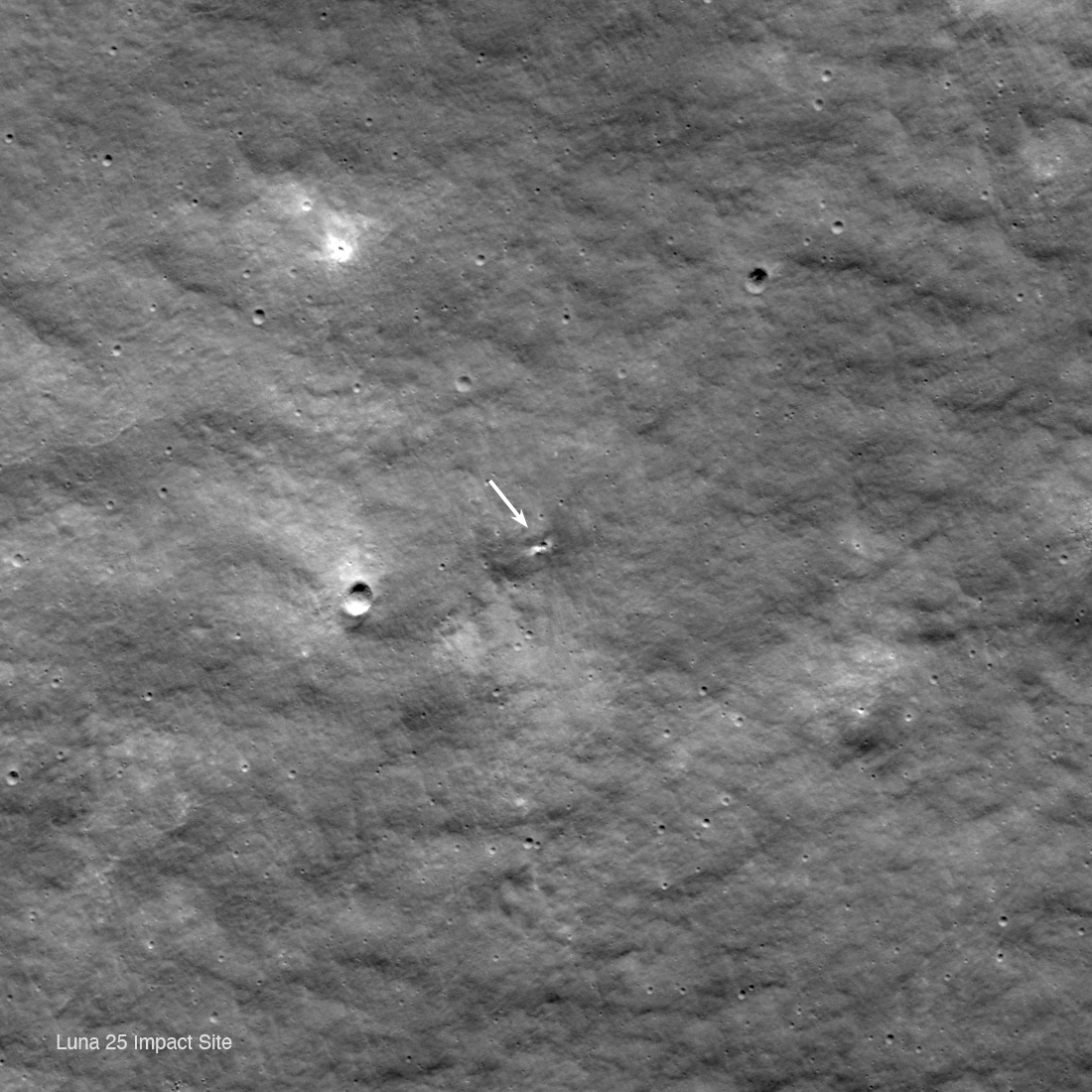
Now NASA’s Lunar Reconnaissance Orbiter (LRO) has spotted Luna 25’s final resting place.

Luna 25 was Russia’s first mission to the Moon in over 40 years. Roscosmos launched it into orbit on August 10th on a Soyuz 2.1b rocket from the Vostochny Cosmodrome. The launch and the travel to the Moon went well, and the spacecraft entered lunar orbit on August 16th. But, perhaps sadly, it crashed while executing a failed orbital maneuver.

Remove All Ads on Universe Today

Join our Patreon for as little as $3!

Get the ad-free experience for life

The Luna-25 mission lifting off from the Vostochny Cosmodrome on Aug. 11th. Credit: Roscosmos/Reuters

Initially, Roscosmos announced that they’d lost contact with the spacecraft. “The measures taken on August 19 and 20 to search for the device and get into contact with it did not yield any results,” Roscosmos reported.

Later, on Telegram, they said, “During the operation, an emergency situation occurred on board the automatic station, which did not allow the maneuver to be performed with the specified parameters.”

Luna 25 was in a sort of race with India’s Chandrayaan-3 lunar lander. C3 was launched before L25, but Roscosmos planned for L25 to pass the Indian lander and reach the Moon’s surface first. It did reach the surface first, but only as a wreck. And as everybody knows, C3 landed successfully and is going about its business. That must sting.

Artistic rendering of the Luna-25 lander on the surface of the Moon. Credit: NASA

On August 21, Roscosmos revealed the likely location of L25’s impact, and NASA instructed the LRO to image the region. On August 24, the LRO captured these images and compared them to previous images of the same region pre-impact. The most recent pre-impact image is from June 2022, and a small new crater appeared sometime between the dates of the two images. The new crater is so close to the impact site that NASA confidently concluded that the new crater is indeed the impact crater created by L25’s crash. The crater is about 10 meters (33 feet) in diameter.

Russia is a political pariah right now for obvious reasons. But Luna 25 was predominantly a scientific endeavour, so it’s unfortunate that the mission failed.

Luna 25 carried eight science instruments, including an instrument for the spectrometry of minerals, an important part of modern lunar exploration. It was also going to measure the regolith’s thermal properties, measure plasma in the exosphere, and measure dust and micrometeorites, among other things. But that’s all gone now.

Luna 25 was also going to carry a demonstration navigation camera provided by the ESA, but they pulled it after Russia invaded Ukraine. The ESA announced that they were discontinuing their participation in Luna 25, 26 and 27, saying, “As with ExoMars, the Russian aggression against Ukraine and the resulting sanctions put in place represent a fundamental change of circumstances and make it impossible for ESA to implement the planned lunar cooperation.”

There’s significant schadenfreude involved in Russia’s failures right now, and that’s not likely to dissipate any time soon. That’s what happens when you invade your neighbour and do all the terrible things Russia’s done. It’s just the way it is.

But Russia is a dictatorship, and while leadership might deserve to fail, this latest disappointment must be difficult for the dedicated scientists and other personnel who have no way of voicing discontent and do their work while suffering under crude leadership. There must be some people in Russia like that, right?

Luna 25’s failure might not be restricted to this single mission. It was intended as a sort of test bed for subsequent landers in the Luna series. Will this failure affect future Luna missions?

Russia is not exactly open about its failures. For example, when their Phobos-Grunt mission to Mars’ largest moon failed, they quickly blamed foreign sabotage. So far, they haven’t placed blame for Luna 25’s crash on anyone, but they still might.

Poster art for the Russian Phobos-Grunt mission. Russia blamed foreign sabotage for the mission’s failure, with no evidence. Russian Federal Space Agency)/IKI

The real problem might lie with the nature of Russian society. Rampant corruption is well-documented in Russia, and corruption tends to eat into everything. It may have played a role in Luna 25’s failure, but that’s only speculation at this point. We may never know exactly what role it might have played.

For its part, NASA has avoided criticizing or condemning Russia’s latest failure. Thomas Zurbuchen, NASA’s former Associate Administrator for the Science Mission Directorate, had a conciliatory message for Roscosmos. He said on X, “Too bad to read this. None of us ever wishes bad onto other explorers. Hope this can be fixed. We are reminded that landing on any celestial object is anything but easy & straightforward. Just because others managed to do it decades ago does not guarantee success today.”

Classy, diplomatic words.

This latest Russian failure is just another chapter in their decline. If there’s a new space race happening between nations, Russia isn’t really participating.

Prior to Luna 25’s launch, NASA Administrator Bill Nelson wished Russia well, emphasizing the cooperation between NASA and Roscosmos over the decades, pointing out that the two built the ISS together. But he also said, “I don’t think a lot of people at this point would say that Russia is actually ready to be landing cosmonauts on the Moon in the timeframe that we’re talking about going to the Moon or that China would be,” he said.

Like this:

Like Loading…