Categories
Entertainment

Toni Braxton Denies Rumor Claiming She Secretly Married Birdman

Toni Braxton is setting the record straight following rumors that she had secretly tied the knot with Birdman.

As The Shade Room previously reported, the claim stemmed from a post on X that had spread like wildfire on the social media platform.

Toni Braxton Didn’t Marry Birdman

Allegations surfaced that Braxton flew out to Mexico to marry the music mogul, whom she first began dating in 2016.

But in a post shared to her Instagram on Sunday (December 31), the ‘He Wasn’t Man Enough’ singer not only denied the rumor, she also made it known that she and Birdman were both single.

She shared a screenshot of a side-by-side photo of her and Birdman with a headline that read, “Congratulations! Toni Braxton & Birdman Married In A Private Ceremony In Mexico.”

The hashtag #FakeNews was added right below. In the accompanying caption, the Grammy winner wrote:

“My dear friend @birdman and I are not married…never been married. We are both single.”

Her sister, Tamar, who initially spoke on the rumor in an Instagram Live session on Saturday (December 30), took to the comment section under The Shade Room’s post to add her two cents.

“My dear friend is wild,” she commented. “And ima mind my business and ride for my sister till the wheels fall of and then we walking or someone to drive us.”

One day before Toni made her statement, Tamar said she had no idea her sibling had tied the knot after seeing the headlines on X.

While on her way to Disneyland with her fiancé, Jeremy Robinson, and their kids, she went Live, telling her followers that she even had to call their mother, Evelyn, to verify the news.

“I can definitely tell she knows something, because I was like, ‘Why you can’t just give me a straight answer? I don’t know,” the singer said.

But she did express her happiness for the pair, despite her confusion about why her sister had decided to keep her wedding plans from her.

Toni Braxton And Birdman Dated In The Past

Back in 2016, Toni and Birdman started dating after their almost two-decades-long friendship evolved into a full-blown relationship,

Toni, who had previously collaborated with Birdman on the 2002 song ‘Baby You Can Do It,’ opened up about their romance in an episode of ‘Braxton Family Values,’ where she gushed about the sentimental things he had done to show her just how much he loved her.

“Luckily for me, he likes to do things to show that he cares about me, like sending flowers. I’m a flowers girl, what can I say?” she said, per Essence.  “He’s an undercover gentleman and he makes me feel adored.”

The R&B icon announced her engagement to Birdman back in February 2017, just one year after they started dating, and released a song together, titled ‘Heart Away.’

Even though the couple had already put their wedding plans into full effect, Toni hinted at a break-up in a New Year’s Eve post she shared on Instagram that same year, per PEOPLE.

Her resolution for the new year was to start a new chapter, which “isn’t always an easy choice,” she said, “but ALWAYS choose to be chosen.”

RELATED: My Man, My Man, My Man! Toni Braxton Seemingly Updates Fans On Her Relationship With Birdman
Categories
Technology

After a yr of breathless hype, AI will face actuality in 2024

Artificial intelligence went mainstream in 2023. The watershed moment arrived at the end of the previous year, with the November 30 release of ChatGPT. Just two months later, the OpenAI system was reaching an estimated 100 million active users. According to analysts at investment bank UBS, the headline-grabbing chatbot had become the fastest-growing consumer app of all time.

Over the remaining course of 2023, the hype train went into overdrive. Suddenly, AI seemed to be everywhere. It was transforming our lives. It was taking our jobs. It was even threatening to cause an apocalypse. 

In reality, however, the breakthroughs have largely emerged within a single portion of artificial intelligence: generative AI. The excitement sparked by ChatGPT’s text, GitHub Copilot’s code, and Stable Diffusion’s images is yet to spread across the field.

“While the use of GenAI might spur the adoption of other AI tools, we see few meaningful increases in organisations’ adoption of these technologies,” McKinsey concluded in its report on the state of AI in 2023.

“The percent of organisations adopting any AI tools has held steady since 2022, and adoption remains concentrated within a small number of business functions.”

The <3 of EU tech

The latest rumblings from the EU tech scene, a story from our wise ol’ founder Boris, and some questionable AI art. It’s free, every week, in your inbox. Sign up now!

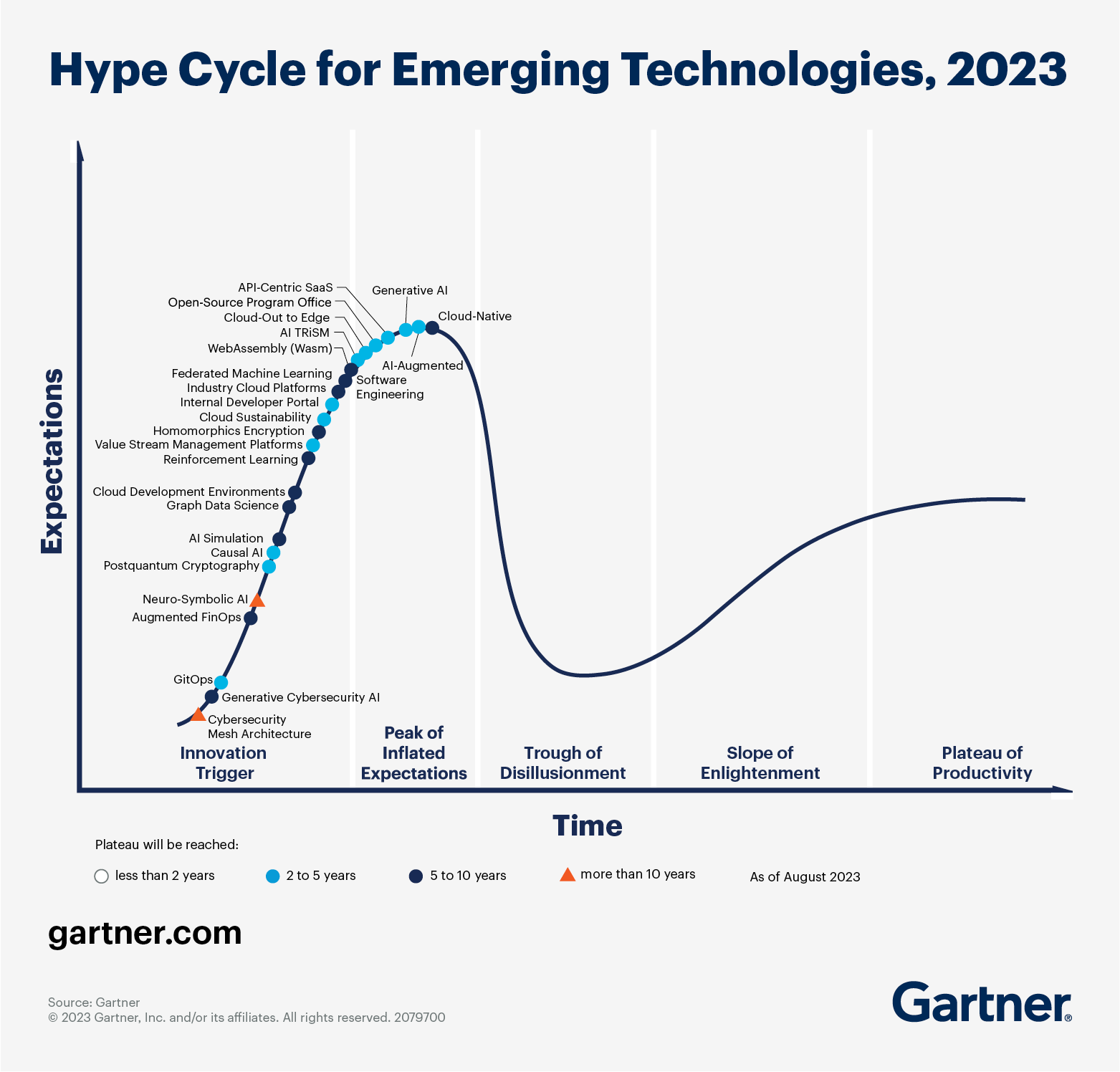
Generative AI also still has more to prove. In recent research from Infosys, the Indian IT giant found only 6% of European companies are producing business value with their GenAI use cases. In Gartner’s famous hype cycle for emerging technologies, the subsector has reached the “peak of inflated expectations.” 

The next stage of the cycle for GenAI is the “trough of disillusionment.” In that phase, interest wanes as experiments and implements fail to deliver, while producers of the tech shake out or fail. 

Graph showing Gartner's hype cycle for AIGenerative AI  has reached the apex of Gartner’s hype cycle.

Gartner’s warning echoed across our conversations with European tech insiders. In 2024, they expect a cautious and pragmatic approach to AI adoption. 

“Boardrooms need proof that these investments will increase the bottom line,” said Adi Andrei, the director of the UK’s Technosophics and a former senior data scientist at NASA. “A lot of money and effort has been poured into monetising ChatGPT and similar GenAI solutions, but the results are lacking.”

One critical shortcoming is the inaccuracies caused by AI hallucinations. While the remarkable text produced by large language models (LLMs) offers a veneer of reason, beneath the surface the systems merely calculate the probable order of different words. Those odds don’t always lead to correct results. 

“Such superficial intelligence is not always valuable and reliable, and the industry is waking up to reality,” Andrei said. 

Entering new spaces

Despite the challenges, GenAI is set to enter a growing range of industries in 2024.

According to McKinsey’s research, businesses that rely on knowledge work have the most to gain. The consulting firm expects tech companies to reap the biggest benefits, adding the equivalent of up to 9% of global industry revenue. Other sectors set to cash in are banking (up to 5%), pharmaceuticals and medical products (also up to 5%), and education (up to 4%).

“Market watchers find something else to look at.

Ali Chaudhry, the founder of the Generative AI and RL Community in London, predicts that the tech will also spread into manufacturing, engineering, automotive, aerospace, and energy industries. 

“Unfortunately, given the ongoing political situation across the globe, we might as well witness growing investments in AI applications in the defence sector,” he added.

In many sectors, however, the uptake will be gradual. In the games industry, for instance, monetising AI remains challenging for most players. Paraag Amin, CFO of Slovakian startup SuperScale, a growth platform for games, doesn’t anticipate real revenues to emerge before 2025.

“Adopting AI and associated tools into widespread processes takes time,” Amin told TNW. “In this integration and adoption phase, monetization models will continue to evolve, and also compete with free or freemium offerings. This makes driving short-term revenue more difficult until these models stabilize and winners emerge.”

Future fears

There are also growing concerns about AI’s inroads into nefarious applications. With 1.5 billion people set to vote in national ballots next year, experts fear that deepfakes will turbocharge political disinformation

Synthetic media also has the power to wreak havoc in boardrooms.

“Without sophisticated monitoring and detection tools, it’s almost impossible to detect this type of synthetic imagery,” said Andrew Newell, the chief scientific officer at biometrics firm iProov. “As such, we fully expect to see an AI-generated Zoom call lead to the first billion-dollar CEO fraud in 2024.”

The Ukrainian AI firm behind Luke Skywalker’s de-aged voice explains deepfake risksDeepfakes aren’t only a problem for celebrities.

Another pressing issue for 2024 is the scraping of web data to train AI systems.

Critics are now calling for curbs on the practice. Juras Juršėnas, the chief operating officer at web intelligence platform Oxylabs, warns that reining in data scraping will have mixed results. 

“Unfortunately, restrictions on public web data collection might delay innovations in the AI field,” she said. “On the other hand, the web data collection industry has long lacked clear guidelines and answers regarding data ownership, privacy, and data aggregation at scale. So, we hope that case law will start clearing up those grey zones.”

Further legal clarity could emerge from regulation. Around the world, governments are taking diverging paths to control the tech. The EU’s AI Act applies a sweeping set of rules and a risk-based approach, while the US is following a more sector-specific model that aims to reduce red tape. In the UK, the interventions have thus far fallen somewhere between the two.

“What this means is that we’re going to see three distinct rule books develop across these three markets,” said Richard Bownes, principal for AI and ML at digital consultancy Kin + Carta. “2024 will see these rulebooks get tighter, which is going to catch out those companies who didn’t start building their data infrastructure that underpins AI use.”

The tip of the AI iceberg

Amid the increasing restrictions and fading hype, analysts expect GenAI to leave a positive legacy for the broader realm of artificial intelligence.

The experiences and technological advances will provide valuable insights, investments, and IT stacks for the sector. In 2024, other emerging techniques could take advantage of the GenAI boom.

Juršėnas highlights two particularly promising contenders. The first is federated learning, which enables the training of ML algorithms without direct access to private data. As a result, efficiencies, performance, algorithms, and privacy could all be enhanced.

The second is causal AI, which seeks to reduce bias and increase accuracy by equating correlation with causation. In a sense, the approach brings AI closer to the workings of the human mind. Questions are posed as “what ifs” and connections are probed between cause and effect.

“Federated machine learning and causal AI might help create a healthy competition in the AI field, which is currently dominated by only superficially intelligent generative systems,” Juršėnas said.

Graphic of a chatbot in a speech bubble wearing a headsetChatbots could be an entry point for diverse AI applications.

As for GenAI, Juršėnas expects the deployments to depend on the ability of providers to serve models as web-based APIs. That may not herald a revolution, but the results could still be powerful.

Indeed, the progress from hype to reality is where the true impact emerges. Bownes is bullish about the possibilities.

“AI and, in particular, generative AI enjoyed as much hype as any technology in the last 100 years,” he said. “It was inevitable that the results wouldn’t come as fast or be as impactful as to justify the level of excitement from even casual onlookers.

“What this means, though, is that as the market watchers find something else to look at, real use cases will emerge, the tech will develop, and excitement will begin anew. Much like the aftermath of an eruption, yes, the volcano is exciting, but the fertile land is what’s of actual use.”

Categories
Health

Large Pharma takes on counterfeit medication

In Las Vegas, Lazaro Hernandez was a flamboyant, jet-setting poker player shown in televised tournaments with stacks of colorful chips. But the casually dressed gambler spotted on security cameras with wads of cash at the casino cage was hiding a secret life.

And federal investigators say he was gambling with people’s lives. Hernandez, they say, oversaw a nationwide $230 million scheme to counterfeit prescription medications, particularly lifesaving HIV drugs, in which pill bottles were altered and sold back to pharmacies at a huge discount.

Hernandez’s operation altered bottles for Biktarvy, the No. 1 prescribed drug for HIV, as well as Descovy, another HIV medication, and other pharmaceuticals, according to court records. In some cases, the records show, the pills in the bottles were swapped for Seroquel, an antipsychotic drug.

Hernandez, based in south Florida, gambled with proceeds from the counterfeiting operation, taking private jets to Las Vegas and appearing in numerous poker tournaments, authorities say.

The drug counterfeiting scheme was part of what the World Health Organization estimates is up to $431 billion in drugs counterfeited worldwide annually. In the U.S., there were 2,121 incidents of counterfeiting in 2022, up 17% from the prior year, according to the Pharmaceutical Security Institute, which tracks industry trends.

It’s a huge concern for Gilead Sciences, which has made it a priority to find and fight prescription drug diversion and counterfeiting more broadly.

The company filed a lawsuit in July 2021 against 161 defendants, including pharmacies and wholesale pharmaceutical distributors, accusing them of participating in the scheme to alter the company’s medications Biktarvy and Descovy. Johnson & Johnson filed a similar lawsuit against 27 defendants over its HIV medication Symtuza in April 2022. Other lifesaving drugs have been counterfeited over the past several years, including cancer medications, according to industry experts and law enforcement officials. The suits are pending.

“These criminals are preying on the most vulnerable,” said Lori Mayall, Gilead’s head of anti-counterfeiting and product security.

What makes a counterfeit medicine?

Lori Mayall, Gilead Sciences’ head of anti-counterfeiting and product security.

Source: CNBC

In an interview at Gilead’s headquarters in Foster City, California, Mayall explained what constitutes a counterfeit: Altered packaging, a bottle with the wrong tablets, the wrong cap or label and even the leaflet attached which contains important information about the medication.

Here’s how drug diversion works: A patient fills a prescription for a medication that is worth several thousand dollars but is paid for by Medicare, Medicaid or insurance. The patient then sells it for a fraction of the list price in cash. The buyer, known as an aggregator, removes the patient information, alters the bottle and sells it to the wholesale distributor, who sells it back to the pharmacy.

Biktarvy has a package list price of $3,795, although most patients’ copays are typically far less or they may obtain significant discounts through the company’s patient assistance programs, according to Gilead.

In the Gilead counterfeiting operation, which authorities say was overseen by Hernandez, the company discovered it had a potential problem in August 2020. That’s when an independent pharmacy reported that a patient had received a sealed bottle of Biktarvy with Excedrin pills inside, according to the lawsuit.

The bottle and label appeared to be authentic. Over the next several months, the company received more complaints from patients and pharmacies that other sealed bottles of Biktarvy contained other medications, primarily Seroquel, the antipsychotic. Mayall said counterfeiters had obtained authentic empty bottles, filled them with the wrong pills and packaged them with a counterfeit seal. In one case, she said, a patient temporarily could not walk or talk after taking the Seroquel, but soon recovered.

“What we’ve seen is our bottles reused,” Mayall said. “They’re cleaned and repackaged to look like genuine Gilead products.”

Every sale of a prescription medication is supposed to be tracked to provide a chain of custody back to the manufacturer under the federal Drug Supply Chain Security Act. But that hasn’t stopped criminals such as Hernandez from circumventing the process by altering the labels and prescription paperwork and counterfeiting the supply chain documentation, according to law enforcement officials interviewed by CNBC.

Typically, the crime starts at the street level, where patients are approached outside a homeless shelter or clinic, Mayall said. They’re induced to sell their month’s supply of Biktarvy, for example, for several hundred dollars or less.

“It’s kind of the reverse of drug dealing on the streets,” Mayall said. “They go to these locations where they know there are patients who receive medicine that’s been dispensed from a pharmacy, and oftentimes these medications are given to the patients through government insurance or through other free drug programs, and they will pay the patients for their medicine and the bottles that come with the medicine.”

Gilead’s war room

A “war room” at Gilead Sciences contains thousands of confiscated pill bottles.

Source: CNBC

Behind a locked door marked “war room” at Gilead headquarters are tens of thousands of pills and bottles. All were confiscated as counterfeits, Mayall said as she took CNBC on a recent tour. Some of the fakes are obvious because the paperwork contains numerous misspellings.

Legitimate Gilead medicines are manufactured at the company and then sold to a licensed Gilead distributor, who then sells them to a pharmacy. The counterfeit medications in the war room, most of which were connected to the Hernandez case, were repackaged to look like Gilead products, Mayall said.

The Gilead lawsuit includes four licensed distributors: Safe Chain Solutions, Scripts Wholesale, ProPharma Distribution and ProVen.

Of the four, only Safe Chain Solutions, through its attorneys, responded to CNBC’s request for comment.

Safe Chain Solutions denied claims by Gilead in the suit that it sold or bought counterfeit pills.

“Safe Chain is a family-owned, full-service wholesale pharmaceutical company that provides a wide range of pharmaceuticals and other health care products to retail pharmacies and other healthcare facilities nationwide,” the statement said. “Independent wholesalers like Safe Chain play a vital role in supplying independent pharmacies, surgical centers, and other retailers with prescription drugs at prices and in volumes they could not obtain from larger wholesalers.”

The company said it “has never knowingly sold inauthentic drugs or drugs with falsified pedigree documentation, whether manufactured by Gilead or otherwise. It has never altered or fabricated drug transaction histories. Safe Chain and its owners were, at most, victims of this conspiracy.” It said it has shipped more than 100,000 orders with about 2 million units since its founding in 2011 and deals only with licensed suppliers.

Authorities are investigating schemes in which pill bottles containing prescription drugs are altered and then resold to pharmacies.

Source: HHS-OIG

“Safe Chain also communicated extensively with Gilead to investigate concerns about HIV drugs. Indeed, Gilead itself learned about several of these incidents directly from Safe Chain. Safe Chain provided documentation about hundreds of bottles that it sold and further documentation showing what transaction history it had received from its own suppliers. Safe Chain even invited Gilead to inspect its facilities to assure Gilead of its commitment to patient safety and to work collaboratively in investigating these serious issues. These are not the actions of knowing and willful counterfeiters,” the statement said.

ProPharma Distribution settled the Gilead suit for $3.3 million and agreed to be permanently prohibited from selling Gilead medications, court records show. Details of the full settlement are confidential, according to Gilead attorneys.

Johnson & Johnson, in a statement to CNBC, said it learned in November 2020 that counterfeit versions of its HIV medication Symtuza were being distributed to three pharmacies in the U.S. The company said it then reported that to the Food and Drug Administration.

“Counterfeiting of life-saving medications is a criminal act that puts patient lives at risk,” Dr. Dave Anderson, a company vice president, said in the statement. “In addition to the anti-counterfeiting measures and legal action we have taken, we want to remind all stakeholders about the situation and provide specific guidance on how to identify HIV medicines.”

Criminal schemes

Geoffrey Potter, a partner with the New York City-based law firm Patterson Belknap Webb & Tyler, represents both Gilead and Johnson & Johnson.

“We don’t know how much counterfeit medication is in the system because there is no good way of measuring it. But when we do find these schemes, they are very large,” he said.

In the Hernandez case, which involved distributors throughout the country, Potter said, there was no easy way to determine whether a pill bottle was real or fake just by looking at it.

“Virtually nobody inspects their medication before taking it, so they wouldn’t be able to tell,” he said.

Potter said counterfeiters such as Hernandez use sophisticated methods similar to those favored by drug traffickers. That isn’t surprising, since a number of them have been convicted of narcotics-related crimes, he added.

Stephen Mahmood, assistant special agent in charge at the U.S. Department of Health and Human Services’ Office of Inspector General, or HHS-OIG, said the extent of drug diversion fraud is alarming.

Stephen Mahmood, assistant special agent in charge at the U.S. Department of Health and Human Services’ Office of Inspector General.

Source: CNBC

“I’m saddened and disheartened that the schemes cross the entire United States and territories, but I’m not surprised. Fraud is always evolving,” Mahmood said.

Depending on the scheme, he said, a pharmacy may or may not know that it is getting a counterfeit drug.

“Some of the pharmacies are involved with the fraudulent wholesalers. They know exactly what they’re doing,” he said. “Some are unwitting, and they may get a fax from a wholesaler saying, ‘Hey, we have a discounted drug.’ And due to competition and trying to make money, they may buy the drug.”

In a 2014 case handled by HHS-OIG in Miami, agents used an informant wearing a hidden camera to film a woman, her husband and her adult son in a South Florida apartment altering medication bottles. The video, obtained by CNBC, shows how they used lighter fluid to remove the patient information affixed to the bottle.

“Because obviously no one is going to sell a drug with someone else’s name on it. And they’re cleaning it to make it look new again,” said Mahmood, describing the video as a “drug diversion in progress.”

The three were convicted of charges related to the unlicensed distribution of prescription drugs in 2015 and served prison time. All have since been released, and their attorneys did not respond to a request for comment.

A convicted felon who spoke to CNBC on the condition his identity would not be disclosed and who asked to be referred to as “Julio” said altering medication bottles was his life for about 10 years in South Florida.

“Julio” says he made millions from the drug counterfeiting business.

Source: CNBC

“I was in the pill business. I used to have dealers in the road. The pharmacies buying pills from me, wholesale price,” he said.

He said patients desperate for cash willingly forgo their essential medication.

“They will bring it to me. I’ll pay them. I’ll pack it up. I’ll clean it, make it look nice. Then I had a wholesaler who will buy it from me,” he said. He said the wholesaler would then sell the medications back to pharmacies.

Describing how he cleaned the bottles, he said, “When I get them from the dealer, they come with the label over, with the person’s name. I have a thing that I put — it’s like a liquid that we put on it and we clean it, and we make it look brand new again. It’s got to be brand new so we can resell it.”

Eventually, he was caught and went to prison.  

The FDA told CNBC it had no one available to discuss counterfeit drugs, but sent a statement: “The FDA urges the public to obtain prescription drugs only from state-licensed U.S. pharmacies or physicians that are located in the United States, where the FDA and state authorities can assure the quality of drug manufacturing, packaging, distribution and labeling. Non-FDA approved drugs may contain the wrong ingredients, contain too little, too much, or no active ingredient at all, contain other harmful ingredients, or be shipped and/or stored outside of approved conditions.”

For Lazaro Hernandez, his high-flying days ended abruptly earlier this year. He pleaded guilty in April to conspiracy charges related to distributing adulterated and misbranded drugs and money laundering in connection with a $230 million fraud ring. In June, he was sentenced to 15 years in prison.

In court documents, one of his attorneys said his “gambling addiction” was a “driving force behind his participation in the criminal conspiracy,” and said Hernandez regularly took cash from his sales of diverted drugs to casinos.

A different attorney for Hernandez said in an email that she had no comment on the case.

None of the distributors in the Gilead case have been criminally charged.

However, Steven Diamanstein, the owner of Scripts Wholesale, based in the Brooklyn borough of New York City, was indicted in June on charges of buying more than $150 million worth of illegally diverted prescription HIV medication and reselling it to pharmacies, according to the indictment and a Justice Department news release. He pleaded not guilty, and his attorney had no comment.

Other investigations into more counterfeit schemes are pending, law enforcement officials told CNBC, adding that altering pill bottles and the drugs themselves is too lucrative for criminals to slow down.

“We need to put locks on all the doors and windows to keep the criminals out,” Mayall said. “Right now, it is way too easy for these bottles that have been previously dispensed to patients to make their way back into the supply chain.”


Categories
Science

Natural Molecules Come from the Universe’s Chilly Locations

Life, as we all know, is based on chemistry. Prebiotic chemical building blocks existed on our planet for a long time before life arose. Astrobiology and cosmochemistry focus on the formation of those building blocks. They also look at the role each played in creating all the life forms we know today.

For a long time, cosmo-chemists have known that organic molecules called polycyclic aromatic hydrocarbons (PAHs) are quite plentiful in the Universe. Scientists consider them plausible prebiotic building blocks that likely played an important role in the formation of life on Earth. What’s not as well understood is their origin story. For a long time, scientists suspected that they formed in regions where temperatures get to around 1000 K. That would supply energy to promote chemical activity to create PAHs, such as in star-forming molecular clouds or circumstellar disks. It’s also possible they form as part of the processing of carbon-rich dust grains by nearby energy sources (such as stars).

However, based on recent studies of an asteroid and meteorite, it turns out that some PAHs formed in cold regions of space, too. In those regions, the temperature does not get much higher than 100 K. That finding opens up new pathways for understanding life’s chemical journey on other planets and celestial bodies.

Understanding These Organic Molecules

According to Professor Kliti Grice, a researcher at the Western Australia Organic and Isotope Geochemistry Centre at Curtin University, understanding these materials is a big step. “PAHs are organic compounds made up of carbon and hydrogen that are common on Earth but are also found in celestial bodies like asteroids and meteorites,” said Grice.

They’re spread throughout the interstellar medium and detected in galaxies across the Universe. Generally, they’re used as a tracer of cold molecular gas, which is where stars—and planets—begin their formation journey.

An image of an interstellar nebula with some polycyclic aromatic hydrocarbon (PAH) molecular structures superimposed. These organic molecules exist throughout the Universe.
Courtesy: NASA.

As such, scientists want to trace their path from space to Earth and compare space-based PAHs to Earth-based ones. That’s because PAHs are a very likely precursor to the kinds of materials that eventually lead to the formation of life. That makes their presence on other celestial bodies intriguing as scientists work to understand the formation and evolution of life.

Beyond Earth, PAHs account for about 30 percent of all carbon found in regions around stars, in molecular clouds, and on planets (and other bodies). On Earth, many PAHs exist in coal deposits and oil reservoirs. Plants burning (as in forest fires) also produce these compounds. They work their way into the soil and eventually end up in plants (among other things).

Organic Molecules and Rocky Bodies

Grice is part of an international research team that focused on pieces of asteroid Ryugu and the famous Murchison meteorite to figure out where their PAHs formed. The team started with an unusual chemistry project: burning plants. That’s because plants contain PAHs that form here on Earth. “We performed controlled burn experiments on Australian plants,” said Grice, “which were isotopically compared to PAHs from fragments of the Ryugu asteroid that were returned to Earth by a Japanese spacecraft in 2020, and the Murchison meteorite that landed in Australia in 1969. The bonds between light and heavy carbon isotopes in the PAHs were analyzed to reveal the temperature at which they were formed.”

The Murchison Meteorite, which fell to Earth in 1969. It contains organic molecules. Courtesy Basilicofresco, CC BY-SA 3.0

Using high-tech methods to study Ryugu and Murchison, the team found two sources of PAHs with slightly different characteristics. “The smaller ones likely formed in cold outer space, while bigger ones probably formed in warmer environments, like near a star or inside a celestial body,” according to Grice.

Ryugu is particularly interesting since it formed early in the Solar System’s history. A critical analysis of its chemistry found several PAHs. The team also detected organosulfides (compounds with sulfur). These all likely formed in very cold interstellar clouds. That means they predate the formation of the Solar System, making bits of Ryugu older than the Sun and planets.

PAHs on the Pathway of Life

Why are scientists interested in PAHs? Their role as precursor compounds for life is intriguing. The fact that they can exist out in space opens up avenues of research into life beyond Earth. In addition, their presence gives new insight into the bodies that contain them.

Research team member Dr. Alex Holman said that studying the isotopic composition of PAHs found in celestial bodies offers a glimpse of their formation conditions. “This research gives us valuable insights into how organic compounds form beyond Earth and where they come from in space,” Dr Holman said. Ultimately, in the search for life elsewhere in the Universe, understanding the chemical pathways it takes through different formation environments will be important information.

For More Information

Organic Compounds in Asteroids Formed in Colder Regions of Space: Study
Scientists Probe the Source of Key Hydrocarbons on Earth—and in Space
PAHs, hydrocarbons, and Dimethylsulfides in Asteroid Ryugu Samples A0106 and C0107 and the Orgueil (CI1) Meteorite

Like this:

Like Loading…

Categories
Sport

Goran Dragic retires after 15 NBA seasons

Dec 30, 2023, 12:09 PM ET

Former All-Star Goran Dragic is retiring after 15 NBA seasons with seven teams.

The point guard is best known for his time with the Miami Heat from 2015 to ’21, which included his lone All-Star selection in 2017-18.

Dragic, 37, was the NBA’s Most Improved Player and made the All-NBA third team with the Phoenix Suns for the 2013-14 campaign.

He played in 946 games (530 starts) from 2008 to ’23 and averaged 13.3 points, 4.7 assists and 3.0 rebounds with the Suns, Houston Rockets, Heat, Toronto Raptors, Brooklyn Nets, Chicago Bulls and Milwaukee Bucks.

He never won an NBA championship, reaching the 2020 NBA Finals during the bubble season in Orlando. His Heat lost to the Los Angeles Lakers in six games.

Editor’s Picks

Dragic plans to play a farewell game in his native Slovenia in August, according to reports out of that country.

His international accomplishments include leading Slovenia to the 2017 FIBA EuroBasket championship, where he earned MVP honors.

Categories
Entertainment

Gypsy Rose Blanchard Shares Pic With Sister After Jail Launch

Gypsy Rose Blanchard is enjoying family time as a free woman.

The 32-year-old Missouri woman reunited with her loved ones to celebrate her release from prison after serving seven years for her role in the murder of her mom Clauddine “Dee Dee” Blanchard, who she had accused of abuse. On Dec. 29, Gypsy shared a photo of herself at her welcome home party with Mia Blanchard, 22—one of two children dad Rod Blanchard‘s shares with wife Kristy Blanchard.

She captioned her Instagram post, “Sister Love.”

In other images circulating on social media, Gypsy is also seen at the party with her father and stepmother. A video shows her popping Champagne with her husband, Ryan Scott Anderson, who she married in 2022 while in prison.

The photos shortly followed Gypsy’s first “selfie of freedom,” which she shared on Instagram earlier in the day. In all her pics, she wears jeans and a blue and white ombre sweatshirt, the same outfit she was photographed in while leaving prison the day prior.

Categories
Health

Flying solo with out Cigna will maintain Humana centered on 2 huge priorities in 2024

In this photo illustration, Humana Inc. logo seen displayed on a tablet.

Getty Images

It looks like Cigna has scrapped its takeover bid for Club holding Humana, removing a dark cloud over both stocks that’s lingered since the acquisition talks surfaced nearly two weeks ago.

Categories
Science

Right here’s The Most Aggressive Restrictions Biden’s EPA Pushed On People In 2023 • Watts Up With That?

From the Daily Caller

NICK POPE

CONTRIBUTOR

The Environmental Protection Agency (EPA) pushed several aggressive climate regulations in 2023 that could seriously harm the American economy, energy policy experts told the Daily Caller News Foundation.

The agency proposed or finalized rules that would spur the electric vehicle (EV) transition, decrease power grid reliability by imposing costly restrictions on power plants, tighten air quality standards and more in 2023. Under the Biden administration, the EPA has made considerable efforts to further regulations that would nominally help to counter climate change, often at the expense of the American economy, energy policy experts told the DCNF.

“The EPA took a disturbing trend to a new level in 2023: a willingness to use its regulatory power to kill off industries, dictate or influence what businesses can operate and limit what goods and services are available to the public,” Daren Bakst, the director of the Competitive Enterprise Institute’s Center for Energy and Environment, told the DCNF. “Congress never envisioned the agency’s authorized regulatory power would be used as a tool for the agency to engage in central planning, reshape industries and limit consumer choice.” (RELATED: EPA Bureaucrats Can Rake In Six-Figure Salaries While Mostly Working From Home, Report Finds)

The “Clean Power Plan 2.0″

The EPA’s May proposal to slash greenhouse gas emissions from power plants would require fossil fuel-fired generation facilities to adopt expensive developing technologies, such as carbon capture and sequestration (CCS) and hydrogen blending, in order to come into compliance over the coming decades. If finalized in its current form, the regulations— which the EPA contends are legal under the auspices of the Clean Air Act— would significantly raise the chances of blackouts in a massive swath of the Midwest while imposing costs to stakeholders totaling nearly $250 billion, according to analysis conducted by the Center of the American Experiment (CAE).

Power the Future, an energy advocacy organization, dubbed the proposal the “Clean Power Plan 2.0” in a November report because of its strong resemblance to the Obama administration’s “Clean Power Plan” proposal, which the Supreme Court struck down in its landmark decision in West Virginia v. EPAin 2022.

The EPA is moving forward with the proposal, despite the North American Electric Reliability Corporation and a key official for the Federal Energy Regulatory Commission warning that the premature retirement of fossil fuel-fired baseload generation and increased reliance on intermittent green energy, like wind and solar, threatens future grid reliability.

“The proposed rule does not require that plants go offline,” an EPA spokesperson told the DCNF in August. “The proposed rule would require plants to install proven technology to abate greenhouse gas emissions. The proposal provides owners and operators of power plants with ample lead time and substantial compliance flexibilities, allowing power companies and grid operators to make sound long-term planning and investment decisions, and supporting the power sector’s ability to continue delivering reliable and affordable electricity.”

However, CAE and one of its leading grid experts, Isaac Orr, are not convinced.

The agency “does not appear to have the expertise necessary to enact such a sweeping regulation on the American power sector,” CAE wrote in its August comments in response to the agency’s proposal.

“This is the regulatory equivalent of studying the structural integrity of the top floor of a 100-story building without doing so for the preceding 99 floors,” Orr told the DCNF.

Tailpipe Emissions Standards

In April, the agency unveiled its proposal for new tailpipe emissions standards in an effort to curb emissions attributable to transportation. The proposed standards would be historically stringent if finalized and they would effectively mandate that 67% of all light-duty vehicles sold after model year 2032 are EVs, according to the EPA.

Under the proposed rules, 46% of medium-duty vehicle sales and 25% of heavy-duty sales will be EVs, according to the agency’s projections.

The proposal could be “tremendously damaging for the American people,” Diana Furchtgott-Roth, the director of the Heritage Foundation’s Center for Energy, Climate and Environment, told the DCNF. “The reason the agency is pushing these rules is because Congress would never pass these as laws … this rule would be very damaging for Americans and get rid of an iconic means of transportation.”

The administration has spent billions to facilitate its ambitious EV push, and other agencies, such as the National Highway Traffic Safety Administration, have promulgated their own similar rules as well. Despite these efforts, the American EV market is on tenuous footing: consumer demand is not growing as rapidly as anticipated, companies are losing large sums of money on their EV product lines, auto executives are starting to back away from short-term EV production targets and the nation’s EV charging infrastructure remains inconsistent and unevenly distributed across the country.

Notably, the House passed a bill that would effectively nullify the proposal earlier in December by a bipartisan vote, but it is unlikely to make it through the Senate, and the White House has suggested that President Joe Biden will veto the bill if it lands on his desk, according to The Hill.

Fine Particulate Pollution Standards

In January, the EPA proposed to tighten the existing National Ambient Air Quality Standards (NAAQS) for fine particulate pollution (PM 2.5) in order “to better protect communities, including those most overburdened by pollution,” the agency announced in a press release.

More than 70 industrial executives penned a letter to White House Chief of Staff Jeff Zients warning him that it could lead to massive swaths of the nation falling out of compliance with the rule, which would in turn choke economic development and complicate key goals of Biden’s own green industrial agenda, according to its text.

The states that would be most directly impacted by a finalized PM 2.5 NAAQS update would be Texas, California, Michigan, Ohio, Pennsylvania, Georgia, Nevada, Arizona and Illinois, according to the letter’s text.

“PM 2.5 is the most demonstrable science fraud going on at the EPA,” Steve Milloy, a senior legal fellow for the Energy and Environment Legal Institute, previously told the DCNF. “There is more than enough scientific research to demonstrate that what EPA is doing here is fraud, and it is really a testament to the corruption of the scientific community.”

If finalized, the proposal would kill jobs and put the EPA in a position to deny local economies the right to develop, because states that can not comply with the tightened standards would have to receive approval from the agency to develop new industrial factories and power facilities, Milloy told the DCNF.

The EPA projects that the policy would generate up to $43 billion in net health benefits in 2032, as well as prevent 4,200 premature deaths per year and restore 270,000 lost workdays per year by reducing the current standard of allowable fine particle pollution by up to 25%.

Waters of the United States

In January, the agency proposed a regulation that would define the “Waters of the United States” (WOTUS) under the EPA’s regulatory purview as “navigable waters” to include lands containing small streams and wetlands. A federal court blocked the January proposal in April, finding that the 24 states that sued the agency had “persuasively shown that the new 2023 Rule poses a threat to their sovereign rights and amounts to irreparable harm.”

Then, in May, the Supreme Court limited the EPA’s authority under the Clean Water Act — which it had cited as the enabling statute for the January proposal — in its decision in Sackett v. EPA, a case brought by a couple whom the EPA tried to stop from constructing a house on their land in Idaho.

In August, the agency “finalized amendments to its January rule, which are just a half-hearted and incomplete set of corrections to try and fix the flawed rule,” Bakst told the DCNF. “These amendments don’t properly comply with the Sackett opinion and fail to provide needed clarity to implement the opinion. And they did so without seeking public comment.”

The EPA exhibited a “complete disregard for private property owners and the rule of law” in its proceedings pursuant to WOTUS regulation in 2023, Bakst told the DCNF.

Neither the EPA nor the White House responded immediately to a request for comment.

All content created by the Daily Caller News Foundation, an independent and nonpartisan newswire service, is available without charge to any legitimate news publisher that can provide a large audience. All republished articles must include our logo, our reporter’s byline and their DCNF affiliation. For any questions about our guidelines or partnering with us, please contact licensing@dailycallernewsfoundation.org.

Like this:

Like Loading…

Categories
Technology

The applied sciences set to drive medtech innovation in 2024

Recent technological advances are transforming the medtech sector. European companies and research institutions are working on solutions aimed at improving our knowledge and response to genetics, diseases that impact millions of people, and public health emergencies.

How will this momentum continue in 2024? And which technologies will further push medtech innovation forward?

Yes, AI

From predicting genetic diseases to improving cancer treatments and making variant-proof vaccines, AI has already proved that it can be an invaluable tool in solving some of the biggest challenges in healthcare.

“In 2024, we will see significant strides made in the field of techbio, particularly in the promising area of generative AI for drug discovery,” Dr Diana Rottger, Principal at APEX Ventures, tells TNW. Dr Rottger expects a higher number of companies in the sector moving forward into clinical development phases, including both in silico and in vivo approaches.

The trend towards enhanced diagnostics is also poised to continue especially thanks to the ability of large language models (LLMs) to process massive amounts of information.

“AI algorithms can analyse vast amounts of medical data, including patient records, genetic information, and imaging results,” says Dag Larsson, CEO and founder of Doccla, a healthtech startup providing a virtual hospital ward.

“By identifying subtle patterns and correlations that may not be visible with smaller datasets, AI can therefore assist in the early detection of diseases. This can lead to more accurate predictions and insights, particularly in complex and heterogeneous patient populations.”

Relieving pressure from the healthcare system is another trend, according to Julia Hawkings, General Partner at VC firm LocalGlobe.

“Yes, GenAI has the potential to enhance medical research, aid drug discovery, and diagnose diseases, but its power over the next year will come from its ability to overhaul the more under-the-radar tasks,” she notes. These include administrative processes, learning support for clinicians, the automation of insurance and provider workflows, and the communication around early disease detection.

The quantum push

The quantum revolution might still be a few years away, but industries (and states) are already jumping on the bandwagon of what could be a life-changing technology. In healthcare specifically, quantum computing is expected to reach a global market size of $1bn (€0.9bn) by 2030 — underscoring the rising importance of the tech in the future of the medical sector.

The impact of quantum on healthcare could be massive, to say the least, thanks to the ability of quantum computers to process trillions of units of information at the same time, enabling them to be exponentially faster than their classical counterparts.

“There are various quantum technologies with the potential to be game-changing for the medtech arena,” Ilana Wisby, CEO at UK-based Oxford Quantum Circuits (OQC), tells TNW.

One of them is quantum simulation, the ability of high-quality qubits in quantum computers to model molecules and simulate chemistry. According to Wisby, quantum simulation could have a “potentially profound impact” on drug discovery and currently incurable diseases.

“Theoretically, quantum computers can simulate the complete problem in drug development because they can simulate chemistry and molecules with an unprecedented precision,” she explains.

“This will enable pharma companies to simulate larger, more complex molecules as they develop new drugs — how they act and react — in a way classical computers can’t, resulting in billions of R&D savings and reduced time to get these new drugs out into the market.”

Another potential benefit lies in the power of quantum machine learning which can deliver “faster and more accurate data pattern identification, classification, data compression, and image classification.” This could enhance diagnostic tools and lead to the creation of predictive models for diseases.

Virtual care, remote monitoring, and VR

“2024 will see the continued use and streamlining of remote treatment options to better meet the clinical needs of more patients, as well as easing the pressure on hospital capacity and staff,” Dr Owain Rhys Hughes, founder and CEO of Cinapsis, a London-based platform for planned and urgent care advice and guidance, tells TNW.

Dr Hughes believes that the coming year will see the wider uptake of such solutions, including virtual hospital wards and remote monitoring equipment like wearables — the estimated global market value of which has reached $30.06bn (€27.3bn) in 2023.

According to Amanda Philpott, co-founder and CEO of hearing training app eargym, the upcoming further growth of wearables and health apps will bring another benefit: awareness of under-recognised health conditions that have serious implications for both individuals and resources.

One such example is heart health. “We have seen a dramatic increase in demand for cardiac monitoring apps which educate users about the importance of understanding invisible illnesses and the associated symptoms which can impact millions of people worldwide,” she says.

Meanwhile, in response to the record-high waiting times for operations across Europe, next year will bring virtual and mixed reality to the fore, predicts Alison Sundset, CEO at Oslo-based Holocare, which provides a holographic toolkit for 3D surgical planning.

“2024 will see surgeons wearing VR headsets that enable them to visualise a patient’s organs through interactive holograms, to plan smarter, safer operations,” Sundset tells TNW.

The tech’s ability to offer a shared spatial view of a patient’s anatomy, she explains, will benefit surgical planning as well as in-person and virtual communication among teams, which can also enable collaboration beyond geographical boundaries.

Outside of the operating room, VR and MR can be a “catalyst for the upcoming workforce” by allowing healthcare professionals to practise in risk-free virtual environments, speed up their learning process, and even reduce the risk of burnout.

According to Sundset, next year “these developments will shape what will become the new norm of surgical practice.”

Categories
Sport

Win the Weekend – Fantasy soccer playoff notes, NFL and faculty bowl betting ideas

Dec 29, 2023, 09:00 AM ET

Want to know the latest trends, matchups and injury news in football? We’ve got you. Want to know where the public has money this week? We’ve got you. Want to know which teams to play, whom to roster in DFS or whom to pick in your Eliminator pool? We’ve got you there, too. Here’s everything you need to know as you prepare for your fantasy football matchups and potential bets on the games this weekend.

Odds by ESPN BET.

CFB: Action Report | Analytics Edges

NFL: Injury update | Matchups to exploit | Eliminator Challenge | DFS plays |Analytics Edges | Action Report

Sports Betting home | Fantasy Football home

College Football

play

1:04

Prepare for something wonderful in the CFP Semifinals

Alabama, Michigan, Washington and Texas get ready to clash in College Football Playoff Semifinals.

David Purdum’s Action Report

Capital One Bowl Mania

Go perfect in your bowl picks and win up to $1 million, plus more prizes! Make Your Picks

  • After a little early line movement last week, the lines on the two College Football Playoff semifinals were holding steady heading into the weekend. The Michigan Wolverines remained a consensus 2-point favorite over the Alabama Crimson Tide as of Thursday, with the bulk of the action backing the underdog Tide at sportsbooks. DraftKings was reporting Thursday that 75% of the money that had been wagered on the Rose Bowl point spread was on Alabama. The point spread reached as high as Michigan -2.5 before Christmas at ESPN BET but was settling back near its opening number of -1.5 or -2 at most sportsbooks. “The vast majority of the action right now is on Alabama,” Joey Feazel, Caesars Sportsbook’s lead college football trader, said on a company podcast.

  • In the Sugar Bowl, the Texas Longhorns remained a 4-point favorite over the Washington.Huskies. “The line’s been stuck on four since we opened,” Feazel said. “The action is pretty split.” Feazel said the Alabama-Michigan game had attracted three times as much betting action as Washington Texas at Caesars Sportsbook.

  • The line on the Orange Bowl between the Georgia Bulldogs and Florida State Seminoles continued to grow this week after multiple Seminoles, including their projected starting quarterback, entered the transfer portal or opted out of the game. Georgia, which opened as a 13.5-point favorite, was -20 as of Thursday. Nearly 80% of the money that had been bet on the game’s point spread as of Thursday at DraftKings was on Georgia.

  • Looking ahead to bowls on Saturday and Monday, Feazel pointed to ReliaQuest Bowl between the Wisconsin Badgers and LSU Tigers as one of the biggest decisions the book was facing. “I expect we’re going to need Wisconsin pretty bad early on,” Feazel told ESPN. The line opened at LSU -10.5, dropped to -7 after Tigers quarterback Jayden Daniels opted out, but has since grown back to -10.

Seth Walder’s biggest edges from ESPN Analytics

  • Memphis Tigers (+10.5) vs. Iowa State Cyclones: From FPI’s perspective, we’re getting double-digit points here to take the team with the better offense — Memphis ranked 29th in offensive efficiency, Iowa State 36th. Both teams’ regular quarterbacks — who rank 38th and 39th in QBR — should play in the game. Of course, Iowa State’s defense is better, but not by enough, in FPI’s opinion, to justify this spread. The model makes the Cyclones just 4.6-point favorites in Friday’s AutoZone Liberty Bowl (3:30 p.m. on ESPN/ESPN+).

NFL

play

2:00

Why Field Yates is high on Dak Prescott but low on Tony Pollard in Week 17

Field Yates and Daniel Dopp explain why they believe Dak Prescott will have a big fantasy day against the Lions but Tony Pollard wont.

Stephania Bell’s injury update.

Matt Bowen’s matchups to exploit

Editor’s Picks

2 Related

  • Slot targets for CeeDee Lamb vs. the Lions defense: Let’s watch Lamb in the slot on Saturday night, where he has caught seven of his nine touchdowns this season. Here, Dallas can scheme for Lamb to attack the middle of the field versus zone coverage, while also setting him up on catch and run targets to win the man matchups. Lamb has logged 56 receptions out of the slot this season.

  • Brock Purdy vs. the Commanders’ 2-High schemes: I expect a bounce-back week for Purdy on Sunday against a Washington defense that has allowed 261.6 yards passing per game, the second-most in the league. The Commanders play split-safety coverage on 51.2% of opponent drop-backs, so look for Kyle Shanahan to push the safeties deep while creating intermediate windows for Purdy. Defined, timing throws here.

  • For more breakdowns, check out Matt Bowen’s Film Room.

Mike Clay’s Eliminator Challenge advice

  • Jacksonville Jaguars: We’re down to our final two weeks and have several decent options. They included the Browns (vs. Jets) on Thursday night, but if you didn’t go that direction, we have the Jaguars (vs. Panthers), Chiefs (vs. Bengals), Rams (at Giants), Broncos (vs. Raiders) and perhaps even the Bears (vs. Falcons). The Chiefs are likely going to be our best Week 18 play (at Chargers), the Rams are on the road and the Broncos made a QB change, so the Jaguars are the call … for now. Regardless of the QB situation, Jacksonville will be the favorite at home against the 2-win Panthers, but obviously the Jaguars will be a riskier play if Trevor Lawrence is sidelined. I’ll roll with the AFC South leaders for now, but we certainly have pivots if need be.

  • Be sure to also check out Clay’s Eliminator Challenge cheat sheet (updated weekly).

Al Zeidenfeld’s DFS plays

  • There’s so much value this week at running back and tight end that it makes it very easy to wrap your tournament stacks around the core value plays and possibly even afford Christian McCaffrey ($9,600). Clyde Edwards-Helaire ($5,300) has done well earlier this month in relief of Isaiah Pacheco, and with Pacheco in concussion protocols and not yet cleared, CEH provides a very clear path to volume this weekend against the Bengals, who have allowed the most explosive plays per game on the season. Zamir White ($5,100), Ezekiel Elliott ($6,000), and Devin Singletary ($5,600) are all available at $6,000 or less on DraftKings, making lineup-building around a cheap core built on massive volume opportunity extremely possible.

  • More DFS plays here.

Seth Walder’s biggest edges from ESPN Analytics

  • Trey Hendrickson under 0.5 sacks (+125): Yes, Patrick Mahomes is coming off a game in which he took four sacks at the hands of the Raiders. But he is still one of the absolute greatest quarterbacks at avoiding sacks, and I’m going to need to see many more bad games before I move off of that belief. After all, he still has the second-lowest sack rate (3.9%) among qualifying quarterbacks. My model makes Hendrickson -150 to go under.

  • Pete Werner over 5.5 tackles + assists (-125): The Buccaneers lean run-heavy and that plays right into the hands of the over since almost all linebackers record tackles at a higher rate on running plays than passing plays. Werner’s playing time dipped after missing Week 13 with shoulder and oblique injuries, but it ramped up to 87% of defensive snaps last week. My model projects 6.7 tackles + assists for the Saints linebacker.

David Purdum’s Action Report

Winning Never Looked So Good

Victory shines brighter with a blinged-out ESPN championship trophy and belt. Shop Now >>

  • The Baltimore Ravens moved from 3- to 4-point favorites over the Miami Dolphins after their impressive win over the San Francisco 49ers on Monday. The line has moved back down toward the Dolphins and was sitting at Miami -3 (-115) as of Thursday night at most sportsbooks. “There was some sharp action on the Dolphins +3.5,” Adam Pullen, assistant director of trading for Caesar Sportsbook said.

  • The line on the Detroit Lions-Dallas Cowboys game Saturday was sitting at Dallas -5.5 most of the week. Caesars said they did push it up to -6 earlier in the week but quickly took a bet on the Lions, causing them drop the line back to -5.5.

  • Teams that attracted early lopsided point spread action as of Thursday at DraftKings included: the San Francisco 49ers (-12.5) had 78% of the money wagered against the Washington Commanders; the Denver Broncos (-3.5) had 73% of the money wagered against the Los Angeles Chargers.