Categories
Science

A Biocatalytic Reactor for Detoxifying Water on Mars!

Mars is the next frontier of human space exploration, with NASA, China, and SpaceX all planning to send crewed missions there in the coming decades. In each case, the plans consist of establishing habitats on the surface that will enable return missions, cutting-edge research, and maybe even permanent settlements someday. While the idea of putting boots on Martian soil is exciting, a slew of challenges need to be addressed well in advance. Not the least of which is the need to locate sources of water, which consist largely of subsurface deposits of water ice.

Herein lies another major challenge: Martian ice deposits are contaminated by toxic perchlorates, potent oxidizers that cause equipment corrosion and are hazardous to human health (even at low concentrations). To this end, crewed missions must bring special equipment to remove perchlorates from water on Mars if they intend to use it for drinking, irrigation, and manufacturing propellant. This is the purpose of Detoxifying Mars, a proposed concept selected by the NASA Innovative Advanced Concepts (NIAC) program for Phase I development.

The lead developer of this concept is Lynn Rothschild, a Senior Research Scientist at NASA’s Ames Research Center (ARC) and the Research and Technology Lead for the Science and Technology Mission Directorate (STMD) at NASA HQ. As she and her colleagues noted in their proposal, the “scale of anticipated water demand on Mars highlights the shortcomings of traditional water purification approaches, which require either large amounts of consumable materials, high electrical draw, or water pretreatment.”

Graphic depiction of Detoxifying Mars: the biocatalytic elimination of omnipresent perchlorates. Credit: Lynn Rothschild

Perchlorates (ClO4-) are chemical compounds that contain the perchlorate ion, which form when chlorine compounds become oxidized. Perchlorate salts are kinetically stable, very soluble, have a low eutectic temperature (the lowest possible temperature they can achieve before freezing), and become very reactive at high temperatures. Chlorate (ClO3-) salts are similar, though they are less kinetically stable than perchlorates. Perchlorates were first detected on Mars by the Wet Chemistry Laboratory (WCL) instrument on the Phoenix mission, which landed in the northern Vastitas Borealis region in May 2008.

With concentrations of about 0.5% found in these northern plain soils, scientists realized why previous attempts to find organic molecules in Martian soil had failed. In short, the perchlorate prevented mass spectrometers on the Phoenix and the famed Viking 1 and 2 landers (which explored Mars between 1976 and 1980) from detecting anything. This discovery led to renewed interest in the search for organics and astrobiology studies on Mars, leading to the Curiosity and Perseverance rovers. Since then, perchlorate (and likely chlorate) concentrations have been detected by multiple missions from both the surface and orbit.

Here on Earth, perchlorates are naturally reduced by bacteria found in hypersaline soils, which have applications for water decontamination. Unfortunately, these same bacteria are unsuitable for off-world use since they are not spaceflight-proven. Instead, Rothschild and her team envision a bioreactor that leverages synthetic biology to take advantage of (and improve upon) this natural perchlorate-reducing process. Specifically, their method relies on two key genes found in Earth-based perchlorate-reducing bacteria (pcrAB and cld).

These genes are then engineered into the spaceflight-proven Bacillus subtilis 168 bacteria strain, which will naturally convert chlorate (ClO-3) and perchlorate (ClO4-) into chloride (Cl-) and oxygen gas (O2). The oxygen gas would be immediately useable in Martian habitats or stored in tanks for extra-vehicular activities (EVAs), while the chloride could be used for various purposes, including nutrition. The process is highly sustainable, scalable, and (unlike conventional filtering systems) eliminates the need to dump the perchlorate and chlorate waste elsewhere.

A collage of illustrations highlighting the novel concepts proposed by the 2024 NIAC Phase I awardees. Credit: (clockwise, from upper right) Benner/Zhang/McQuinn/Romero-Calvo/Hibberd-Kennedy/Carpenter/Bickford/Romero/Calvo/Cabauy/Landis/Rothschild/Ge-Cheng Zha/NASA

With Phase I funding secured, Rothschild and her colleagues plan to test the feasibility of sending a bioreactor to Mars. The first step will be to engineer the genes PcrAB and cld into strains of B. subtilis 168 and test their perchlorate-reducing abilities. They also plan to conduct a trade study to compare the performance of their process against traditional engineering approaches, especially in terms of the mass, power, and time it takes to complete the process. The final step will consist of Rothschild and her team creating a plan to incorporate the technology into the architecture for a crewed mission to Mars.

“The system will be launched as inert, dried spores stable at room temperature for years,” they state. “Upon arrival at Mars, spores will be rehydrated and grown in a bioreactor that meets planetary protection standards. Martian water will be processed by the bioreactor to accomplish perchlorate reduction. Processed water can then be used or further purified as required.”

As they also indicate in their proposal, the technology will have implications for water decontamination systems and environmental restoration here on Earth:

“Development of our detoxification biotechnology will also lead to more efficient solutions to natural and particularly industrial terrestrial perchlorate contamination on Earth. It will also shine a spotlight on the potential of using life rather than only industrial solutions to address our environmental problems, which may spur further innovations for other terrestrial environmental challenges such as climate change.

Further Reading: NASA

Like this:

Like Loading…

Categories
Sport

Sources: Arizona Cardinals hearth CFO, two VPs amid shakeup

  • Josh Weinfuss, ESPN Staff WriterJan 18, 2024, 02:03 PM ET

    Close

      Josh Weinfuss is a staff writer who covers the Arizona Cardinals and the NFL at ESPN. Josh has covered the Cardinals since 2012, joining ESPN in 2013. He is a member of the Pro Football Writers of America and a graduate of Indiana University. You can follow him via Twitter @joshweinfuss.

TEMPE, Ariz. — A day before the Arizona Cardinals moved the majority of their non-football operations out of their longtime practice facility and into a nearby workspace Wednesday, they fired three high-ranking employees at the vice president level or above, sources told ESPN.

In all, there were under 10 departures throughout various departments on the business side, a team spokesperson told ESPN.

Chief financial officer Greg Lee, who had been in that position for almost 15 of his nearly 18 years with the team, was the highest-ranking executive to be fired, sources told ESPN. Mike Iaquinta, the vice president of business development who had been with the team for 15 years, and Tim Delaney, the vice president of digital content and creative who was a 16-year veteran, also are out, sources said.

Editor’s Picks

2 Related

Steve Ryan, the Cardinals’ senior vice president for corporate partnerships, will leave on his own later this offseason after 20 years with the team, the team spokesperson told ESPN.

The exits also included two members of the Cardinals’ social media team, sources said.

The team held a meeting with its business development, content and marketing departments in the auditorium of the practice facility Tuesday, when the employees who were moving to the new facility had already packed their desks, sources told ESPN. During the meeting, the message from new chief operating officer Jeremy Walls was that the jobs of those employees in attendance were safe, sources said.

Walls, in an email obtained by ESPN that was sent minutes before that meeting, said the Cardinals have made “important changes and updates” over the past year after studying the organization and identifying ways to “modernize our approach, strengthen our culture, invest in our people and provide clarity for the future.”

In the email, Walls called the changes — the new facility and laying off the employees — a “new beginning” for the team. He also said he’s confident the Cardinals’ organization will “be at its peak when we all come together as a team, which starts now.”

The moves come five months after Arizona hired Walls in August and more than two months after ESPN’s investigation into the toxic workplace culture that current and former employees found to be abusive and intimidating due, in part, to owner Michael Bidwill.

Walls directed an internal audit of the non-football departments that a team spokesperson described as a “thorough review.”

That led to the restructuring of the non-football side, which added seven new departments while renaming another, according to an examination of the team website since October. The Cardinals have hired more than 40 employees in recent weeks and are set to hire more in the near future.

In August, Forbes listed the Cardinals as the 29th most valuable franchise in the NFL, worth $3.8 billion with $500 million in revenue and $83 million in operating income.

Categories
Technology

EU desires music streaming platforms to pay artists extra pretty

The European Parliament has called for more fairness and transparency in the music streaming sector, including better pay for smaller artists. 

Members of the European Parliament (MEPs) overwhelmingly voted to adopt the new resolution on Wednesday. The motion aims to ensure European musical works avoid being overshadowed by the “overwhelming amount” of content being continually added to streaming platforms. 

“The Parliament is giving voice to the concerns of European creators, who are at the heart of the music streaming market,” said rapporteur Ibán García del Blanco in an EU press release. This includes preserving the “cultural and linguistic diversity” of music, he said.

This is similar to efforts in other countries such as Canada, which passed the Online Streaming Act to support Canadian artists. In the future we may see the EU enforce quotas to make a certain amount of work from European artists represented on music streaming platforms. 

This won’t necessarily be welcome though — in France, radio stations are currently protesting against a regulation that forces them to play a certain number of French-language songs. Music streaming services might end up doing something similar. 

The proposal also calls for “pre-digital royalty rates” to be revised, condemning the so-called “payola schemes” that force authors to accept lower or no revenues in exchange for greater exposure. 

The MEPs also urged platforms like Spotify to make their recommendation algorithms more transparent, to disclose when songs are AI-made, and to crack down on deepfakes. Music streaming platforms are not doing enough to tackle algorithmic biases that favour major record labels and famous artists, they said. 

“Platforms should make their algorithms and recommendation tools transparent, to prevent unfair practices, such as manipulation of streaming figures, which is allegedly used to reduce artists’ fees,”said the parliamentarians.

MEPs also suggested introducing a label to inform the public when the songs they listen to have been generated by AI and urged for stricter measures to tackle deepfakes on music streaming platforms — similar to what French streaming service Deezer started doing last year.

While MEPs have overwhelmingly accepted that these issues need to be addressed, the resolution itself is nonlegislative. Instead, it is a plea for the European Commission to acknowledge the concerns and initiate legislation to improve things — which could take several years to take effect, even if the demands are met.


Categories
Entertainment

Olympian Shawn Barber Useless at 29

A young athlete has died after experiencing health issues.

Canadian pole vaulter Shawn Barber died Jan. 17 at his home in Kingwood, Texas, his agent Paul Doyle told The Associated Press. He was 29.

Barber passed away due to medical complications, according to the outlet. His official cause of death has not been shared.

“More than just an incredible athlete, Shawn was such a good-hearted person that always put others ahead of himself,” Doyle told the AP Jan. 18. “It’s tragic to lose such a good person at such a young age.”

After competing at the University of Akron, Barber became the world champion for pole vaulting in 2015 with a height of 5.90 meters. The same year, he was crowned a Pan American Games champion and went on to compete at the 2016 Olympics in Rio de Janeiro. 

Categories
Health

We like health-care shares in 2024 regardless of presidential election yr weak spot

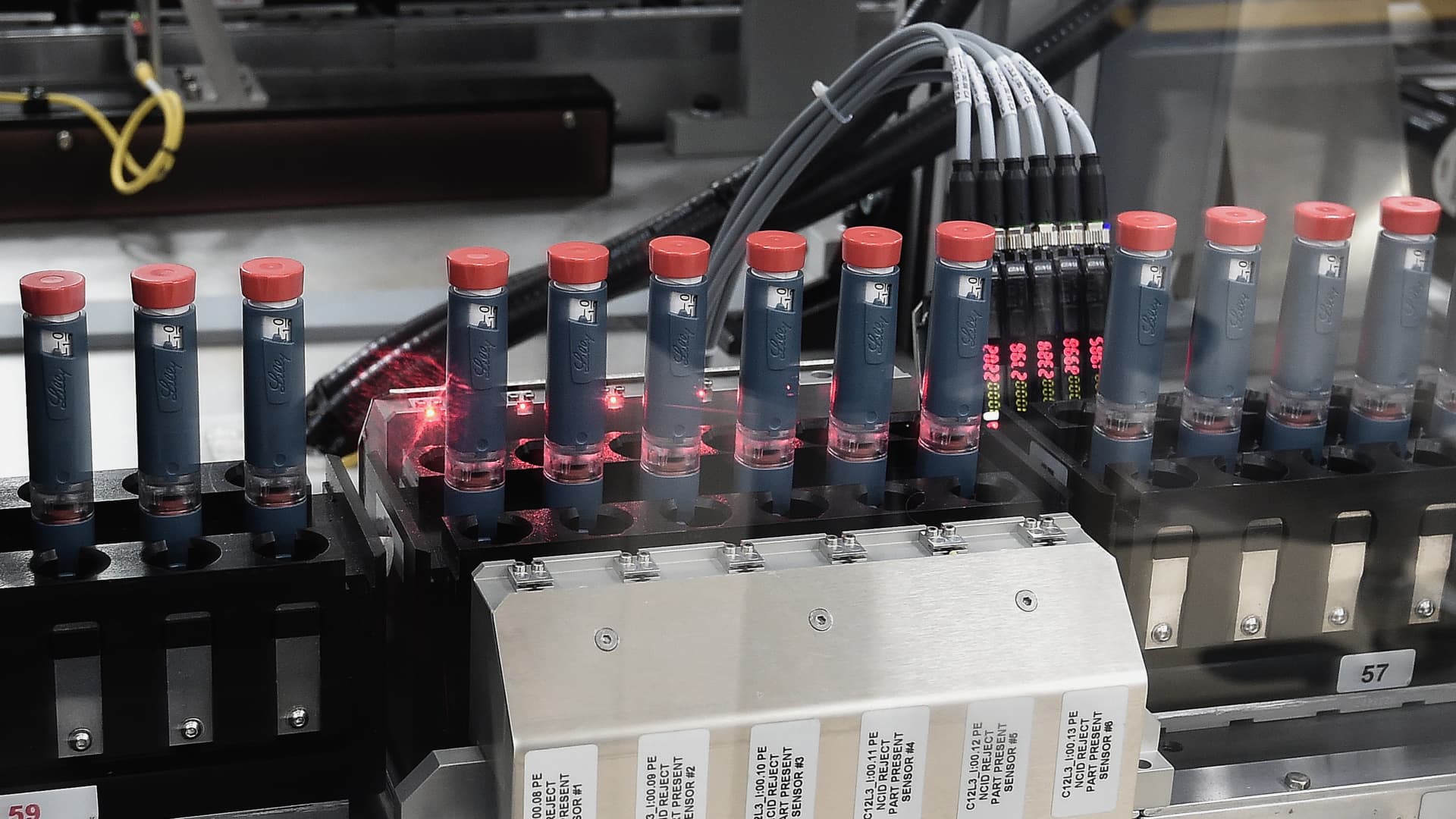
This picture shows an unit dedicated to the production of insulin pens at the factory of the US pharmaceutical company Eli Lilly in Fegersheim, eastern France.

Frederick Florin | AFP | Getty Images

As the old Wall Street adage goes, health care tends to underperform the stock market in presidential election years — and in recent cycles, that’s been true. But, there’s reason to believe this year that many health-related stocks, led by Eli Lilly, could defy historical convention.

Categories
Science

Fed’s First Multi-Website Offshore Wind EIS is Ridiculous – Watts Up With That?

From CFACT

David Wojick

After numerous requests going back several years, the Bureau of Ocean Energy Management has finally published a draft Programmatic Environmental Impact Statement for a combination of coming offshore wind projects. Comments are due by February 27.

See here for details and documents.

In his case, the EIS is for a cluster of six big projects in what is called the New York Bight. The Bight is a triangular indentation on the Atlantic coast bounded by New York and New Jersey. Think of it as the underwater mouth of the Hudson River.

In principle, this PEIS should identify and assess those impacts that arise from the combination of projects, over and above the individual project impacts. In fact, it does nothing of the sort. The result is simply ridiculous.

Most of the 800 or so pages are an eye-glazing academic discussion of the general environment, the sorts of impacts that might or might not occur, and what might or might not be done about them. There is basically nothing about this specific combination of projects.

The greatest concern is that the combined noise from these six projects will severely harm whales and other protected species. This is especially true for the incredibly loud noise from driving the monster monopiles that hold up the giant wind turbines. Construction of all six projects may occur simultaneously, piling on the noise.

Here, the PEIS is simply absurd. It is structured like a project EIS, so the pile-driving impacts are supposedly addressed in a technical appendix on “acoustics”. In this case, it is “Appendix J: Introduction to Sound and Acoustic Assessment”.

That it is labeled an introduction is the tip-off as it is basically an academic treatise. In fact, it starts off by explaining at length how underwater sound is measured. We do finally get to the Bight, but that is about it. What we find is a regurgitation of an academic paper that bears no resemblance to the six projects this assessment is supposed to be about.

To begin with, it uses just two theoretical sites, with a mere 60 turbines each, for a total of 120. BOEM says these six real sites are expected to develop up to 7,000 MW of generating capacity. Recent site designs use 13 MW turbines, which would give about 540 turbines or almost five times more.

But the PEIS study uses noise levels from small 6 MW turbines. At that size, we are talking about more like 1,200 turbines, or roughly ten times as many as are considered. The potential impact of 120 turbines is clearly not helpful in assessing 1,200.

Even worse, the pile driving noise level is for driving a roughly 20-foot diameter pile, which is very small by present and future standards. Today’s 13 to 15 MW turbines use piles around 40 feet in diameter. Moreover, gigantic 20 MW turbines have just been introduced, which might take 60-foot diameter piles.

The noise level is based on the energy of the pile driving hammer, and bigger piles take a lot more energy to drive, so there is a lot more noise. One wonders why BOEM did not measure the noise from the much bigger piles being driven back in July just off Rhode Island. The answer seems that BOEM did not want to put any serious work into this PEIS.

In short, the academic acoustic case considered in the PEIS tells us absolutely nothing about the potentially huge noise impact of the six projects supposedly being assessed. There is literally no environmental impact assessment here.

This vacuum seems to hold for pretty much the entire PEIS, although I have not read it all by any means. But I looked in a lot of places and have yet to find any real assessment of the six projects. There is certainly nothing of substance on noise.

As environmental impact statements go, this one is a joke.

Like this:

Like Loading…

Categories
Sport

Warriors assistant Dejan Milojević, 46, dies after coronary heart assault

Jan 17, 2024, 03:26 PM ET

Golden State Warriors assistant coach Dejan Milojević, a mentor to two-time NBA MVP Nikola Jokic and a former star player in his native Serbia, died Wednesday in Utah after suffering a heart attack, the team announced. Milojević, part of the staff that helped the Warriors win the 2022 NBA championship, was 46.

Milojević died in Salt Lake City, where he was hospitalized Tuesday night after the medical emergency happened during a private team dinner. The Warriors had been scheduled to play the Utah Jazz on Wednesday night, a game the NBA postponed.

“We are absolutely devastated by Dejan’s sudden passing,” coach Steve Kerr said in a statement released by the team. “This is a shocking and tragic blow for everyone associated with the Warriors and an incredibly difficult time for his family, friends, and all of us who had the incredible pleasure to work with him.”

Milojević was in his third season with the Warriors. He previously coached in Serbia — where he once worked with a young Jokic before the now-Denver Nuggets star came to the United States — along with Montenegro. He had been a head coach for eight years in Europe and previously was an assistant coach for the Serbian national team alongside current Atlanta assistant Igor Koskoskov.

“The NBA mourns the sudden passing of Golden State assistant coach Dejan Milojević, a beloved colleague and dear friend to so many in the global basketball community,” NBA Commissioner Adam Silver said. “In addition to winning the 2022 NBA championship in his first season with the Warriors and mentoring some of the best players in the world, Dejan had a decorated international playing career and was a distinguished head coach in his native Serbia.”

Milojević worked closely with Jokic, Los Angeles Clippers center Ivica Zubac, Orlando center Goga Bitadze and Houston center Boban Marjanovic, among others, during his time as a coach in Europe. With the Warriors, he worked primarily with the big men like Kevon Looney, who raved about Milojević’s attention to detail.

“Rest in peace, Deki,” Dallas Mavericks star Luka Doncic wrote on social media.

Kerr said he originally learned of Milojević from Kent Lacob, the son of Golden State owner Joe Lacob. And when the Warriors went through some staffing changes in 2021, Kerr decided to pursue Milojević. It took some convincing, but Milojević finally agreed to take the offer. Kerr was thrilled.

“I immediately saw what Kent was talking about,” Kerr said in a video produced by the Warriors last year. “He was so great to be around. At the same time, he had this amazing basketball background both as a player and a coach. It made so much sense for us to bring Deki in.”

Milojević won three consecutive MVP awards in the Adriatic League, taking those trophies in 2004, 2005 and 2006 when the 6-foot-7, 240-pound power forward was at the peak of his playing career. Jokic was MVP of that league in 2015, a year after current Golden State forward Dario Saric was MVP.

No player has more Adriatic MVPs than Milojević, and the stories of some games in his youth were legendary. Among them: how he scored 141 points as a 14-year-old in 1991, with 83 of those points coming in the second half after his coach ordered he take all the shots.

“I teach all my players that basketball is not a job, but that they should enjoy the game,” Milojević told Bosnian radio-television outlet RTV in a 2018 interview. “Because if you want to do something for the next 20 years, then you have to love it a lot. It’s not easy to endure all these efforts if you don’t like something. Only those who have a sincere love for the game can handle everything with great success.”

Before joining the Warriors, Milojević had NBA experience through Summer League assistant-coach stints with Atlanta, San Antonio and Houston.

Toronto coach Darko Rajaković said he had known Milojević since he was a teenager.

“He was a role model as a player, as a man, as a husband, as a coach — somebody that I really admired and have a lot of respect for,” Rajaković said. “Unfortunately, last night, his heart stopped working and he left his wife and two kids behind and a big, big legacy. This is a really sad day for the whole NBA community.”

Tributes like those began pouring in after Milojević’s death was announced, from teams he worked with and even teams he didn’t. “I had the pleasure of working with Dejan during my time with the Warriors,” former Golden State assistant and current Sacramento coach Mike Brown said. “Not only was he an extremely talented coach, he was an even better person.”

Added Dylan Ennis, a longtime international pro who was once coached by Milojević: “You were not only a basketball master, you were an amazing human being. You will be missed by so many.”

A rescheduled date for the Warriors-Jazz game was not immediately announced. The Jazz said tickets for Wednesday night would be honored at the rescheduled game. Golden State is next scheduled to play at home Friday against Dallas.

Milojević is survived by his wife, Natasa, and their children, Nikola and Masa.

“Their loss is unfathomable,” Kerr said.

Categories
Entertainment

Halle Bailey Shares Child Bump Video W/ Sister Chloe (Watch)

Halle Bailey is continuing to share snippets of her formerly hidden pregnancy with social media users! As The Shade Room previously reported, the singer-and-actress revealed she gave birth to her and her boyfriend DDG’s first child earlier this month.

Since then, the 23-year-old has given folks a look at her postpartum body, goals, and maternity shoot.

RELATED: Snap Back! Halle Bailey Shares A Look At Her Post-Baby Body & Fitness Goals (PHOTOS)

More Details On Halle Bailey’s Baby Bump Video Alongside Chloe

On Wednesday, January 17, Bailey took to her Instagram Story to repost a TikTok posted initially to her sister Chloe’s account. In the clip, the duo danced to Sexy Redd’s single ‘Rich Baby Daddy,’ featuring Drake and SZA.

Halle, who appeared several months pregnant then, rocked a black sports bra and grey sweatpants. Chloe donned a black corset and matching Victoria’s Secret Pink two-piece sweat suit.

Check out the sister’s dance ensemble below.

Chloe Bailey has not publicly commented on her sister’s private pregnancy and birth of her nephew, Halo. However, the singer also took to X, formerly Twitter, to share the clip with some laughing emojis.

🤣🤣🤣 pic.twitter.com/gXvQFgddJ8

— Chlöe (@ChloeBailey) January 17, 2024

Furthermore, Halle also took to X, to repost the video with additional emojis.

😭🤣🩵✨ https://t.co/j4vz1fcerO

— Halle (@HalleBailey) January 17, 2024

Social Media Reacts

Social media users wasted no time entering Chloe Bailey’s comment section on X to share their reactions. One user jokingly came down on the singer for also keeping her sister’s pregnancy private.

so you KNEW?? pic.twitter.com/q2pEAYNzTS

— dre coulee’ (@dre__cole) January 17, 2024

Another user applauded Halle’s support system.

okay but can we talk abt Halle’s support system 🥰 nobody said a word leaked or drop hints that’s how u do it !!!!

— Da Original T Nasty👅 (@muneyhongrey_) January 17, 2024

Meanwhile, Instagram users also chimed in in The Shade Room’s comment section.

Instagram user @__lipstickjunky wrote.

“Yall so mad she enjoyed her PRIVATE pregnancy 😂😂 yall need to go pray”

While Instagram user @shawtyb00m added.

“I’m actually enjoying seeing the little snippets of her pregnancy! lol so cute. I’m glad she was able to enjoy her pregnancy in peace”

Instagram user @unchelltered wrote.

“While y’all was on here arguing, sis was making tik toks with her sister having a happy pregnancy 😂😂😂😂😂 I love this!”

Here’s What We Know Thus Far About Halle Bailey’s Pregnancy

As The Shade Room previously reported, Halle Bailey was spotted walking with her boyfriend in October 2023. At the time, social media users speculated she was pregnant due to her oversized clothing and what appeared to be a protruding bump.

Earlier this month, the 23-year-old took to Instagram to share a photo of her and DDG holding an infant’s hand. In the picture, the baby wore a bracelet that read, “Halo.” Additionally, Halle confirmed that the infant was their son.

RELATED: Congrats! Halle Bailey & DDG Reveal They’ve Welcomed Their First Child Together! (PHOTO)

Since then, the new mother has shared a look at her postpartum body while revealing her fitness goals, per The Shade Room.

Additionally, the 23-year-old even shared a look at her underwater-themed maternity shoot.

RELATED: Awww! Halle Bailey Shares Photos & Footage Of Her Underwater Maternity Shoot

Categories
Technology

Dutch startup nets €8M for ‘quantum modem’ tech

Delft-based QphoX just raised the biggest round of a Dutch quantum startup to date. The €8mn will aid the company in its mission to develop core hardware required to allow quantum computers to communicate over an optical network — a quantum “modem,” if you will.

As the quantum computing ecosystem continues to develop globally, it is becoming increasingly clear that no one company will be responsible for “the” quantum breakthrough. Rather, it will come from a combination of companies all working on solving their specific part of the puzzle.  

QphoX’s technology supports quantum transduction, i.e. the process of converting quantum information from one form of physical system to another. This will enable the scalability of large quantum computing systems within data centres. Ultimately, the company says, this could form the backbone of a future quantum internet.

The quantum internet would represent a major milestone in communication technology, essentially utilising the principles of quantum mechanics for entirely new ways of transmitting information. 

It would be, among other things, un-hackable, and enable quantum teleportation, i.e. the transfer of quantum states from one location to another without physically moving the particles that make up those states. Most likely, it will also introduce entirely new applications, some of which we cannot yet imagine.

Part of a growing Dutch quantum ecosystem

TNW Conference 2024 – Speakers announced!

Meet the powerhouse experts that will take the stage on June 20 & 21 in Amsterdam and save your seat today.

But we are getting ahead of ourselves — back to QphoX and the news at hand. The €8mn funding round is led by QDNL Participations, a €15mn fund aimed at bridging the gap between the grant-giving phase of quantum research and venture investment. The EIC Fund, and existing investors Quantonation, Speedinvest, High-Tech Gründerfonds, and Delft Enterprises also participated. 

“We are very grateful to be entrusted by our investors to build the technology that will enable real quantum computing applications. At the moment, we are the only company with the transduction hardware at a performance level that will allow quantum systems to connect through optical quantum channels,” said QphoX co-founder and CEO Simon Groeblacher. 

QphoX is something so rare as a tech startup with gender balance. Credit: QphoX

The Netherlands may be a small country, but its growing quantum ecosystem is emerging as a leader in specialised quantum technologies. There are five specific innovation hubs under the umbrella of Quantum Delta NL (QDNL) — in Delft, Leiden, Eindhoven, Amsterdam, and Twente. 

Its €15mn QDNL Participations fund has already invested in other technology-leading quantum startups, including QuantaMap, QuantWare, Fermioniq, and Q-bird. 

Chad Rigetti, venture partner and lead investor at QDNL Participations will join the QphoX advisory board. “Quantum transduction, and the ability to interconnect modular quantum computers over an optical network, is a breakthrough capability that could shift how we think of building large scale quantum computers and the quantum internet,” he said, adding that QphoX is the “clear leader” in its category.

Categories
Health

Renewed curiosity in ADCs will proceed in 2024

Medical personnel use a mammogram to examine a woman’s breast for breast cancer.

Hannibal Hanschke | dpa | Picture Alliance | Getty Images

SAN FRANCISCO — An established but promising group of cancer drugs was a red-hot market in 2023, and more companies could look to the treatments to fuel growth in the year ahead.

That was one clear takeaway from the JPMorgan Healthcare Conference in San Francisco, the nation’s largest gathering of biotech and pharmaceutical executives, analysts and investors. 

During the four-day event, the biotech and pharmaceutical industry signaled its enthusiasm for antibody-drug conjugates, or ADCs, which deliver a cancer-killing therapy to specifically target and kill cancer cells and minimize damage to healthy ones. Meanwhile, standard chemotherapy is less selective – it can affect both cancer cells and healthy cells.

Johnson & Johnson last week announced a $2 billion acquisition of ADC-developer Ambrx Biopharma to beef up its existing pipeline of ADCs, which some researchers believe could be heralding a “new era” for cancer treatment. Other drugmakers such as Pfizer and Merck, which closed some of the more than 70 ADC-related deals over the last year, said those drugs will be key growth drivers for their businesses. 

Interest in the drugs will only continue this year, as some analysts expect more dealmaking and advancements in ADCs currently in development.

The factors fueling the recent rise of ADCs will not abate this year, and a fear of missing out among businesses that have not entered the market will only push more companies to enter the space, Andy Hsieh, an analyst at William Blair & Company, told CNBC. 

Those factors include increased confidence in ADC technology among companies and researchers, the potentially longer market exclusivity of those drugs and the rise of attractive ADCs from drugmakers in Asia.

The drugs also have potential to draw huge profits: ADCs could account for $31 billion of the $375 billion worldwide cancer market in 2028, according to a report citing estimates from the drug market research firm Evaluate. The market for those drugs in 2023 was estimated to be worth around $9.7 billion, another report from research firm MarketsandMarkets said.

“It’s kind of like FOMO, right? Everyone wants to gain exposure to [ADCs] and basically make it a cornerstone of their entire corporate strategy,” Hsieh told CNBC. “I really don’t see any sort of slowing down and it will very much, in our view, be a continuation of the 2023 momentum.” 

Why ADCs have become popular

ADCs aren’t new.

Roughly a dozen have won approvals from regulators worldwide, with the earliest coming in 2000. But dealmaking started to pick up in 2020 and “really take off” in 2022 and 2023, according to Daina Graybosch, senior research analyst at Leerink Partners covering immuno-oncology.

She called the recent rise of ADCs a “multi-decade innovation cycle,” where it took several years for the industry to make some “fundamental transformative innovation, which then unlocked more investment and a lot more potential.”

Improvements in ADC technology appeared to have made some newer iterations of the drugs more safe and effective, which boosted the industry’s confidence in their potential and encouraged more investments in the space. The steady surge of approvals and acquisitions over the last several years also contributed to that confidence, convincing some companies that ADCs have a “lower-risk development path,” Hsieh said.

A view of an AstraZeneca facility is seen during Prime Minister Scott Morrison’s visit on August 19, 2020 in Sydney, Australia.

Lisa Maree Williams | Getty Images News | Getty Images

Graybosch highlighted an ADC jointly developed by AstraZeneca and Japanese drugmaker Daiichi Sankyo called Enhertu, which she called the first of “the next-generation ADC” that had a greater breadth of treatment compared to older versions of the drugs. For example, Enhertu became the first ADC to show the ability to treat breast cancer patients with both high and low levels of a protein called HER2, which controls how breast cells grow, divide and repair damage.

Drugmakers have fine-tuned key components of ADCs over the last several years, such as the chemical bond that helps those drugs deliver a cancer-killing therapy to cancer cells, according to William Blair’s Hseih. He said companies are learning how to maximize the efficacy of those drugs “without getting into too much side effects.”

ADCs still have their drawbacks — for example, cancer tumors can develop resistance to them over time. And not all newer ADCs in development are successful: Last month, Sanofi scrapped its only experimental ADC after it fell short in a late-stage trial in lung cancer patients.

Graybosch also noted that companies from Japan and China have emerged as effective ADC developers that are rapidly “innovating tweaks” to the drugs and bringing ADCs to the market that could be better than older versions of the drugs.

U.S. and U.K.-based companies are inking deals with those international drugmakers, such as two licensing agreements GSK signed late last year with Chinese-based Hansoh Pharma for ADCs targeting several types of cancer.

The complexity of ADC technology has likely become another motivation for companies to invest in and develop the drugs, Hsieh noted. He said it could reduce the chances that other companies will create biosimilars, allowing drugmakers to keep ADC prices high for longer periods of time. 

Gilead’s approved ADC for breast cancer, Trodelvy, has a U.S. list price of more than $2,000 per vial. But some ADCs on the market have far higher list prices: An advanced ovarian cancer drug from biotech company ImmunoGen costs more than $6,000 per vial as of 2022.

List prices are before insurance and other rebates.

How some drugmakers are betting on ADCs

Merck now expects $20 billion in new cancer drug sales by the early to mid-2030s, thanks in part to its recent investments in ADCs, executives announced during the conference. That’s double the estimate the company provided during the same conference last year. 

The raised forecast signals Merck’s confidence in the future of its cancer drug offerings, even as its blockbuster immunotherapy Keytruda nears a loss of exclusivity in 2028. That will expose it to generic competition. 

Merck executives highlighted its up to $5.5 billion licensing agreement with Daiichi Sankyo to jointly develop three of the Japanese drugmaker’s experimental ADCs. This year, the company hopes to win an approval for one of those ADCs for the treatment of non-small cell lung cancer. 

“….We have a leading position now in antibody-drug conjugates, and we’ve done that through what I think is very smart deal-making,” Merck CEO Robert Davis said. He added that “what all of that really translates to is the potential for growth.”

Newly built Merck research facility located at 213 E Grand Ave in South San Francisco.

JasonDoiy | iStock Unreleased | Getty Images

Pfizer hopes ADCs will help the company turn around after a rocky 2023. Shares fell roughly 40% last year as Pfizer grappled with weakening demand for its Covid products and other commercial missteps. 

Pfizer CEO Albert Bourla told reporters that the company’s $34 billion acquisition of ADC-developer Seagen would help restore investor confidence in Pfizer, especially now that the deal is officially closed. 

Bourla noted that antibody-drug conjugates have become the hottest area of oncology, adding that Seagen’s expertise in ADCs will give Pfizer a huge advantage in developing those drugs further and establishing itself as a leader in cancer treatment. 

Pfizer believes the Seagen acquisition will bring in more than $10 billion in risk-adjusted sales by 2030. Seagen specifically brings four approved cancer drugs, including three ADCs, which will beef up Pfizer’s own ADC portfolio.