Categories
Science

China Names its Capsule and Lander for its Upcoming Human Lunar Missions

In a recent announcement, the Chinese Space Agency (CSA) unveiled the names for its forthcoming lunar mission components. The CSA have been working towards sending humans to the Moon through a series of robotic missions. The 22-tonne capsule that is taking the astronauts to the Moon is called Mengzhuo (translates to ‘dream vessel’) and the lander has been named Lanyue (meaning ‘embracing the Moon’). Assuming all goes to plan, they will send two humans and a rover to the surface of the Moon by 2030.

Despite the fact that the CSA have not published a date for the mission yet, if all goes well then they will become the second country to get humans to the lunar surface. The capsules will launch to the Moon atop their new super-heavy-lift carrier rocket named Long March 10.

According to Chinese state media, the Mengzhou spacecraft will include the re-entry module designed to house the astronauts and will also function as a control centre. In addition to this, there will be the service module that is home to power and propulsion systems.  Overall, Mengzhou will be 9 metres long and weigh in at 22 tons. 

In an attempt to get the public involved in the mission, the names of the craft were picked by a group of experts from nearly 2,000 ideas put forward by the public. The names have history too. ‘Lanyue’ first appeared in a poem written by Mao Zedong (the founder of People’s Republic of China) in 1965. It symbolises the Chinese aspirations and confidences in their exploration of the Universe. The name ‘Mengzhou’ is linked to the Chinese nations dream of landing on the Moon. 

That same dream is shared by President Xi Jinping with the goal of revitalising the nation and establishing itself as a prominent technological country. The aspirations for lunar exploration are on par with many other countries that wish to enhance their space capability.  Doing so may yield scientific discoveries, national prestige and opportunities for identifying resource supplies to facilitate deeper space exploration. 

This all comes when the United States are also gearing up with their Lunar hopes, in particular trying to get humans to the Moon in 2026 as part of the Artemis program. If successful then it will mean NASA will have got back to the Moon over 50 years after their first visit.

The Chinese mission comes after a successful series of unmanned lunar probes, the Chang’e missions which, in 2019 became the first to achieve a landing on the far side of the Moon. The series hasn’t stopped there though. Chang’e 6 is scheduled to launch later this year and aims to retrieve the first ever samples from the far side of the Moon.

Source : China Names Its Manned Lunar Exploration Vehicles Mengzhou, Lanyue

Like this:

Like Loading…

Categories
Health

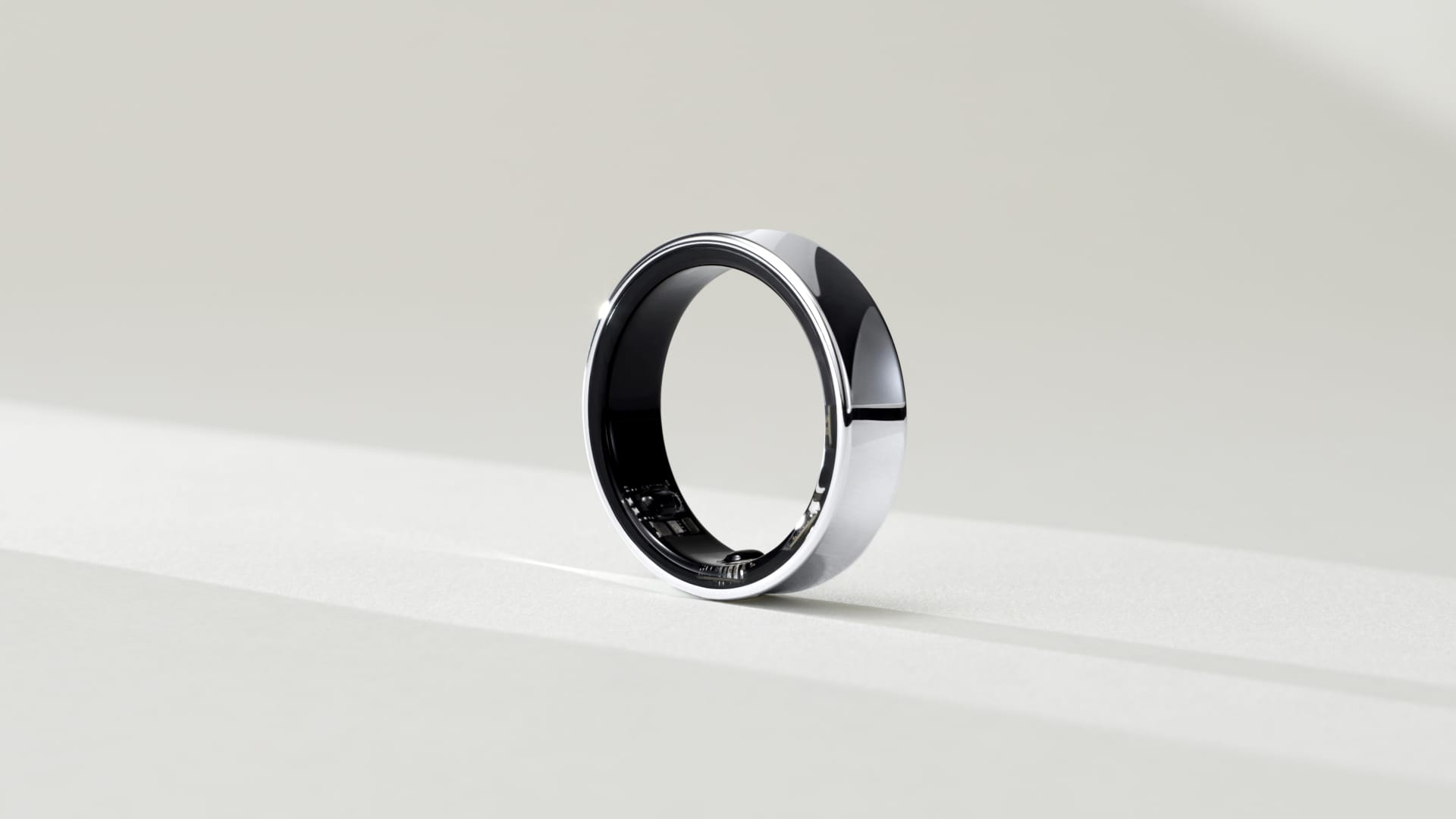
Samsung Galaxy Ring: specs, options, launch date

The Samsung Galaxy Ring has various sensors to track things like heart rate.

Samsung

BARCELONA, Spain — Samsung’s Galaxy Ring, its latest wearable, is launching with health-tracking features including heart rate and sleep monitoring while also giving users a score of their readiness for the day, a top executive told CNBC.

In a wide-ranging interview, Hon Pak, head of the digital health team at Samsung Electronics, discussed the company’s first foray into the product category of rings, considerations for a subscription model for the Samsung Health app and his vision for an artificial intelligence “coach.”

Samsung teased the Galaxy Ring in January during the news conference when it launched the S24 smartphone. The South Korean tech giant is putting it on display for the first time at the Mobile World Congress in Barcelona, which kicks off Monday.

Samsung Galaxy Ring features

Pak said the ring, which is fitted with sensors, will be able to give readings on heart rate, respiratory rate, the amount of movement made during sleep and the time it takes a person to fall asleep once in bed.

He also said the ring will be able to give a user a “vitality score” which “collects data about physical and mental readiness to see how productive you can be.”

All of that will be accessible through the Samsung Health app.

The ring is set to go on sale this year, but Pak did not give a timeline or the pricing.

Pak also said the company is considering adding a feature that would allow the Galaxy Ring to do contactless payments, as with smartphones.

“We have a whole … team that is looking at that. But I think clearly looking at multiple different use cases for the Ring beyond just health, for sure,” Pak said.

The Samsung executive also said the company is working on noninvasive glucose monitoring as well as blood pressure sensing through its wearable devices.

“I think we have some ways to go,” Pak said of noninvasive glucose monitoring. Currently, people use devices that pierce the skin to check glucose levels. A noninvasive way to do that would be a huge step.

Samsung ecosystem play

Samsung is hoping that various devices will boost its positioning in health, an area it has been working on for several years.

The company has its smartphones and smartwatches. The Galaxy Ring is the newest product category in health. Samsung said the decision to launch a “smart ring” was driven by its customers.

“Our own customers told us, I want choice. I want the ability to have other forms of wearables to measure health,” Pak said. “And some want to wear the watch, some want to wear the watch and the ring and get benefit from both. Some just want more simplicity.”

The Samsung Galaxy Ring will work in conjunction with Samsung’s smartwatches.

Samsung

Pak confirmed that when the smartwatch and Ring are worn together, users will be able to get different health insights.

Samsung is not the first company to launch smart rings. There are a handful of other players such as Oura.

Previous generations of Samsung’s flagship smartphone, such as the S7, have sensors that track things like heart rate. Users could put their finger on the sensor and it would give a reading. Samsung has done away with those sensors on its phones, especially since it has smartwatches that offer these features.

However, Pak did not rule out the possibility that future smartphones would have health sensors on them.

“Mobile is still very pervasive and so I think there are reasons why we may want to put a sensor on a mobile versus having it on a wearable,” Pak said.

AI ‘coach’

Pak discussed how artificial intelligence will play a role in Samsung’s health services. AI can help make sense of all of the data these devices are collecting. And ultimately, Pak’s goal is to get the AI to give deeper insights into a person’s health.

He said large language models, which are AI models trained on huge amounts of data and that underpin applications like chatbots, can help to give greater insights.

“Imagine that large language model, acting as my digital assistant, while looking at the context of my medical records, my physiological data, my engagement with a mobile device, the wearables during all of that … begins to bring greater insights and personalization opportunities,” Pak said.

“There’s a digital assistant coach in the future, because we think that’s absolutely needed,” the Samsung executive said.

Pak described a scenario in which a digital assistant offers health advice in the right tone and context, saying “our ability to change our behavior becomes much greater.”

Bixby, Samsung’s digital assistant, could have a part to play, Pak said.

“So we are exploring various different ways in which the human computer interface will change over time. … And so we think Bixby with speech represents a significant part of that option. But we don’t think it’s the only option. But Bixby potentially combined with large language models can be a phenomenal game changer. And we’re obviously having that conversation,” Pak said.

The executive also said the company is “considering” a subscription service for its Samsung Health app, but that the capabilities and insights it offers need to be improved before that can happen. AI assistants can help.

“If you’re going to really make me pay for something, you better give me something that’s more end to end that’s more comprehensive” in terms of health insights, Pak said.

Categories
Sport

How NCAA Division I conferences take care of court docket storming

Feb 26, 2024, 12:13 PM ET

More than half of the NCAA’s 32 Division I conferences say that they either have no policy on court storming or that their crowd-control approach covers storming without specifically mentioning it, according to an analysis by ESPN.

Eleven conferences — the Atlantic 10, Big East, Big South, Big Ten, Big 12, Conference USA, Mid-Eastern Athletic, Pac-12, WAC, Southeastern and West Coast — recently told ESPN that the home school for a court storm could be subject to a fine under certain circumstances. Some have precise penalties, while others have general language regarding disciplinary measures and their applicability.

The ACC, which saw fans from one of its schools — Wake Forest — storm their home court after defeating Duke on Saturday, does not have a fine structure or disciplinary measures for when fans rush the court, according to information provided to ESPN. Each school manages its own events. The conference does have some requirements for keeping officials and visiting teams safe and helping them off the floor.

“Across college athletics, we have seen far too many of these incidents that put individuals at serious risk, and it will require the cooperation of all — including spectators — to ensure everyone’s well-being,” ACC commissioner Jim Phillips said in a statement after the incident at Wake Forest. “As a conference, we will continually assess with our schools the best way to protect our student-athletes, coaches, and fans.”

Many conferences have guidelines that emphasize the need for visiting teams and game officials to have a safe way to exit before crowds reach the floor, and numerous conferences require schools’ action plans in writing.

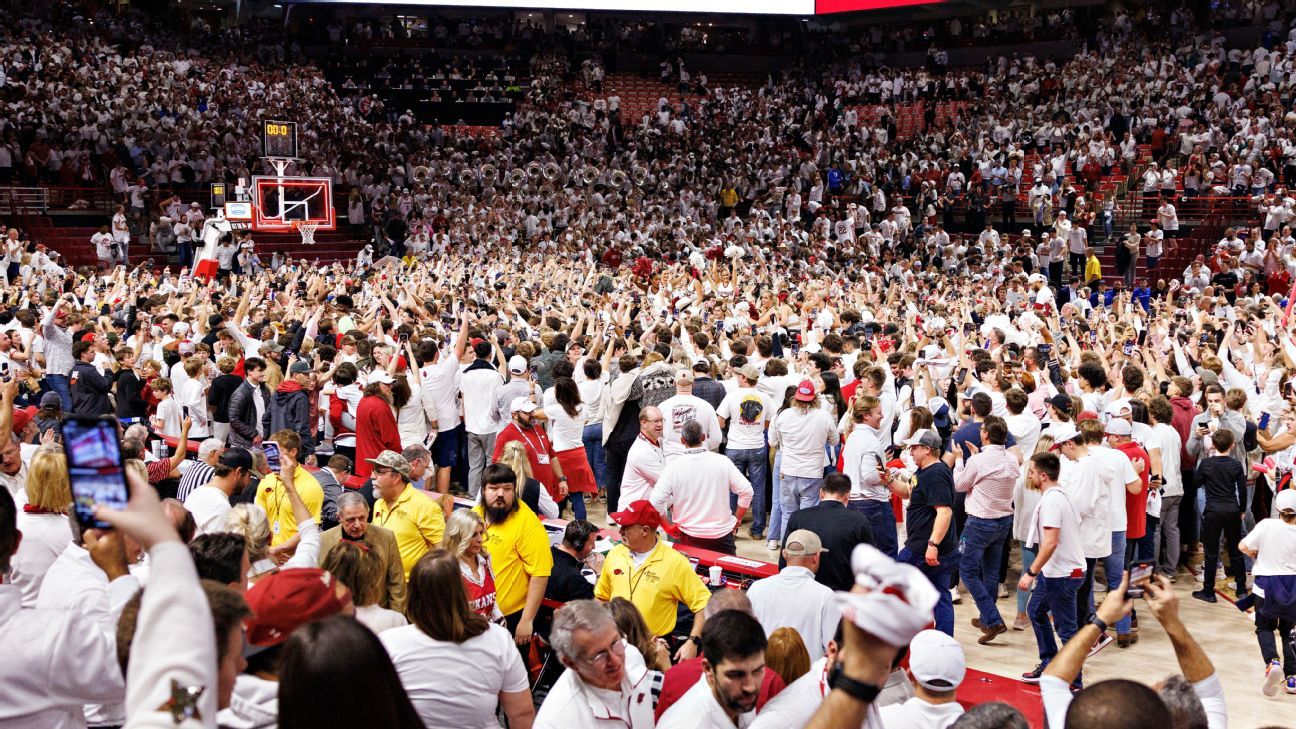
According to an ESPN review, although official statistics aren’t available, there have been about three court storms a week over the past three months in college basketball. On Feb. 21, during a three-hour span, there were episodes in Louisiana, Pennsylvania and Virginia.

Editor’s Picks

2 Related

Questions about conference policies and procedures nationwide arose last month after Iowa women’s basketball star Caitlin Clark collided on the court with an unidentified woman during a court storm at Ohio State on Jan. 21.

Debate over storms surfaced again Saturday after what happened at Wake Forest. Seconds after the Demon Deacons’ 83-79 win, fans streamed onto the court and an unidentified fan ran into Duke’s 7-foot center Kyle Filipowski, who appeared to suffer a hit to his right leg and then hobbled off the court with the help of teammates. The scene prompted Duke coach Jon Scheyer to call for a ban on court storming. In comments after the game, Wake Forest coach Steve Forbes agreed.

Other recent incidents have contributed to questions about whether storming the court should be banned, and if so, how? The same day as the Clark collision, a fan in New Orleans put his hand on the back of Memphis player David Jones as Tulane fans stormed the court. Jones wasn’t injured. Tulane apologized and condemned the incident.

Arkansas fans storm the court after an 80-75 home win against Duke on Nov. 29. Wesley Hitt/Getty Images

In the final second of Kansas State’s 75-70 home overtime win against Kansas on Feb. 5, as fans were seen preparing to run onto the court, men’s coach Jerome Tang and his staff motioned to them during a timeout, imploring them to remain in the stands and not storm the court — fans had stormed last season after a home win against KU. In postgame comments after this season’s win against the Jayhawks, Tang said he wants to build a program that expects to win.

“I never see them storm the court at Allen Fieldhouse,” Tang said. “I never see them storm the court at Duke and North Carolina, and I don’t believe there’s any reason why, given time, and the opportunity, that we can’t build that kind of a program here at Manhattan, Kansas.”

NCAA president Charlie Baker told ESPN in a Feb. 20 interview — before Filipowski got injured — that he understands why people want to storm courts, “but I think the risks, especially given the stakes involved for a lot of these young people, are pretty high.

“If we could move away from this, I think it’s a decision that’s got to be made at the conference level.”

So what are conferences doing? Of the 32 D-I conferences ESPN contacted after Clark’s collision, all 32 replied with information on their court-storming policies and approaches, and 11 said the home school for a court storm could be subject to a fine under certain circumstances. Here’s a breakdown of those 11 conferences’ financial penalty policies:

• SEC: The conference imposes fines “for any field or court rush that occurs when the visiting team and/or game officials are still on the playing surface.” Additionally: “In all sports, institutions shall limit access to the competition area to participating student-athletes, coaches, officials, support personnel, and properly credentialed or authorized individuals at all times.”

The conference has a 20-year history of assessing fines. In 2004, the structure was $5,000 for a first offense; $25,000 for a second and $50,000 for a third. The league increased the amounts in 2015 to $50,000, $100,000 and $250,000, respectively. Another update in 2023 boosted the fines to $100,000, $250,000 and $500,000 for a third and each subsequent offense. The commissioner can impose additional penalties. For conference games, the money goes to the visiting school.

The SEC has imposed nearly $3.9 million in fines on its schools over the past 20 years for fans storming basketball courts or football fields, according to figures provided to ESPN. Fines totaled nearly $1.3 million in penalties as a result of “access to competition area” violations in men’s basketball. Vanderbilt ($630,000) and Arkansas ($355,000) rank atop the league for fines from men’s basketball court storms. The conference imposed $2.6 million in football fines — LSU ($605,000) and Auburn ($505,000) received the most for football field incidents. No fines have been levied because of women’s basketball court storms.

“While fines don’t impact the immediate decision-making process of fans, they do provide an incentive from universities to develop strategies,” SEC commissioner Greg Sankey said in a report by The Athletic last June about the SEC’s announcement of its newly increased fines. Sankey said part of such thinking concerns “allowing people to celebrate, but not do so necessarily on the field or court.”

The SEC’s structure of penalties, all in six figures, is exponentially higher than any other conference’s. But critics say the effectiveness of such punishments in sending a forceful message and serving as a deterrent is questionable at best.

“I appreciate the fining, but don’t think it’s well thought out,” said two-time player of the year Nancy Lieberman, an adamant opponent of storming. A two-time AIAW national champion, Lieberman said she felt uncomfortable during court storms when she was at Old Dominion (1976-80) and that the situation in the game is much worse now. “I’d make the first offense $500,000; why wait for the third? Put your foot down so it won’t happen again, there should be no redo or mulligan.”

Said ESPN analyst Jay Bilas, a former Duke player: “When a school gets fined by the conference for a court storming after a big win that they enjoy, they round up the money from their boosters to pay and they basically say, ‘We’ll be glad to pay it.’ It doesn’t make any sense, and it sends a contradictory message.”

While Bilas opposes court storming, his fellow “College GameDay” analyst Seth Greenberg supports it, as long as proper safety protocols are in place. But the former D-I coach, who experienced storms firsthand, shares in the skepticism over fines imposed by the SEC and other conferences.

“Let’s face it, most of those schools, when you have that moment, you’re willing to pay the fine,” Greenberg said. “Because that’s a great marketing tool for your university in terms of showing really the synergy between the student body, athletic department and the institution.”

Duke player Kyle Filipowski was injured when Wake Forest fans stormed the court after the Demon Deacons beat the Blue Devils. Is this the tipping point for change to be made regarding the rules for court storming? Cory Knowlton-USA TODAY Sports

• Big Ten: A discretionary fine can result on a third offense for failure to “provide adequate security for visiting teams from their arrival for a game through their departure.” There is a private reprimand for a first offense; a public reprimand for second.

Nebraska, which has had three storms in Big Ten home games since the start of 2024, including after the women defeated Clark and No. 2 Iowa on Feb. 11, declined ESPN’s requests to interview athletic director Trev Alberts and other administrators, but provided a statement from Alberts, saying in part: “The issue is not the home team and its fans, it is the safety of the visiting team. This is an area where we can do a better job as schools and as a conference and there must be clear protocol in place to make sure the opposing team gets off the court safely. It is important for schools to communicate that plan, and that the opposing team adheres to the plan that is in place.”

A Nebraska spokesperson said the school modified its protocol after fans stormed the court following a men’s win against No. 1 Purdue in January — so a visiting team would have “a more direct and expedited path off the court.” He added that the new approach was in effect when fans stormed the court after the Huskers men defeated Wisconsin in February.

The Big Ten did not announce a reprimand or penalty for Nebraska, so it is not known whether the conference deemed that any of the three Huskers storms violated policy or whether the conference issued a private reprimand. The Big Ten confirmed those possibilities and said there have been no situations this season that have risen to the level of a public reprimand, let alone a fine.

• Big 12: Fines are implemented “when the safety of game participants is compromised,” and all court/field storming incidents are reviewed to determine whether safe passage was provided for visiting team players/personnel and game officials to exit.

Like the Big Ten, the Big 12 did not provide information on the amounts of fines, but it did slap UCF with a $25,000 penalty for its Jan. 10 court storming after a men’s basketball victory over No. 3 Kansas.

• Pac-12: Fines are: $10,000 for a first penalty, $25,000 for a second, $50,000 for a third and $100,000 for a fourth. When court rushing occurs within 60 seconds of the end of a game, reprimands and/or fines may apply. Mitigating factors may include whether the visiting team, working personnel and game officials have safely exited.

• Big East: Fines in effect since 2017 are $5,000 for a first offense and up to $25,000 for a second. No fine of greater than $5,000 has been levied to date. Before a storm at Creighton on Feb. 20, when the No. 15 Bluejays beat No. 1 UConn by 19 points, the most recent example was Feb. 10, 2023, at Butler, when the Bulldogs beat No. 13 Xavier.

• West Coast Conference: Fines, which are new for 2023-24: $5,000 for a first offense, $25,000 for a second and up to $50,000 for a third or more in the same season. They are levied when storms occur before a visiting team, coaches and officials are escorted off. Funds are donated to a charity associated with the late Bill Russell. The first WCC fine was after a Jan. 11 storm when Santa Clara beat Gonzaga.

• Atlantic 10: The league appears to prohibit storming without mentioning it: “At no time before, during or after a contest, shall spectators be permitted to enter the competition area.” And “the Commissioner may, at her sole discretion, impose penalties (including financial fines) as she deems appropriate.” There is no set range of penalties and no documented examples. There have been two recent A-10 storms — after Dayton’s losses Jan. 27 at Richmond and Feb. 21 at George Mason.

• Conference USA: Penalties are at the commissioner’s discretion. For first-time offenders, they include possibilities of reprimands and fines (no amounts provided). For repeat offenders inside of a five-year period, fines would increase.

• Big South: The policy manual doesn’t mention court storming, but if one is deemed to violate conduct and crowd-control guidelines, a school could face a $3,000 fine and public reprimand, and a repeat offense could mean a $5,000 fine and forfeiture of the game.

• Western Athletic Conference: Each occurrence is handled on a case-by-case basis. The policy allows for potential monetary penalties, but the WAC said there is no set amount and there have been no fines levied to date.

• Mid-Eastern Athletic Conference: There are no specific penalties on crowd control, but the MEAC commissioner and/or executive committee may find a member institution guilty of a violation of conference rules and/or regulations, or unethical conduct, and may impose an appropriate penalty, which could include financial penalties.

ESPN researcher John Mastroberardino contributed to this report.

Categories
Entertainment

Priyanka Chopra Embraces Her “Recent Confronted” Pores and skin in Make-up-Free Selfie

Priyanka Chopra isn’t afraid to bare it all.

Well, at least in the beauty department. In fact, the Citadel actress embraced her natural features by going makeup-free in her latest Instagram selfie. As she captioned her Feb. 25 post, “Fresh faced Sundays.”

In the snapshot, the 41-year-old appeared to be poolside, as water droplets cascaded down her cheeks, while her hair looked slightly damped and wavy. She also kept her eyes closed in the selfie, lifting her face toward the sun.

While the Quanitco alum has been embracing the skin she’s in, that wasn’t always the case. 

Last year, she opened up about how her past surgery, in which she got a polyp in her nasal cavity removed, negatively impacted her mental health.

“It was a dark phase,” Priyanka said on the Howard Stern Show in May. “This thing happens, and my face looks completely different, and I went into a deep, deep depression.”

Categories
Technology

Mistral releases new ‘top-tier’ AI mannequin, companions with Microsoft

Less than a year since its founding, Paris-based Mistral is launching a new AI flagship model for developers, Mistral Large — just a few months after the release of its first model, Mistral 7B

Much like its predecessor, Mistral Large is an open-source generative AI model. According to the startup, it boasts “top-tier” reasoning capabilities and is proficient in code and mathematics. It’s also multilingual and fluent in five languages (English, French, German, Spanish, and Italian). 

This is a significant milestone for us, as the unparalleled performance of this multilingual model will continue to push the boundaries of what is possible with frontier AI,” said the company’s co-founder and CEO Arthur Mesch. 

The startup has also teamed up with Microsoft and is releasing the model on the tech giant’s Azure AI platform, which is now Mistral’s first reselling partner. The partnership makes the startup the second company to launch commercial language models on Azure — right after OpenAI’s ChatGPT. 

TNW Conference 2024 – Group ticket offer

Save up to 40% with our Group offer and join Europe’s leading tech festival in June!

Microsoft will help Mistral bring its AI models to market and will take a minor (undisclosed) stake in the startup, the Financial Times reports

Meanwhile, Mistral is also launching a multilingual conversational assistant. Called “Le Chat” (the French word for “cat”), the tool will enable conversational interfacing with the company’s AI models. Today, Le Chat enters beta access for early customers and will soon be available for enterprise users. 

The young startup has so far witnessed exponential growth. Last June, it raised 105mn in Europe’s largest-ever seed round, while in December, it reached a 2bn valuation, securing 450mn in investment. Mistral is also one of the main European players offering an alternative to OpenAI’s ChatGPT alongside Germany’s Aleph Alpha and Helsinki-based Silo AI.

Categories
Science

The Local weather Cargo Cult – Watts Up With That?

By Julius Sanks

“In general, we look for a new law by the following process. First we guess it. Then we compute the consequences of the guess to see what would be implied if this new law that we guessed is right. Then we compare the result of the computation nature, with experiment or experience, compare it directiy with observation, to see if it works. If it disagrees with experiment it is wrong. In that simple statement is the key to science. It doesn’t make any difference how beautiful your guess is. It does not make any difference how smart you are, who made the guess, or what his name is — if it disagrees with experiment it is wrong.”

— Dr Richard Phillips Feynman, Nobel Laureate, The Character of Physical Law (1999)

You can watch him making the point here.

Would that we had Dr Feynman’s ethical approach today! His thinking about the scientific process went beyond comparing theory with experiment. He was also well aware of other ways science could go wrong. In 1974 he gave the CalTech commencement speech. He titled it “Cargo Cult Science.” This speech is arguably the greatest speech on science ever presented. Why? Because in it, he examines completeness. Sadly, I have not found a video of him presenting it.

For those who are unfamiliar with the Cargo Cult, it appeared in various forms in Melanesia during the early to mid-20th Century. The best known, and the one to which Dr Feynman refers, was the John Frum Movement. During World War II, these cultists observed the belligerents using aircraft to move cargo, either by air-drop or landing on airstrips. Wanting this wealth for themselves, though knowing nothing about aviation, they tried to replicate factors they had observed. As Dr Feynman put it:

During the war they saw airplanes land with lots of good materials, and they want the same thing to happen now. So they’ve arranged to make things like runways, to put fires along the sides of the runways, to make a wooden hut for a man to sit in, with two wooden pieces on his head like headphones and bars of bamboo sticking out like antennas — he’s the controller — and they wait for the airplanes to land. They’re doing everything right. The form is perfect. It looks exactly the way it looked before. But it doesn’t work. No airplanes land. So I call these things Cargo Cult Science, because they follow all the apparent precepts and forms of scientific investigation, but they’re missing something essential, because the planes don’t land.

https://calteches.library.caltech.edu/51/2/CargoCult.htm

Dr Feynman then goes on to explain researchers should not only describe their findings; they should also report anything they know of that might make their findings invalid.

And that is the link to the Climate Cargo Cult. Global Climate Warming Change alarmism is replete with examples of cherry-picked data, irrelevant data, bad logic, deception, and stuff that is just plain wrong. There is also a lot of wishful thinking and, of course, fear-mongering. Alarmist claims are often ridiculously easy to debunk.

A recent example relates to Greenland. A University of Leeds team, as described in a press release, claims melting ice is causing all kinds of problems there:

An estimated 11,000 sq miles or 28,707 sq kilometres of Greenland’s ice sheet and glaciers have melted over the last three decades, according to a major analysis of historic satellite records.

The total area of ice loss is equivalent to the size of Albania, and represents about 1.6 % of Greenland’s total ice and glacier cover.

Where there was once ice and snow, there is now barren rock, wetlands and areas of shrub.

https://www.leeds.ac.uk/news-environment/news/article/5511/greenland-s-ice-sheet-is-melting-and-being-replaced-by-vegetation

Since the 1970s, the region has been warming at double the global mean rate.

https://www.leeds.ac.uk/news-environment/news/article/5511/greenland-s-ice-sheet-is-melting-and-being-replaced-by-vegetation

The press release publicizes this paper, which contains a lot of whining about climate change and its effect on Greenland. The paper opens, “Land cover responses to climate change must be quantified for understanding Arctic climate, managing Arctic water resources, maintaining the health and livelihoods of Arctic societies and for sustainable economic development. This need is especially pressing in Greenland, where climate changes are amongst the most pronounced of anywhere in the Arctic.”

How fast is the ice melting? 30 years to melt 1.6% is 0.000533% per year. That does not seem very fast. Indeed, at that rate it will take 18,750 years for the ice to disappear; but only if the ice is not replaced during future winters.

That is Climate Cargo Cult science.

Julius Sanks is an engineer and manager with experience developing weather forecasting systems and environmental satellites, among other things.

4.9
15
votes

Article Rating

Like this:

Like Loading…

Categories
Health

UnitedHealth subsidiary Change Healthcare down for a fourth day following cyberattack

UnitedHealth Group Inc. headquarters stands in Minnetonka, Minnesota, U.S.

Mike Bradley | Bloomberg | Getty Images

Change Healthcare’s systems are down for a fourth straight day after parent company UnitedHealth Group disclosed that a suspected cybersecurity threat actor gained access to part of its information technology network on Wednesday. 

UnitedHealth, the biggest health-care company in the U.S. by market cap, owns the health-care provider Optum, which merged with Change Healthcare in 2022. Optum services more than 100 million patients in the U.S., according to its website, and Change Healthcare offers solutions for payment and revenue cycle management. 

UnitedHealth said it identified a “suspected nation-state-associated” actor behind the attack, according to a filing with the U.S. Securities and Exchange Commission on Thursday. The company isolated and disconnected the impacted systems “immediately upon detection” of the threat, the filing said. UnitedHealth did not share any more details about the nature of the attack in the filing.

In an update at around 2 p.m. ET Saturday, Change Healthcare said the disruption is expected to continue “at least” through the day. The company said Friday that it has a high level of confidence that Optum, UnitedHealthcare and UnitedHealth systems have not been impacted. 

“We are working on multiple approaches to restore the impacted environment and will not take any shortcuts or take any additional risk as we bring our systems back online,” Change Healthcare said Saturday. 

UnitedHealth did not share any additional information with CNBC beyond the update. 

While UnitedHealth did not specify exactly which Change Healthcare systems were impacted by the attack in its regulatory filing, companies like CVS Health said the interruption is impacting some of its business operations. 

CVS Health is continuing to fill prescriptions, but it is not able to process insurance claims in certain cases, the company told CNBC in a statement on Saturday. CVS Health said there is “no indication” that its own systems have been compromised.

“We’re committed to ensuring access to care as we navigate through this interruption,” CVS Health said in the statement. 

The American Hospital Association released a statement Thursday urging health-care organizations to disconnect from Optum until it is deemed safe to reconnect. The AHA said it has been talking with the Department of Health and Human Services, the FBI and the Cybersecurity and Infrastructure Security Agency about the attack, according to the statement.

The AHA declined to comment on the Change Healthcare cyberattack. The FBI, HHS and CISA did not return CNBC’s requests for comment. 

Categories
Sport

Bordeaux’s Alberth Elis has surgical procedure after severe head damage

Feb 25, 2024, 10:05 AM ET

Bordeaux forward Alberth Elis has undergone surgery after sustaining a serious head injury during a Ligue 2 match against Guingamp, his club said on Sunday.

The 28-year-old Honduras international collided with Guingamp defender Donatien Gomis just 40 seconds into the game at Nouveau Stade de Bordeaux on Saturday, after which he was carried off on a stretcher.

Thirteenth-placed Bordeaux, who secured a 1-0 win over Guingamp, said Elis was rushed to the hospital after the incident and underwent surgery during the night.

Honduras international Alberth Elis suffered a serious head injury during Bordeaux’s win over Guingamp on Saturday. Omar Vega/Getty Images

They added that Elis had to be placed in an induced coma.

“We will be monitoring his condition in the hospital over the next few days. At this stage, it is not yet possible to give an opinion on Alberth’s vital and functional prognosis,” Bordeaux said in a statement.

“The club therefore expects that it will not be able to communicate any new decisive information for a few days and will not comment further on Alberth’s state of health.”

Categories
Science

A Planetary Disk within the Orion Nebula is Destroying and Replenishing Oceans of Water Each Month

Planet-forming disks are places of chaotic activity. Not only do planetesimals slam together to form larger worlds, but it now appears that the process involves the destructive recycling of water within a disk. That’s the conclusion from scientists studying JWST data from a planetary birth crèche called d203-506 in the Orion Nebula.

The data they studied suggest that an amount of water equivalent to all of Earth’s oceans is created and replenished in a relatively short period—about a month. According to study co-lead Els Peeters at Western University in Canada, it was relatively easy to discover this process in the protoplanetary disk. “This discovery was based on a tiny fraction of our spectroscopic data,” she said. “It is exciting that we have so much more data to mine and I can’t wait to see what else we can find.”

The Orion Nebula is a vast active star- and planet-forming region and the d203-506 protoplanetary disk lies within it at a distance of about 1,350 light-years away from Earth. Astronomers study the nebula to understand all aspects of star birth since there are so many newborn stars there. In addition, many are surrounded by disks of gas and dust, called protoplanetary disks (proplyds, for short). Those regions are excellent places to observe planet-formation processes, and particularly the interplay between the young stars and their disks.

The Orion Nebula is one of the most studied objects in the sky. Many of its protostars and their planetary disks likely contain water in some form. Image: NASA

The Water Cycle of a Proplyd

We all know that water is an important ingredient for life. It certainly played a role in creating and sustaining life on our planet. As it turns out, water is a significant fraction of the materials in a proplyd. In the infant Solar System, water existed throughout our proplyd long before any of the planets formed, largely in their icy form, either as icy bodies or locked into asteroids and planetesimals. It also exists in interstellar space.

This view of Earth’s horizon by an Expedition 7 crewmember onboard the International Space Station. A new study suggests that Earth’s water didn’t all come from comets, but likely also came from water-rich planetesimals. Credit: NASA

Most of Earth’s water got delivered to the forming planet over millions of years. It melted or outgassed to form the oceans, rivers, and lakes we see today. But, some fraction of the water in our system’s birth disk probably went through a “freeze-thaw” cycle within the disk. That happened when the Solar System was still just a disk of gas and dust. The water was essentially destroyed and then re-formed at higher temperatures.

We can’t see that effect anymore in our system. But, astronomers can point telescopes at other proplyds to see if the same process happens there. That’s what Peeters and her team did. They used JWST to look at d203-506. There, bright young stars flood the nearby regions in the proplyd with intense ultraviolet radiation. The UV breaks up water molecules to form hydroxyl molecules and that process also releases infrared light. JWST can search out that light and report back on how much hydroxyl is in the birth cloud. The team estimates that the process in d203-506 regularly destroys and replenishes about an Earth oceans-full of water each month.

Formation of the Solar System Implications

The d203-506 system is currently forming new worlds, but it began as a cloud of gas and dust without a star. That’s exactly how our own Solar System began—as a cloud of gas and dust more than 4.5 billion years ago. The cloud it formed from was a cold, dark nebula containing some amount of water ice, or water-rich material. Something nudged the cloud to coalesce into a region of higher density, and that continued to shrink in on itself under the force of gravity. Temperatures rose, and eventually, a protostar began to form. Ultraviolet from the Sun irradiated the birth cloud, and that led to a similar water-destroying and replenishing activity. Heat and radiation from the Sun also forced lighter elements to migrate out to cooler regions in the system.

So, d203-506 makes a great analog to study the water cycle in the infant Solar System. Based on this JWST data, it’s very likely that water in Earth’s oceans went through this same process. Eventually, that water made its way to the planetesimals and icy bodies that helped form the worlds of the Solar System.

The icy bodies of the outer solar system probably didn’t experience the same extremes of heating, destruction, and replenishment. That’s because they migrated out to (or already existed at) great enough distances that the irradiation from the Sun didn’t have the same effect. That’s one reason planetary scientists are also interested in sampling those distant bodies. Their “primordial” water ices are a good sample of what conditions were like in the original nebula before it coalesced to form the Sun and planets.

For More Information

Researchers Find Destruction of Oceans’ Worth of Water per Month in Orion Nebula
OH as a Probe of Warm-water Cycle in Planet-forming Disks (journal link)
OH as a Probe of Warm-water Cycle in Planet-forming Disks (arXiv link)

Like this:

Like Loading…

Categories
Entertainment

Tyler Perry Says He is Irritated Over ‘Sister Act 3’ Delay

Tyler Perry recently voiced his frustration regarding the slow progress of the much-anticipated ‘Sister Act 3.’

The ‘Madea’ star, who is collaboratively working on this project with its lead star, Whoopi Goldberg, expressed his annoyance at the extended time it’s taken to get the film off the ground.

The ‘Sister Act’ Franchise Lives On…Thanks To Tyler Perry

The previous films in the ‘Sister Act’ franchise, which first hit screens in the early 90s, were hugely successful. Whoopi delivered with an unforgettable comedic performance as a lounge singer hiding out as a nun in a convent.

Disney+ announced the third installment news in December 2020, and fans greeted it with much enthusiasm. Three years later, however, the development stage of this third installment has been slow, to say the least.

Perry, a producer of the upcoming movie, shed light on where things currently stood with the project and whether we should be on the lookout.

In a recent interview with Entertainment Tonight, the film director who initially convinced Disney to greenlight the movie said, “I’m a little annoyed with how long this has taken me. It’s taking so long — like, I’ve done four movies since we started talking about this.”

He elaborated that the delay to get ‘Sister Act 3’ in theaters wasn’t his decision.

“When I’m outside producing with…you know, Disney’s a huge, wonderful company, but I really want to get this movie, and Whoopi really wants to get this movie.”

More details about the film’s plot and release date remain under wraps.

Whoopi Previously Said Disney Was Hesitant To Make The Film

During a previous appearance on ABC’s ‘The View’ in September 2022, Perry confirmed that he had worked on a script for the movie.

And while things appeared to be off to a “good start,” the ‘Gone Girl’ actor stressed that they were still trying to assemble everyone and steer them “in the right direction to get it going.”

That’s when Goldberg chimed in, asserting that Disney wasn’t initially fond of developing the movie, fearing that the general public had no interest in a third movie.

“[Disney was] sort of lukewarm for the longest time; they said nobody wanted to see it, and then Tyler went in and said, ‘I want to see it. The next thing I knew, we were on! That’s the power of TV.”

So far, the film only confirms Goldberg as a cast member.

https://www.youtube.com/watch?v=_6xhp5clbKc

Whoopi Asks Sheryl Lee Ralph To Join

Back in January, however, it seemed as if Goldberg was ready to choose her own actors for the film when she formally offered Sheryl Lee Ralph to take part in the flick.

The invitation left Ralph, a guest on ‘The View,’ in utter shock. Ralph starred in the second installment, released in 1993, playing Florence Watson opposite Goldberg and Lauryn Hill.

“We’re in the process of putting together 3. Would you come be part of it, whatever it is?” the Oscar winner told her guest. The ‘Abbott Elementary’ actress almost burst into tears as she exclaimed Goldberg’s name.

Before she could answer, though, Goldberg transitioned the conversation to Ralph’s charitable work, highlighting her ongoing efforts to help vulnerable communities achieve better health outcomes.

Watch the interaction below.

https://www.youtube.com/watch?v=-GjAW6eXdlw

RELATED: Standing On Business! Mo’Nique Responds To Greg Mathis By Giving Oprah Winfrey & Tyler Perry An “Apology” After Viral Interview