Categories
Health

Walgreens (WBA) Q2 2024 Earnings

A person drives past a Walgreens truck owned by Walgreens Boots Alliance, Inc. on November 26, 2021 in Manhattan, New York City, United States.

Andrew Kelly | Reuters

Walgreens on Thursday reported fiscal second-quarter sales that beat Wall Street expectations, but cut the top end of its full-year adjusted profit outlook in part due to a “challenging” U.S. retail environment

The company also posted a large net loss in the quarter as it took a large charge of nearly $6 billion related to the decline in the value of its investment in primary care provider VillageMD. Walgreens has closed 140 VillageMD clinics due to the company's financial problems, which the company views as critical to its ongoing efforts to transform itself from a major drugstore chain into a major healthcare company.

But Walgreens does not believe the VillageMD indictment “will have a material impact on our financial condition or our ability to invest across businesses in the future,” Walgreens global chief financial officer Manmohan Mahajan said during a conference call Thursday.

The results come as Walgreens' new CEO, Tim Wentworth, is working to cut costs and steer the company out of trouble with a slate of new executives. Shares of Walgreens fell 30% last year as the company faced weaker demand for Covid products, low reimbursement rates for pharmacies, an uncertain push into healthcare and a challenging macroeconomic environment.

In a press release Thursday, the company said it is confident it will achieve its goal of $1 billion in fiscal 2024 savings through its ongoing cost-cutting program. Walgreens has, among other things, laid off employees, closed unprofitable stores and used artificial intelligence to make its supply chain more efficient.

Here's what Walgreens reported for the quarter compared to Wall Street's expectations, based on an analyst survey from LSEG, formerly known as Refinitiv:

  • Earnings per share: $1.20 adjusted versus 82 cents expected
  • Revenue: $37.05 billion versus expected $35.86 billion

Walgreens cut its fiscal 2024 adjusted earnings forecast to $3.20 to $3.35 per share. This compares to the company's previous guidance of $3.20 to $3.50 per share. Analysts surveyed by LSEG expect full-year adjusted earnings of $3.24 per share.

Walgreens said the new forecast reflects hurdles facing U.S. retailers and an early termination of its sales leaseback program. This also includes lower returns from Walgreens' forward sale of shares of drug retailer Cencora, formerly known as AmerisourceBergen.

The company said stronger performance in its pharmacy services segment and a lower adjusted effective tax rate helped offset factors weighing on its earnings.

But Mahajan said Walgreens expects the current economic backdrop to “continue to negatively impact our U.S. retail sales in the near term.”

Wentworth noted on the call that the company is “exploring innovative ways to increase profitability and growth” in its retail pharmacy division, such as through new pharmacy reimbursement models.

The company did not provide a new sales forecast for the fiscal year. Walgreens hasn't made that forecast since October, when it expected sales of $141 billion to $145 billion.

The company reported a net loss of $5.91 billion, or $6.85 per share, for the quarter. By comparison, net income was $703 million, or 81 cents per share, in the same period last year. A

Excluding certain items, including VillageMD's $5.8 billion non-cash charge, adjusted earnings per share for the quarter were $1.20.

The company reported revenue of $37.05 billion in the quarter, up about 6% from the same period last year.

Walgreens is experiencing growth across all business areas

The company said this increase reflected revenue growth across its three business segments. But Walgreens' U.S. healthcare division stood out as sales rose about 33% in the fiscal second quarter compared with the same period last year.

The segment's revenue was $2.18 billion.

The company said the higher sales reflected VillageMD's acquisition of multi-specialty care provider Summit Health and growth across all businesses in that segment on a pro forma basis.

VillageMD's revenue increased 20% due in part to same-clinic growth. Sales at the segment's specialty pharmacy business, Shields Health Solutions, increased 13% due to new contracts and expansions of existing partnerships.

Specialty pharmacies are designed to supply medications with unique handling, storage and distribution requirements, often for patients with complex diseases such as cancer and rheumatoid arthritis.

Walgreens and VillageMD

Source: Walgreens

Meanwhile, Walgreens' U.S. pharmacy segment generated revenue of $28.86 billion in the fiscal second quarter, up nearly 5% from the same period last year.

This segment operates more than 8,000 drugstores in the United States that sell prescription and over-the-counter medications, as well as health and wellness, beauty, personal care and grocery products.

Walgreens said pharmacy sales rose 8.2% in the quarter compared to the same quarter last year. Comparable sales rose 8.7% due to price inflation in branded drugs and “strong execution” in pharmacy services, primarily driven by the company’s vaccine portfolio.

Total prescriptions filled in the quarter, including vaccinations, were 305.7 million, up more than 2% from the same period last year.

Retail sales fell 4.5% in the quarter compared to the same quarter last year, and comparable retail sales fell 4.3%. The company cited a challenging retail environment and a weaker respiratory season, among other factors.

Walgreens' international segment, which operates more than 3,000 retail stores abroad, had sales of $6.02 billion in the fiscal second quarter. This is an increase of more than 6% compared to the same period last year.

The company said sales at its British subsidiary Boots rose 3%.

When asked in the call Eli LillyWentworth did not comment specifically on Wentworth's new direct-to-consumer website, which aims to expand access to its weight loss drug Zepbound.

However, he noted that the company is a “natural partner” for pharmaceutical companies that “may want to go directly to patients for a particular product where the normal supply chain, reimbursement model, etc. does not work effectively.”

As an example, Wenworth pointed to GLP-1, a new class of weight loss and diabetes drugs that includes Zepbound. These medications must be taken chronically, but are expensive, which can be a hurdle for patients as well as health insurance companies and other payers.

Wentworth said Walgreens is “uniquely positioned” to distribute medications and serve as a “clinically aligned partner” that can help patients navigate their treatment safely.

Categories
Science

Fallacious Each day Mail, local weather change isn't inflicting a chocolate Easter egg disaster – do you agree?

From the climateREALISM

By H. Sterling Burnett

The Daily Mail published an alarming Easter-themed story saying that climate change has driven up the price of chocolate Easter eggs. That's wrong. Prices of chocolate Easter eggs and other chocolate candies have increased; However, data shows that this is not due to a shortage of cocoa beans, as cocoa production has increased as the Earth has warmed. If climate change does not affect cocoa production, it cannot be the reason for rising prices.

“With Easter fast approaching, you may have noticed that Easter eggs are more expensive this year,” begins the Daily Mail article titled “Chocolate Easter eggs have risen in price by 50% or more in the UK – scientists say Climate”. The change is to blame. “But it’s not just inflation, as scientists say climate change is one of the main reasons your chocolate is becoming more expensive.”

“A combination of wet heatwaves and drought has hit this year’s cocoa harvest, according to researchers at the Energy and Climate Intelligence Unit (ECIU),” writes the Daily Mail.

The ECIU's claim is false on several counts. Firstly, heat waves and heavy rains, punctuated by periods of drought, occur frequently, not infrequently, in the West African region. These conditions are referred to there as typical weather. Hot weather is the norm in West Africa. While the northern part of West Africa is the semi-arid Sahel, a transition from the Sahara to savanna grasslands, much of the region consists of tropical forests where rainfall is frequent and often heavy. Therefore, a “wet heat wave” is not uncommon and cocoa production actually requires and thrives in hot, humid conditions, which is why the majority of global cocoa production occurs in jungles and forests near the equator, where much of West Africa lies.

The rains are punctuated by periods of intense drought, particularly in the arid north of West Africa. As the US National Science Foundation recently wrote: “West African droughts are the norm, not an anomaly… some droughts in the past have lasted centuries…” So a year-long drought following heavy rain is not evidence or even an indication of climate change. In fact, history indicates that West Africa periodically cycles from wet periods to dry periods, each lasting several decades. For example, several studies, here , here and here , confirm the region's climate history. Since 1991, the Sahel region of West Africa has experienced a rainy period, recovering from an extended dry period from the early 1970s to the 1990s. As has been pointed out repeatedly at Climate Realism, scientific panels here and here, for example, recognize climate change as a sign of a shift in average weather recorded over a 30-year period, rather than as weather experienced in a single year or multiple years occurs. There is no drought or extreme rainfall trend to suggest that climate change is affecting normal rainfall patterns in West Africa. Rather, the current weather was well within historical cyclical norms for the region.

While the weather has changed little in the cocoa-growing region of West Africa, cocoa production has changed dramatically, even as the weather has fluctuated from year to year. Like most other crops, cocoa production has increased significantly during the recent period of climate change, partly in response to increased levels of carbon dioxide in the atmosphere. Data from the United Nations Food and Agriculture Organization (FAO) shows that during the period when climate alarmists claim warming was at its worst, between 1992 and 2022 (the latter being the most recent year for which data is available): The Cocoa bean production in West Africa increased by more than 158 percent. West Africa set production records 17 times during this period, most recently in 2022. (see figure below)

The story is similar worldwide. Global cocoa bean production grew nearly 120 percent from 1992 to 2022, setting 19 production records, with each of the past six years setting new production records. (see image below)

With West Africa's climate not changing and cocoa production reaching records, it's hard to blame climate change for the higher cost of chocolate Easter eggs in the UK or elsewhere.

Interestingly, the Daily Mail pointed out two other more likely candidates for the price rise in its article: El Niño and inflation. Regrettably, the Daily Mail immediately downplayed these two tangible factors to present the wrong position on climate change.

The major weather fluctuations of the last two years around the world have been marked by the shift from a La Niña year to a “strong El Niño year”, as the Daily Mail admits.

Added to this is the dramatic rise in inflation affecting most of the world, complicated by supply chain issues. It should be noted that inflation is partly driven by developed countries' climate policies, which have increased the cost of producing and using fossil fuels, contributing to higher costs of energy for processing and fuels used to transport cocoa has ready-made chocolate products.

In conclusion, there is no evidence that climate change played any role in the UK chocolate Easter egg crisis. Instead of publishing another fairy tale: “Climate change causes everything bad,” the Daily Mail would better serve its readers by checking the facts and publishing them. This would reduce readers' climate anxiety and focus their attention on a more likely cause of higher chocolate prices: government climate policies that increase energy costs.

Like this:

How Is loading…

Categories
Sport

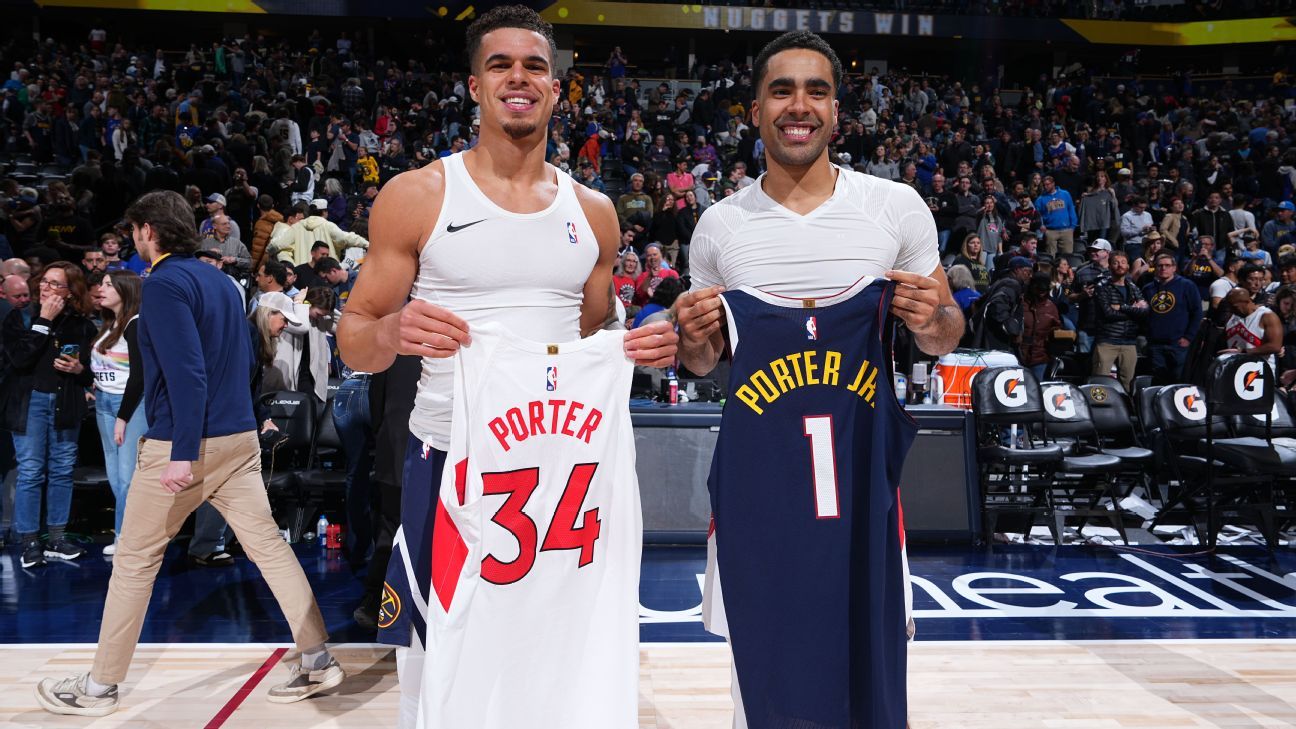
Michael Porter Jr. defends brother Jontay in a betting investigation

March 28, 2024, 2:53 a.m. ET

Denver Nuggets forward Michael Porter Jr. said Wednesday night that he was sure his younger brother Jontay would never do anything that could jeopardize his budding NBA career.

Toronto Raptors forward Jontay Porter is under investigation by the NBA following several betting irregularities in recent months, sources told ESPN earlier this week. According to sources, these are prop bets involving Porter from games on January 26th and March 20th. An NBA spokesman told ESPN that the league is “reviewing the matter.”

Michael Porter Jr. stood at the podium after the Nuggets' home loss to the Phoenix Suns on Wednesday night and was asked about his brother's physical.

Michael Porter Jr. said he didn't have more details than the media, but he vouched for his brother, who at 24 is a year his junior, saying “Jontay loves the game of basketball” and was excited to play for Toronto a two-way contract this season.

“I have known my brother my whole life. I know what kind of guy he is and I know he's excited to play basketball and I highly doubt he would do anything to jeopardize that,” Michael Porter Jr. said.

Editor favorites

2 relatives

Jontay Porter has not publicly addressed the situation and he has missed the Raptors' last few games, with the team citing personal reasons.

The younger Porter averaged 4.4 points, 3.2 rebounds and 2.3 assists in 26 games, including five starts. The 1.90 meter tall Porter also played eleven games for Memphis in the 2020/21 season.

NBA players and all league employees are prohibited from betting on NBA events, including prop betting. Violations of the policy may include, but are not limited to, fines, suspensions, and possible contract terminations.

Michael Porter Jr. said he and others regularly hear how their performance on the course affects bettors.

“Yeah, especially in the last few years, you hear people in the audience saying what you need to score tonight or what you don't want you to score,” he said. “Every night you disappoint someone. You disappoint people when you score too much because they might have bet on the under, and you disappoint people when you don’t score enough.”

“So, it’s part of the game now. I think it's obviously a dangerous habit. It is a dangerous vice for people,” he added. “You know, the love of money is the root of all evil. So I think even though it's one thing, we as players just have to accept it. We get paid a lot of money to play this game and I know it. These people, these fans want to make some money too.

“It’s definitely something that has kind of taken over the sports world – I don’t know if it’s a good thing or a bad thing.”

The Associated Press contributed to this report.

Categories
Entertainment

Shakira is rumored to be courting actor Lucien Laviscount

The couple showed no PDA but left in the same vehicle.

Meanwhile, a source told US magazine that the “Girl Like Me” singer is “not ready for a relationship” but is single and dating men.

And some social media users aren't buying this budding love. They speculate that it might simply be great marketing for their new single “Puntería.” The two have a few flirty scenes in the song's music video, but he's an actor, right?

Shakira's Divorce and Alleged Post-Breakup Dates

The 'Queen of Latin Music' has been linked to a few eligible bachelors since her divorce from the former Spanish footballer Gerard Pique. Shakira is experiencing something of a revival as she releases new music in seven years. She explained that divorcing her husband allowed her to be free and work again.

The source added: “Shakira has a new light about her that she hasn’t had since Piqué.”

@shakira

Thank you @Jimmy Fallon for the great interview and making me feel at home every time I appear on your show. You are the best!! 🥰 @FallonTonight #LMYNL #fallontonight

♬ Original sound – Shakira

Categories
Health

UnitedHealth Group has paid over $Three billion to suppliers for the reason that cyberattack

In this photo illustration, the UnitedHealth Group logo is displayed on a smartphone screen.

Sheldon Cooper | Sopa pictures | Light rocket | Getty Images

UnitedHealth Group has paid out an additional $1 billion since last week to providers affected by the Change Healthcare cyberattack, bringing the total amount of funds provided to more than $3.3 billion, the company said Wednesday.

UnitedHealth, which owns Change Healthcare, discovered in February that a cyber threat actor had penetrated part of the unit's IT network. According to its website, Change Healthcare processes more than 15 billion billing transactions annually and one in three patient records passes through its systems.

According to a filing with the Securities and Exchange Commission, the company shut down the affected systems “immediately upon discovery” of the threat. Due to the disruptions, many healthcare providers were temporarily unable to fill prescriptions or receive reimbursement from insurers for their services.

Because many healthcare providers rely on reimbursement cash flow to operate, the impact has been significant. Smaller and mid-sized practices told CNBC they are making difficult decisions about how to stay afloat. A survey released earlier this month by the American Hospital Association found that 94% of hospitals suffered financial disruption as a result of the attack.

That's why UnitedHealth launched its Temporary Financial Assistance Program to help providers who need support. The company said the $3.3 billion in advances would not have to be repaid until claims flows returned to normal. According to a press release, federal agencies such as the Centers for Medicare & Medicaid Services have introduced additional options to ensure states and other stakeholders can make interim payments to providers.

UnitedHealth has been working to restore Change Healthcare's systems in recent weeks and expects some disruptions to continue into April, according to its website. The company began processing a backlog of more than $14 billion in claims on Friday and said Wednesday: “The number of claims has begun.”

Shares of UnitedHealth have fallen more than 6% since the attack was reported.

Late last month, the company announced that the Blackcat ransomware group was behind the attack. According to a December press release from the U.S. Department of Justice, Blackcat, also known as Noberus and ALPHV, steals sensitive data from institutions and threatens to release it unless a ransom is paid.

The State Department announced Wednesday that it is offering a reward of up to $10 million for information that could help identify or locate cyber actors linked to Blackcat.

UnitedHealth said Wednesday that it is “still determining the content of the data collected by the threat actor.” The company said a “leading provider” was analyzing the affected data. United Health is working closely with law enforcement and third parties such as Palo Alto Networks and Google's Mandiant to assess the attack.

“We continue to remain vigilant and have not seen any evidence of data being published online,” UnitedHealth said. “And we are committed to providing appropriate support to people whose data has been compromised.”

Rep. Jamie Raskin, D-Md., ranking member of the House Oversight and Accountability Committee, wrote a letter Monday to UnitedHealth CEO Andrew Witty requesting information about the “scope and extent” of the breach.

Raskin asked Witty for information about when Change Healthcare notified its customers of the breach, what specific infrastructure and information was affected, and what cybersecurity procedures the company has implemented. The committee requested written answers “no later than” April 8.

“Given your company's dominant position in the nation's health and health insurance industry, Change Healthcare's extended outage as a result of the cyberattack has already had 'significant and far-reaching' consequences,” Raskin wrote.

The Biden administration also launched an investigation into UnitedHealth earlier this month due to the “unprecedented scale of the cyberattack,” according to a statement.

Don't miss these stories from CNBC PRO:

Categories
Technology

Astroforensics might be one of many coolest new jobs of the longer term

NASA's Artemis program aims to return astronauts to the moon and establish a permanent orbiting laboratory by the end of the decade.

Meanwhile, private companies are taking significant steps to bring paying customers further into space. As humanity's footprint expands beyond the familiar reaches of Earth to the moon and possibly beyond, a fascinating new field is emerging at the final frontier: astroforensics.

Still in its infancy, this discipline is driven by the inevitability of human nature. Space provides a unique and harsh environment for forensic investigations. Environments that exhibit altered gravity, cosmic rays, extreme temperatures, and the need for oxygen-supplying climate systems are some examples of the unearthly variables that future explorers will face.

Unlike on Earth, where gravity, a constant force, shapes many aspects of our reality, the significant reduction in gravity in space presents new challenges for understanding the behavior of evidence. This shift is critical to forensic sciences such as Analysis of bloodstain patterns, relying heavily on gravitational effects to determine the circumstances under which bloodstains form.

TNW Conference 2024, 20-21 June – Hurry, price increase on March 29th!

Register now to get the best deal and save hundreds on all passes.

The thought of gravity in space immediately conjures up images of astronauts floating hauntingly in the emptiness of space or levitating gymnastics exercises on the International Space Station (ISS).

However, true weightlessness exists far from all celestial bodies. Gravitational influence occurs near a body such as a moon or a planet, even if it is in orbit around a planet such as Earth.

Therefore, most space environments experience low or microgravity rather than weightlessness. Given that gravity is omnipresent and largely constant, we pay little attention to it and usually automatically include it as a constant in calculations without thinking about it.

Altered gravity

But for a forensic discipline like bloodstain pattern analysis, it's gravity
plays a critical role in how liquid blood in the air interacts with a surface and creates stain patterns. Bloodstain pattern analysis uses fluid dynamics, physics and mathematics to understand the flight and origins of blood and interpret how it is deposited on a surface during criminal investigations.

In a recently published study, we and our colleagues sought to understand the basic principles of how the changing gravity environment of space will impact future forensic science disciplines.

For this study, published in Forensic Science International: Reports, we used a parabolic research aircraft that induces short periods of microgravity due to its up-and-down trajectory. This type of flight is also known colloquially as a “vomit comet”.

During this period of weightlessness in free fall, a series of blood drops were projected onto a sheet of paper and the resulting blood spot was then analyzed using routine Earth-based protocols. Although the concept sounds simple, the challenge was to create a safe and controllable area to conduct experiments in a plane that essentially fell to Earth for 20 seconds.

Therefore, the test environment had to be connected to the cabin
Research level and the generation and documentation of all blood stains can be easily controlled. The experiments were conducted in a repurposed children's incubation chamber called a glove box. This chamber is used in space medicine research to study bleeding control.

Due to biohazard concerns, a synthetic analogue of blood was used in the cabin of the aircraft instead of real blood. This analogue replacement mimicked the physical properties of blood viscosity and surface tension. To start the experiment, the analog blood was loaded into a syringe, and once microgravity was induced in free fall, the syringe was manually depressed to project the blood over 20 cm onto a white sheet of paper.

Although this bears little resemblance to real crime scenarios, what is of interest to the forensic investigator is the interaction between the blood and the surface – rather than the actual mechanism of projection. The bloodstained papers were then photographed and analyzed as usual.

We found that microgravity actually changes the behavior of blood drops and the stains they create. On Earth, blood tends to fall parabolically, with gravity pulling it downward until it hits a surface. But in this case the blood continued to move in a straight line until it reached the surface.

This straight-line trajectory is a fluid example of inertia in action. However, at a distance of only 20 cm, this had minimal impact on the later pattern.

This difference would be more apparent over longer distances, but due to the operational limitations of the parabolic research aircraft, it would be difficult to replicate effectively. The second important observation was the spreading effect of the blood upon hitting the surface.

In Earth's typical gravity environment, liquid drops of blood go through a series of phases in the process of staining. This causes the droplet to collapse, creating a small ripple and spreading out into a final spot shape.

However, when gravity is eliminated in this action, the spreading effect is inhibited by the dominant force of surface tension and cohesion, resulting in the spot being smaller in shape and size than its terrestrial counterpart.

We are at the beginning of a new era of research, exploring the influence of the extraterrestrial environment on the behavior of forensic evidence. However, the implications of this research are not limited only to the forensic sciences, but also to more traditional natural sciences, such as fluid dynamics in spacecraft design and the analysis of errors in space forensic engineering following a spacecraft malfunction.

Expanding research in this new forensic discipline will require larger microgravity environments, and the authors would be more than happy to operate the galaxy's first extraterrestrial forensic science laboratory.The conversation

Graham Williams, Professor of Forensics, University of Hull and Zack Kowalske, PhD candidate, Staffordshire University

This article is republished from The Conversation under a Creative Commons license. Read the original article.

Categories
Science

DART Modified the Form of Asteroid Dimorphos, not Simply its Orbit

On September 26th, 2022, NASA’s Double Asteroid Redirection Test (DART) collided with the asteroid Dimorphos, a moonlet that orbits the larger asteroid Didymos. The purpose of this test was to evaluate a potential strategy for planetary defense. The demonstration showed that a kinetic impactor could alter the orbit of an asteroid that could potentially impact Earth someday – aka. Potentially Hazardous Asteroid (PHA). According to a new NASA-led study, the DART mission’s impact not only altered the orbit of the asteroid but also its shape!

The study was led by Shantanu P. Naidu, a navigation engineer with NASA’s Jet Propulsion Laboratory (JPL) at Caltech. He was joined by researchers from the Lowell Observatory, Northern Arizona University (NAU), the University of Colorado Boulder (UCB), the Astronomical Institute of the Academy of Sciences of the Czech Republic, and Johns Hopkins University (JHU). Their paper, “Orbital and Physical Characterization of Asteroid Dimorphos Following the DART Impact,” appeared on March 19th in the Planetary Science Journal.

The Didymos double asteroid system consists of an 851-meter-wide (2792 ft) primary orbited by the comparatively small Dimorphos. The latter was selected as the target for DART because any changes in its orbit caused by the impact would be comparatively easy to measure using ground-based telescopes. Before DART impacted with the moonlet, it was an oblate spheroid measuring 170 meters (560 feet) in diameter with virtually no craters. Before impact, the moonlet orbited Didymos with a period of 11 hours and 55 minutes.

Artist’s impression of the DART mission impacting the moonlet Dimorphos. Credit: ESA

Before the encounter, NASA indicated that a 73-second change in Dimorphos’ orbital period was the minimum requirement for success. Early data showed DART surpassed this minimum benchmark by more than 25 times. As Naidu said in a NASA press release, the impact also altered the moonlet’s shape:

“When DART made impact, things got very interesting. Dimorphos’ orbit is no longer circular: Its orbital period is now 33 minutes and 15 seconds shorter. And the entire shape of the asteroid has changed, from a relatively symmetrical object to a ‘triaxial ellipsoid’ – something more like an oblong watermelon.”

Naidu and his team combined three data sources with their computer models to determine what happened to the asteroid after impact. The first was the images DART took of Dimorphos right before impact, which were sent back to Earth via NASA’s Deep Space Network (DSN). These images allowed the team to gauge the dimensions of Didymos and Dimorphos and measure the distance between them. The second source was the Goldstone Solar System Radar (GSSR), part of the DNS network located in California responsible for investigating Solar System objects.

The GSSR was one of several ground-based instruments that precisely measured the position and velocity of Dimorphos relative to Didymos after impact – which indicated how the mission greatly exceeded expectations. The third source was provided by ground-based telescopes worldwide that measured changes in the amount of life reflected (aka. light curves) of both asteroids. Much like how astronomers monitor stars for periodic dips (which could indicate a transiting planet), dips in Didymos’ luminosity are attributable to Dimorphos passing in front of it.

Artist’s impression of the ESA’s Hera mission rendezvousing with Dimorphos. Credit: NASA

By comparing these light curves from before and after impact, the team learned how DART altered Dimorphos’ motion. Based on these data sources and their models, the team calculated how its orbital period evolved and found that it was now slightly eccentric. Said Steve Chesley, a senior research scientist at JPL and a co-author on the study:

“We used the timing of this precise series of light-curve dips to deduce the shape of the orbit, and because our models were so sensitive, we could also figure out the shape of the asteroid. Before impact, the times of the events occurred regularly, showing a circular orbit. After impact, there were very slight timing differences, showing something was askew. We never expected to get this kind of accuracy.”

According to their results, DART’s impact reduced the average distance between the two asteroids to roughly 1,152 meters (3,780 feet) – closer by about 37 meters (120 feet). It also shortened Dimorphos’ orbital period to 11 hours, 22 minutes, and 3 seconds – a change of 33 minutes and 15 seconds. These results are consistent with other independent studies based on the same data. They will be further tested by the ESA’s Hera mission, scheduled to launch in October 2024, when it makes a flyby of the double-asteroid and conducts a detailed survey.

Further Reading: NASA

Like this:

Like Loading…

Categories
Sport

Males’s March Insanity 2024: Second spherical match updates

Mar 25, 2024, 12:25 AM ET

If anything, Sunday’s action taught us that it’s really not over – until it’s over. Houston had cruised to what appeared to be an easy win over Texas A&M before a combination of bad decisions, missed shots and foul trouble forced the Cougars to unravel before they salvaged the game in overtime. Baylor made a late run in a loss to Clemson. Grand Canyon did the same against Alabama and Colorado nearly caught Marquette, too.

But Purdue and UConn emerged from the final day of the second round as juggernauts in the field. Some of the other squads that stamped their tickets to the Sweet 16, however, were not as convincing. But they’ve survived. And that’s what matters.

Scroll to read our breakdown of every game of the second day of the men’s round of 32. Find our takeaways to the first day here. Check your bracket here.

play

0:20

Jamal Shead takes over late in OT as Houston avoids collapse vs. Texas A&M

Jamal Shead steps through the lane and scores a big bucket for Houston as the Cougars thwart Texas A&M’s comeback and advance to the Sweet 16.

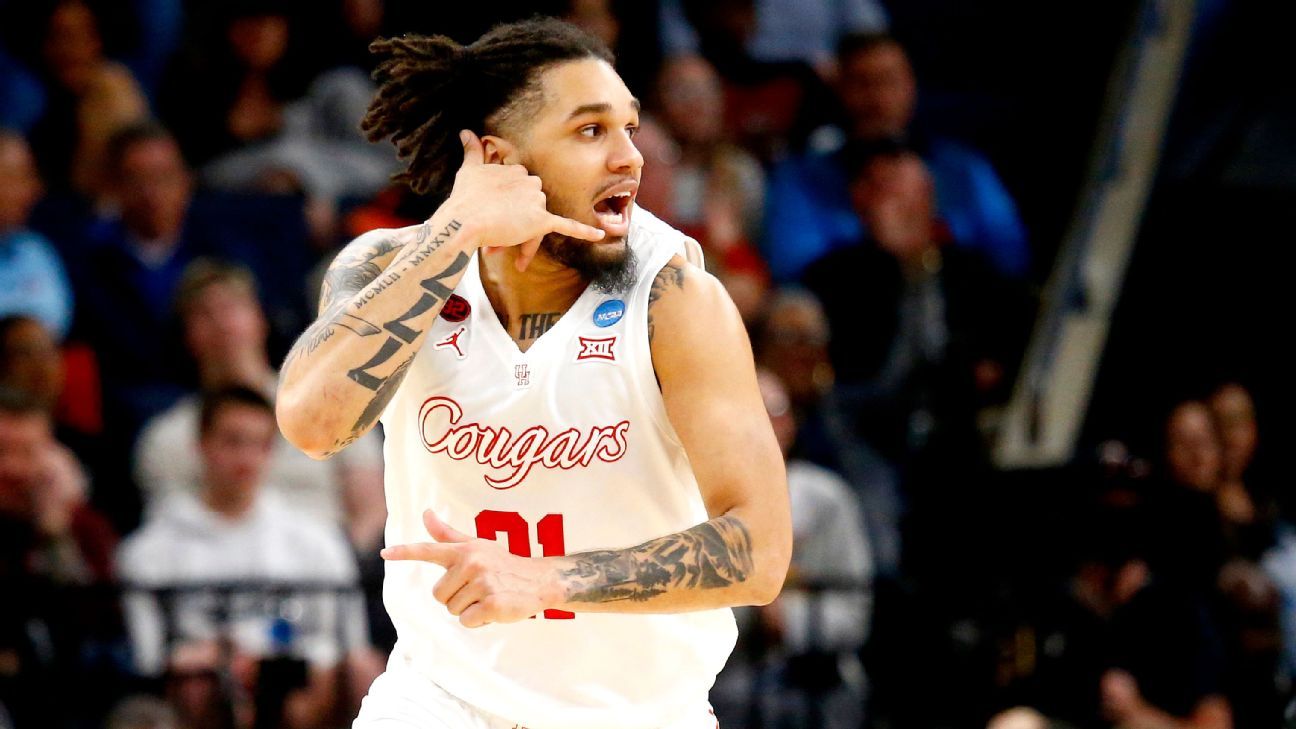
Is Houston healthy enough to keep it rolling? A fairly large red flag appeared for the Cougars on Sunday: foul trouble. The Cougars had four players foul out and another finish one short of joining them. Coach Kelvin Sampson traced the blowout loss to Iowa State in the Big 12 championship to a battered lineup and compressed conference tournament timetable, but a significant pile of fouls and a short bench almost sent the Cougars packing Sunday. There were times when J’Wan Roberts, who Sampson has called “probably our most important guy,” was limping through plays. Roberts, who has dealt with a shin injury of late, and Ramon Walker, who has returned to the lineup in the tournament after dealing with a right knee injury, added just enough depth in a game they barely advanced past. Houston watched a 13-point lead with 3:39 to play evaporate, showing just how thin their margin of error could be if the whistles come again, especially with the in-your-face tenacity the Cougars like to play with on defense. The backcourt of Jamal Shead and L.J. Cryer was defensively disruptive as usual and they were smooth on offense, combining for 41 points and 14 assists — but they both fouled out. Emanuel Sharp, who also fouled out, led the Cougars with 26 points, including six 3-pointers.

What the win means for Houston: The Cougars’ (32-4) great escape and second win over the Aggies this season — they defeated Texas A&M, 70-66, Dec. 16 — means they move on to Dallas, where they will face Duke (26-8) in the Sweet 16. Shead’s defensive wizardry — Texas A&M coach Buzz Williams said in Memphis that Shead could “guard anybody in the United States, no matter how old they are, no matter how much money they’re getting paid through NIL or through the National Basketball Association” — is a major factor moving forward. Texas A&M point guard Wade Taylor IV was 0-for-6 in the first half Sunday, 5-of-27 for the game with Shead doing most of the defending. Taylor had seven 3-pointers in the Aggies’ win Friday over Nebraska.

What the loss means for Texas A&M: It took a bit for Williams to find the sweet spot with his lineup this season. But when he added Manny Obaseki more into the mix –Obaseki played at least 20 minutes in nine of the final 10 games — things got better. Once the pain wears off of being so close to knocking off a No. 1 seed, the Aggies can turn the page to next season when Obaseki could certainly a big part of the plan. Taylor, however, is a senior and guard Tyrece Radford, who led the Aggies with 27 points in the loss, has closed out his career as well. — Jeff Legwold

When it was all falling apart, Houston turned to Jamal Shead: Just when it appeared that Houston was headed to another Sweet 16 after the Cougars had enjoyed a double-digit lead late, Texas A&M made a ridiculous run at the end of regulation to tie the game. Andersson Garcia’s buzzer-beating 3-pointer sent the game into overtime. And that was the good news. At least Houston had more time. But they didn’t have more players. In overtime, three Houston players had fouled out, including a pair of players (Emanuel Sharp and LJ Cryer) who’d combined to score 50 points in the game. Wade Taylor IV had started 2-for-17 from the field but he had made big shots late. Jamal Shead, however, was fearless, despite the circumstances. He hit key free throws and a big shot in the final minute of overtime to send his team to the Sweet 16. Talent matters this time of year. Coaching matters, too. But Houston just needed a leader and Shead (21 points) accepted the role before he eventually fouled out with 18.2 seconds to play. The maturity on Sampson’s roster helped his squad win the game after it had unraveled at the end of regulation. It’s not easy to find your way again in those moments. But Houston did with Shead’s help. — Myron Medcalf

play

0:28

Chase Hunter’s buzzer-beating 3 keeps Clemson rolling at the half

Clemson’s Chase Hunter knocks down a runner 3-pointer just before the halftime buzzer sounds to increase the Tigers’ lead.

Why has Clemson suddenly become everybody’s tournament problem? Clemson has an NBA prospect in the post with PJ Hall and a willingness to run its offense off the block with others as well. Baylor coach Scott Drew had said Saturday “most teams are lucky to have one to play in the post, they’ve got four, five guys they can run [into the post].” That already gave the Tigers a slightly different profile from many teams in the bracket. But when the Tigers (23-11) shoot like they did early on Sunday from beyond the 3-point line as well, that makes them a migraine. They were 6-of-11 on 3-point attempts in the first half Sunday. Toss in the Tigers’ defensive efforts during their two games in Memphis (held New Mexico to 29.7% shooting in the first round, Baylor to 38.9%) and a Clemson team that came into the tournament having lost three of its past four games suddenly has loads of confidence. Chase Hunter led the Tigers with 20 points and Joseph Girard III added 13.

What the win means for Clemson: The Tigers were on wobbly legs down the stretch as they almost let a 15-point lead with 6 minutes, 41 seconds to play slip away, but they are now in the Sweet 16 for the first time since the 2017-18 season. They move on to Los Angeles where they will face Arizona (27-8) on Friday. Clemson has moved this deep into the bracket without its usual output from Hall. The 6-foot-10 senior got into foul trouble against New Mexico in the first round and again against Baylor, finishing with nine and 11 points, respectively. If Hall cranks up the offense to his usual output — he led the Tigers in scoring this season at 18.7 points per game — Clemson could give the Wildcats plenty to handle.

Editor’s Picks

2 Related

What the loss means for Baylor: Drew had spoken on Saturday to the difficulty of matching the makeup, consistent effort and injury luck it takes to get into position to win a national championship. After a tough shooting night ended this year’s run, Drew could face significant roster makeover. Jalen Bridges and RayJ Dennis are seniors and freshmen Yves Missi and Ja’Kobe Walter are on the NBA’s radar as potential first-round prospects. — Legwold

Baylor’s flaws exposed when the shots stop falling: Drew’s Baylor squad played in a Big 12 this season that was even more competitive than it had been in the past with Houston and BYU joining the league. But the Bears owned the most efficient offense in the league and hit 3-pointers at 39.3%, third in the country. They also boasted a pair of projected first-round picks, Walter and Missi. In recent weeks, however, the 3-pointers stopped falling. Outside of a stellar effort in the win over Colgate in the first round (53%), the Bears entered Sunday with a 15-for-64 success rate in three previous games and couldn’t find a rhythm against Clemson, either. Once they were no longer an elite 3-point shooting team, Baylor’s defensive pressure — they finished at the bottom of the Big 12 in efficiency — was insufficient to stop Clemson, despite a late rally. The Bears finished 6-for-24 from beyond the arc in the loss. It was another example of how everything can change fast, for better or worse, in March. — Medcalf

play

0:24

Nick Pringle throws down two-handed slam in crunch time

Nick Pringle takes the feed from Mark Sears and throws it down with authority for Alabama.

Can Alabama reach the Final Four?: The short answer: yes. Coach Nate Oats has the Tide playing with confidence and they believe deeply in their maximum-tempo offense that resulted in the nation’s highest scoring average. What they learned Sunday was that even when they struggle to get good looks and finish like they’re accustomed to, they can grind things out in a high-stakes environment. Don’t be fooled by Grand Canyon’s lack of history. The Lopes play like a high major power and have multiple players who will play professionally for a long time overseas. Even so, a more convincing win would have inspired more confidence about a potential run but going through this kind of a game can pay dividends. If guard play is one of the keys in March, then the performance of Mark Sears is particularly encouraging. He has been one of the best players in the tournament, scoring 26 points against GCU following his 30-point night against Charleston.

What the win means for Alabama: Upsets avoided; a blue blood awaits. After going through No. 13 Charleston and No. 12 Grand Canyon, the Crimson Tide will have a role reversal as the underdog against No. 1-seeded North Carolina in Los Angeles. The Tar heels have won 10 of their past 11 games and won convincingly against Michigan State on Saturday to advance. It will be Alabama’s third trip to the Sweet 16 in four seasons, but the Tide have just one Elite Eight trip in program history (2004).

What the loss means for Grand Canyon: The best season in school history has come to an end. After recording their first-ever NCAA tournament win against No. 5 Saint Mary’s on Friday, the Lopes’ athleticism advantage was no longer there against Alabama. After reaching the tournament for the third time in four years under coach Bryce Drew, GCU has established itself as an up-and-coming, mid-major force in the West. The next step for GCU — and this can be difficult — is to line up a more challenging nonconference schedule, as it doesn’t get enough games in the WAC to truly prepare the school for the rigors of the tournament. — Kyle Bonagura

With Mark Sears, Alabama emerges from the chaos: To anyone who watched Alabama for the first time Sunday night in its win over Grand Canyon, you did not see anything new. All season, Alabama has been a team with phenomenal scoring talent, sufficient for a top-five mark in efficiency. But the Crimson Tide also have a sub-100 defense that you can’t trust. That’s why Sunday’s win was important. Alabama has been in those scenarios multiple times this season, but it hasn’t always survived. Yet, Mark Sears (26 points), the Ohio transfer, carried this team to back-to-back Sweet 16 appearances even as everything appeared to be working against the Crimson Tide. Grand Canyon shot 37 free throws. Alabama lost Latrell Wrightsell Jr. to a head injury in the first half. And Oats’ squad finished 8-for-31 from the 3-point line. In those circumstances, the Tide had to find out if they could finally win one of those ugly affairs. On Sunday, they did. — Medcalf

play

0:30

Donovan Clingan’s block turns into a sweet Tristen Newton and-1

UConn’s Donovan Clingan gets up for an emphatic block, and it turns into a Tristen Newton acrobatic and-1 on the other end of the floor.

Who can play with the Huskies? Northwestern was a team that took Purdue, a No. 1 seed, to overtime twice and won one of those games. It still never really stood a chance against UConn on Sunday at the Barclays Center. The Huskies were too big, too athletic and too talented for the Wildcats. It makes you wonder just who can play with the defending national champs if they bring their A-game. The Huskies (33-3) have now won their last eight games in the NCAA tournament by double digits. It’s the second-longest streak of all time, one shy of the great 2000-01 Michigan State team. Connecticut will be heavy favorite in the Sweet 16. It would have to play a total dud to lose there, with Iowa State (2) or Illinois (3) potentially its only real test before the Final Four. With the way that sophomore center Donovan Clingan (14 points, 14 rebounds, 8 blocks) is playing, it’s possible this UConn team is actually better than last year’s national champs. That is trouble for everyone else on their road to a potential repeat.

What it means for UConn: The defending champs remain the heavy favorites to win it all. They just waltzed into the Sweet 16 while barely breaking a sweat against Stetson and Northwestern. UConn showed they can do it in so many different ways. They led by as many as 30 against the Wildcats despite hitting just 3 of 22 three-pointers (14%). But the Huskies defense was once again suffocating. They allowed less than 60 points in their first two games of this tournament and their size is making it tough on everyone. Northwestern’s Boo Buie, the school’s all-time leading scorer, didn’t even record his first made field goal until his 11th attempt midway through the second half on Sunday.

2024 Men’s College Basketball Championship Odds

What it means for Northwestern: Their season once again comes to an end before the Sweet 16. That has been the case in each of the school’s only three tournament appearances, the first being in 2017 after coach Chris Collins took over. There is no shame in losing to Connecticut though. Join the club. The Huskies were the better team, and that showed from start to finish. The Wildcats (22-12) were completely out of sorts offensively until midway through the second half after winning a tough first-round game over FAU in overtime. Northwestern’s top two scorers, Buie and Brooks Barnhizer, combined to shoot 0-for-14 in the first half against UConn. The Wildcats will be a different looking team next season without Buie and grad transfer Ryan Langborg. — Jordan Raanan

History and the Huskies: UConn is trying to become the first team to win two consecutive national championships since Florida defended its title in 2007. By making it as far as the Sweet 16, the Huskies have already outperformed most champions of the last 17 years. Five defending champions since 2007 have reached a regional semifinal: Kansas in 2009, Duke in 2011, Louisville in 2014, the Blue Devils again in 2016 and now UConn. No defending champion has advanced to the Elite Eight since the Gators in 2007.

The Huskies have also avoided another pitfall. Of the four post-2007 champions that earned No. 1 seeds the following year, three were upset in the Round of 32: Villanova lost to Wisconsin in 2017, Baylor fell to North Carolina in 2022 and Kansas was defeated by Arkansas last year. — John Gasaway

play

0:30

San Diego State’s Jaedon LeDee breaks away for a hammer dunk

After a steal, San Diego State’s Jaedon LeDee breaks away to the basket and throws down a massive dunk.

Can Jaedon LeDee keep carrying the Aztecs?: In his first four seasons of college basketball at Ohio State (2018-19), TCU (2019-20, 20-21) and SDSU (2022-23), Jaedon LeDee scored a total of 601 points. Fresh off his 26-point performance in the win against Yale, LeDee is at 754 just this season. Few players ever have made this kind of year-over-year jump. He’s a posterchild for development in college basketball. College basketball legacies, however, are truly made this time of year. This is the first time SDSU has ever reached back-to-back Sweet 16s, so it is already in rarified air. LeDee will always be associated with that. If the Aztecs win again? That ensures legendary status.

What the win means for San Diego State: After reaching the championship game last year, this is a stage of the tournament that the Aztecs expected to reach — especially once Yale upset Auburn. But now the stakes are raised: SDSU has to travel to Boston to play UConn, the tournament’s No. 1 overall seed and the team that beat them to win the national title. History repeats. Last year, SDSU was a No. 5 seed, beat the No. 12 (Charleston), then a No. 13 (Furman) before squaring off with the tournament’s No. 1 overall seed (Alabama). For that reason, it would be silly to write off the Aztecs.

What the loss means for Yale: Yale got its moment. Its players will remember the win against Auburn forever, a win that is arguably the best in program history. Against SDSU, the Bulldogs had an off night against a better team that was on its game. A nightmare combination. They can take solace in the fact that as their game wound to a close there was only 17 teams remaining in the tournaments. They’ll continue to be a force in the Ivy League, which has shown well in the tournaments the past two years. — Bonagura

Can San Diego State pull off a repeat of last season? San Diego State is in the same exact spot in the bracket as last season. Top-left region, 5-seed, about to play against the overall 1-seed in the Sweet 16. Last time around, the Aztecs erased a nine-point second-half lead to topple Alabama and made a run all the way to the national championship. On Thursday, San Diego State will have a rematch against the team that beat them in that title game as overall 1-seed UConn awaits in Boston. Sunday’s win over Yale provided some optimism that the Aztecs’ vaunted defense hasn’t totally disappeared. Entering the weekend, San Diego State ranked No. 73 in the country in adjusted defensive efficiency over its past six games — a far cry from the top-10 units that have regularly been produced under coach Brian Dutcher. But on Sunday, SDSU held Yale to 37% shooting and 57 points, their best defensive performance in weeks. — Jeff Borzello

play

0:38

Jared McCain nails 8 treys to help propel Duke to Sweet 16

Jared McCain scores 24 of his 30 points from beyond the arc as Duke defeats James Madison 93-55.

Is Jared McCain the best freshman in the tournament? He’s at least in the conversation, and might even be at the top of the list after Colorado’s Cody Williams got sent home Sunday. McCain, a 6-3 guard, came into the tournament as Jonathan Givony’s 20th-ranked prospect for the 2024 NBA draft. If anything, he has improved his stock, especially with the first half he had in Sunday’s second-round blowout of a good James Madison team. McCain scored 22 points in the first half against the Dukes, hitting 7 of 11 shots and 6 of 8 3-pointers. He finished with 30 points, going 8-of-11 from beyond the arc, despite sitting the final seven-plus minutes. It was quite the performance, the most points by any player during the first half of this year’s tournament. It came on the heels of a 15-point, six-rebound performance in the opening round against Vermont. McCain was a few inches from that being a big scoring night as well. He had two or three 3-pointers halfway down before they popped out in that contest. This is what the Blue Devils need from McCain to make a big run in the tournament.

What it means for Duke: The Blue Devils reached their 29th Sweet 16 since it officially began in 1975. Only North Carolina (31) has more. Duke goes into the Sweet 16 with confidence after blitzing James Madison with a dominant effort, led by McCain. But it was more than that. Duke outrebounded the Dukes 21-13 in the opening half, moved the ball well while assisting on 11 of 17 field goals and played suffocating defense that resulted in five steals. That continued in the second half as the Blue Devils’ lead ballooned to as much as 38. Some of that was from hitting 14 of 28 from beyond the arc in this game. If this version of Duke shows up the rest of the way, it’s probably capable of winning a national championship.

What it means for James Madison: The Dukes’ dream season concludes with 32 wins. They had their second 14-game win streak of the year end Sunday in the second round of the tournament at the hands of a national powerhouse. From the start, nothing went right for James Madison. Leading scorer Terrence Edwards Jr. picked up two fouls in the opening two minutes. Even though the Dukes (32-4) failed to reach their first-ever Sweet 16, this remains one of their most successful seasons in school history. — Raanan

Duke shows youth can still win in 2024: When Kentucky was upset by Oakland in the round of 64, Wildcats head coach John Calipari said the sport of college basketball has changed. “All of a sudden, it’s gotten really old,” he said. “So we’re playing teams — our average age is 19. Their average age is 24 and 25.”

Calipari was correct in saying UK was young this year, with an average age weighted for minutes of 20.7 years.

Coincidentally, Duke is the same age: 20.7. The Blue Devils are going to the Sweet 16 two years after reaching the 2022 Final Four with an average weighted age of 20.0.

Youth is no longer the default approach in the portal era. But when a rotation is both young and talented, it can still win in March. — John Gasaway

play

1:11

Zach Edey drops a first-half double-double in Purdue’s rout

Zach Edey’s 23-point, 14-rebound performance powers Purdue to a blowout win over Utah State.

Is Purdue built for a deep run? The Boilermakers are more than center Zach Edey. Sure, Edey had a monstrous opening weekend and another 20-point, 10-rebound performance Sunday. But Purdue also knocked down a ton of shots from behind the arc. Purdue was 11-of-23 on its 3-point shooting. Myles Colvin hit three 3s coming off the bench and guards Fletcher Loyer, Braden Smith and Lance Jones each had at least one 3-pointer, including the one Jones banked in right before halftime. That kind of shooting will keep teams honest as they try to figure out how to stop Edey, who has been as dominant as advertised.

What the win means for Purdue: On Sunday, the Boilermakers confirmed what they had been saying all weekend in Indianapolis. This is indeed a better team than last year’s group that lost in the first round as a No. 1 seed. Purdue thoroughly dominated a Utah State team that thumped TCU in the first round. Now, the Boilermakers will advance to the Sweet 16 and face a tough fifth-seeded Gonzaga team in Detroit.

Top stories of the week from

Get exclusive access to thousands of premium articles a year from top writers.
• Men’s hoops: Louisville’s coach opening? »
• Miller’s updated NFL draft rankings: Top 50 »
• Which European teams spend smartest? »
More ESPN+ content »

What the loss means for the Utah State Aggies: On Saturday, Purdue coach Matt Painter praised first-year Utah State coach Danny Sprinkle for his team’s communication. Painter initially called Sprinkle one of the best young coaches in the game before removing the age qualifier. The consensus appears to be that Utah State’s program is in good hands with the 47-year-old after winning its first NCAA tournament game in 23 years. — Ben Baby

Sprinkle’s next job will be …: Though the final game of the season won’t be remembered fondly, Sprinkle produced an incredible first-year coaching performance at Utah State. The Aggies didn’t return a single point per game from last season, but Sprinkle led them to their first Mountain West regular-season title in program history and then their first NCAA tournament win since 2001. This was Sprinkle’s third consecutive trip to the Big Dance, after he went back-to-back with Montana State. But it’s likely to be only a one-year layover in Logan for Sprinkle. He has been strongly linked to the vacancy at Washington, although athletic director Troy Dannen departing for Nebraska could leave the door open. If Sprinkle does leave, can Utah State strike gold again with its next coaching hire? The Aggies’ past three hires were Craig Smith, Ryan Odom and Sprinkle — who all led the program to the NCAA tournament very quickly and were pursued by bigger schools almost immediately. — Borzello

play

0:17

Tyler Kolek weaves through the paint and hits a clutch bucket

Marquette’s Tyler Kolek races around the defense and drops in a smooth shot over Colorado’s Eddie Lampkin.

Is Tyler Kolek the best guard in the country? Perhaps. When Marquette needed a spark in the second half, it went to Kolek every time. As Colorado clawed back from an 11-point halftime deficit and forced the Golden Eagles to take the lead back, Kolek assisted or scored on nearly every trip down the floor. He finished with 21 points and 11 assists, his second double-double in as many games this weekend. If Kolek is scoring and creating at this level, Marquette will be in every game for the rest of the tournament.

What the win means for Marquette: The Golden Eagles are headed to the Sweet 16 for the first time since 2013. For the second straight year, Marquette was a 2-seed in the tournament. This time, however, coach Shaka Smart’s team avoided being bounced during the first weekend. Marquette will face 11-seed NC State in the Dallas Regional and will try to cool off the Wolfpack, who went on a run to win the ACC tournament and are now trying to be the latest double-digit seed to wreak havoc on the bracket.

What the loss means for Colorado: The Buffaloes were a few buckets away from reaching the Sweet 16 for the first time in the modern era. Freshman Cody Williams, who battled injuries all year, is likely headed to the NBA as a potential lottery pick. But if KJ Simpson returns for another season, Colorado will have an important player for a potential tourney run in 2025. — Ben Baby

Marquette’s guards give them a chance to get to Phoenix: There might not be a pair of guards in the country playing better than Kolek and Kam Jones. Jones has been on an incredible offensive run over the past month, averaging 23.8 points and shooting 52.2% from 3-point range in his past 10 games — including three 30-point outings. In the first half Sunday, he scored 16 points in 14 minutes before foul trouble forced him to the bench. But that simply allowed Kolek to take over. His second half was a masterclass in manipulating the defense, getting to his spots and constantly finding ways to use his left hand for finishes in the lane.

The six games Kolek sat because of an oblique injury have been hugely beneficial; he’s averaging 19.5 points and 11.0 assists in his two NCAA tournament games. If Kolek and Jones continue playing like this, they can get Marquette to its first Final Four since Tom Crean and Dwyane Wade managed the feat in 2003. A Kolek vs. Jamal Shead battle in the Elite Eight would be a matchup between the two best point guards in the country. — Borzello

Categories
Health

Nvidia’s AI ambitions in medication and well being care have gotten clear

Nvidia CEO Jensen Huang delivers a keynote address during the Nvidia GTC Conference at the SAP Center in San Jose, California, on March 18, 2024.

Justin Sullivan | Getty Images

Last week, Nvidia announced deals with Johnson & Johnson for use of generative AI in surgery, and with GE Healthcare to improve medical imaging. The health care developments at its 2024 GTC AI conference, — which also included the launch of roughly two dozen new AI-powered, healthcare-focused tools — demonstrate just how important medicine is to Nvidia’s non-tech sector revenue opportunities in the future.

“The reason why Nvidia is so popular today is because it basically provided the plumbing and the technology for something that you could not do simply before or if you had to do something like this you would need probably several times more time, money and cost,” said Raj Joshi, a technology analyst and senior vice president at Moody’s Ratings. “Health care, whether it’s biotechnology, chemicals, or drug discovery is a very powerful area.”

Nvidia shares are up close to 100% year-to-date, and the biotech industry is an example of the untapped potential that investors are continue to bet on. AI can speed up the process of drug discovery and even find uses for drugs that may have failed to produce results for the initial disease they were developed to target.

“Over the last 18 months or so, we tend to believe it is more hope than hype because of the tangible outcomes and then the very compelling use cases how AI helped with the pharmaceutical industry, medtech industry or biotech industry,” said Arda Ural, EY Americas health and life sciences industry market leader.

Drug development is a risky process that can take at least a decade from concept to clinical studies, Ural said. It’s also a process that can cost billions, with a high chance of failure.

About 41 percent of biotech CEOs surveyed by EY in late 2023 said they were looking at “concrete” ways generative AI could be used for their companies. “This is very high for my experience, having been 30 years in this industry,” Ural said. “This is a really unique feature we are seeing with AI that’s being picked up much faster than other technologies.”

The health care focus from Nvidia at its conference was a doubling down on an ambition it’s had for a long time. During an earnings call with investors in February, Nvidia mentioned several ways its technology was being adapted for the medical field. Companies like Recursion Pharmaceuticals and Generate: Biomedicines have been expanding their biomedical research with the help of hyperscale or GPU specialized cloud providers, and they need Nvidia AI infrastructure to facilitate the process.

“In healthcare, digital biology and generative AI are helping to reinvent drug discovery, surgery, medical imaging and wearable devices,” said Colette Kress, Nvidia chief financial officer. “We have built deep domain expertise in healthcare over the past decade, creating the NVIDIA Clara healthcare platform and NVIDIA BioNeMo, a generative AI service to develop, customize and deploy AI foundation models for computer-aided drug discovery.”

Last year, NVIDIA invested $50 million in Recursion for its drug discovery projects. Recursion is inputting its biological and chemical data to train NVIDIA’s AI models on its cloud platform. The company has also worked with Roche’s Genentech to develop new medications and better treatment protocols. It also partnered in 2021 with Schrödinger for drug discovery.

One of NVIDIA’s greatest health-care strengths to date is the BioNeMo platform, a generative AI cloud service specifically made for drug development.

“It’s one thing to design semiconductors and computing platforms for others to do something. But it’s another thing altogether when you can build full-fledged packages of technology that you can sell to a customer,” Joshi said. “Let’s say if you are a biotech firm, you take the full technology from Nvidia, and you just start working on it as opposed to figuring out ‘how do I use this information technology?'”

Biotech-focused generative AI platforms have the ability to reduce costs for pharmaceutical companies beyond the drug development process. Many firms offshored their back office processes for supply chain, finance and administrative functions, as well as manufacturing, to save money. But with the rise in geopolitical tensions and the emphasis on bringing jobs back to the U.S., moving jobs overseas has become an increasing cost.

“Now you can do that at home with AI with a much lower cost because you have now robotic process automation, powered by AI,” Ural said. “So it’s not only helping speed up the drug development, but also it helps with lowering the cost of running a company. That means you can deploy more of the capital towards drug development and find more cures faster.”

The health-care space is an example of how far a company that was designing gaming graphics cards a decade ago has come. “You have to give credit to them that Jensen had the foresight way back in 2012 when he saw some people actually use his graphics card at Stanford University to solve some types of mathematical problem,” Joshi said. “He said, ‘You know what, this can actually be used to do what is called general computing, you know, the things that we all do everyday on a normal basis.'”

But to fully realize the benefits of AI that are just becoming clear in the health-care sector, leaders will need to get more support from one of the nation’s largest workforces. According to EY’s AI Anxiety in Business survey, more than two-thirds of health science and wellness employees have concerns about the use of AI, and 7 out of 10 are anxious about AI adoption in the workplace. 

Categories
Science

World Warming will Drive Up Meals Inflation, Until Farmers Adapt – Watts Up With That?

Essay by Eric Worrall

“… in a low emission-scenario most impacts could be removed by adjustment once global temperatures stabilise …”

Global warming and heat extremes to enhance inflationary pressures

Maximilian Kotz, Friderike Kuik, Eliza Lis & Christiane Nickel 

Abstract

Climate impacts on economic productivity indicate that climate change may threaten price stability. Here we apply fixed-effects regressions to over 27,000 observations of monthly consumer price indices worldwide to quantify the impacts of climate conditions on inflation. Higher temperatures increase food and headline inflation persistently over 12 months in both higher- and lower-income countries. Effects vary across seasons and regions depending on climatic norms, with further impacts from daily temperature variability and extreme precipitation. Evaluating these results under temperature increases projected for 2035 implies upwards pressures on food and headline inflation of 0.92-3.23 and 0.32-1.18 percentage-points per-year respectively on average globally (uncertainty range across emission scenarios, climate models and empirical specifications). Pressures are largest at low latitudes and show strong seasonality at high latitudes, peaking in summer. Finally, the 2022 extreme summer heat increased food inflation in Europe by 0.43-0.93 percentage-points which warming projected for 2035 would amplify by 30-50%.

Read more: https://www.nature.com/articles/s43247-023-01173-x

But farmers will apparently be able to adapt to these upheavals, “once temperatures stabilise”;

… Although the empirical evidence indicates that adaptation to temperature shocks has been limited historically, we explore the potential of adaptation via adjustment to changing temperatures to reduce these future impacts. We do so by using empirical models in which temperature shocks are defined relative to a 30-year moving average rather than a constant baseline (Fig. S6k–t), and by evaluating potential impacts using future temperatures defined in this way. This method indicates that adaptation via adjustment could substantially reduce future impacts (Supplementary Fig. S14). In particular, in a low emission-scenario most impacts could be removed by adjustment once global temperatures stabilise (Supplementary Fig. S14c, d). However, in scenarios of un-mitigated warming, persistent impacts of considerable size remain despite introducing adjustment of this type which has not been observed historically (Supplementary Fig. S14). …

Read more: same link as above

The study authors also admit renewables may be increasing sensitivity to adverse weather.

… Second, our empirical results refer predominantly to food and headline inflation, whereas we find a limited response of other price aggregates to weather changes. However, the strong response of electricity demand to temperature5,6 suggests that impacts on electricity prices are plausible. Indeed, we find that electricity prices show some consistent and persistent response to temperature increases (Supplementary Fig. S1k), but with much larger uncertainty which precludes statements of significance at conventional levels. Lesser data availability for this more detailed price aggregate as well as complex and heterogeneous electricity price-setting practices may contribute to these large errors. However, as electricity supply is increasingly met with renewable sources, the price sensitivity to weather may change. A detailed analysis of electricity and other price aggregates may be a fruitful avenue of future work. …

Read more: same link as above

Naturally the study makes heavy use of RCP 8.5.

In my opinion, citing 2022 in Europe as an example of climate disruption caused food inflation is absurd. The problems being experienced by Europe are because of EU incompetence, not climate change.

Food inflation in Europe is a problem, because European farmers are under attack by radical greens. Ongoing demands farmers restrict use of fertiliser and chemicals, and insane attempts to cut the number of farmers, by coercing farmers to sign agreements to never farm again, are probably not encouraging farmers to invest in upgrading their land. Dutch police shot live ammo at farmers protesting climate rules in 2022.

In 2022, in response to fertiliser shortages triggered by the war in Ukraine, there were crazy policy responses to the looming food shortages. The Scottish Agriculture Minister refused to release more land for agriculture to help farmers maintain food supply. “We are still in a nature emergency that hasn’t gone away… so it’s a no

Europe experienced fertiliser shortages in 2022, because of their reliance on Ukraine and Russia. Ukraine and Russia are (were?) major suppliers of fertiliser, because they have lots of cheap energy. Producing fertiliser is energy intensive.

Europe’s disastrous green energy policies have made it uneconomical to produce fertiliser in Europe, which made Europe vulnerable to the supply shock caused by the Ukraine war.

In addition the EU operates a strict tariff regime, The European Common Agricultural Policy, which taxes imports of food, and restricts Europe’s ability to combat weather shocks by importing more food from outside the EU.

I’m not disputing that in 2022 Europe suffered adverse weather conditions, but there were confounding factors. If Europe hadn’t made such a mess of their agriculture, climate and energy policies, there would have been a lot less food inflation.

As for adaption, why would a regime of continuous warming be so different to stabilisation at a higher temperature?

Are the researchers suggesting farmers are too dumb to pick up the phone? Why would persistent impacts remain in scenarios of unmitigated warming? Can’t farmers talk to their friends down South, to discover what crops and techniques work in warmer climates?

Farmers all over the world adapt the same crops to radically different temperatures. Subtropical Bundaberg can grow Maine potatoes at 25 degrees South of the Equator, a few hours drive from the 23.4 degree tropic of Capricorn, the boundary of the Southern tropics, because they plant the potatoes in Fall, then harvest them in Spring before the Summer heat kills them.

If temperature rose significantly every year, farmers would adapt by borrowing last year’s planting practices from their friends 50-100 miles South, or switch to new crops.

The Potsdam researchers are wrong about farmers not adapting to a warmer climate. Canadian Geographic admitted in 2020 that global warming is opening millions of square kilometres of new agricultural land. This is a continuation of the process which begun with the end of the Little Ice Age in 1850. Farmers will move into these lands the moment they become viable, unless agriculture hating politicians prevent them from doing so. Similar land openings would occur in Greenland and far Northern Europe, were global warming to continue.

As for drought and flood, there is no evidence extreme weather is getting worse. Upgraded water infrastructure could capture and store floodwater, and transport water to where it was needed. If Western governments spent a fraction of the cash they squander on useless renewables, on building infrastructure which is actually needed, floods and droughts would be much less of a problem.

Like this:

Like Loading…