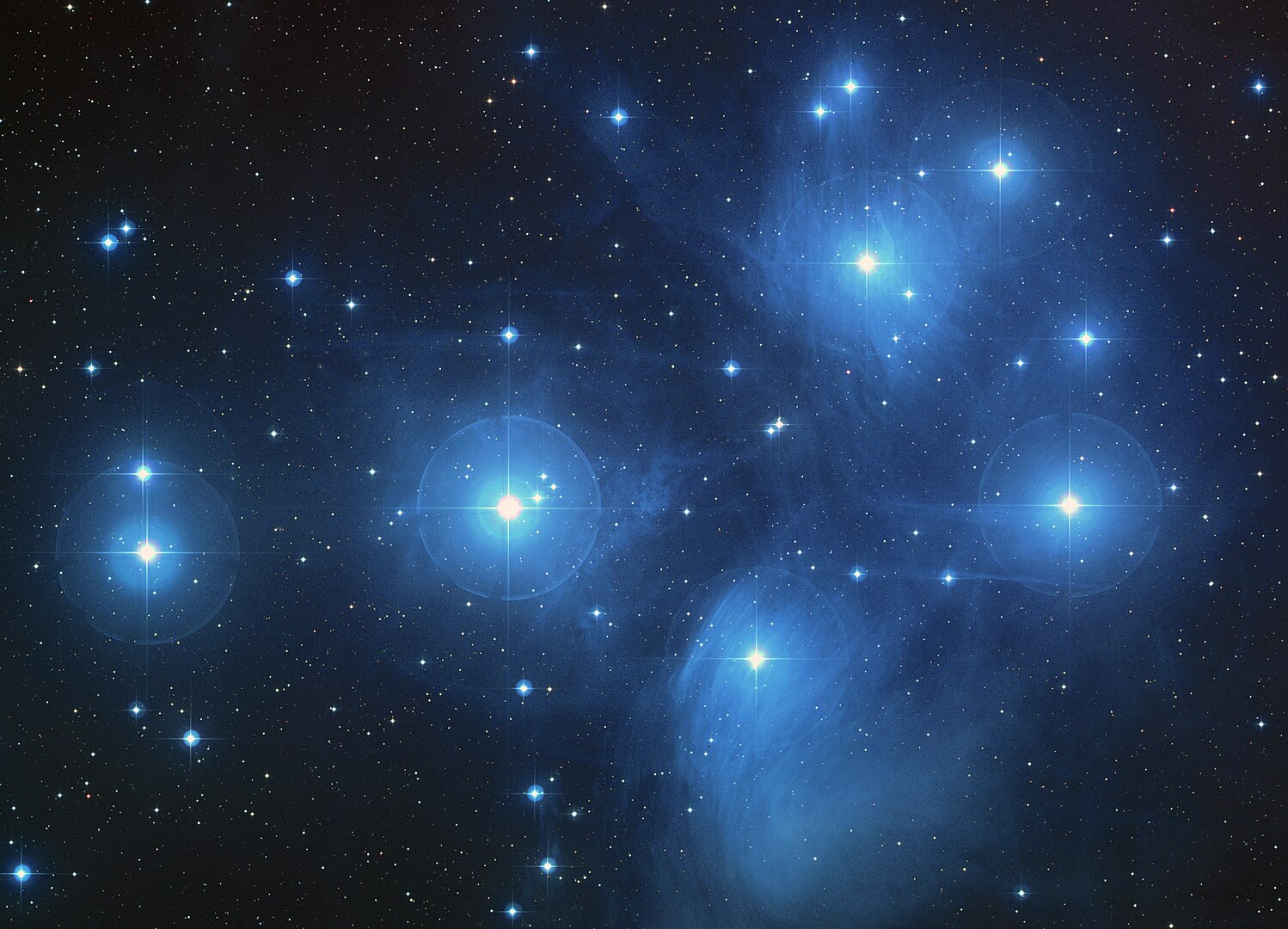
Many people interested in astronomy know the Hyades and the Pleiades. They are star clusters in the constellation Taurus. They are two of a handful of star clusters that are visible to the naked eye in dark skies.
It turns out that these clusters, as well as more than 150 other clusters nearby, all originate from just three massive star-forming regions.
Open clusters such as the Hyades and Pleiades contain hundreds of stars loosely bound together by mutual gravity. They have fewer stars than globular clusters and are not as densely packed. They are also not spherical like globular clusters, but follow the galactic plane. They are usually found in the spiral arms of the Milky Way rather than in the halo where globular clusters are located.
Open star clusters eventually lose their gravitational bond with each other and are called stellar associations. They still move together through space and are then called a moving group. Their motion allows astronomers to understand their origins.
In a new research article in Nature, a team of researchers has traced the origins of 155 young star clusters within about 3,500 light years of the Sun. The article is titled “Most nearby young star clusters formed in three massive complexes.” The authors come from institutes in Austria, Germany and the USA.
“Young star clusters are ideal for studying the history and structure of the Milky Way. By studying their movements in the past and thus their origin, we also gain important insights into the formation and evolution of our galaxy,” says João Alves of the University of Vienna, co-author of the study.
The researchers used Gaia data and spectroscopic observations of star clusters to trace their history back 60 million years. They discovered three families of star clusters, each of which is associated with one of three star-forming regions. “This suggests that the young star clusters originate from only three very active and massive star-forming regions,” says Alves.
The researchers started with a sample of 272 star clusters. They found that between 30 and 50 million years ago, almost 60 percent of their orbits converged in three locations. This showed that “a large proportion of star clusters in the solar neighborhood have common origins.”
The three cluster families are named after their best-known members: Collinder 135 (Cr135), Messier 6 (M6), and Alpha Persei (?Per). The clusters contain 39, 34, and 82 star clusters, respectively. Together, they contain 57% of the 272 star clusters in the sample and 59% of the 48,514 stars in the sample.
This research illustration shows the positions of the clusters' stars across the sky, as well as some optical images of some of their members. Alpha Persei's members are spread out further across the sky because they are closest to the Sun. (Interactive version here.) Image credit: Swiggum et al. 2024.
“These findings provide a clearer understanding of how young star clusters in our galactic neighborhood are connected to each other, similar to family members or 'bloodlines,'” says lead author Cameron Swiggum, a doctoral student at the University of Vienna. “By studying the three-dimensional motions and past positions of these star clusters, we can identify their common origin and locate the regions in our galaxy where the first stars in these respective star clusters formed up to 40 million years ago.”
The team's research uncovered more than just the history of the star clusters. They also found that over 200 supernova explosions must have occurred in the three star-forming regions to eject all of these clusters. However, supernova explosions are extraordinarily powerful, and 200 of them release enough energy to shape their surroundings on a large scale.
The authors say these explosions created a gigantic bubble in the ISM. “This could explain the formation of a superbubble, a giant bubble of gas and dust 3,000 light-years in diameter around the Cr135 family,” Swiggum said in a press release.
Our solar system is also located in one of these bubbles, the Local Bubble. Inside the bubble, the gas is thinner and hotter than outside. “The Local Bubble is also probably linked to the history of one of the three star cluster families,” adds Swiggum. “And it has probably left traces on Earth, as measurements of iron isotopes (60Fe) in the Earth's crust suggest.”
This image from the research shows three star cluster families and other local features on a dust map. The dust is shown in gray and two prominent dust features, the Vela Molecular Ridge and the Radcliffe Wave, are labeled. The Sun is the yellow dot and the local bubble is shown in blue. (Interactive version here.) Image credit: Swiggum et al. 2024.
It's a truism that finding connections between things creates meaning. The stars in the sky aren't just “there.” There's a long story to tell when you unravel what we perceive as static. This research is another example of the powerful Gaia spacecraft's ability to find relationships between stars and weave an evidence-based story of their history. And we're somewhere in the middle of it.
“We can essentially turn the sky into a time machine that allows us to trace the history of our home galaxy,” says João Alves. “By deciphering the genealogy of star clusters, we can also learn more about our own galactic lineage.”
Like this:
Is loading…