As part of the Artemis program, NASA will return astronauts to the lunar surface for the first time since the Apollo 17 landing in 1972. Beyond this historic mission, scheduled for September 2026, NASA plans to build the infrastructure that will enable annual missions to the Moon and eventually lead to a permanent human presence there. As we touched on in a previous article, this will create enormous demand for cargo delivery systems that can meet the logistical, scientific and engineering needs of the crews involved in exploration.
Beyond these crew and cargo transport capabilities, there is also a need for transportation systems to meet logistical requirements and assist in exploration efforts. These requirements were laid out in a Moon to Mars Architecture 2024 white paper titled “Lunar Mobility Drivers and Needs.” This white paper follows on from the “Lunar Surface Cargo” paper released at the same time and addresses the need for lunar infrastructure to enable the transport of astronauts and payloads from landing sites to where they are most needed. As usual, a critical gap was identified between current capabilities and what is expected.
The authors reiterate the need for mobility systems that meet NASA's goals as outlined in the Moon to Mars Architecture Definition Document (ADD). As they note, recent analyses of integrated surface operations have highlighted the importance of transportation systems that can move cargo from delivery sites to operations sites across the lunar surface. This could range from “crew logistics and consumables to science and technology demonstrations to large-scale infrastructure requiring precise relocation.”
Artist's impression of the new spacesuit NASA is designing for Artemis astronauts. It's called xEMU, or Exploration Extravehicular Mobility Unit. Image credit: NASA
In short, in addition to landers capable of transporting crews, supplies, experiments and habitats, NASA's Moon-Mars program also requires vehicles and support networks capable of transporting them from point A to point B. As they themselves say, the mobility elements currently defined are either primarily for crew use or limited in mobility. These include elements such as the Lunar Terrain Vehicle (LTV) and the Pressurized Rover (PR) – which are components of the Artemis Base Camp – as well as robotic missions contracted through the Commercial Lunar Payload Services (CLPS) program.
In addition, the needs and challenges that will arise during the course of the Artemis program will be divided into three segments: Human Lunar Return (HLR), Foundational Exploration (FE), and Sustained Lunar Evolution (SLR). The HLR segment includes the Artemis III mission, currently scheduled for September 2026, which will land a two-person crew on the lunar surface using a Starship HLS. The FE segment will coincide with Artemis IV and Artemis V (2028 and 2030), which will increase crew size from two to four and expand the required infrastructure.
After that, NASA plans to launch one mission each year during the SLR portion and establish a permanent habitat on the Moon. During that time, the need for payloads and transport systems will exceed current capacities, which are limited to 15,000 kg (33,070 pounds) of cargo. Similarly, as NASA explains in its Lunar Surface Cargo white paper, achieving key mission objectives will require cargoes of sizes and masses that exceed these capacities, requiring additional solutions.
Separation and transport
As the authors say, a major problem on the lunar surface affecting mobility is the need for separation between landing sites and operational sites. This separation is motivated by several factors, including scientific objectives, lighting conditions, and safety considerations. In short, crew vehicles, habitats, and critical infrastructure will be positioned at a certain distance from the landing sites to avoid being affected by darkness from the shadow of the landers, contamination from the landers, and regolith or blast ejecta from engine exhaust. Depending on the level of concern, separation distances are divided into three levels:
- Distance to the shadow of the lander (several dozen meters, several dozen yards)
- Limitations due to ejected material from the lander explosion, either due to the distance between the lander and existing infrastructure or due to the ascent of the lander (> 1,000 m; ~ 1090 yards)
- Support the aggregation of elements in ideal residential zones from available regional landing areas
(up to 5,000 m)
In addition, the architecture of NASA's Moon-Mars mission emphasizes the need for in-situ resource utilization (ISRU) such as water ice, regolith, and minerals. NASA also recognizes the need to select habitation and hibernation sites that minimize darkness from shadows caused by local topography and the tilt of the Sun during lunar nights (which last two weeks each). This is easiest at higher elevations and on crater ridges. This requires two things:
- Exploration, residential and energy sites must be located far from landing and ISRU sites.
- On the way from the landing site to the residential areas, gradients of up to 20 degrees can occur.
These overlapping challenges can be addressed, the authors explain, by ensuring that appropriate systems are in place to allow mission elements to move away from landers once they are deployed on the surface:
“This could be achieved using independent or integrated mobility systems. The frequency of crossings between downslope and upslope sites would depend on the cadence at which landers deliver cargo to the lunar surface and the mass that a given mobility system can transport on each crossing. Integrated architecture operations require significant relocation and staging areas for cargo and assets.”
Transport options
During the FE portion of the Artemis program, NASA plans to increase the number of surface crews from two to four, who will be required to operate on the surface for approximately 30 days. This will require a wide range of mobility requirements that can accommodate payloads of different sizes and masses and over different distances. These include:
- Smaller technology demonstrations: 500 to 2000 kg (~1100 to 4410 lbs)
- Logistical elements per manned surface mission: 2,000 to 6,000 kg (~4410 to 13,230 lbs)
- Residential systems: 12,000 to 15,000 kg (~26,455 to 33,070 lbs)
The authors acknowledge that current mobility elements may provide some opportunities for cargo shifting—the LTV, for example, can carry 800 kg (~1764 lbs) of cargo unmanned. However, according to the NASA team's analysis, mobility capacity is 1,000 to 15,000 kg (2,200 to 33,070 lbs) below needs per object at distances of 50 to 5,000 m (~55 to 5470 yards). In addition, the “frequency of shifting requirements” (i.e., how often payloads need to be moved) will vary considerably, ranging from single operations for large elements to multiple trips per year for containers and smaller cargo.
Forecasts for mobility demand compared to LTV and LRV transport capacities. Image credit: NASA
Conditions
The authors also discuss how important lunar conditions are when developing mobility systems. One of the biggest hazards on the Moon is regolith (also called “lunar dust”), the fine silicate powder that covers much of the surface and sticks to anything it comes into contact with. There are light conditions, where parts of the south polar region are in shadow due to the Sun's tilt, and permanently shadowed regions (PSRs) where it is constantly dark. Finally, there is the terrain, which can be rocky or covered by 1 to 10 m of regolith, and where tilts of more than 10 degrees are common.
This combination of factors, they argue, “creates a significant technology gap between existing systems and mobility requirements for future exploration.” First, energy systems must provide enough power to allow vehicles to maintain adequate speeds and transport capacity and operate during lunar nights. The authors also recommend more studies on regolith mitigation strategies to prevent wear and the effects of regolith on electromechanical systems. They also emphasize the need for sufficient autonomy and/or remote control to allow for greater flexibility and range.
These autonomous systems must cope with the challenging lunar terrain, map the local topography, detect obstacles and impassable areas, and find optimal paths to the destination. As the authors note, these systems could provide greater flexibility in mission planning and increase the speed of mobile resources, especially in areas where the terrain impairs communications and makes remote operations impossible.
In summary, the white paper “Lunar Mobility Drivers and Needs” identifies some key requirements for establishing a permanent human presence on the Moon. This will entail transporting cargo and goods across the lunar surface from landing sites to destinations 5 to 5,000 meters away. The vehicle will also need to be able to carry payloads of up to 12,000 kg or more, which is well above the current capabilities of the proposed LTV of 800 kg.
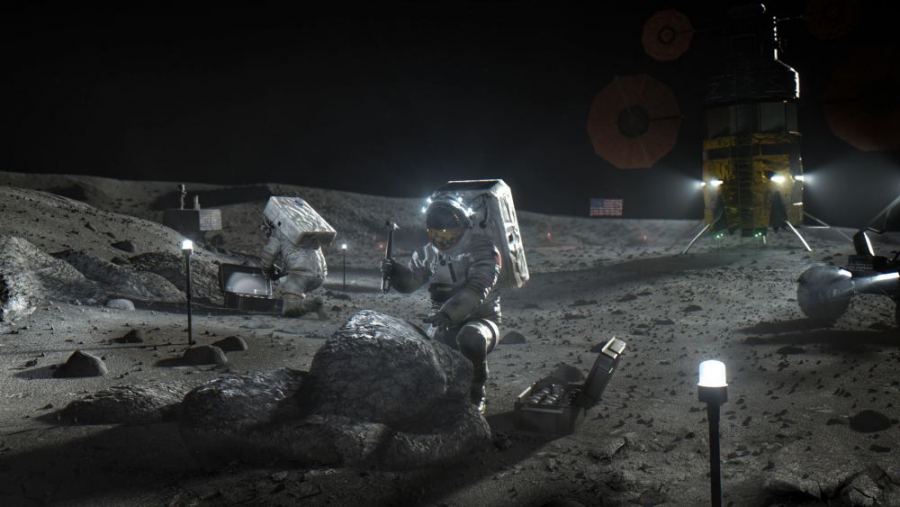
Artist's impression of an Artemis astronaut exploring the lunar surface during a future mission. Image credit: NASA
In addition, the document notes that energy and environmental considerations are crucial to the design process. It is not simply a matter of scaling small mobility systems to create large ones. Finally, the computer systems and software that future mobility systems will run on will need to be interoperable, able to share information between vehicles and base sites, and able to function autonomously or semi-autonomously.
As with Lunar Surface Cargo, these findings will be explored in more detail in the 2024 Architecture Concept Review (2024 ACR), to be released later this year, along with white papers describing NASA's cargo return needs and its lunar surface strategy.
Further reading: NASA
Like this:
How Is loading…