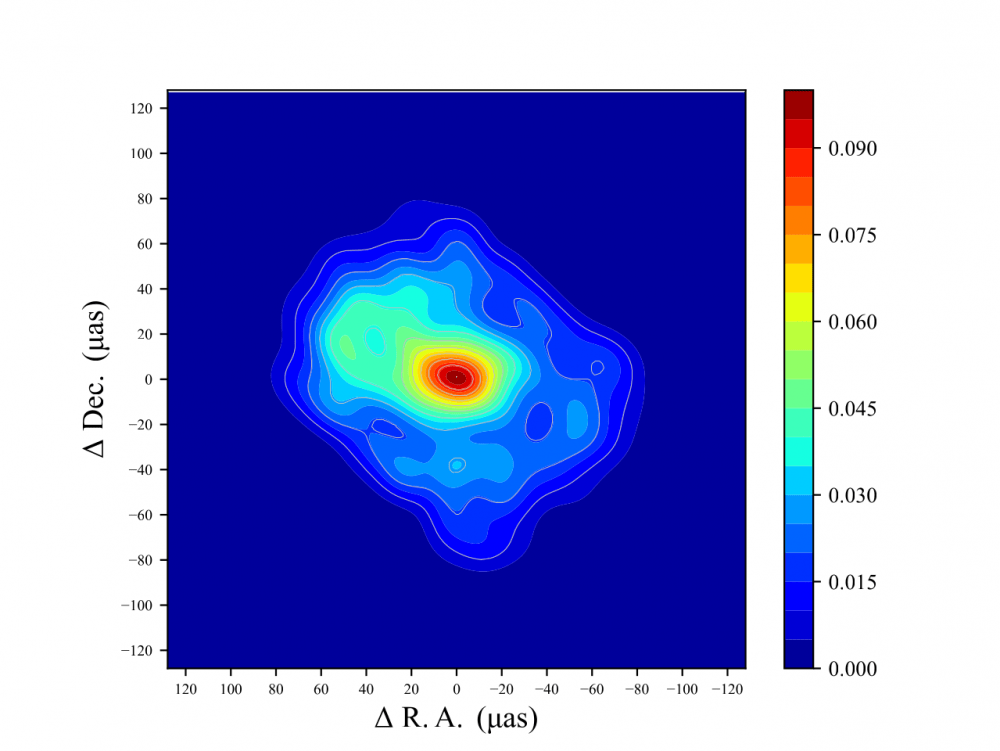
Remember the amazing “first image” of the Sagittarius A* (Sgr A) black hole at the heart of the Milky Way? It may not be entirely accurate, according to researchers at the National Astronomical Observatory of Japan (NAOJ). Instead, the accretion disk around Sgr A* may be more elongated than the circular shape we first saw in 2022.
Scientists at NAOJ applied various analysis methods to the Sgr A* data first captured by the Event Horizon Telescope (EHT) team. The EHT data came from a network of eight ground-based radio telescopes. The original analysis showed a bright ring structure surrounding a dark central region. The reanalysis, which results in a different shape, reveals something about the movements and distribution of matter in the disk.
To be fair to both teams, analyzing radio interferometry data is notoriously complex. According to NAOJ astronomer Miyoshi Mikato, the rounded appearance could be due to the way the image was created. “We suspect that the ring image was due to errors in EHT's image analysis and that part of it was an artifact rather than the actual astronomical structure,” Miyoshi suggested.
This is the first image of Sgr A*, the supermassive black hole at the center of our galaxy. A reanalysis of the EHT data by NAOJ scientists suggests that the accretion disk may be elongated rather than circular. Photo credit: EHT
Explaining the appearance of a black hole
What does Sgr A* look like in the NAOJ reanalysis? “Our image is slightly elongated in the east-west direction and the eastern half is brighter than the western half,” Miyoshi said. “We think this phenomenon means that the accretion disk surrounding the black hole is rotating at about 60 percent of the speed of light.”
The accretion disk is filled with superheated material that “circles the drain,” so to speak. It flows into the black hole with a mass of 4 million solar masses. As it passes through the accretion disk, the material is heated by friction and the effect of magnetic fields. This means that it shines primarily in X-ray and visible light and also emits radio emissions.
Various factors also influence the shape of the accretion disk, including the spin of the black hole itself. In addition, the accretion rate (i.e. how much material falls into the disk) as well as the angular momentum of the material influence the shape. The black hole's gravitational pull also distorts our view of the accretion disk. This type of “funhouse mirror” distortion makes it incredibly difficult to image. As it turns out, either view of the disk's actual shape – the original “circular” EHT view or the extended NAOJ view – could be correct.
So why the different views of the black hole?
How did the teams arrive at two slightly different views of Sgr A* using the same data? “No telescope can capture an astronomical image perfectly,” emphasized Miyoshi. The EHT observations show that interferometric data from the widely networked telescopes can have gaps. When analyzing data, scientists must use specialized techniques to create a complete picture. This is what the EHT team did and this is how the image of the “round black hole” was created.
Miyoshi's team published a paper describing their findings. In it, they suggest that the “ring” structure in the 2022 image released by EHT is an artifact caused by the bumpy point spread function (PSF) of the EHT data. The PSF describes how an imaging system handles a point source in the region under consideration. It helps determine the amount of blur that occurs due to imperfections in the optics (or in this case the gaps in the interferometric data). In other words, there were problems “filling” the gaps.
The NAOJ team reanalyzed the data and used a different mapping method to compensate for the gaps in the data. This resulted in an elongated shape of the Sgr A* accretion disk. One half of the disk is brighter and they suspect this is due to Doppler enhancement as the disk is spinning rapidly. They suggest that the reanalyzed data and the extended image show a portion of the disk located a few Schwarzschild radii from the black hole, rotating extremely quickly and viewed from an angle of 40° to 45°.
What's next?
This re-analysis is intended to provide a better understanding of what the Sgr A* accretion disk actually looks like. The EHT study of Sgr A*, which led to the image release in 2022, was the first detailed attempt to map the region around the black hole. The EHT consortium is working on improvements to produce better and more detailed interferometry images of this and other black holes. Ultimately this should lead to more accurate views. Follow-up studies should help close any gaps in the observations of the accretion disk. In addition, detailed studies of the black hole's immediate surroundings should provide further clues about the black hole hidden in the disk. I
More information
First image of black hole in Milky Way may not be accurate
An independent hybrid imaging of Sgr A* from the EHT 2017 observation data
Like this:
Load…