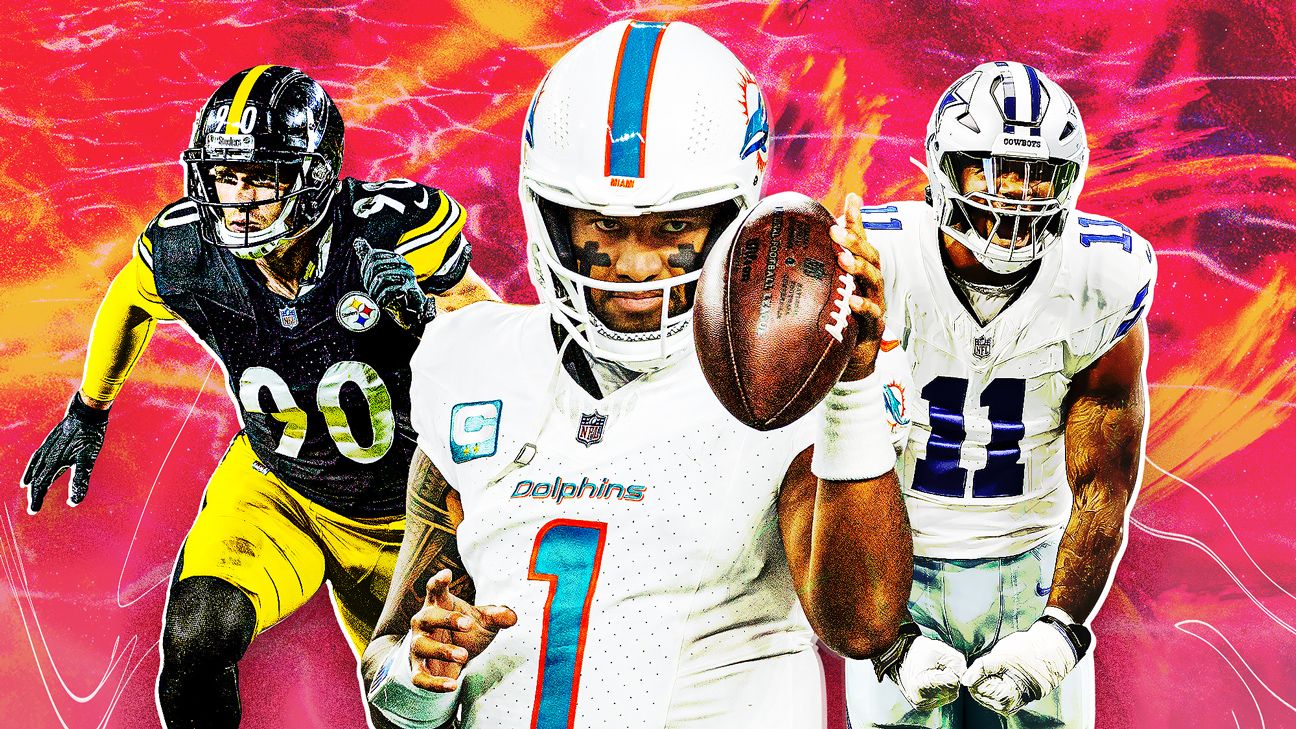
While there are more trades in the NFL than ever before, I will admit that I occasionally look longingly toward my colleagues covering the NBA. When Kevin Garnett said “Anything is possible!” after winning a title in 2008, I’m guessing he wasn’t thinking about his league’s trade market, but there’s no better way of explaining what’s, well, possible in the NBA. Trading a star for five first-round picks feels ho-hum. Heck, trading a star for just one first-round pick is wild these days.
These sorts of deals don’t happen in the NFL, where teams can trade picks only within the next three draft cycles, keeping them from making the sort of long-term moves that NBA teams are happy to make. While the NBA salary cap is perhaps even more arcane and mysterious than the NFL’s, the structure of NBA deals makes them easier to deal than their NFL counterparts — dead money in the NFL can make a contract all but untradeable at certain times.
Let’s live in that world for just one moment. In a universe in which dead cap doesn’t exist and teams could trade for players on their existing deals, how much would the top players in the NFL land? Sure, it’s impossible to imagine a scenario in which the Chiefs trade Patrick Mahomes or the Bills deal away Josh Allen, but who could have expected the Mavericks to ship off Luka Doncic? I’ve gone through every team’s roster and identified the players who could realistically land at least one first-round pick in a trade, moving all the way up to the top of the market, where we’re approaching a decade’s worth of first-rounders in a hypothetical swap.
There are some contextual concerns, of course. No team is going to deal its starting quarterback without a successor in place during training camp, so we have to assume these trades take place during some indeterminate void between the end of the prior season and the start of the next one. The price to blow away a team that doesn’t want to trade away a player is far different than the price when a team wants to get rid of a player at all costs, so I’ve tried to strike the balance between those two scenarios.
Subscribe: ‘The Bill Barnwell Show’
The idea of a player being valued at a first-round pick level can mean a lot of different things; one team thinking a guy is worth the No. 32 pick is very different than all teams thinking a guy is worth the first overall pick. Here, I tried to move past the idea of one outlier team considering something and tried to treat players with a first-round grade if I believed more than a handful of organizations would think they were worth that much via trade. I discounted more than I normally would for future first-rounders, given that we’re talking about picks well into the next decade in some cases, but not by the “one-round-per-year” rule.
I’ve tried to use real trades and player valuations to reflect how teams typically value archetypes around the NFL. That means positional value, contracts and age make a massive impact in evaluating how much even talented players get in return. Quarterbacks are always in demand, but the last time a non-quarterback got traded for a first-round pick after turning 30 was 1994, when the Vikings dealt 33-year-old Chris Doleman to the Falcons.
The only 29-year-olds to be dealt for first-rounders both involved the Raiders, who sent those picks off for pass rusher Richard Seymour (2009) and wide receiver Davante Adams (2022). Factoring in contract value and advancing age, only superstars get dealt for significant draft capital as they approach 30. And on the other hand, guys who went in the top half of Round 1 in this year’s draft (or some players who went in the bottom half, especially if they play premium positions) would likely be worth a first-round pick, even though they’ve never played a single pro snap.
What’s tougher is evaluating the trade value of players who are never going to hit the market. We don’t know what 25-year-old future Hall of Famers are going to land via trade because their teams hold onto them for dear life. Bills and Chiefs fans have waited generations to land Allen and Mahomes. Those guys aren’t going anywhere in the real world. But for one day, let’s live in a world where anything is possible.
Jump to a team:
ARI | ATL | BAL | BUF | CAR | CHI | CIN
CLE | DAL | DEN | DET | GB | HOU | IND
JAX | KC | LAC | LAR | LV | MIA | MIN
NE | NO | NYG | NYJ | PHI | PIT | SF
SEA | TB | TEN | WSH
NFC EAST
Two first-round picks and more: Edge Micah Parsons. Still waiting for his long-term contract extension, the price to procure his signature is only going up after Myles Garrett and T.J. Watt signed their own extensions. The baseline for a Parsons deal a year ago would have been Nick Bosa’s extension, which is worth $34 million per year. Now, Watt’s deal is up to an average annual value (AAV) of $41 million. Parsons is going to get a record-setting deal when he signs.
I expect that to occur with the Cowboys before Week 1, but if they did decide they couldn’t justify paying three players market-setting deals at the league’s three most expensive positions, he would attract a massive trade haul. The closest comp is Khalil Mack, who in 2018 was traded before his fifth season with a second-round pick for two first-round picks, a third-rounder and a sixth-rounder.
Parsons is a year younger than Mack was at the time. And while Mack had a Defensive Player of the Year award under his belt, Parsons has more sacks (52.5 to Mack’s 40.5) and quarterback knockdowns (112 to Mack’s 84) over his first four seasons. The Mack deal came in just shy of two first-round picks of value after accounting for the other selections involved; the Cowboys would expect more for Parsons.
Editor’s Picks
2 Related
One first-round pick and more: WR CeeDee Lamb, G Tyler Smith. Lamb is a special receiver, and at 26 years old, he should be right in the peak of his career. Unlike Parsons, though, he’s already earning top-of-the-market money at $34 million per year, making it tough for teams to realize significant surplus value on the player they would be acquiring. (Parsons is about to get paid, but there’s more runway with potential franchise tags than there is for Lamb.) Lamb would demand a first-round pick and a second-rounder, but probably not much more.
Smith signifies both the value in adding rookie contract players and the increased emphasis placed on interior linemen over the past decade. While he is capable of kicking out and playing tackle, Smith has been an elite guard since being drafted in 2022. Good guards such as Robert Hunt have commanded $20 million per year on the open market, and Smith’s on another level from the Carolina lineman. He’s also owed only $2.5 million in 2025 and a $21.2 million fifth-year option in 2026, which would be a meaningful savings from what he will get on his next deal in Dallas.
One first-round pick: QB Dak Prescott, G Tyler Booker. Booker gets in by virtue of being a player taken in the top half of April’s draft. Prescott would be a fascinating trade candidate if his contract made it financially feasible, which it would theoretically become in 2026 if he was willing to waive his no-trade clause. You don’t need me to fill you in on both the good and bad of Prescott as a player, but no other team has been willing to top the $60 million average salary the Cowboys gave him last September, even with Brock Purdy and Josh Allen signing new deals this offseason.
Average salary isn’t everything, but between the money, the no-tag and no-trade clauses and the guarantee structure, Prescott has the league’s most player-friendly deal. There are organizations that would be willing to pay him $60 million and accept good, sometimes great performance, but would they also be willing to give up a first-round pick for that privilege? Given how often teams manage to get something for QB contracts that seem underwater, my instinct is yes, but there are passer-needy teams that likely would prefer to sit this one out and go after a passer on a rookie deal instead.
Missing out: OT Tyler Guyton, a first-round pick last year, struggled as a rookie. While it’s too early to draw conclusions about his future, players taken toward the end of Round 1 who fail to live up to those expectations in their first season don’t have first-round trade value within the league. Him suffering fractured bone in his knee in training camp won’t help matters.
The two ball-hawking cornerbacks don’t make it here. Trevon Diggs hasn’t quite been the same since his torn ACL in September 2023, while DaRon Bland wasn’t his usual self after returning from a stress fracture in his foot last season. I liked what I saw from LB DeMarvion Overshown, but the 2023 third-round pick also suffered a catastrophic knee injury last season. DT Osa Odighizuwa signed a four-year, $80 million extension in March, and while that was fair, I’m not sure other teams would attach significant draft capital for the right to pay out his contract.
Two first-round picks and more: WR Malik Nabers. He still has three years and about $10.4 million in total remaining on his rookie deal; in other words, he’ll make about as much over the next three years as Ja’Marr Chase will make every 4½ games. And that’s without considering a fifth-year option for 2028 that should end up being a bargain versus whatever the top of the wide receiver market looks like at that point.
Chase is more of a sure thing than Nabers, but there’s a staggering sum of money being saved that can go to other parts of New York’s roster. Let’s say the Giants are relatively conservative about Nabers’ impact and think he is a top-20 wide receiver; a top-20 wideout on a non-rookie deal is making $25 million per year now (and a price that’s going up faster than the cap each year). That’s $60 million in surplus value. It’s tough for even transcendent non-quarterbacks to be that valuable when they’re making top-of-the-market money.
Nabers started his career with a 1,204-yard season while catching passes from Daniel Jones, Tommy DeVito and Drew Lock. He doesn’t turn 22 until next week. While acknowledging that wide receiver career paths don’t always go the way Chase’s has — Michael Thomas, JuJu Smith-Schuster and former Giants standout Odell Beckham Jr. are examples of injuries hampering a Hall of Fame start — Nabers was already playing at a star level last season. He won’t be paid like a star for years to come.
One first-round pick and more: Edge Abdul Carter. Regarded by some as the best player independent of position in April’s draft class, Carter slipped to the Giants with the No. 3 pick. He was extremely productive in his final college season, racking up 12 sacks and 24 tackles for loss. He’s still only 21 years old and plays a premium position. Even though he hasn’t played a down yet, he would land more than a randomly assigned first-rounder if traded.
Missing out: DT Dexter Lawrence is arguably the best nose tackle in the game, even if his career-high sack total from 2025 (9.0) was inflated by cleaning up other defenders’ pressures. With three years remaining on a four-year, $87.5 million extension, he makes second- or third-tier tackle money. He’s the sort of rare athlete at 6-foot-4 and 340 pounds that coaches love to have in their lineup. Nearing age 28, though, teams might need to see more consistent pass-rush production to deal a first-rounder.
OT Andrew Thomas plays a premium position and is in the prime of his career, but injuries have held him back, as he has missed 22 games over the past four years with a variety of ailments. He would be back on the first-round side of things with another healthy, productive season. S Jevon Holland earned a three-year, $45.3 million deal in free agency, which is great for the him but might limit his theoretical trade market. Edge Kayvon Thibodeaux has flashed moments of dominance, but he has one great season since being drafted in 2022.
Two first-round picks: DT Jalen Carter, QB Jalen Hurts. Go back and watch the final two snaps of the Rams’ 2024 season if you have any questions about Carter. He doesn’t have spectacular numbers, racking up 10.5 sacks and 25 knockdowns over his first two seasons, but the tape shows a player who consistently pushes the pocket and presents an incredibly difficult matchup for interior offensive linemen. He’s on the verge of a 10-sack season, which might come as early as 2025.
Are there teams that wouldn’t be willing to mold their offense to fit Hurts’ style of play? I suppose. It’s their loss. In Jeremy Fowler’s recent story polling league execs, Hurts was valued as the league’s ninth-best quarterback, which reflects reality: There are some in the league who never believed in him as a viable starter and some who see his style of play and injury concerns as worrisome over the long term. There are others who note the slowdowns the Eagles have had in the passing game in the second half of the 2023 and 2024 seasons and wonder what Hurts would do without a great offensive line and the threat of the run game.
At the same time, Hurts is propelling the run game forward, both with his actual running and his gravity as a potential threat to keep the football. He has dropped his interception rate below 1.5% in two of the past three seasons, and while he does take too many sacks, that’s his only statistical weakness as a passer. He has also been lights-out in the postseason, arguably outplaying Patrick Mahomes in each of their two Super Bowl matchups. There’s a wider range of opinions on Hurts than other star quarterbacks, but he’s a 26-year-old with a meaningful MVP push and two Super Bowl appearances in the past three seasons.
One first-round pick and more: WR A.J. Brown, WR DeVonta Smith, OT Jordan Mailata, CB Quinyon Mitchell. Both wideouts belong here, especially with the market continuing to rise after both Brown and Smith signed new contracts last spring. Brown has arguably been the NFL’s most efficient receiver since joining the Eagles in 2022, while Smith is more than a year younger and would surely have more impressive cumulative numbers if he wasn’t in a run-first offense with another star pass catcher.
Mailata’s prior deal was a bargain for the Eagles, which helped them as they negotiated a new extension for him (three years, $66 million) last offseason. He has rounded into a prototypical left tackle, albeit one stuck in the same conference as Trent Williams and Tristan Wirfs. Mitchell was one of Philadelphia’s two rookie cornerbacks who excelled last season, and his stock is higher than it was a year ago after he grew into a defender to avoid on throws to the sideline.
play
0:38
The latest action from Day 4 of Eagles training camp
Tim McManus recaps the latest action from day four of Eagles training camp, including a nice interception from Quinyon Mitchell.
One first-round pick: CB Cooper DeJean, G Landon Dickerson. DeJean could justify something beyond a lone first-round pick after his ascension into the starting lineup coincided with the Eagles morphing into the league’s best defense. He was a second-round pick a year ago, however, and almost exclusively played in the slot, a role teams typically don’t value quite as highly. If he repeats that level of play while moving outside more often, he’ll rise further. Dickerson is a three-time Pro Bowler on a deal with a $21 million AAV, which might soon look like a bargain relative to other guard contracts.
Missing out: Well, there’s the guy who nearly won MVP last season. RB Saquon Barkley represents one of the league’s most unique situations; it’s clear he wouldn’t have landed a first-round pick in a trade last year, when he hit free agency and signed for just over $12.5 million per season. Now, he just finished one of the greatest running back seasons ever and looked like a walking 60-yard touchdown every single week, including deep into Philadelphia’s run through the NFC side of the playoff bracket.
Teams would love to have the 2024 version of Barkley, but that’s no guarantee going forward. Given his significant injury history with the Giants, the inherent benefits of playing behind a dominant offensive line and alongside a quarterback who changes the numbers in the run game and a new deal that will pay him more than $20 million per season, my guess is most teams wouldn’t be able to justify shipping out a first-round pick for the 28-year-old. (The Giants might be the exception.)
Other offensive linemen could feature here. C Cam Jurgens just signed a new deal and plays the least-valued position along the line, although he was also just fine at guard in 2023. Lane Johnson is the best right tackle in football on a snap-by-snap basis, but injuries have been a reality of life for the six-time Pro Bowler. No team is trading a first-round pick for a 35-year-old non-quarterback.
There are front-seven players who could make the leap to the next tier with another big season. Edge Nolan Smith was lost as a rookie before looking more like his old self under coordinator Vic Fangio. He had four sacks and five quarterback hits during the postseason. DT Jordan Davis hasn’t quite turned into the unblockable defender the Eagles hoped for, but if he ends up as a great two-down defender who occasionally runs over an interior lineman one-on-one next to Carter, he’s still a valuable player. And while LB Zack Baun’s 2024 season was every bit as impressive as Barkley’s, he’ll need to do that again to get front offices believing he really is the league’s best off-ball linebacker.
Four first-round picks plus more: QB Jayden Daniels. I can see both sides of the argument. While nobody doubts what Daniels did last season, he has only done it once, as opposed to Patrick Mahomes, Josh Allen and Lamar Jackson, who have been MVP candidates for most of their careers. There are still teams that would hesitate to invest in him because of his slight frame, and there’s always a concern that a quarterback who had so much success scrambling and creating on fourth down might not be able to keep that up. Maybe that side thinks Daniels is worth two first-round picks.
Then there’s the other side, which would (correctly) point out that Daniels reinvigorated an entire fan base last season. He had one of the best rookie seasons in league history, throwing for 3,568 yards with 25 touchdowns while adding 891 rushing yards and six more scores on the ground. He did that with wideout Terry McLaurin, offensive coordinator Kliff Kingsbury and a bunch of guys who weren’t moving the needle around the league. There probably won’t be another Hail Mary to beat the Bears or another 86-yard touchdown to nearly tie the game in the fourth quarter against the Cowboys, but Daniels doesn’t need those plays to be an elite quarterback. If he cuts unnecessary sacks out of his game, what else would he need to be on the same level as those guys I mentioned?
Crucially, while Mahomes, Allen and Jackson are all on significant contracts, Daniels is in the second season of his four-year, $37.7 million rookie deal. With the Commanders already having paid his signing bonus, they’ll pay him $2.5 million in 2025 and $4.3 million in 2026 before he is even eligible for an extension. He might be one of the league’s two or three biggest bargains while playing the most important position in sports. Is that worth five first-round picks? Six? Seven? The answer is “too many,” so I tried to strike a middle ground.
One first-round pick: CB Mike Sainristil. The other star from Washington’s 2024 rookie class, Sainristil entered the season expecting to play the slot before quickly ending up outside, where he picked off four passes, including two in the playoff run to the NFC title game. His size (5-10) might concern some teams, but he’s a reliable tackler and is quickly becoming a leader for a team finding the guys who will be the formative parts of its culture once veterans such as Zach Ertz and Bobby Wagner move on.
Missing out: It turns out there are a lot of rentals on the roster, so while there are plenty of other talented players in Washington, they’re not in the first-round pick range. OT Laremy Tunsil was just dealt from Houston without a first-round pick attached, although the Commanders sent second- and third-round selections the other way. Elsewhere along the line, G Sam Cosmi was excellent during the first half of the season, but he tore his ACL in January.
Commanders fans don’t want to find out whether they can land a premium pick for WR Terry McLaurin, whose public battle for a new contract has felt like a relic of the Daniel Snyder days. As good as I believe McLaurin is, it would be tough to see a team trading a first-round pick for a wideout who turns 30 in September. The other young player who might be able to get on the first-round track with more playing time is second-year DT Jer’Zhan Newton, who will assume a larger role after the departure of Jonathan Allen.
NFC NORTH
Two first-round picks and more: QB Caleb Williams. For now. The Bears wouldn’t have taken anything close to this for him a year ago, but that was then. He struggled through a dismal rookie season, and while it’s fair to chalk up some of his woes to an underwhelming scheme and seemingly disinterested playmakers, he deserves plenty of the blame for what went wrong. Indulging the worst elements of his game most weeks and eventually losing his confidence, Williams wasn’t reliably creating within the offense, and his attempts to improvise often proved disastrous.
And yet, he was the consensus first overall pick and a potential superstar quarterback prospect. While Williams has essentially wasted a year of a bargain rookie contract, he’s still on a team-friendly deal for up to four more years. If new coach Ben Johnson does everything Bears fans are expecting with Williams this season — and he is willing to rein in his hero-ball tendencies — he could be back toward the untouchables in 2026. If not, something will have gone very wrong in Chicago.
One first-round pick: WR Rome Odunze, TE Colston Loveland, CB Jaylon Johnson. Chicago’s two highly drafted playmakers for Williams would still fetch first-round picks. We haven’t seen Loveland play yet, but he was attracting plenty of interest before the Bears took him at No. 10 in April. Odunze’s rookie season wasn’t anything to write home about, but there were flashes of the receiver who ran away from coverages and racked up 2,785 yards and 20 touchdowns over his final two college seasons.
Catch up on the NFL offseason
• Judging overreactions | Summer reset
• Offseason grades | Top 50 newcomers
Training camp buzz | More NFL
Like just about everybody on the Bears’ defense, Johnson was better in 2023 than he was in 2024, but he stayed healthy and did enough to earn his second straight Pro Bowl nod. He is one of the league’s best zone corners, and after struggling at times with his tackling, he was far more reliable there last season. His $19 million AAV isn’t onerous given the deals that have since pushed up the top of the cornerback market.
Missing out: CB Kyler Gordon and S Jaquan Brisker are both very good defensive backs, but Gordon just got paid and is primarily a slot corner. Brisker has battled injuries throughout his career, including a concussion that cost him most of the 2024 season. Edge Montez Sweat and LB Tremaine Edmunds are good players, but they’re on significant contracts.
WR DJ Moore was worth a first-round pick earlier in his career and represented meaningful trade value as part of the trade that led to Carolina getting QB Bryce Young, but he looked slow on tape in 2024 and is about to start a four-year, $110 million deal. OT Darnell Wright could earn more consideration if Chicago’s improvements at guard make his life easier on the right side.
Two first-round picks and more: Edge rusher Aidan Hutchinson, OT Penei Sewell. Detroit’s two homegrown building blocks along the line of scrimmage are both needle-movers at their respective positions. Sewell is an elite two-way tackle, and while Lane Johnson is a better pass blocker, Sewell’s age (24) and health (he has missed just one game as a pro) make him the far more valuable player from this perspective. I could see an argument to push him into the range of three first-round picks, if only because he appears to be four years into a Hall of Fame career.
Hutchinson would have been in that tier if he had stayed healthy and continued producing the way he did last season before suffering a broken leg. The 2022 second overall pick had 7.5 sacks and 17 knockdowns in 4½ games before his season-ending injury. He plays a more valuable position than Sewell, and while they’re both 24, he is still on his rookie deal. I’d expect that to change shortly. The Hutchinson we saw before the injury had been a Defensive Player of the Year-caliber edge rusher for more than a year. As long as he gets back to that level, he is going to remain incredibly valuable.
One first-round pick and more: RB Jahmyr Gibbs, WR Amon-Ra St. Brown, S Brian Branch. Two members of Detroit’s wildly successful 2023 draft class, Gibbs and Branch have overcome concerns about their positional value to create an outsized impact. Gibbs has been devastating as a runner between the tackles and a threat to make defenders look foolish at the second level; the only reason he doesn’t have more catches and receiving yards is the sheer quantity of playmakers in Detroit’s offense. Branch’s versatility and impact as a run defender, tackler, blitzer and space eraser has been essential for a team that blitzes as much as any in the league. Both are due for extensions.
I can poke some holes in their games, too. Gibbs has been the featured back for only a brief spell last season while David Montgomery was injured. Branch has the ability to create takeaways and break up passes, but teams have been able to throw on him in coverage when they isolate him in space. Even acknowledging those concerns, these are two of the most exciting young players in the NFL, and they’re still on team-friendly contracts.
St. Brown is starting a four-year, $120 million extension, which seems entirely fair now and could look like a bargain very soon. But there are teams that would be hesitant to pay that much for a guy who primarily works out of the slot. After three years at a star level, it seems foolish to not regard him as a great wide receiver, full stop. He has been effective lining up outside on a route-by-route basis, has a great feel for coverage, might have the best hands in the league in tight quarters and is enough of an athlete to create after the catch.
One first-round pick: QB Jared Goff, CB Terrion Arnold, S Kerby Joseph. Would the Lions get more for Goff? We’re only a few years removed from the Rams giving up on him and winning a Super Bowl after doing so. While he has done excellent work to rebuild his career in Detroit, some of the credit for those improvements will likely go to Ben Johnson, his now-departed coordinator. Goff has plenty of fans, and he can be nearly unstoppable when he gets hot, but there still are whispers about his struggles against pressure and organizations that would be nervous about paying him $53 million per season.
Missing out: A handful of players come close. TE Sam LaPorta was excellent as a rookie, but tight end is low on the list of positions that teams target with first-round picks. DT Alim McNeill was having a breakout season when he signed a four-year, $97 million deal last October, but he tore his ACL late in the season and might not be ready to start the 2025 campaign on the active roster. LB Jack Campbell, a first-round pick in 2023, plays a position the league doesn’t typically value at that level. While he’s a solid player, I’m not sure there would be a ton of interest in him if the Lions were asking to get back their Round 1 pick.
The 2024 on-field version of WR Jameson Williams was worth a first-round pick, especially in a speed-starved market where WR3 types such as Dyami Brown and Tutu Atwell were able to command $10 million per season. With a significant ACL tear and a gambling suspension in the recent past, though, teams likely would be wary of committing a first-round pick to acquire him. I’d expect a theoretical Williams trade to look closer to what the Steelers got for George Pickens (a 2026 third-round pick) than a first-rounder.
Two first-round picks: QB Jordan Love. He was one of the toughest players to evaluate during this exercise. He’s a 26-year-old franchise quarterback who ranks seventh in Total QBR over his two seasons as a starter. He doesn’t take sacks, can make any throw needed, has won big games (including a victory over the Chiefs and a playoff win over the Cowboys) and has finished each of the past two regular seasons as one of the league’s hottest QBs. He has done that without a No. 1 receiver.
All of that is true, but it feels a lot of important information is missing. After spending three years sitting behind Aaron Rodgers, Love already has played through his rookie deal and signed a significant extension, with the Packers paying him $55 million per year. He’s also turning 27 this season. He struggled in the first half of his debut season as the starter in 2023, and while a knee injury undoubtedly played a part, he wasn’t great during the first half of 2024, throwing at least one pick in each of his first eight games. He finished the season with three picks in a playoff loss to the Eagles, albeit in a game that finished with his top interior lineman and his three top wide receivers all injured.
Love plays in a quarterback-friendly offense, both in terms of the run-pass option game and how heavily the Packers rely on the run game; even removing the two games Malik Willis started from the equation, coach Matt LaFleur ran the league’s most run-heavy offense on early downs in neutral game scripts. There’s nothing wrong with running the ball and creating extremely efficient early-down passing opportunities off play-action, but if this is all Love ends up being, teams might not be thrilled with that guy at his price range. He might also be able to piece together the player we’ve seen in the second half over the past two seasons for a full 17 games and challenge for MVP honors.
One first-round pick: WR Matthew Golden, OT Zach Tom, LB Edgerrin Cooper, S Xavier McKinney. After chatter in 2024 that Tom could be a Hall of Fame-caliber player if he moved to the interior, the Packers left him at right tackle and got Pro Bowl-level play, leading them to lock him up on a four-year, $88 million deal last week. While that makes him the league’s third-highest-paid right tackle, it’s not an unreasonable deal for the prime years of a player who has been ever-present over the past two years, although it might be too much if Green Bay ended up moving him to center.
play
0:39
LaFleur hopes experience can help Packers take the next step
Coach Matt LaFleur talks about how experienced the Packers are for a young team.
Cooper’s case is interesting. A second-round pick in 2024 at one of the league’s least-appreciated positions, he was awesome across 491 snaps as a rookie, racking up 3.5 sacks, seven knockdowns, 13 tackles for loss and allowing a 78.8 passer rating in coverage. On a snap-by-snap basis, he was one of the NFL’s most productive linebackers, and he’s making just under $1.6 million per year over the next three seasons. I’m not sure every team would be interested in giving up a first-round pick on an off-ball linebacker with a limited history, but he could be a superstar on an extremely team-friendly deal.
Missing out: With the league’s deepest, flattest roster, the Packers are full of talented young players who are one breakout season away from being extremely valuable. That group doesn’t include their free agent signings over the past two years beyond McKinney, who was excellent in his debut season with the Packers and turns 26 in August. While the Packers employ favorable contract structures with limited guarantees for their free agent additions, I’m not sure any of them would justify a first-round pick in return.
Instead, it’s general manager Brian Gutekunst’s draftees across the board who could qualify. The rookie defensive back next to McKinney in the backfield had a banner season, but it wasn’t the one people expected, as S Evan Williams was able to push Javon Bullard into a slot role (and now seemingly into an uncertain spot in the lineup after the arrival of Nate Hobbs in free agency.) Williams ranked third in the top 25 prospects list in the recently released FTN Football Almanac 2025, trailing only Jalyx Hunt (Eagles) and Trey Benson (Cardinals).
On offense, C Elgton Jenkins has been underrated throughout his career, with the versatile lineman playing just about everywhere on the line for the Packers. Set to move to center this season, he wants to talk about his contract as part of the move to a less-compensated position. He is a Pro Bowl-caliber player, but as he turns 30 this year, it would be a surprise if Green Bay landed a first-round pick for the guy who might be their best lineman. OT Rasheed Walker could make the leap if he improves his pass protection in obvious passing situations.
Two first-round picks and more: WR Justin Jefferson. Five years into what looks to be a Hall of Fame career, he is a top-two player at one of the league’s most valued positions. As Jefferson just turned 26 in June, the Vikings would surely have plenty of suitors if they did put him on the open market, although that won’t be happening after he signed a four-year, $140 million extension last summer. The contract limits Jefferson’s surplus value, which is why he wouldn’t be worth more, but guys who are as valuable and impactful as him in the prime of their careers almost never become available.
One first-round pick: Edge rusher Jonathan Greenard, QB J.J. McCarthy. Both teams won when the Vikings and Texans essentially swapped Greenard for Danielle Hunter in free agency last year. The Vikings landed the younger of the two, and while Greenard’s 12.5-sack season in 2023 had been a career-best figure, he followed it with a 12-sack, 22-knockdown season in his first season with the Vikings. He’s a very good pass rusher and a quick “diagnoser,” which is valuable for a defense that calls for him to drop into coverage more often than most other pass rushers of his ilk.
McCarthy missed the entire 2024 season with a torn meniscus. Taken in the top half of the first round, he’s undoubtedly less valuable than he was a year ago after the injury wasted a year of his rookie deal, but I still think the Vikings would have been able to land a first-round pick if they had decided to re-sign Sam Darnold and trade McCarthy somewhere else this offseason. Obviously, we should know a lot more about McCarthy once he steps back onto the field as the starter this season.
Missing out: Two young standouts have concerns away from their level of play. WR Jordan Addison has been very effective in the second receiver role and just turned 23 this year, but he’s likely to be suspended by the league after pleading no contest to charges of reckless driving with the involvement of alcohol. And OT Christian Darrisaw is an above average left tackle in the prime of his career, but the 26-year-old tore his ACL and MCL last October. A healthy season would restore his status in a higher tier, but he has yet to finish a full year as a pro, and there would be teams nervous about paying $26 million per year to a player coming off such a serious knee injury. OT Brian O’Neill is one of the most underappreciated offensive linemen in football, but he also turns 30 this year.
Combining their two trades up the board, the Vikings paid a massive price to add edge rusher Dallas Turner behind McCarthy in the first round of the 2024 draft, but Turner contributed with only three sacks on 300 snaps as a rookie. Two things can be true: Turner didn’t play much because the Vikings were thrilled with what they got from Greenard and Andrew Van Ginkel, but he didn’t force his way onto the field and make the Vikings clear out snaps for him, either.
NFC SOUTH
One first-round pick and more: WR Drake London. It was difficult to evaluate London in the context of Arthur Smith’s offense, given that the 2022 No. 8 pick would go quarters or even games with the ball barely being thrown in his direction. Finally moved into a more pass-friendly offense under coordinator Zac Robinson in 2024, London caught 100 passes for 1,271 yards with nine touchdowns, figures that might have been even higher without Kirk Cousins’ injury-induced midseason collapse. London finished with 106 and 187 yards in the final two games of the season, both of which came with Michael Penix Jr. at quarterback.
London turned 24 last week, so there still might be some room for further growth. He’s now eligible for an extension, and while the Falcons have two more years to work with on his rookie deal, he’s surely looking at the four-year, $130 million deal classmate Garrett Wilson inked with the Jets as a potential comparable for his own contract. I think Wilson is a slightly better player and London would be less valuable once he signs the deal, but there’s still some untapped upside here that might make London underpaid even after that extension.
One first-round pick: QB Michael Penix Jr., RB Bijan Robinson, Edge Jalon Walker, CB A.J. Terrell. Penix, the No. 8 pick a year ago, saw the field for only three starts last season, so we still really don’t know much about how his game will translate to the pros. What we do know is that there’s now one cost-controlled year lopped off his rookie deal and that he’s already 25, which would make him one of the older first-time starters in recent memory. For reference, he is one day older than Trey Lance, who was in the 2021 draft. If he turns out to be a great quarterback, that won’t matter, but teams might not be as aggressive in trading for a more marginal starter who will be in his late 20s by the time he’s eligible for an extension. At this point, we just don’t know much about what Penix will be.
Terrell is a veteran standout on a reasonable contract and is only 26. Robinson is two years into his rookie deal and has been a very good pure runner, even if the suggestions that he would be an elite receiver while split out of the backfield haven’t turned out to be true. There are not many teams that would be willing to use a first-round pick to trade for a running back, especially when he’s one year from likely earning a deserved extension. If Robinson spikes more big runs this season, that could change.
Missing out: While Walker made it into the first-round tier as the No. 15 pick, it’s tougher to make the same case for edge rusher James Pearce, solely because he came off the board at No. 26 in April’s draft. The Falcons clearly valued Pearce as a first-rounder, given that they sent their 2026 first-rounder to move up and grab him, but with the vast majority of teams passing on him, it’s tough for me to say with some certainty that he would land a top pick on the market. G Chris Lindstrom is one of the league’s best guards, but he’s now 28 and in the middle of a market-value deal.
One first-round pick: WR Tetairoa McMillan. One of Carolina’s newest players is the only player likely to land a first-rounder in a hypothetical trade. He came off the board at No. 8, and if he’s a hit, he will be a bargain at an increasingly expensive position: He will make just under $28 million over the next four years before a potential fifth-year option in 2029. We should know more about his potential trade value by then.
Missing out: It’s not a long list for the Panthers, unfortunately. There are two young defensive building blocks, but both are signed to significant contracts and have major injury concerns. DT Derrick Brown broke out in a big way in 2023, but after signing a four-year, $96 million extension, he missed most of last season with a torn meniscus. And while CB Jaycee Horn has been great when healthy for most of his career, he has played just 37 of his 68 possible games over his first four years in the league. A healthy Horn would be worth a first-round pick, but factoring in a new deal averaging $25 million per season, I’m not sure a lot of other teams would be willing to take that plunge.
As for QB Bryce Young, well, he’s on the right track. The Young who showed up after his September benching was much improved, if not necessarily on the level of the player the Panthers were hoping to add when they traded so much to acquire the right to draft him in 2023. There might be a truly desperate team out there willing to send a first-round pick to the Panthers right now, but I suspect most would probably prefer to wait and see whether the QB from the second half of 2024 is the guy we see in 2025. We might find out what Young really fetches in a trade after this season.
One first-round pick: OT Kelvin Banks Jr. As with the Panthers, the only player on New Orleans’ roster likely to return a first-round pick is the team’s actual first-round pick from the 2025 draft. Banks, the team’s fourth first-round pick along the offensive line across the past six drafts, will slot in at left tackle, a spot the Saints have struggled to fill since losing Terron Armstead in free agency in 2022. While some teams evaluated him as a future guard, Banks played left tackle throughout his college career. If he can pass protect well enough to stick on the blind side, he’ll be a valuable building block for the Saints as they go through the thing they’re pretending isn’t a rebuild.
Missing out: There are a number of players on offense who came close. C Erik McCoy is the team’s best lineman and a Pro Bowl-caliber pivot, but he has missed 19 games over the past four seasons and plays a position teams don’t typically target with first-round picks as part of trades. OT Taliese Fuaga was overmatched in pass protection last season, but with the Saints moving him to the right side, the 2024 first-rounder might find his level and look more well-rounded in his second pro season.
Chris Olave is a legitimate No. 1 receiver and ranked fourth in ESPN’s receiver score metric a year ago, but the 25-year-old has been afflicted by a series of concussions, with the most recent one ending his 2024 season after just eight games. Everyone’s rooting for a healthy season from Olave, but any team interested in trading for him would be wary of his injury history. And unfortunately, there isn’t really anybody on the New Orleans defense who comes close to justifying a conversation here.
Two first-round picks: OT Tristan Wirfs. Wirfs was the league’s best left tackle as a 25-year-old last season, and although he has the largest average salary on a multiyear deal for any lineman, $28 million a year for him feels like a bargain when Dan Moore Jr. landed $21 million per season in free agency. The only red flag here is a knee injury that required arthroscopic surgery earlier this month. Assuming he returns from the injury and looks the way he did in 2024, the price tag might stretch all the way to three first-round picks if we do this exercise again next year.
One first-round pick: QB Baker Mayfield, WR Emeka Egbuka, C Graham Barton, S Antoine Winfield Jr. Tampa’s two most recent first-round picks feature in this category. Egbuka was a “best player available” fit at a premium position, while Barton immediately belonged in his first year at center after spending most of his college career playing left tackle. A team trying to trade a first-round pick for him might want to see whether he could stretch to guard or even all the way out to tackle, but the Bucs don’t have those concerns.
I went back and forth on Mayfield more than just about anybody else on this list. After all, it was only three years ago that he was dumped by the Browns and Panthers in the same season before spending a cup of coffee with the Rams and landing with the Bucs on a one-year, $4 million deal. The 2018 No. 1 pick has entrenched himself as the starter in Tampa and ranks 18th in Total QBR over the past two years, representing the rare middle-class quarterback starter who exceeds expectations. He’s due $72.5 million over the next two years, which seems entirely reasonable. The QB premium tips things ever so slightly onto the “Yes” side of the first-round pick ledger, but ask me again tomorrow and I might lean “No.”
play
1:40
Does Mayfield give the Buccaneers enough to contend in NFC?
Mike Tannenbaum and Kevin Clark discuss whether the Tampa Bay Buccaneers are a threat in the NFC.
Missing out: I came close to finding a spot for OT Luke Goedeke, who has rounded into form as an above-average lineman over the past two years on a rookie deal, but he has missed 10 games over his first three campaigns with injuries. RB Bucky Irving excelled running behind Barton & Co. during the second half of last season, and while he’s only one year removed from being a fourth-round pick in the 2024 draft, there’s a lot of surplus value to be gained here. He will make just $3.3 million combined over the next three seasons. If he’s that guy again in 2025, he should justify something in the ballpark of first-round trade value.
I wasn’t able to get close to a first-round value on the defensive side of the ball after Winfield. DT Vita Vea is still playing at a high level, but he turned 30 this year. There have been flashes from Edge Yaya Diaby and DT Calijah Kancey, but I don’t think any team would be willing to take the plunge and trade a first-round pick for their potential.
NFC WEST
One first-round pick and more: WR Marvin Harrison Jr., OT Paris Johnson Jr. The Cardinals’ two first-round picks on offense in 2023 and 2024 are their building blocks. Johnson looked a little overmatched at left tackle as a rookie, but he improved across the board in Year 2 and might challenge for Pro Bowl honors with another step forward this season. Likewise, Harrison was underwhelming during his debut season, but the hope is that a player with his pedigree as a prospect improves with more time in the league. There are natural comparisons to former Cardinals legend Larry Fitzgerald, who had only 780 receiving yards in 16 games as a rookie before nearly doubling that total in his sophomore campaign.
One first-round pick: QB Kyler Murray, TE Trey McBride, DT Walter Nolen. Murray has four years and $150 million remaining on his extension, with the structure of the deal likely putting him in place to earn $106 million over the next three seasons before an unguaranteed final year. That seems reasonably fair for the quarterback he has revealed himself to be so far, extremely consistent on a yearly basis and inconsistent on a weekly one. I’m not sure I’d want to ship out a first-round pick for that package, but teams routinely overpay for quarterbacks, so I suspect there would be meaningful interest from quarterback-needy teams if a healthy Murray hit the market.
Missing out: S Budda Baker is one of the league’s most underrated defenders, but I don’t believe there was interest at the first-round level when he requested a trade two years ago, and he’s now 29 years old. Edge Darius Robinson, a first-rounder a year ago, missed most of his rookie season with a calf injury that lingered deep into the winter; the hope will naturally be that Nolen, who hit the PUP list with a calf injury of his own, doesn’t become the second first-rounder up front in as many years to have his rookie season ruined by a calf problem.
Two first-round picks and more: Edge Jared Verse. This might seem exorbitant for a player who had only 4.5 sacks as a rookie, but Verse was a terror on a snap-by-snap basis and was arguably the best player on the field in the Rams’ divisional-round loss to the Eagles. He contributed 11 tackles for loss and 18 quarterback knockdowns last season, and he ranked 14th in pass rush win rate, creating 9.5 sacks and three interceptions with pressures. Under contract for a total of $6.5 million combined, Verse has Defensive Player of the Year-level upside while being paid less than $130,000 per game.
Two first-round picks: WR Puka Nacua. The Rams were the team that drilled down on using first-round picks to acquire young stars in the middle of their rookie deals, so it’s safe to say they’re acutely aware of how valuable Nacua would be on the market. While he missed six games and most of a seventh last season, he led the NFL in yards per route run and averaged 90 yards per contest. He’s an incredibly slippery route runner and an excellent blocker, something even other elite receivers around the league can’t necessarily say. He’ll remain one of the league’s biggest bargains for one more year, making just over $1 million in 2025, before the Rams lock him up with a well-deserved extension next spring. Verse’s extra year of cost control at a slightly better-compensated position pushes him ahead of Nacua in trade value, even if Nacua has been the more productive player.
One first-round pick: QB Matthew Stafford, DL Braden Fiske, DT Kobie Turner. Would the Rams have landed a first-round pick for Stafford if they had actually traded him to the Giants or Steelers this offseason? I’m not sure. It’s tough to believe L.A. would have landed the third overall pick from New York, but it’s more plausible to imagine it getting the No. 21 pick from Pittsburgh or enough alongside the Giants’ pick at No. 34 to count as a first-rounder’s worth of compensation. Even if Stafford is a two-year rental, we saw the Jets send about a first-round pick’s worth of compensation to the Packers for Aaron Rodgers just two years ago, and Stafford is both younger and better than Rodgers was at the time of the deal.
Missing out: RB Kyren Williams has been consistently productive over the past two seasons, but he has missed time with foot and ankle injuries and is likely to get a significant pay raise before the start of 2025. In addition to the three other defensive linemen I named, I could also see a case for third-year Edge Byron Young, who has 15.5 sacks in his first two seasons, but the former third-round pick was an overaged prospect and is already entering his age-27 season, which would hurt his value in a potential swap.
Two first-round picks: Edge Nick Bosa. He’s on one of the largest edge rusher contracts in football, which would cut down his trade value a bit, but he has essentially been a Pro Bowl-or-better player since entering the league in 2019. Leaving aside his second season, which was abbreviated by a torn ACL, he has five straight Pro Bowl appearances and a Defensive Player of the Year award. His career line prorates to 13 sacks and 34 knockdowns per 17 games. He has added 10 more sacks in 12 playoff games. In any given season, he’s in the small group of favorites to be the league’s top pass rusher.
One first-round pick and more: QB Brock Purdy. I could believe any sort of valuation after he signed his new extension with the 49ers. There likely are teams that see a 25-year-old quarterback who led his team to an NFC Championship Game and a Super Bowl in his first two seasons, who has averaged nearly 9.0 yards per attempt and completed nearly 68% of his passes, who has ranked third in the NFL in Total QBR over the last three years, and see a player who would be a bargain at this trade value, even with a deal for $53 million per season.
And on the flip side, are there teams that think Purdy would struggle away from Kyle Shanahan and a dominant group of playmakers and who would see $53 million per year for him as far too much? I believe so. One group might see him as easily being worth two or three first-round picks. The other might not want to trade a seventh-round pick for him. I’m somewhere between the two, but with quarterbacks, I err on the price being on the high side.
Read more on the NFL’s greatest
• Best all-time draft picks at every slot
• Introducing the ‘Bag’ Hall of Fame
• Our 53-man All Quarter Century team
One first-round pick: G Dominick Puni, DL Mykel Williams. Puni is one of the highest-rising players from the 2024 draft, a late third-round pick who immediately stepped in and became the second-best player on the San Francisco line behind future Hall of Famer Trent Williams. The unrelated Mykel Williams, the 11th pick in April’s draft, is one of the many great Georgia linemen to enter the league in recent years.
Missing out: There are a lot of big names who come up short, mostly because they’re older than most teams would like, expensive or some combination of the two. RB Christian McCaffrey is a transformative player when healthy, but he’s now three years older than he was in 2022, when the Panthers weren’t able to land a first-round pick in return in a trade. While Carolina did land the equivalent of a first-round pick in cumulative draft capital, the 49ers would struggle to match that feat today for a player who is now 29 and coming off his third lost season in five years.
TE George Kittle (turning 32 this year) and OT Trent Williams (37) also have a shot at being the best players at their respective positions if they’re healthy for a full season, but even great non-quarterbacks in their 30s don’t land first-round picks in trades. WR Brandon Aiyuk is coming off a torn ACL and on a contract the 49ers seemingly didn’t want to hand out. WR Ricky Pearsall had 400 receiving yards in 11 games as a rookie after being taken with the No. 31 pick, with the late-in-the-round slot suggesting a fair number of teams didn’t have him as a first-rounder heading into the draft.
On defense, I went back and forth on LB Fred Warner, who is still a special talent and a true difference-maker in coverage at the second level. I can’t argue at all with the talent, but he’s 28, just signed a deal for north of $20 million per year and plays a position the league doesn’t typically trade first-round picks to acquire. A year ago, he would have been on the first-round side of the equation. Now, if the 49ers hadn’t signed him to an extension, I think a second-rounder would be a more likely return.
One first-round pick and more: CB Devon Witherspoon. He might not have been quite as spectacular last season as he was as a rookie, but there’s still a ton to like here. He can play both outside in the slot at a high level, has great instincts, makes an impact as a tackler and in the run game, and has the ability to take a stray pass or a loose ball to the house from anywhere on the field. He also has two years left on his rookie deal without even considering a potential fifth-year option. He’s not quite on the level Jalen Ramsey was when the Rams traded two first-round picks to acquire him from the Jaguars in 2019, but I have a sneaking suspicion Witherspoon is about to have an All-Pro season.
One first-round pick: WR Jaxon Smith-Njigba, OT Charles Cross, G/OT Grey Zabel. Cross ranks 30th among tackles in pass block win rate over the past three years, which feels about right: He has been a rare bright spot among what’s otherwise been a dreadful Seahawks offensive line, but that still might leave him as only an average left tackle relative to the competition. That’s a valuable player in a league in which below-average or inexperienced left tackles were making much more in free agency this offseason, although he is now eligible for an extension of his own after completing his third pro campaign a year ago. Zabel played across the line in college and might have been a tackle if he ended up with a different team, although he’ll start his Seattle career at guard.
Missing out: DT Leonard Williams is coming off his second-best pro season, having racked up 11 sacks and 28 knockdowns, but he’s also 31 and on a significant contract. DT Byron Murphy, a first-rounder last year, barely registered in his debut season, but that was also the case for 2023 second-rounder Derick Hall, who was much better in his second season with the Seahawks and could rise further up the ranks with a big season in 2025. CB Riq Woolen has games in which he looks like a top-five cornerback and others in which he looks like the guy who came into the league as a fifth-round pick in 2022.
AFC EAST
Five first-round picks: QB Josh Allen. Pick a number. Five? Six? Seven? The Bills aren’t trading Allen for any number of first-rounders after ripping up his old contract in March and signing the reigning MVP to a six-year, $330 million deal, the vast majority of which is practically guaranteed. You don’t need me to tell you he’s an incredible quarterback.
The only concern some teams would raise about the 29-year-old superstar is his style of play. Attempts by the Bills to rein in Allen as a runner and finisher at the end of plays have mostly gone unheeded or been abandoned to sustain a wildly successful offense. There’s always a perpetual concern he’s going to take one too many hits and get injured or wear down quicker than expected, but at the same time, he hasn’t missed a game since his rookie season in 2018. There are only a handful of teams that wouldn’t drive their starting quarterback to the airport if it meant acquiring Allen.
One first-round pick: Edge Greg Rousseau, OT Spencer Brown. There’s a significant gap between Allen and the rest of the Buffalo roster, which is a product of its recent offseason — so many of its young players got paid on second extensions, which limits their surplus value. One who still might be able to exceed expectations is Rousseau, who is usually the guy creating big plays up front for the Buffalo defense. He had eight sacks and a career-high 24 knockdowns last season, the latter rising for the third consecutive year. Still only 25, the 6-foot-6 Rousseau has underperformed his expected sack total each of the past two seasons; if he keeps getting to the quarterback, that’s going to turn around and get him to the Pro Bowl.
play
1:02
Stephen A.: More pressure on Lamar to reach Super Bowl than Josh Allen
Stephen A. Smith breaks down why he feels Lamar Jackson has more pressure to reach a Super Bowl with the Ravens than Josh Allen does with the Bills.
Brown made one of the biggest leaps of any veteran in football last season, as the previously average-to-solid right tackle might have been the best player at his position in the AFC. The Bills bet big on him and won, as he’s signed to a four-year, $72 million extension that will age very well if he continues his existing level of play.
Missing out: Several Bills players come close, but CB Christian Benford and WR Khalil Shakir aren’t really significant bargains anymore after signing their new extensions. DT Ed Oliver is a couple of years into his extension and a great player at his best, but he hasn’t played a full season since 2021 because of various injuries; his 9.5-sack output in 2023 is a career outlier.
RB James Cook is also eligible for an extension, and after an 18-touchdown season, he isn’t going to come cheap. He’s a complete back who had plenty of highlight-reel plays a year ago, but I’m still not sure whether there’s a real appetite across the league to both use a first-round pick on a back and sign him to a significant extension in the process. Some teams will look at the touchdown total as an outlier — Cook had two rushing scores on 30 more carries in 2023 — but he’s a very good player.
Two first-round picks: Edge Chop Robinson. Even after spending the first seven weeks of the 2024 season in extended training camp mode, Robinson was so good over the final 11 weeks of the season that I named him my Defensive Rookie of the Year, topping a guy who also looks like an immediate superstar in Jared Verse (Rams).
Robinson ranked second in pressure rate (15.5%) and fourth in quick pressure rate (7.4%) among all pass rushers, and while he only finished with six sacks, he was close to a handful of others and created more for his teammates. He is still only 22 years old and signed for the next three seasons at a total cost of $6.5 million before a fifth-year option in 2029. If the Dolphins decide to blow things up, he would be the first guy opposing teams would ask about and the last one they should be willing to trade away.
One first-round pick: WR Jaylen Waddle, DT Kenneth Grant. I was on the fence with Waddle, who fell below 50 receiving yards per game in 2024 in a season that was disappointing for everybody involved. Injuries impacted Waddle and his quarterback, but Waddle averaged only 1.9 yards per route run with Tua Tagovailoa on the field, down from 3.3 in 2022 and 2.8 in 2023. I’m not giving up on him as he enters his age-27 season, but with a three-year, $85 million extension on the way, he is not the slam-dunk superstar addition he might have been a couple of years ago.
Missing out: The big name left off here is QB Tua Tagovailoa, whose history of concussions would make a trade difficult to negotiate, if not impossible. Starting a four-year, $212.4 million extension this year, there might not be a huge market for him based on his on-field performance, which has been excellent when everything’s right around the 27-year-old and something less when it isn’t.
Injuries have also been a career-altering problem for Edge Jaelan Phillips, with the 2021 first-round pick limited to 12 games over the past two seasons by a torn Achilles and an ACL tear. The Phillips who racked up 25 knockdowns in 2022 as a 23-year-old looked to be on track to become one of the league’s finest edge rushers, but as he plays out his fifth-year option, the league will be watching to see if he returns to form. And while the Dolphins once traded a first-round pick for Edge Bradley Chubb, the former Broncos defender missed all of 2024 with his own torn ACL and just turned 29.
Two first-round picks: QB Drake Maye. Saddled with the league’s worst combination of offensive line and receivers last season, Maye played well enough across 12 starts to finish 17th in Total QBR, one spot ahead of fellow rookie Bo Nix. The offense was sometimes geared more toward keeping its quarterback alive than trying to score points, but Maye’s athleticism and ability to create within the structure of the offense from the pocket played through. He would have been the No. 1 pick if he had been in the 2025 draft.
One first-round pick and more: CB Christian Gonzalez. While he missed virtually all of his rookie season in 2023 with a torn labrum, he was excellent before the injury and returned to form in 2024. Playing in a man-heavy scheme without much of a pass rush, he posted excellent cover numbers while often matching up against the opposing team’s top wide receiver, while his size (6-1, 205 pounds) allows him to make an impact as a tackler and in the run game. Injuries are the only real reason opposing teams might hesitate to deal for Gonzalez.
Breaking News from Adam Schefter
Download the ESPN app and enable Adam Schefter’s news alerts to receive push notifications for the latest updates first. Opt in by tapping the alerts bell in the top right corner. For more information, click here.
One first-round pick: OT Will Campbell. I would typically peg a rookie top-five pick as being worth something more than a first-round pick, especially playing at a premium position, but there were teams around the league who were worried about Campbell’s ability to hold up at left tackle in the long term. He will be a massive upgrade on the replacement-level players the Pats had at left tackle over the past two seasons, but there are some teams that need to see him thrive on the blind side at the pro level before they really believe he can do it for the next decade.
Missing out: There’s a massive gap between the top three and the rest of the roster, which was shored up by a significant spending spree in free agency this offseason. There were plenty of teams interested in DT Milton Williams, but at $26 million per season, no franchise would also give up a first-round pick on top of a massive salary for a guy who was a (great) rotation defender for the Eagles. DT Christian Barmore was a young building block for the Pats, but after signing a four-year, $83 million deal last April, the 26-year-old missed most of the season with a series of blood clots. New England will hope that he’s healthy and on the field this season, but there’s a level of uncertainty about his future.
One first-round pick and more: WR Garrett Wilson, CB Sauce Gardner. Wilson and Gardner would have been in the tier of two first-round picks before earning their new deals in mid-July. They’re still two of the most exciting young players in football, but they’re in a different financial bracket after signing extensions.
One first-round pick: Edge Will McDonald IV, DT Quinnen Williams, OT Olu Fashanu, OT Armand Membou. McDonald was one of the Jets’ few bright spots last season, as he had 10.5 sacks and 24 knockdowns in Year 2. Listed at 236 pounds, he might be limited to a pass-rushing role in the same way Bryce Huff was during his time in New York. There are a lot of teams that would love to have that sort of production from a player who still has two years of rookie contract runway and a fifth-year option remaining.
The two tackles are more unproven than excellent. Fashanu had some trouble holding up against the variety of moves he saw from elite athletes last season, but he was mostly solid across his seven starts as a rookie. Membou was the No. 7 pick in April and doesn’t have any experience on the left side, which limits his trade ceiling considering that teams still pay a premium for left tackles over their counterparts on the right side. If he emerges as an above-average right tackle, that would still be a bargain over the next four years on a rookie deal.
Missing out: Edge Jermaine Johnson made it to the Pro Bowl in 2023 after a 7.5-sack, 16-knockdown campaign, but he tore his Achilles in September 2024 and missed the remainder of the season. He was recently cleared to return to practice, so while the Jets picked up his fifth-year option, teams will want to see whether the 25-year-old returns to his prior form.
AFC NORTH
Four first-round picks: QB Lamar Jackson. It was only two years ago that teams with such entrenched starters as Desmond Ridder seemed loathe to even consider the idea of sacrificing two first-round picks as part of a deal to acquire Jackson on the franchise tag. From that point forward, all he has done is win an MVP award and come within 26 ballot points of winning a second. Last season — the season he didn’t win MVP — he threw 41 touchdown passes against four picks, averaged a league-high 8.8 yards per attempt and became the first player to throw for 4,000 yards and run for 800 more in the same season.
And yet, having seen just how limited the market was when Jackson was at least plausibly available in March 2023, I can only be realistic and suggest he would land less in the way of draft compensation than Josh Allen and Joe Burrow. Jackson is a future Hall of Famer and has a strong case as the best football player on the planet, but there are too many franchises that weren’t willing to mold their identities around his unique skill set. I suspect some of those same organizations would come up with excuses again this time around.
Two first-round picks: S Kyle Hamilton. Once seen as the player the Ravens settled for after the Eagles moved ahead of them for defensive tackle Jordan Davis, Hamilton has quickly overcome concerns about his 40-yard dash time and emerged as one of the most dynamic defensive playmakers in the game. He was the best player on one of the best defenses of the past decade, the 2023 Ravens, and then transformed Baltimore into an elite unit when coordinator Zach Orr moved him back to free safety in the second half of last season. He’s a better player than Jamal Adams was in 2020, when the Seahawks sent two first-round picks to acquire the then-Jets standout.
One first-round pick and more: WR Zay Flowers, CB Nate Wiggins. While Flowers is never going to post otherworldly volume stats in this offense, he averaged 2.5 yards per route run last season, which ranked just ahead of stars such as Drake London and Amon-Ra St. Brown. Flowers might be less efficient in a more pass-happy attack, but he would also get more targets as a result. The Ravens missed him when he was forced to miss the postseason because of a knee injury. With two years left on his initial rookie deal, he will still be a relative bargain for some time.
While Eagles defensive backs Cooper DeJean and Quinyon Mitchell received plenty of praise for their work last season, Wiggins belonged right with them as part of an excellent class of young cornerbacks. According to the FTN Football Almanac, Wiggins’ 63% success rate when targeted in coverage was the league’s fourth-best mark among all cornerbacks, just ahead of DeJean, who finished sixth. The No. 30 pick in last year’s draft doesn’t turn 22 until the end of August, giving the Ravens yet another young building block on defense.
play
0:36
Why Lamar Jackson has nothing left to prove
Damien Woody explains why Lamar Jackson has nothing to prove, but must perform in the postseason for the Ravens to reach the Super Bowl.
One first-round pick: DT Nnamdi Madubuike, S Malaki Starks. Madubuike wasn’t quite able to hit his lofty heights from 2023, but there aren’t many tackles who have the upside he showed during his breakout season. His 6.5 sacks and 17 quarterback knockdowns were still enough to return to the Pro Bowl for the second consecutive season.
Missing out: C Tyler Linderbaum is coming off back-to-back Pro Bowl seasons, but he might not land a first-round pick by virtue of a weird contractual quirk. The NFL still lumps all offensive linemen in the same bucket for the purposes of franchise tags and fifth-year options, meaning centers are evaluated against the salary market for left tackles, who make far more. With his two Pro Bowl appearances, Linderbaum’s fifth-year option in 2026 was set to be $23.4 million, more than $5 million ahead of the top of the center market.
The Ravens declined that figure, and while it seems likely the two sides will negotiate a new deal, he’s now one year away from unrestricted free agency. There are plenty of teams that would be interested in making him the league’s highest-paid center, but most will likely wait out the year to see if they can hold on to their first-round pick. OT Roger Rosengarten could earn more serious consideration if he improves as a pass blocker in Year 2.
On defense, CB Marlon Humphrey is coming off an All-Pro season in the slot and deserved to be counted among the best corners in football last season. But he’s also 29 and has had injuries cost him meaningful time in 2021 and 2023. LB Roquan Smith has back-to-back first-team All-Pro nods over his first two full seasons in Baltimore, but the Ravens sent second- and fifth-round picks to acquire him from the Bears in 2022, and that was when the 28-year-old was both younger and playing on a less expensive contract. He would probably move for about the same trade return in a deal today.
There might be a case for Edge Odafe Oweh, a 26-year-old coming off a season with a career-high 10 sacks and 23 knockdowns. That was a major step forward for the 2021 first-round pick. While it’s a level of play he hadn’t hit as a pro beforehand, consider that the Ravens have had edge rushers such as Za’Darius Smith and Matthew Judon make leaps late in their rookie deals before then thriving elsewhere as free agent additions. Like Linderbaum, Oweh is one year from unrestricted free agency.
Four first-round picks and more: QB Joe Burrow. The only reason a team wouldn’t be interested in Burrow would be because it has one of the other under-30 quarterbacks who have won MVP over the past few years. He’s Joe Burrow. There are only a handful of people on the planet who can make plays like this, let alone what he routinely does within the pocket before the pass rush can ever get home.
Are there little holes that could be poked that might lead a team to place higher value on Patrick Mahomes and Josh Allen (and potentially Lamar Jackson)? Sure. Burrow turns 29 this year, so he’s actually a few months older than Allen, who arrived in the league two years earlier. Burrow has a major knee reconstruction in his past. He takes a few too many sacks, even after adjusting for the offensive line struggles, and seems to have at least one ailment bothering him in training camp each year. He doesn’t add much value as a runner in the way that most other elite quarterbacks do these days.
All of that can be true and not matter much when it come to valuing Burrow as a top-end quarterback. He’s good enough that the Bengals can have any quarterback on the planet show up on the other sideline and still believe they have the best guy on the field, and that’s a very small club.
Two first-round picks and more: WR Ja’Marr Chase. Chase propelled the wide receiver market forward this offseason, jumping north of $40 million per season on his new deal. I still think teams would line up to acquire him at that rate if the Bengals put him on the market. He won the receiving triple crown last season, combining astronomical volume with elite efficiency. He just turned 25 in March; he is only a few months older than Zay Flowers, who just finished his second NFL season. There might be a few teams that don’t want to pay wide receivers this much money, but guys like Chase simply don’t hit the open market.
One first-round pick: WR Tee Higgins, OT Amarius Mims, Edge Shemar Stewart. If Higgins was going to hit the trade market this spring, there would have been teams willing to deal for him while projecting that he could hit new heights as the true No. 1 wideout, which he hasn’t had the chance to be since Chase arrived in Cincinnati. Instead, on a four-year, $115 million deal, Higgins isn’t the same sort of bargain he was on his rookie deal, and there are teams that would be nervous about his run of ankle and hamstring issues over the past few years. At 26, there likely would be enough interest in him to justify a first-round pick as the return.
Missing out: The Bengals obviously wanted a first-round pick for Edge Trey Hendrickson if they were going to move him, but with the 31-year-old wanting a new deal, that was always going to be a difficult get. It was fun to watch RB Chase Brown emerge as a dynamic threat in his second season, but even playing on one of the league’s cheapest contracts for a starting back, it’s tough to see a team trading a first-round pick for a back who didn’t top 1,000 rushing yards.
First-round pick and more: Edge Myles Garrett, DT Mason Graham. Garrett is one of the few plausible exceptions to the idea that players turning 30 won’t land a first-round pick; while he’s now making $40 million per year, he plays a premium position at a Hall of Fame level. I’m not sure the Browns were ever going to get multiple first-round picks if they dealt him after his trade request earlier this spring, but I found that a first-round pick was a reasonable expectation. Garrett would probably land something just beyond what the Raiders sent the Packers for Davante Adams in 2022, a similarly gifted player at the top of his craft about to enter his decline years.
Missing out: Denzel Ward, 28, is still one of the league’s top cornerbacks, but teams just do not want to send significant draft capital for even great corners after they’ve signed veteran extensions, with Darius Slay and Jalen Ramsey both failing to land even a second-round pick for their teams when they were traded around this same age. Cleveland has a pair of talented young corners alongside him in Greg Newsome II and Martin Emerson, but both are entering the final seasons of their rookie deals and will be unrestricted free agents next spring. (And Emerson injured his left Achilles earlier this week.)
Would the Browns land more for WR Jerry Jeudy after a solid debut season in Cleveland? While drops were still an issue, he caught 90 passes for 1,229 yards despite what might charitably be described as inconsistent quarterback play. Crucially, the 26-year-old is making about $46.5 million over the next three years combined, which is a bargain for low-end WR1 performance. His inconsistency and injury issues from Denver still linger, which is why I’m skeptical the Browns would actually get a first-rounder. If he can repeat his 2024 line again, though, Jeudy’s contract would be one of the best wide receiver bargains in the league.
First-round pick: C Zach Frazier, Edge T.J. Watt, DL Derrick Harmon, DL Keeanu Benton, CB Joey Porter Jr. I’m not sure teams were offering a first-round pick for Watt when there were rumors that the star edge rusher might be on the move this summer, but I suspect things might have been different if the discussions had come in March. He was also a year away from free agency at the time. Watt turns 31 in December and is more than a year older than Myles Garrett, so it’s fair to say he would probably attract less than Garrett in a deal and probably won’t be in the first-round pick consideration from this point forward. My guess is Steelers fans won’t mind that their future Hall of Famer on the edge is still sticking around on a big extension.
Porter could be more valuable, especially in a market in which Sauce Gardner and Pat Surtain have raised the top of the cornerback market with their extensions. Porter is still a good player, and his deal is a bargain over the next two years, but he ranked 81st in success rate among corners last season, per the FTN Football Almanac. At the same time, opposing offenses generally preferred to test Pittsburgh’s other cornerbacks, which hints toward Porter being an effective player. Even if his rookie season was more impactful, there’s Pro Bowl upside here with a player who will average less than $2 million per year over the next two seasons of his existing contract.
Your League, Your Rules
Create a league and customize league size, scoring and rules to play in the league you want to play in.
Create a league today!
There aren’t many centers who would command a first-round pick via trade, but Frazier was good enough last season to be considered an exception. He was able to move defensive linemen in the run game, which isn’t always the case for centers as they adjust to the physicality and sheer strength at this level. He ranked second among centers in one-on-one pressure rate allowed (2.9%), trailing only Luke Wattenberg (Broncos). The Steelers gave Frazier plenty of help in pass protection, but he’s still a talented pivot on a rookie deal for years to come.
Missing out: WR DK Metcalf was just dealt for a second-round pick and a swap of late selections, so he doesn’t quite make the first-round tier. A young offensive line could challenge for more attention next year, although the players need to be on the field to qualify. OT Troy Fautanu missed most of his rookie season because of injuries to both knees after being the No. 20 pick. OT Broderick Jones, a first-rounder in 2023, hasn’t been overwhelming on the right side, but the Steelers are challenging the 24-year-old with a move to left tackle to replace the departed Dan Moore Jr. If Jones finds the blind side more to his liking, left tackles on rookie deals are incredibly valuable.
Edge Alex Highsmith had a 14.5-sack season in 2022, but he has produced 19 sacks over his three other seasons in the starting lineup. He’s unquestionably a good player, but there are organizations that would suggest he benefits from the presence of Watt on the other side of the field. At the same time, Highsmith ranks sixth in the NFL in pass rush win rate over the past two seasons. Likewise, LB Patrick Queen is a solid player, but there seems to be a clear line between how good he was alongside Roquan Smith in Baltimore and the player he has been without Smith on the field.
AFC SOUTH
Three first-round picks and more: QB C.J. Stroud. While the Texans didn’t live up to lofty expectations on offense in 2024, it seems like most of the blame for those issues has been placed on injuries in the receiving corps and dismal offensive line play, which is fair. He spent more time in third-and-long than anybody else and was better in those spots than his teammates deserved; he made a few so good-you-have-to-laugh completions to win games.
And yet, it’s fair to consider both of Stroud’s seasons as equally meaningful insights into his true level of play. His interception rate, an astronomically low 1% as a rookie, more than doubled last season. Some of those sacks are a product of him trying to extend plays. Of the 31 quarterbacks who dropped back 600 times between 2023 and 2024, he ranked 21st in Total QBR and 27th in off-target rate. He’s still right alongside Jayden Daniels in the conversation about the league’s best quarterbacks on a rookie deal, but 2025 might recalibrate whether we should count on him to take the leap into MVP consideration or settle in as a merely good signal-caller.
Two first-round picks and more: Edge rusher Will Anderson Jr. He ranks third in pass rush win rate on the edge over the past two seasons, trailing only Micah Parsons (Cowboys) and Myles Garrett (Browns). Pretty good company. Just as the explosion at the top of the wide receiver market has made star rookie wideouts more available, Anderson still having two years left on his rookie deal and a potential fifth-year option to come makes him a huge bargain. Even with prorating his signing bonus, he’s making only about $10 million a year over the next two seasons, which is roughly Garrett’s monthly rate.
Two first-round picks: WR Nico Collins, CB Derek Stingley Jr. Outside of Pat Surtain, Stingley was the best cornerback in football last season. Per the FTN Football Almanac, he led all cornerbacks in throws toward his direction, and he ranked eighth in DVOA on those passes. He’s not in man coverage as much as the Denver star, which makes a difference, but he also didn’t commit as many penalties as Surtain, either.
Collins is a good example of how valuable it can be to know where the market’s going. After his breakout season in 2023, general manager Nick Caserio signed him to a three-year, $72.8 million extension to start at the end of his rookie deal. That’s an average of $24.2 million per season. Since then, eight different wideouts have signed deals with larger multiyear averages, and the top of the market has jumped north of $40 million per season. I’d understand if people thought Justin Jefferson and Ja’Marr Chase were better than Collins, but they’re going to make about twice as much money per year on their extensions. Leaving rookie contracts aside, Collins is on one of the most team-friendly deals in the league.
One first-round pick: CB Kamari Lassiter. The secondary was the strength of the Texans’ lineup last season, with Lassiter and fellow rookie Calen Bullock stepping in and playing well. The second-round pick allowed a completion percentage 11.5 points below expectation in coverage, the third-best mark in the league among corners with at least 200 coverage snaps. There were concerns that he might end up in the slot as a pro, but he was excellent across from Stingley on the outside.
Missing out: Edge Danielle Hunter was deservedly a Pro Bowler in his first season with the Texans, but he turns 31 this year and has a lot of mileage on his body, having entered the NFL as a 21-year-old in 2015. Of course, after dealing with neck issues a few years ago, he hasn’t missed a game in three seasons while racking up 39 sacks and 67 knockdowns, so it’s entirely possible teams would see him as an exception to their usual rules about players on the wrong side of 30.
One first-round pick: TE Tyler Warren, Edge Laiatu Latu. Latu wasn’t always a consistently impactful pass rusher last season, but he made some offensive linemen look foolish, including a snap in which he dusted superstar Lions tackle Penei Sewell one-on-one. The 2024 first-rounder had some trouble converting his hard work into sacks, but there’s a compelling player here with the potential to be something special if he develops further.
Missing out: OT Bernhard Raimann is Indy’s best developmental story of the past few years, a project of a left tackle who struggled alongside so many other Colts during the 2022 season, only to round into form with more experience in 2023. I had him in the first-round tier before he signed his four-year, $100 million contract extension week; while the deal is reasonable enough for a starting left tackle, he turns 28 this year, so it’s tougher to project him making it to a significant third contract than classmates like Charles Cross and Tyler Smith, both of whom are still only 24.
Quenton Nelson is still one of the league’s best guards, and what was once a market-setting $20 million average salary doesn’t stand out as particularly expensive any longer. He’s now 29, though, and two years away from free agency. Even with more money going to guards, that’s not a position in which teams are willing to devote first-round picks and new deals to players approaching 30. RB Jonathan Taylor looked like his 2021 self in the final quarter of 2024, but that’s after nearly three years of struggling to stay healthy and live up to those lofty expectations.
play
1:07
Is Anthony Richardson’s job on the line this season?
Kevin Clark says Colts QB Anthony Richardson is firmly on the hot seat and his job as QB1 is on the line.
Two first-round picks: QB Trevor Lawrence, WR Brian Thomas, WR/CB Travis Hunter. The Jags just sent two first-round picks to the Browns to move up and acquire Hunter in April. Some of the bloom is off the Lawrence rose in Jacksonville after he went 2-8 as the starter last season, but he isn’t far removed from being excellent between the second half of 2022 and the start of 2023, and he’s still about to be only 26 years old. There are too many teams that had him as a truly elite college prospect to think there wouldn’t be a significant market for his services, even if the results haven’t necessarily been what the Jags and their fans would have hoped.
One first-round pick: Edge Josh Hines-Allen, Edge Travon Walker. Two things can be true. So far, it looks like the Jaguars erred by taking Walker ahead of Aidan Hutchinson with the first overall pick in the 2022 draft. It’s simultaneously true that Walker has emerged as a solid pass rusher, posting back-to-back double-digit sack campaigns in his age-23 and age-24 seasons.
Hines-Allen has been a better player and exhibited a higher ceiling, but he is also three years older than his fellow edge rusher and already on a five-year, $141.2 million extension.
Missing out: There’s a pretty big drop-off between Jacksonville’s five most valuable players and the rest of the roster. The only player in the middle might be CB Tyson Campbell, who had an excellent sophomore season in 2022 before missing time in each of the past two seasons with injuries. He’s still only 25, so there’s time for him to turn things around, but he has to stay on the field to restore some trade value.
Two first-round picks: QB Cameron Ward. It feels a little like Ward was the first overall pick by default in April, which might be unfair to a player who was as good last season as he was. The Jaguars were presumably willing to send the same picks they sent to the Browns to Tennessee to move up to take Travis Hunter with the top pick, and the Titans presumably weren’t willing to take that offer, so they believe Ward was worth more than two first-rounders. I’d say that’s a fair price for a pretty good quarterback prospect, and we’ll see where he lands after this season.
One first-round pick: DT Jeffery Simmons. Still one of the most underrated players in all of football, he might be the NFL’s most slippery 305-pounder. In addition to being excellent against the run, he has created 16.5 sacks for himself and his teammates over the past two seasons, which ranks fourth among defensive tackles over that stretch. Injuries have cost the 28-year-old a handful of games over the past three years, so as good as Simmons is at his best, it’s tough to place him higher than this tier.
Missing out: The Titans hope their young offensive linemen are worth counting here. OT JC Latham led all linemen in sacks allowed last season, per NFL Next Gen Stats; he was likely stretched at left tackle and will return back to his college role on the right side. If he excels there, he will be back in the first-round range, but there are no guarantees he lives up to expectations; not being able to play on the left side limits a tackle’s ceiling.
Likewise, there was chatter about OL Peter Skoronski being able to play tackle at the pro level, but he hasn’t established himself as even an above-average guard through two seasons. There’s still time for those guys to develop, but the hope with first-round linemen is that they’ll step right into the starting lineup and hold their own. DT T’Vondre Sweat, a second-rounder last year, was very good as a rookie nose tackle, but he’ll need to do more against the pass to attract the kind of value Simmons would have around the league.
AFC WEST
Two first-round picks and more: CB Pat Surtain II. He’s about as close to a perfect cornerback as there is in the modern league, with penalties the only stain on his 2024 Defensive Player of the Year campaign.. While he’s signed to one of the league’s biggest corner deals, I’ve spoken to people in the NFL who feel that the position as a whole is undervalued and that cornerbacks who can play in any scheme or excel in man coverage, like Surtain, are particularly underappreciated. Outside of the top edge rushers, there might not be another player opposing coordinators would be happier to start their defense with than Surtain, who is still only 25 years old.
One first-round pick and more: QB Bo Nix. While the 24-year-old was undoubtedly blessed to enter the league behind an excellent offensive line and with Sean Payton as his coach, the Broncos were able to parlay his mobility and accuracy into a solid rookie season. Nix finished 18th in Total QBR, which includes the impact he made as a scrambler and by avoiding sacks. He had the fifth-lowest pressure-to-sack rate of any starter. There are still questions about his ceiling, given how often Denver sheltered him in obvious passing situations and against good defenses, but if he ends up as a league-average starter on a rookie deal, he’s still an extremely valuable player.
With iconic stories, hit Originals and live sports, there’s something for everyone on Disney+, Hulu and ESPN+. Get all three for a price you’ll love.
One first-round pick: Edge Nik Bonitto, CB Jahdae Barron. While Bonitto had hinted at a breakout in 2023, the former third-rounder exceeded even the lofty expectations by becoming a second-team All-Pro last season. He had 13.5 sacks and 24 knockdowns in a career season. He got some help from the excellent play in the secondary, as he finished a more-realistic 15th in pass rush win rate, but Denver had to have been thrilled to get that level of production for $1.2 million last season. Entering the final year of his rookie deal, Bonitto is due for a deserved raise.
Missing out: You could make a case for fellow Edge Jonathon Cooper, who had 10.5 sacks last season, but he is two years older than Bonitto and ranked 40th in pass rush win rate. DT Zach Allen had a career season and racked up a whopping 40 knockdowns while terrorizing offensive linemen as part of Vance Joseph’s pass-rush games, but he turns 28 this month and is in the final year of his deal, limiting Denver’s leverage.
The other breakout player on offense was C Quinn Meinerz, who went from flashing with highlight-reel power to consistently controlling the line of scrimmage on a drive-by-drive basis . I took no issue with the 26-year-old being named a first-team All-Pro. Signed to a four-year, $72-million deal, his contact will be a bargain if he continues to play at this level. Teams don’t typically value guards at the first-round level, but if Meinerz has a repeat of his 2024 campaign, he might become the exception to that rule.
Seven first-round picks: QB Patrick Mahomes. What, you were expecting Creed Humphrey? I suppose there are reasons to be at least a little reticent to throw the infinity symbol out there. Mahomes turns 30 in September, so he’s not exactly a young gunslinger anymore. After an MVP season in 2022, he has been more ordinary the past two years, ranking sixth in Total QBR. And while his 10-year, $450 million deal has been a bargain for the Chiefs considering where the quarterback market has gone since, he is probably due for another deal in the next 12 months, and I don’t think anyone would bat an eye if that contract averaged $70 million per season.
If teams had the opportunity, they would line up to pay Mahomes that much. He has been a walking trip to the AFC Championship Game and has taken the Chiefs to five Super Bowls in seven seasons as a starter. He was bogged down by the worst wide receiver drop rate in recent league history in 2023 and an offensive line that forgot about left tackle in 2024 yet still managed to carry Kansas City to victories. Outside of a knee injury in 2019 and the concussion that knocked him out of a playoff game against the Browns, he has been ever-present on the field. He could do this for another decade, if not longer.
I’m not sure there’s a realistic number. The Herschel Walker trade amounted to three first-round picks, three second-round picks and a third-round pick, with the Cowboys sending Walker and two third-round picks to the Vikings in the deal that launched their dynasty. While running back was a premium position in the 1980s, it’s clear that the asking price for Mahomes would be more. Organizations can’t actually trade seven first-rounders, but would the Texans send C.J. Stroud, Will Anderson Jr. and Derek Stingley Jr. to the Chiefs for Mahomes? Would the Lions send Penei Sewell, Aidan Hutchinson, Jared Goff and Jahmyr Gibbs? If any team actually had a shot at acquiring him, no star player or draft pick would be off the table. Mahomes is on a different level than anybody else, even his fellow top quarterbacks.
One first-round pick and more: CB Trent McDuffie. Mr. Do Everything in the Chiefs’ secondary, he’s capable of giving opposing top wideouts a tough day in man coverage, slicing down running backs in the flats and, as the Bills found out, creating a season-altering pressure with a perfectly timed blitz. McDuffie is not quite as impactful in coverage as the league’s best corners, but the Chiefs would be lost without him. He’s now eligible for an extension, but general manager Brett Veach & Co. might instead choose to let him play out his $2.6 million base salary in 2025 in advance of a $13.6 million fifth-year option in 2026.
One first-round pick: WR Xavier Worthy, C Creed Humphrey, Edge George Karlaftis. Worthy showed enough last season to suggest he isn’t just a pure speed threat, including a 157-yard performance against the Eagles. Humphrey might be the league’s best center, and while there isn’t any recent history of teams trading first-round picks for centers, the 26-year-old could be good enough to lead other teams to change their mind.
Missing out: I went back and forth on DT Chris Jones, who managed only five sacks and 20 knockdowns last season, although a closer look made it clear he was still unblockable on plenty of key snaps. He is still a great player, but he’s now 32 and on a deal worth nearly $32 million per season, which is still a major outlier for the defensive tackle market. The Chiefs are paying for a certain level of playoff excellence, and I’d suggest he is worth more to them than he would be to another team.
The Chiefs were able to get a deal done with G Trey Smith, who signed a four-year, $94 million pact after being retained via the franchise tag. He’s coming off his best season and is still only 26 years old, but I don’t think there was a ton of interest in the idea of paying him more than $23 million per year while giving up a first-round pick in the process when he was on the tag. WR Rashee Rice looked like a star during the second half of 2023 and before tearing his ACL last September, but the combination of his injury and a looming suspension would limit his trade value.
Two first-round picks: TE Brock Bowers. Teams don’t typically trade two first-round picks for players who are at the bottom end of the positional spectrum, but Bowers isn’t a typical tight end. He’s coming off what might be the best rookie season by a tight end in league history and is signed for the next three years at a total of $7.3 million. Even if you treat him more like a WR2 than a tight end, that’s still an incredible bargain. He doesn’t turn 23 until December, so while even great tight ends have shorter careers than players at most other positions, he should be a building block for years to come. Every offensive-minded head coach in the league would hand the phone to his general manager and tell him to get a deal done if Bowers were available.
One first-round pick and more: RB Ashton Jeanty, Edge Maxx Crosby. Being the top running back selected in a deep class hasn’t always yielded top-of-the-class results, but it’s clear many teams saw Jeanty as a cut above the rest of the backs in the 2025 draft. ESPN’s Field Yates had Jeanty as the fourth-best player overall in the class, while the next-best back was Omarion Hampton, who came in at 26th.
There are organizations that wouldn’t want to use a first-round pick on a running back for fear of incurring an opportunity cost and missing out on a position that’s more difficult to fill. And there are enough, especially after what we saw last season with Saquon Barkley and Derrick Henry, that would have been happy to send a first-round pick and more to the Raiders to move up for Jeanty in April.
Crosby, who has toiled for one of the league’s worst teams for most of his career, has been the lone reason to watch Raiders games at times. The 27-year-old missed five games last season, but before that point, he had stayed healthy while enduring the largest snap share of any other defender. He ranks 14th in the league in pass rush win rate and 11th in pressure rate over the past three seasons, most of which has come without a secondary rusher to give opposing lines any pause. Crosby is earning nearly $36 million per season on his new deal, which makes it tough to generate the sort of surplus value needed to land multiple first-round picks. There aren’t many better defensive players in the league right now, though.
Missing out: Nobody else really comes close. Edge Malcolm Koonce looked as if he could be emerging as a valuable second pass rusher for the Raiders across from Crosby in 2023, but after an eight-sack, 17-knockdown season, he missed all of 2024 with a knee injury.
Three first-round picks: QB Justin Herbert. While Herbert hasn’t yet won a playoff game or pieced together the sort of MVP-caliber season his talents hint toward, there would be a line of coaches trying to acquire him if he ever did hit the market.
Consider that the closest comparable for Herbert at this point of his career is probably Matthew Stafford, and the then-Lions star cost the Rams two first-round picks and Jared Goff when Los Angeles acquired him as a 33-year-old in 2021. Herbert is only 27. Coach Jim Harbaugh undoubtedly wanted to take the Chargers’ job last year so he could take advantage of Herbert’s talents. It would take a massive premium for L.A. to justify moving on from him, even if it feels as if there’s a lot left to accomplish.
Two first-round picks: OT Joe Alt. Apart from a brief midseason period when he seemed to struggle, Alt was every bit as good as expected last season. He was the second-best right tackle in the AFC behind Spencer Brown to my eyes, and at 22, he is still years from being in position to land a second contract. Although he’s at right tackle in Los Angeles because of the presence of Rashawn Slater, Alt played three years of left tackle at Notre Dame and teams before the 2024 draft seemed comfortable with the idea of the No. 5 pick playing there at the pro level, which would make him even more valuable.
One first-round pick and more: OT Rashawn Slater. Signed to a record-setting deal a few days ago, he’s been an upper-echelon tackle on the blind side when healthy since entering the league in 2021. He ranked 10th in pressure rate allowed last season, per the FTN Football Almanac. I’m not sure he’s on a level with Tristan Wirfs (Bucs) and Trent Williams (49ers), which is why he’s not up in a tier with Alt, but he should challenge for Pro Bowl appearances every season he’s healthy.
One first-round pick: WR Ladd McConkey, RB Omarion Hampton. Based on his 2024 tape, McConkey should have been a first-round pick. If the Chargers get more of that, his remaining deal (three years at a total of $5.1 million) will be one of the biggest bargains at any position. I can see an argument for him being worth more than one first-rounder via trade.
So, why isn’t McConkey higher? College evaluations. There were teams that saw him as a slot-only option, and although he averaged a robust 2.9 yards per route run split out last season, nearly 70% of his receiving production came out of the slot. There were also injury concerns after he dealt with toe, back and ankle ailments during his final two college seasons. McConkey is in the same place that Amon-Ra St. Brown was after his first season with the Lions, when teams that didn’t love him heading into the pros were still skeptical. Do it again and it’ll be much harder for the league to hold on to those priors.
Missing out: There are teams that might see Edge Tuli Tuipulotu as a star in the making after his 8.5-sack, 17-knockdown season, although the third-year pro ranked 50th out of 51 qualifiers in pass rush win rate, suggesting his production was a product of great secondary play and extended quarterback chases rather than quick victories at the line of scrimmage.
Elsewhere on defense, S Derwin James had a resurgent season, but the four-time Pro Bowler turns 29 this year and wasn’t quite as impactful during the Brandon Staley era. CB Tarheeb Still was excellent as a rookie, ranking seventh in DVOA on passes thrown in his direction, per the FTN Football Almanac. The 2024 fifth-round pick looks like a steal.