-
Ryan S. Clark
Close
Ryan S. Clark
ESPN NHL reporter
Ryan S. Clark is an NHL reporter for ESPN.
,
-
Kristen Shilton
Close
Kristen Shilton
ESPN NHL reporter
Kristen Shilton is a national NHL reporter for ESPN.
,
-
Greg Wyshynski
Close
Greg Wyshynski
Senior NHL writer
Greg Wyshynski is ESPN’s senior NHL writer.
Multiple Authors
Mar 3, 2026, 07:00 AM ET
The NHL trade deadline is at 3 p.m. ET on Friday.
Though several blockbusters have already happened — including Quinn Hughes to the Minnesota Wild and Artemi Panarin to the Los Angeles Kings — there are some big names still reportedly available to contenders.
So, who will get traded next?
ESPN reporters Ryan S. Clark, Kristen Shilton and Greg Wyshynski devised logical trades that could happen before the deadline and benefit all teams involved, keeping salary cap implications in mind.
Let’s start with a deal that would have seemed improbable in the preseason:
Edmonton Oilers get:
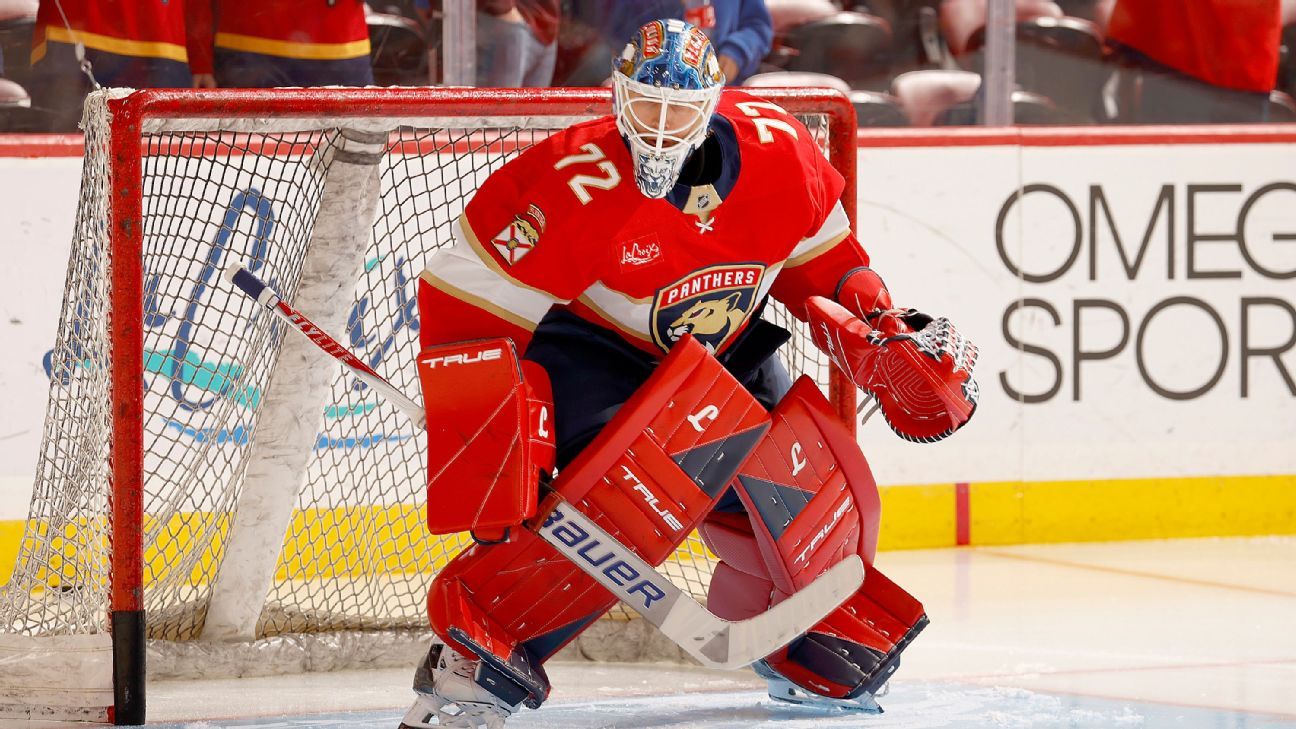
G Sergei Bobrovsky
Florida Panthers get:
G Connor Ingram, F Isaac Howard
Why it works: If you can’t beat them, acquire them!
Editor’s Picks
2 Related
This transaction would require some serious soul-searching by Edmonton general manager Stan Bowman and Florida GM Bill Zito. For Bowman, it would mean acknowledging that his previous plan to fix the team’s goaltending — acquiring Tristan Jarry from the Penguins — still puts the team’s postseason fortunes at risk. For Zito, it would mean that this Aleksander Barkov-less season is a write-off, and that Bobrovsky, who turns 38 in September, accumulated too much wear and tear during the past three seasons to get a multiyear contract.
The Oilers know they have a three-year window before Connor McDavid becomes an unrestricted free agent. Chances must be taken. Bobrovsky has been pretty bad in the regular season, but that’s not unusual for him. It’s his evolution into Playoff Bob every April that makes him intriguing for Edmonton. The Oilers have witnessed it first-hand for two straight Stanley Cup Finals.
The money could work with full 50% retention by the Panthers and Ingram (with an expiring contract) being shipped out. The acquisition of Connor Murphy on Monday complicates things — putting Mattias Janmark on long-term injured reserve was part of my Bobrovsky gambit, and they did so to make that trade with Chicago — so some other parts would have to move. The Oilers don’t want to give up Howard, but is there a player with the game and swagger who better fits the Panthers’ aesthetic?
Yes, Edmonton needed another defenseman and could use a third-line center. None of that matters if the Oilers don’t have someone who can stop the puck in the playoffs, and that’s what Bobrovsky does. — Wyshynski
Minnesota Wild get:
C Vincent Trocheck
New York Rangers get:
2027 first-round pick, 2028 second-round pick, D Carson Lambos and F Charlie Stramel
Why it works: Trading for one of the proven top-six centers at the deadline isn’t a question of need but rather what it will take to complete the deal and if it makes sense for the acquiring franchise. Wild GM Bill Guerin and his front office are facing that decision ahead of the deadline.
Trocheck is practically the perfect deadline addition for the Wild. As a two-way center, he fits within their defensive structure, and he can do what’s required in the offensive zone to score and set up others. He can be trusted to play in every situation, and on any special teams unit.
Above all, he gives the Wild someone who has experience playing against top-line centers — a skill that could prove useful in the daunting Western Conference playoff bracket. Trocheck told reporters Monday that there are teams in the West that are on his no-trade list, and The Athletic reported that the Wild are not on that list.
In this trade, the Rangers get two prospects, Lambos and Stramel, and they could play as soon as this spring, or possibly at some point next season. The Rangers, who have two first-round picks this year, would have multiple firsts in 2027 if they completed this deal.
The Wild weathered the buyouts of Zach Parise and Ryan Suter, and that has allowed Guerin and his staff to explore more options — but that comes with a few caveats. Are the Wild comfortable parting with two more prospects and a first-round pick when they’ve already moved on from Zeev Buium, Marat Khusnutdinov, Liam Ohgren and Marco Rossi within the past year? And though they have $11.4 million in deadline cap space, per PuckPedia, are they also comfortable having what would be an eighth player with more than three years remaining on their current deal worth more than $5 million annually?
If Guerin and his front office are comfortable saying yes to those questions, this deal makes a lot of sense. — Clark
play
0:24
Vincent Trocheck’s lone shootout goal wins it for Rangers
Vincent Trocheck fires in a goal for the Rangers to win it in the shootout vs. Penguins.
Colorado Avalanche get:
C Ryan O’Reilly, 2027 sixth-round pick
Nashville Predators get:
2027 first-round pick, 2026 fourth-round pick (from Carolina) and F Nikita Prishchepov
Why it works: Colorado must strike now. The Avalanche have not advanced past the second round in a playoff series since winning the Stanley Cup in 2022. This is Colorado’s best team in the past four years, and the Avalanche have an excellent chance of making another championship run. Colorado already has a one-two punch down the middle with Nathan MacKinnon and Brock Nelson. What the Avalanche need is someone like O’Reilly to round out their center depth with scoring touch, physicality and, of course, winning experience (O’Reilly was part of St. Louis’ Cup victory in 2019).
All of ESPN. All in one place.
Watch your favorite events in the newly enhanced ESPN App. Learn more about what plan is right for you. Sign Up Now
O’Reilly is also having a terrific season. The 35-year-old leads the Predators with 21 goals and 57 points in 59 games while playing over 20 minutes per contest. If the Avalanche can draw that kind of production out of their third-line center, it will make their offensive attack enviably formidable.
But O’Reilly does not want to be traded. His family is happy in Nashville, and he’d like to stay put. But O’Reilly has no trade protection in his contract, which carries a $4.5 million annual cap hit through next season, although there is a sense that Predators GM Barry Trotz would bring a trade proposal to O’Reilly before making anything official.
With that in mind, Colorado would have to give up quite a bit to land O’Reilly. The Avalanche don’t have a first-round pick in 2026 — that went to the New York Islanders in Colorado’s acquisition of Nelson at last year’s deadline. The Avalanche’s win-now mentality makes giving up next year’s top selection a calculated risk. It would be worth it, though, if O’Reilly puts them over the top.
The deal would also include Prishchepov, a 22-year-old center Colorado selected in the seventh round of the 2024 draft. He has played 10 NHL games, and his inclusion is a sweetener for Nashville, which is headed for a rebuilding phase. — Shilton
Carolina Hurricanes get:
C Robert Thomas
St. Louis Blues get:
2026 first-round pick (from DAL), C Jesperi Kotkaniemi, D Alexander Nikishin, F Ryan Suzuki
Why it works: It’s clear that St. Louis and Thomas could benefit from a clean break. Carolina would be an ideal trade partner.
The Hurricanes have had no problem making the postseason, but it’s their lack of playoff scoring that has repeatedly derailed Carolina’s recent opportunities to reach a Stanley Cup Final. The Hurricanes haven’t hesitated to take a big swing before — such as acquiring Jake Guentzel two seasons ago, landing Mikko Rantanen last season (before trading him again), and making a play for Mitch Marner last year, too.
Adding Thomas would give Carolina a 20-plus goal scorer to anchor one of its top two lines who can also be an asset on the power play. Thomas, 26, has five years remaining on his deal with an $8.125 million annual cap hit. The Hurricanes would be getting some of the best years of Thomas’ career.
The return is significant, and it has to be. The Hurricanes would be trading the first-round pick they received when they dealt Rantanen to Dallas. Sending it off to bring in another potential superstar center seems right, somehow. Koktaniemi hasn’t panned out into being the consistent scoring center Carolina hoped for, but he is still productive and could slide into the Blues’ lineup while providing good depth in a second- or third-line role. Nikishin is a burly defender who can contribute offensively, with seven goals and 22 points in 58 games this season. Carolina wouldn’t part with Nikishin easily, but he could swiftly elevate the Blues’ defense corps.
Suzuki. Carolina’s first-round draft choice in 2019, is a 24-year-old center who has played in only two NHL games, but has been excellent in the American Hockey League (he has 10 goals and 39 points in 47 games for the Chicago Wolves this season). St. Louis could give him an NHL spot soon. In Carolina, he hasn’t broken through because of its depth up front.
Blues GM Doug Armstrong might not get a perfect trade return for Thomas. A deal with Carolina makes sense for his club in the short and long term. — Shilton
play
0:33
Robert Thomas scores goal vs. Wild
Robert Thomas tallies goal vs. Wild
Boston Bruins get:
C Robert Thomas, D Justin Faulk
St. Louis Blues get:
C Dean Letourneau, D Mason Lohrei, C Casey Mittelstadt, F Michael Eyssimont, 2027 first-round pick (unprotected)
Why it works: I’ve long felt that the Bruins were keeping their No. 1 center spot open in the hopes that either Connor McDavid or Leon Draisaitl could have filled it before both re-signed with the Oilers. But top-line centers in their prime don’t often become available, which is why it’s noteworthy that the Blues are listening to trade offers for Thomas. The Bruins could pull off that kind of blockbuster because they have a deep well of assets. But why stop at Thomas?
Breaking News from Emily Kaplan
Download the ESPN app and enable Emily Kaplan’s news alerts to receive push notifications for the latest updates first. Opt in by tapping the alerts bell in the top right corner. For more information, click here.
The Bruins have been one of the teams mentioned to have interest in Faulk, who has 32 points in 60 games and is averaging 22:30 of ice time. Faulk, 33, has another year left on his contract at a $6.5 million annual cap hit, and the Blues have the retention slots to keep 50% of his contract to make this trade happen. It’ll cost the Bruins even more, but it could be worth it to slot Faulk behind Charlie McAvoy on the right-side defensive depth chart.
The Blues will, of course, not retain salary for Robert Thomas, who is signed through 2030-31 at an AAV of $8.125 million. To make the money work, the Bruins likely have to send back Mittelstadt ($5.75 million, signed through 2026-27) and Eyssimont ($1.45 million, signed through 2026-27) to go along with Lohrei ($3.2 million AAV, RFA after 2026-27), a player the Blues might want.
But if the Blues are going to move Thomas, they will move him for future assets. Boston won’t move 2025 first-round pick James Hagens. Letourneau is a 20-year-old center for Boston College who is 6-foot-7 and has scored at more than a point-per-game pace this season.
Toss in an unprotected first, and that’s a hefty price to pay. But it’s a deal that helps Boston in the short term as a playoff team, and the long term with Thomas at the top of its center depth chart. — Wyshynski
Anaheim Ducks get:
D Dougie Hamilton
New Jersey Devils get:
D Drew Helleson, 2027 second-round pick (from ANA), 2027 second-round pick (from DET)
Why it works: This one would work for both teams now and in the future.
The Ducks don’t need to make a trade, given what the group has accomplished this season. But getting Hamilton would fit their philosophy of adding veterans and blending them with a roster filled with young players to create a team that has a chance to be one of the NHL’s next long-term factors.
Hamilton would bolster the right side of the Ducks’ defense that already has Radko Gudas and Jacob Trouba. Hamilton’s arrival would also help the Ducks pair their younger defensemen, such as Jackson LaCombe, Pavel Mintyukov and Olen Zellweger, with a veteran.
Gudas and Trouba are both unrestricted free agents at the end of the season, while Hamilton still has two years left on his contract worth $9 million annually. Hamilton would provide the Ducks cost certainty entering what will likely be an expensive offseason, with Leo Carlsson, Cutter Gauthier, Mintyukov and Zellweger set to be restricted free agents. LaCombe’s contract extension begins in 2026-27, bumping his salary from $925,000 to $9 million annually.
The Devils moving off Hamilton’s salary would be a bonus for a team that is facing cap challenges going into the deadline. But it’s possible that the Ducks — or any team that’s interested in Hamilton — could use that as a bargaining chip, provided they have the cap space. That’s what makes assessing a potential return complicated.
It’s possible that Helleson, who will make $1.1 million next season, along with the draft capital, could push this trade through. — Clark