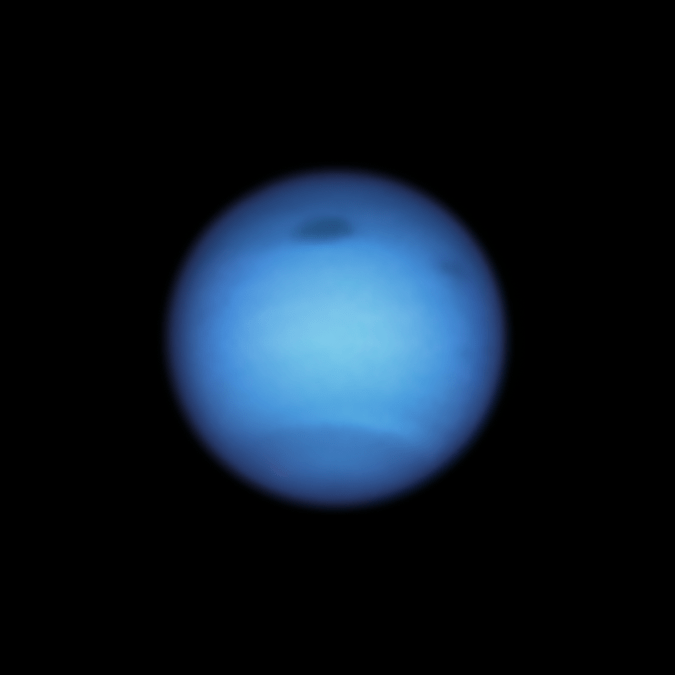
Storms on Neptune appear to follow a pattern that forms, amplifies, and then dissolves over the course of about two Earth years. But a Neptunian storm discovered in the planet’s atmosphere over two years ago did something completely different: it reversed course and is still going strong.
The storm, which is wider than the Atlantic, originated in the northern hemisphere of the planet and was observed with the Hubble Space Telescope in 2018. Observations a year later showed it was drifting south towards the equator, where previous similar cyclones died. However, recent observations with Hubble indicated that the eddy doubled northwards in August 2020.
Scientists say this new storm pattern is something that has not been seen before.
Neptune captured by Voyager 2. Photo credit: NASA
In 1989 Voyager 2 gave us the first glimpse into Neptune. From the earth, Neptune looked like a strange marble. To the astronomers’ surprise, Voyager 2 showed us a dynamic and turbulent world of whirling storms. A huge storm in 1989 was called the Great Dark Spot – a tribute to Jupiter’s legendary Great Red Spot. The Great Dark Spot whirled around in Neptune’s extreme southern hemisphere.
The next time we got a closer look at Neptune was in 1994 when the Hubble Space Telescope turned towards the distant planet. Surprisingly, the mysterious place was gone. Shortly afterwards, in 1995, Hubble discovered another dark storm in the northern hemisphere of Neptune. Over the past three decades, Hubble has seen multiple dark spots come and go.
Annotated view of Neptune with two dark spots. Photo credit: NASA, ESA, STScI, MH Wong (University of California, Berkeley), and LA Sromovsky and PM Fry (University of Wisconsin-Madison)
But this storm is different. And just as mysterious was the storm not alone. Hubble discovered another smaller dark speck in January of this year that temporarily appeared near the larger storm. Scientists believe the small storm may have been part of the giant eddy that broke off, drifted away, and then disappeared in subsequent observations.
“We are pleased with these observations because this smaller dark fragment may be part of the dark spot perturbation process,” said Michael H. Wong, a planetary scientist at the University of California at Berkeley, in a statement. “This is a process that has never been observed. We saw some other dark spots that disappeared and they went away, but we never saw anything disrupted, even though computer simulations predicted it. “
Another unusual feature of the dark blotch is the lack of bright accompanying clouds around it, which were present in Hubble images taken when the vortex was discovered in 2018. Apparently the clouds disappeared when the vortex stopped its journey south. The bright clouds form when the airflow is disturbed and diverted upward via the vortex, which is likely to cause gases to freeze into methane ice crystals. The absence of clouds could provide information on how spots are developing, researchers say.
“Without Hubble, we wouldn’t know about these latest dark spots,” said Amy Simon, who leads a Hubble project called Outer Planet Atmospheres Legacy (OPAL), which Hubble uses to monitor the outer planets in our solar system. “We can now follow the great storm for years and observe its entire life cycle. If we didn’t have Hubble, we might think that the Great Dark Spot that Voyager saw in 1989 is still present on Neptune, as is Jupiter’s Great Red Spot. And we wouldn’t have known anything about the other four spots Hubble discovered. “
Source: HubbleSite
Like this:
Loading…
