
Measuring the atmospheres of different worlds to find out whether or not there are sufficient vitamins there for all times

Life on Earth depends on six critical elements: carbon, hydrogen, nitrogen, oxygen, phosphorus and sulfur. These elements are called CHNOPS and, along with several trace micronutrients and liquid water, are what life needs.
Scientists are on track to discover exoplanets that could be warm enough to have liquid water on their surfaces, the most fundamental signal of habitability. But now they want to up their game by finding CHNOPS in the atmospheres of exoplanets.
We are only beginning to understand how exoplanets could support life. To advance our understanding, we need to understand the availability of CHNOPS in the planetary atmosphere.
A new paper examines the problem. The title is “Limitations to habitability caused by nutrient availability in the atmosphere of rocky exoplanets.” The lead author is Oliver Herbort from the Institute for Astrophysics at the University of Vienna and an ARIEL postdoctoral researcher. The work was accepted by the International Journal of Astrobiology.
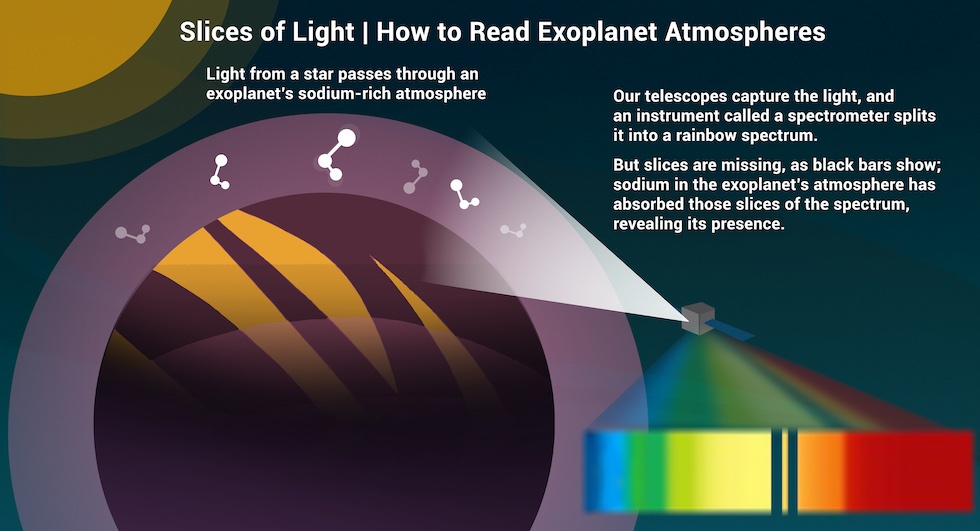
At our current level of technology, we are just beginning to study the atmospheres of exoplanets. The JWST is our main tool for this task and it is good at it. But the JWST is busy with other tasks. In 2029, ESA will launch ARIEL, the Atmospheric Remote-sensing Infrared Exoplanet Large Survey. ARIEL will focus exclusively on the atmospheres of exoplanets.
An artist's impression of ESA's Ariel space telescope. During its four-year mission, it will study 1,000 atmospheres of exoplanets using the transit method. Both the compositions and the thermal structures are examined and characterized. Image source: ESA
In anticipation of this telescope's mission, Herbort and his co-researchers are preparing for the results and their significance for habitability. “Detailed understanding of the planets themselves becomes important for interpreting observations, particularly for detecting biosignatures,” they write. In particular, they explore the idea of aerial biospheres. “Our goal is to understand the presence of these nutrients in atmospheres that have the presence of water cloud condensates, potentially allowing the existence of airborne biospheres.”
Our sister planet Venus has an unsurvivable surface. The extreme heat and pressure make the planet's surface uninhabitable by any conceivable measure. However, some scientists have suggested that life could exist in Venus' atmosphere, largely based on the detection of phosphine, a possible indicator of life. This is an example of what an aerial biosphere might look like.
This artistic impression depicts Venus. Astronomers at MIT, Cardiff University and elsewhere may have observed signs of life in Venus' atmosphere through the detection of phosphine. Subsequent research contradicted this finding, but the problem persists. Photo credit: ESO (European Space Agency)/M. Kornmesser & NASA/JPL/Caltech
“This concept of aerial biospheres expands the possibilities of potential habitability from the presence of liquid water on the surface to all planets with liquid water clouds,” the authors explain.
The authors examined the idea of aerial biospheres and how the detection of CHNOPS plays a role in this. They introduced the concept of nutrient availability in the atmosphere of exoplanets. Within their framework, the presence of water is required regardless of the availability of other nutrients. “We considered any atmosphere without water condensate to be uninhabitable,” they write, pointing to the primacy of water. The researchers assigned different levels of habitability based on the presence and amount of CHNOPS nutrients.
This table from research illustrates the authors' concept of atmospheric nutrient availability. As the top row shows, no atmosphere is habitable without water. Different nutrient combinations have different habitability potential. “Red” represents redox and “Ox” represents the presence of the oxidized state of CO2, NOx and SO2. Photo credit: Herbort et al. 2024.
To investigate the scope of nutrient availability, the researchers used simulations. The simulated atmospheres contained different amounts of nutrients, and the researchers applied their concept of nutrient availability. Their results are not aimed at understanding habitability, but rather the chemical potential for habitability. A planet's atmosphere can be drastically changed by life, and this research aims to understand the atmospheric potential for life.
“Our approach is not aimed directly at understanding the biosignatures and atmospheres of inhabited planets, but rather at the conditions under which prebiotic chemistry can occur,” they write. In their work, the minimum atmospheric concentration for a nutrient to be available is 10?9, or one ppb (part per billion).
“We find that in most atmospheres, at (p-gas, T-gas) points where liquid water is stable, CNS-bearing molecules are present in concentrations above 10?9,” they write. They also found that carbon is generally present in any simulated atmosphere and that sulfur availability increases with surface temperature. At lower surface temperatures, nitrogen (N2, NH3) is present in increasing quantities. However, at higher surface temperatures the nitrogen can be exhausted.
Phosphorus is another matter. “The limiting element of the CHNOPS elements is phosphorus, which is largely bound in the planetary crust,” they write. The authors point out that phosphorus shortages in Earth's atmosphere in ancient times limited the biosphere.
An air biosphere is an interesting idea. But detecting the atmospheres of exoplanets is not the main concern of scientists. Surface life is their holy grail. It should come as no surprise that it is ultimately still liquid water. “Similar to previous work, our models suggest that the limiting factor for habitability on a planet's surface is the presence of liquid water,” the authors write. In their work, CNS was available in the lower atmosphere near the surface when surface water was available.
But surface water plays multiple roles in the chemistry of the atmosphere. In some circumstances it can combine with some nutrients so that they are no longer available, and in other circumstances it can make them available.
“When water is available at the surface, the elements not present in the gas phase are stored in the crustal condensates,” the authors write. They can then be made available as nutrients through chemical weathering. “This provides a way to overcome the lack of atmospheric phosphorus and metals used in enzymes that drive many biological processes.”
Artist's impression of the surface of a Hycea world. Hycean worlds are still hypothetical, with large oceans and thick hydrogen-rich atmospheres that trap heat. It is unclear whether a world without a surface can support life. Image source: University of Cambridge
This complicates the situation on worlds covered by oceans. Prebiotic molecules may not be available if water and rocks have no way to interact with the atmosphere. “If it can indeed be shown that life can form in an aquatic ocean without exposed land, this constraint will weaken and the potential for surface habitability will become primarily a question of water stability,” the authors write.
Some of the models surprise because of the atmospheric liquid water. “Many of the models show the presence of a liquid water zone in the atmosphere that is detaching from the surface. “These regions could be of interest for the emergence of life in the form of aerial biospheres,” write Herbort and his colleagues.
If there's one thing that research like this shows, it's that planetary atmospheres are extraordinarily complex and can change dramatically over time, sometimes due to life itself. This research makes sense when trying to understand everything. The complexity is underscored by the fact that the researchers did not include stellar radiation in their work. Including them would have made the effort unmanageable.
The problem of habitability is complicated and distorted by the fact that we do not have answers to fundamental questions. Does a planet's crust need to be in contact with water and the atmosphere for CHNOPS nutrients to be available? The Earth has a temporary air biosphere. Can aerial biospheres be an important part of exoplanet habitability?
But beyond all the simulations and models, as powerful as they are, what scientists need most is more data. When ARIEL launches, scientists will have much more data to work with. Research like this will help scientists understand what ARIEL is discovering.
Like this:
Is loading…

Comments are closed.