

Guest article by Willis Eschenbach
I have to think about the clouds again. They are certainly the least understood part of the climate. So let me start with what we know.
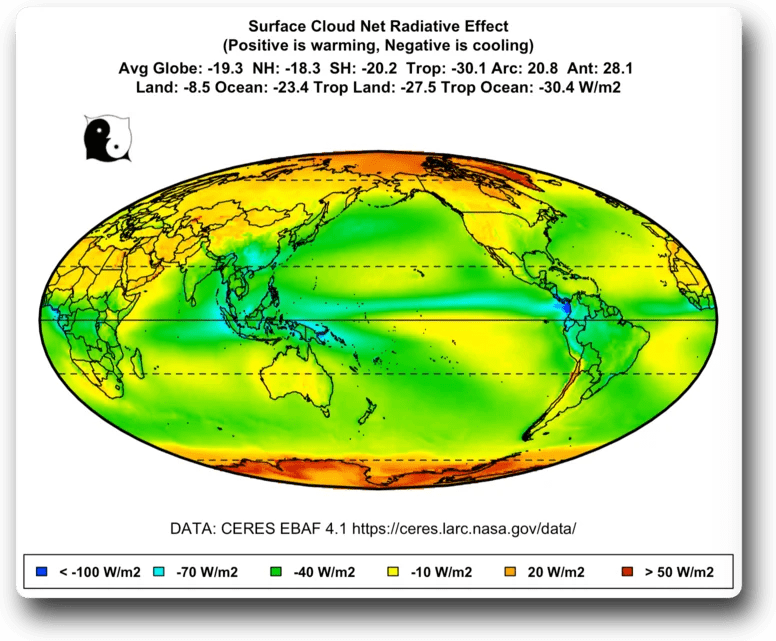
Overall, clouds cool the planet. Here is the effect of clouds on the surface.
Figure 1. Cloud surface net radiation effect. Includes the effect of clouds on both the descending short wave (solar radiation) and the descending long wave (thermal radiation from the atmosphere) at the surface.
There are a few interesting things about Figure 1. First, clouds cool the planet everywhere except at the poles and deserts.
In addition, the clouds over the ice-free parts of the ocean only cool the sea surface. No part of the ocean is warmed by the clouds.
After all, the more clouds, the more the surface cools. Therefore, humid tropical areas with their extensive cloud cover receive the most cooling from clouds.
With this prologue, here follows a thought experiment. Suppose you could control the amount of clouds and wanted to create a thermoregulatory system that would stabilize the Earth's temperature. How would you proceed?
Well, it seems to me that one would want a system where, if the planet were cold to begin with, the warmer it got, the fewer clouds there would be. Fewer clouds means less cooling, and that would encourage the system to continue warming…
…but you only want fewer clouds up to a certain point. Once you reach the desired temperature, you want the opposite to happen. If it continued to get warmer above this temperature, more clouds would be desirable in order to tend to lower the temperature back to the desired value.
So you want the clouds' reaction to look something like this:
Figure 2. Example of a cloud response that would tend to stabilize Earth's temperature.
In Figure 2, the amount of clouds decreases as the temperature increases from freezing to about 20°C. However, further warming brings with it increasing clouds, which tends to cause the temperature to drop again.
And to move from our thought experiment into the real world, here's the actual relationship between cloud area and surface temperature. I only used the temperature of the unfrozen sea surface to avoid the complications of ice, mountains and deserts. However, the entire globe shows the same pattern, just with more dispersion.
Figure 3. Scatterplot, percentage of CERES cloud cover versus sea surface temperature from Reynolds OI.
Note that Figure 3 shows that the preferred temperature in the tropics is around 25°C to 27°C. It is colder and cloud cover decreases as the temperature increases. It is warmer and the clouds increase very quickly, limiting the tropical temperature.
Finally, there are other variables in the equation. For example, at the warm end, the clouds consist of more and more thunderstorms, which cool the surface in various ways, not just through radiation effects.
And that's all the fun I get to have in a 24 hour period… my floor mounted gas heater is broken and I have to crawl under the house, pull out the thermocouple, test it to see if that's the problem, and If so, go to town, buy a new one and crawl under the house to replace it.
Do I know how to have a good time or what?
All the best to everyone,
w.
5
12
Voices
Article review
Like this:
Is loading…

Comments are closed.