

A new theory suggests that Titan's majestic dune fields may have come from space. Researchers had always assumed that the sand that makes up Titan's dunes was formed locally by erosion or condensed from atmospheric hydrocarbons. But researchers at the University of Colorado want to know: Could it come from comets?
The Dunes of Titan
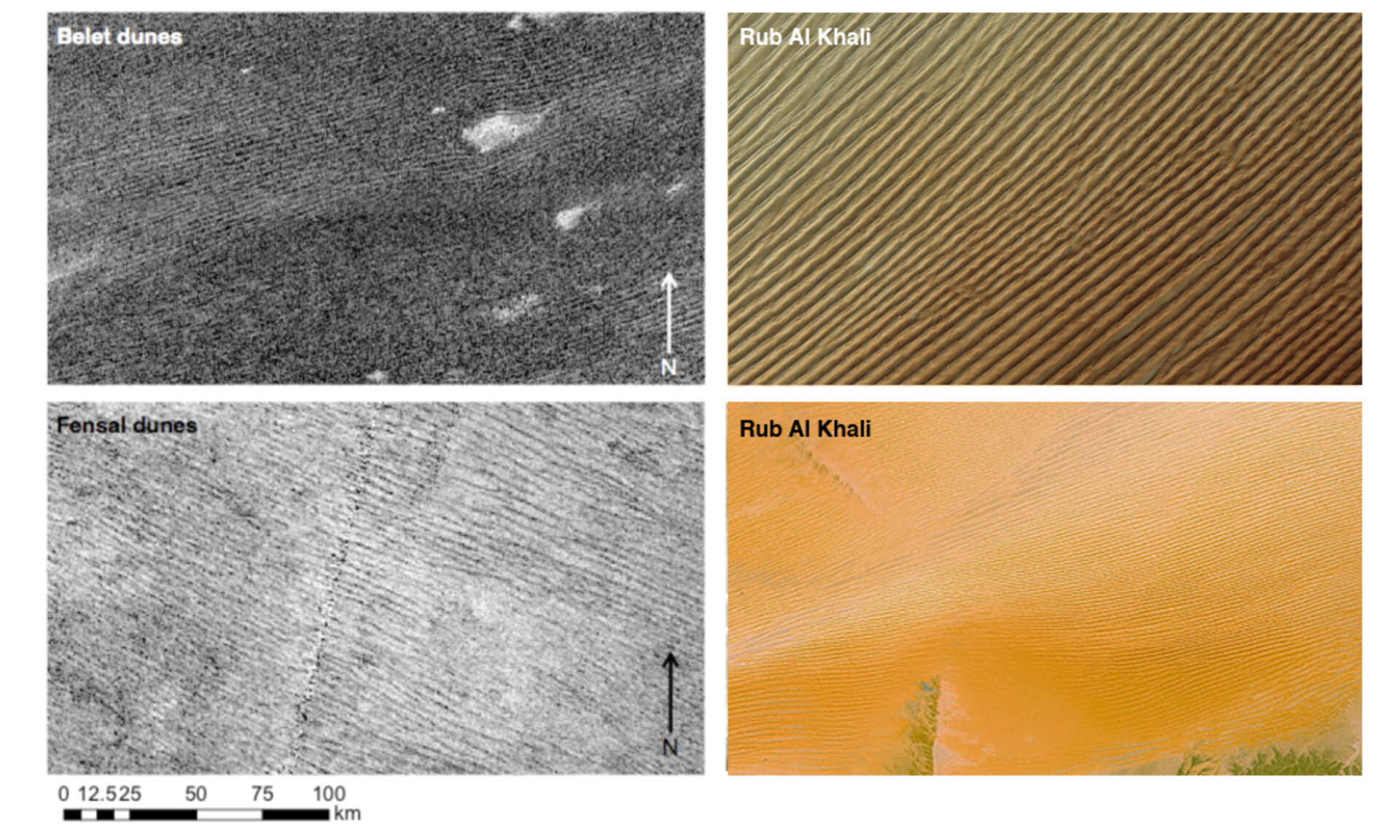
When the Cassini spacecraft arrived in orbit around Saturn, no one had ever seen Titan's thick, hazy atmosphere. When it deployed the Huygens lander and began studying Titan with cloud-penetrating radar, scientists were surprised to learn that Titan has a very Earth-like appearance. There is a thick nitrogen atmosphere, rain, rivers, oceans and huge dune fields. But unlike the dunes of Earth's sandy deserts in Namibia and southern Arabia, Titan's dunes are huge, filling vast fields that cover more than an eighth of the giant moon's surface. These dunes are about 100 meters high, 1 to 2 kilometers wide at the base, and can extend for hundreds of kilometers in length.
Dunes on Earth are made of sand that is blown by the wind and piled up into drifts. Individual sand particles are pushed and blown by the wind so hard that they bounce off and disperse in a process called saltation. If the particles don't bounce, they can't pile up on top of each other, but if the wind can lift them completely off the ground, they will simply be blown away. Salinization depends on the size and mass of the sand particles and the strength of the wind, but also requires that the particles be dry so that they can move freely without sticking together.
The Geology of Titan
Titan is the second largest moon in the entire solar system, surpassed only by Ganymede, which orbits Jupiter. It is Saturn's largest moon and is very old. Unlike most of Saturn's moons, which have been captured over time, Titan would have formed along with Saturn billions of years ago. Although it shares so many similarities with Earth, it is a very different place. It is so cold that rain and rivers are not made of water but of liquid hydrocarbons like methane. Water, on the other hand, is frozen into hard ice; Rocks on Titan are made of water ice rather than granite and basalt, and Titan's equivalent of lava and magma is made of liquid water and ammonia.
This means that the sand on Titan is not quartz sand eroded from larger rocks, as these materials are not found on the surface. One popular theory is that it could be made from ice instead. As liquid methane rains and flows, it could erode the bedrock of water ice, grinding chunks into a sand of ice grains. An alternative idea is that the sand particles are composed of tholins instead. These are found throughout the colder regions of the solar system, where cold hydrocarbons in comets or the outer atmospheres of planets and moons react with ultraviolet light from the sun to form complex compounds. Tholins formed in Titan's dry atmosphere could be caused by static electricity to clump together to form small grains of soot, which then settle on the ground, creating both dust and sand.
Comet 109P/Swift-Tuttle was captured during its last flyby of Earth on November 1, 1992. Photo credit: Gerald Rhemann
What do comets have to do with it?
A paper presented at this year's Lunar and Planetary Science Conference (LPSC) proposes a new idea: What if the sand came from comets? As we know, comets are made of materials left over from the formation of the solar system. Most of the original gas and dust that collapsed from an ancient nebula to form the solar system would have ended up in the sun, and most of the remnants formed the planets. But a lot of material would still have flown free, and some of it would have gradually coalesced into the clumps of dust and ice that we see today as comets. When comets are placed into elliptical orbits and pass through the inner solar system, some of their ice heats up and sublimes into gas, which blows out, carrying dust with it. This dust is scattered throughout the solar system and is concentrated along the various orbits of comets. Individual grains often collide with the Earth, which we see as meteors burning high in our atmosphere. Recent studies in Antarctic ice fields, where there is no surface sand, have found many such particles that survived re-entry into the atmosphere.
But Earth isn't the only place these grains can end up. According to the researchers, there was a time when a large number of comets passed close to Saturn and its moons. They ran simulations to study the evolution of the Kuiper Belt, using a version of the Nice model. The Nice model, named after the city where it was first introduced, suggests that the solar system was originally structured very differently than it is today. Over time, the planets migrated to their current locations. During this time, Neptune passed through the Kuiper Belt and pushed many comets into new orbits. Many of these comets passed close to Saturn and its moons, and some even collided with the moons. The researchers suspect that much of the sand that makes up Titan's dunes could be debris from all of these comets.
Artist's concept of a dragonfly hovering over the dunes of Saturn's moon Titan. Photo credit: NASA/Johns Hopkins APL/Steve Gribben
But is it true? While this idea fits with what we currently know and is supported by computer models, so do the other theories. Fortunately, NASA recently confirmed that the Dragonfly mission will launch in July 2028. Dragonfly is a lander sent to Titan. But unlike previous missions, this one is a flying drone with 8 rotors. Like the rovers on Mars, it will be able to move to any areas of interest that scientists want to explore further. When it arrives in 2034, it will fly to dozens of locations on Titan's surface and should settle the question once and for all: Are Titan's dunes really made of comet dust?
https://www.hou.usra.edu/meetings/lpsc2024/pdf/1550.pdf
Like this:
Is loading…

Comments are closed.