

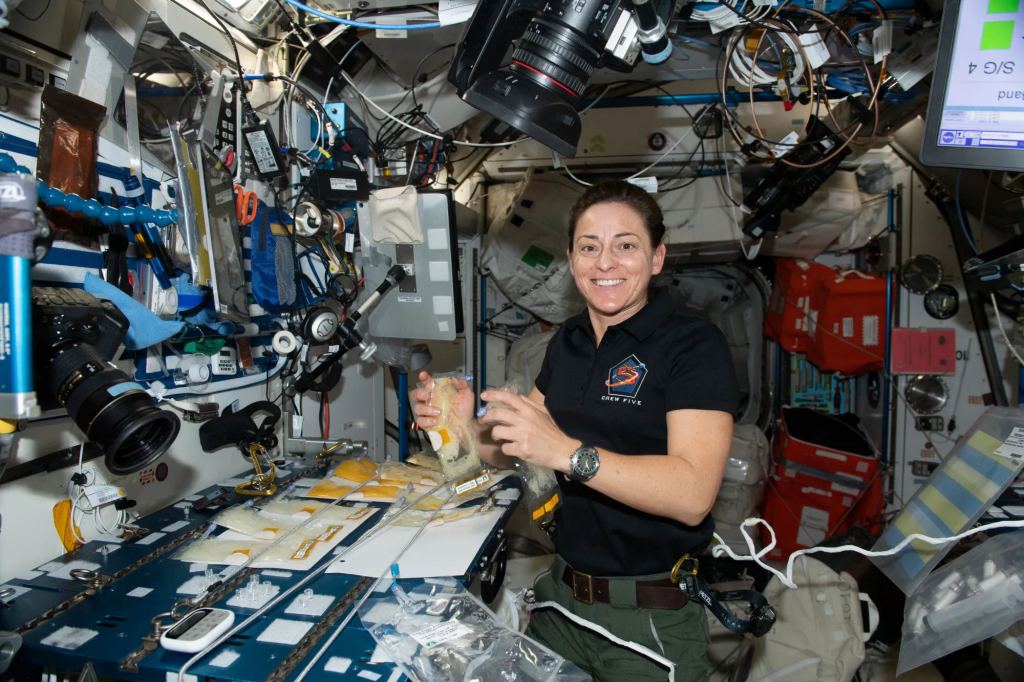
Astronauts on board the International Space Station are often visited by Earth's supply ships with, among other things, food. Take a trip to Mars or anywhere else and the distances are much greater, making it impractical to ship fresh supplies. The prepackaged foods used by NASA lose nutritional value over time. Therefore, NASA is looking for ways for astronauts to produce nutrients. They research genetic engineering techniques that can be used to create microbes with minimal use of resources.
For many of us, eating and drinking is something we take for granted. The food we enjoy is usually tasty and of varied textures. Astronauts traveling through space generally rely on prepackaged foods, which often lack the flavor and texture we normally enjoy. A lot of research has gone into developing a more pleasant dining experience for astronauts, but this has typically focused on short-term travel.
The space station's Veggie Facility, here staffed by NASA astronaut Scott Tingle, during the plant growth study VEG-03, where Extra Dwarf Bok Choy, Red Russian Kale, Wasabi Mustard and Red Lettuce were grown and in orbit samples for later use Tests were harvested soil. Photo credit: NASA
Longer-term missions require astronauts to grow their own food. Not only because of the nutritional issues that are the subject of this article, but also because transporting pre-packaged food for flights that last for many years becomes a logistical challenge and an additional expense for takeoff. To address the loss of nutritional value, Ames Research Center's Space Biosciences Division has launched its BioNutrients project to enable future space travelers to grow their own nutritional supplements.
The team announced that they had found a solution thanks to the wonders of genetic engineering. The approach developed by the team involves microbial-based foods (similar to yeast) that can produce nutrients and compounds using small amounts of resources.
The secret is to preserve dried microbes and bring food-grade bioreactors with you on the trip. Until now, I didn't know what a bioreactor was or that it even existed. Living in the world of physics and astrophysics, this concept fascinated me. It turns out that a bioreactor does exactly what it says on the tin. This is a container of some form, often made of steel, within which a biologically active environment can be maintained. Chemical processes often occur internally, with organisms undergoing either aerobic or anaerobic processes. They are often used to grow cells or tissues, and NASA is pinning its hopes on cultivating food in space.
Even years after departure, the desiccated microbes can be rehydrated and cultured in the bioreactor many years later, producing the nutrients astronauts need. So far, the team has managed to produce carotenoids (a naturally occurring pigment) used as antioxidants, follistatin to combat muscle loss, and yogurt and kefir to keep the gut healthy. But the real challenge is making food the astronauts want to eat.
Source: BioNutrients flight experiments
Like this:
Is loading…

Comments are closed.