

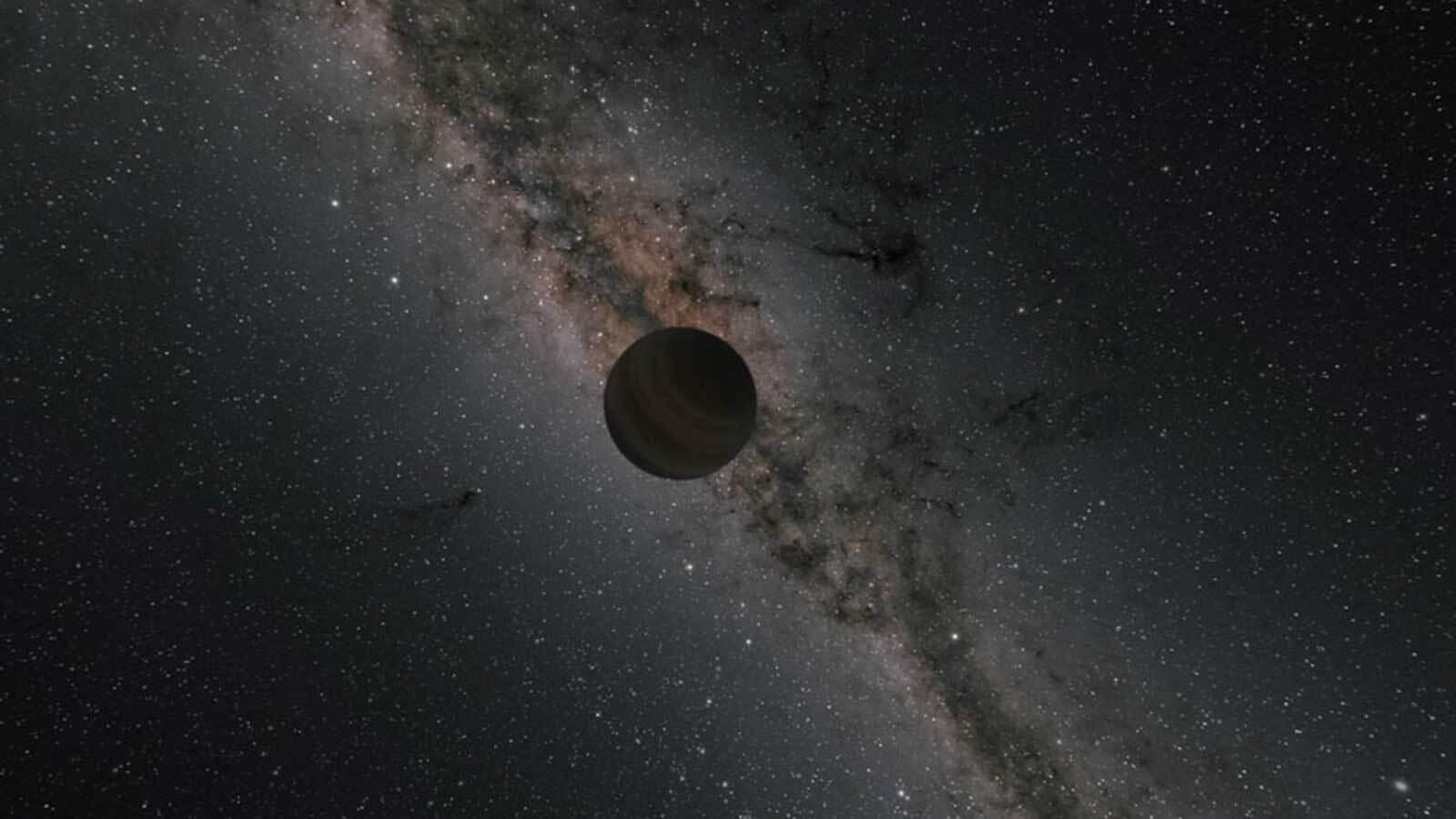
Well over 5,000 planets have been found orbiting other star systems. One of the satellites searching for them is TESS, the Transiting Exoplanet Survey Satellite. Astronomers using TESS think they've made a pretty surprising discovery; their first free-floating – or breakaway – planet. The planet was discovered using gravitational microlensing, where the planet passed in front of a star, distorting its light and revealing its presence.
We all know the eight planets in our solar system and may also become familiar with the concept of exoplanets. But there is another category of planets, the rogue planets. These mysterious objects travel through space without being gravitationally bound to a star. There has been much debate about their origin, but popular theories suggest that they were ejected from their host star system during their formation or possibly later due to gravitational interaction.
Artist's impression of the glory of the exoplanet WASP-76b. Photo credit: ESA
Simulations suggest that these “free-floating planets,” or FFPs, may be abundant in the galaxy, but not many have been discovered so far. However, the popular theory of ejection from star systems may not be the whole truth. It is now assumed that different formation mechanisms are responsible for different FFP masses. The high-mass FFPs may form in isolation as the gas collapses, while those at the end with low mass (comparable to Earth) were likely subjected to gravitational ejection from the system. A paper published in 2023 even suggests that these FFPs are likely more numerous than the bound planets in the entire galaxy!
Tracking such wandering objects among the stars is more challenging than you might expect. Their limited emission (or reflection) of electromagnetic radiation makes them nearly impossible to observe. Gravitational microlensing is then used, a technique that relies on an FFP passing in front of a star, whose gravity then focuses the distant star's light, resulting in a brief change in brightness as the planet moves along its line of sight. To date, only three FFPs have been discovered from Earth using this technique.
A team of astronomers used TESS to search for such microlensing events. Launched in April 2018, TESS scans large swathes of the sky in orbit to monitor the brightness of tens of thousands of stars. Detecting changes in light can reveal the passage of an FFP as it drifts silently in front of the star. It's not an easy hunt, however, as asteroids in our solar system, exoplanets bound to stars, and even stellar flares can provide false clues. Fortunately, Michelle Kunimoto's team has algorithms that help identify potential targets.
Illustration of NASA's Transiting Exoplanet Survey Satellite. Photo credit: NASA Goddard Space Flight Center
The team recently published their results in the Astrophysical Journal, reporting a candidate FFP event associated with the star TIC-107150013, 3.2 parsecs away. The event lasted 0.074 days +/- 0.002 and showed a slight curve with characteristics one would expect from an FFP. This is the first FFP discovered by TESS, an exciting step towards unraveling the mysteries surrounding these strange alien worlds.
Source: Searching for Free-Floating Planets with TESS: I. Discovery of a First Terrestrial Mass Candidate
Like this:
Is loading…

Comments are closed.