

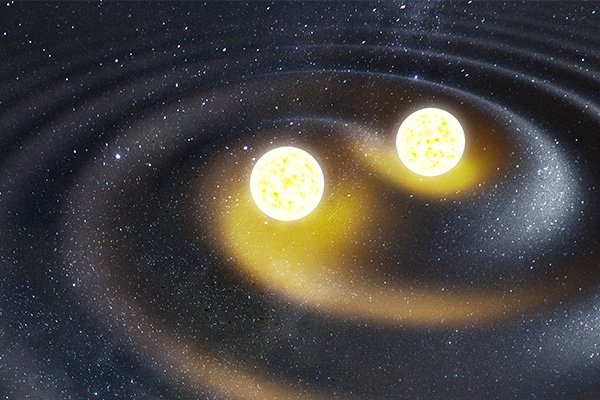
Every event in the cosmos creates gravitational waves. The bigger the event, the bigger the disruption. Events in which black holes and neutron stars collide can emit waves that can be detected here on Earth. It is possible for a visible light event to occur when neutron stars collide. To take advantage of every opportunity, early warning is essential. The LIGO-Virgo-KAGRA observatory teams are working on an alarm system that will warn astronomers of a gravity wave event within 30 seconds. If the warning occurs early enough, it may be possible to identify the source and observe the afterglow.
The very structure of space-time can be imagined as a vast celestial ocean. Every movement in the ocean creates waves. The same applies to movements and disturbances in space that cause compression in one direction and stretching in the vertical direction. Modern gravity wave detectors are usually L-shaped and beam down each arm of the building. The two beams are combined and the interference patterns are examined so that the lengths of the two beams can be accurately calculated. Any change indicates the passage of a gravitational wave.
LIGO Observatory
A team of researchers from the University of Minnesota conducted a study aimed at improving detection of the waves. In addition to improving the detection itself, they hope to set up an alert mechanism so astronomers receive a notification within 30 seconds of event detection.
The team used data from previous observations and created simulated gravity wave signal data to test the system. But it is much more than just an alarm system. Once fully functional, it will be able to detect the shape of the signals, track their evolution over time, and even provide an estimate of the properties of the individual components that led to the waves.
Once fully operational, the software would detect the wave from, for example, neutron star or black hole collisions. The former is usually too faint to detect unless its location is precisely known. It would generate an alert from the wave to pinpoint the location, allowing for follow-up investigations.
Eruptions of light when two neutron stars collide. Photo credit: NASA Goddard Space Flight Center/CI Lab
There are still many open questions surrounding the formation of neutron stars and black holes, not least the exact mechanism that leads to the formation of gold and uranium.
graThe LIGO (Laser Interferometer Gravitational-Wave Observatory) has just completed its last run, but the next one is scheduled for February 2025. Between recent observation runs, enhancements and improvements have been made to improve signal detection capability. Ultimately, of course, it comes down to the data, and once the current run is over, teams can begin.
Source: Researchers are advancing the detection of gravitational waves to study collisions of neutron stars and black holes
Like this:
Is loading…

Comments are closed.