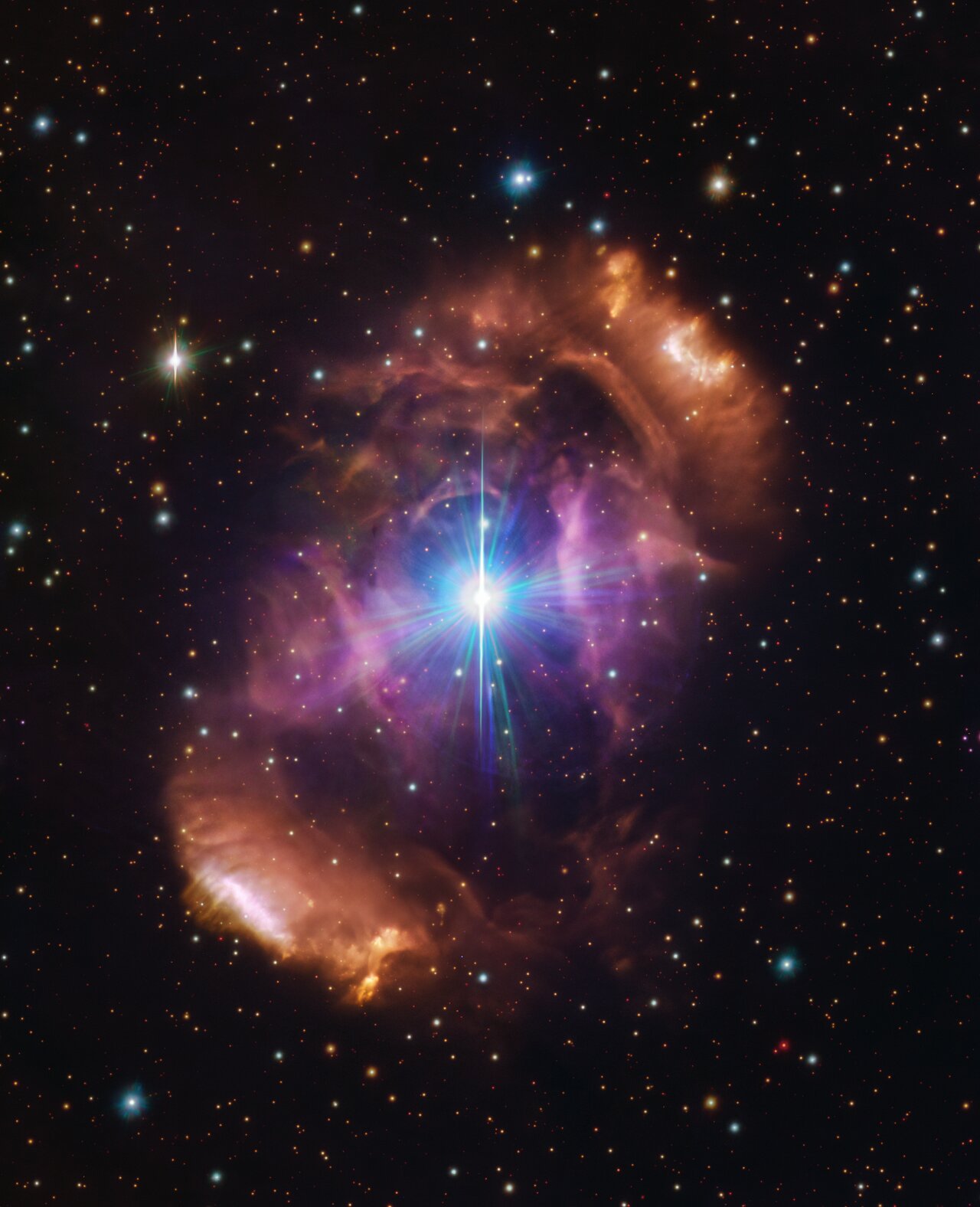
A beautiful southern hemisphere nebula with a binary star at its center appears to be breaking our standard models of stellar evolution. But new data from the European Southern Observatory (ESO) suggests that there may once have been three stars and that one was destroyed in a catastrophic collision.
About 3,800 light-years away, in the southern constellation Norma, is an object called the Dragon Egg Nebula (catalog number NGC 6164). At the heart of this nebula lies a double star called HD 148937. The pair is bright enough to be seen through binoculars and small telescopes, but far enough away that it only appears as a single star. Both stars that make up the pair are hot young blue giants, but the nebula surrounding them is quite unusual, which is why astronomers have been studying them for a long time.
Dr. Abigail Frost is an astronomer at the European Southern Observatory (ESO) in Chile and has been studying this system for nine years.
“When reading the background information, I was impressed by how special this system seemed,” she says. “A nebula surrounding two massive stars is a rarity, and we really felt like something cool must have happened in this system.” Looking at the data, the coolness only increased.”
Frost, like other astronomers before her, has noticed many strange features of the nebula. Most obviously, hot young stars like these are not typically found in nebulae because their intense radiation tends to disperse surrounding dust and gas quite efficiently. But more than that, the nebula itself has an unusual composition. If this nebula were the remnants of the gas cloud from which these stars formed, it would consist almost entirely of molecular hydrogen. Instead, it contains heavier elements such as oxygen, nitrogen and carbon. Old stars produce these elements by fusing helium and expel them in their final stages of life. But that cannot be the cause of this nebula because the stars are still young.
The stars themselves have their own secrets. The larger of the two has a strong magnetic field. Magnetic fields in stars like our Sun arise when the thick central shell of superheated plasma circulates. Much of the heat from the sun's core is transferred to the surface by convection: hot plasma near the core bubbles up to the surface, where it cools and then sinks back down. Plasma is electrically charged, and all the movement of charge creates a magnetic field, which scientists call the dynamo effect.
But truly massive stars like the one in HD 148937 are so large that heat can easily radiate out of the core. The distance from the core to the surface is so large that the temperature gradient is very gradual. There is no place inside the star where the temperature difference is high enough to trigger convection, so there is no flow of material that could create a magnetic field. Nevertheless, the star has a magnetic field, which leads to the next curiosity: magnetic stars experience a braking effect, causing their rotation to gradually slow down. So this star is spinning rapidly with its strong magnetic field, which it shouldn't have, which the magnetic field should have prevented.
Fighting the Dragons of Ara (NGC 6188 and 6164) © Michael Sidonio
But that's not all! The primary star is at least 1.5 million years younger than its companion. According to Dr. Frost said this shouldn't be possible: “After a detailed analysis, we were able to determine that the more massive star appears much younger than its companion, which makes no sense since they should have formed at the same time.”
If this system of stars and nebulae doesn't match what our models of stellar evolution lead us to expect, how do we explain all these anomalies?
“We believe this system originally had at least three stars; Two of them had to be close to each other at one point in the orbit, while another star was much further away,” explains Hugues Sana, professor at KU Leuven in Belgium and principal investigator of the observations. “The two inner stars merged violently, creating a magnetic star and ejecting some material, forming the nebula. The more distant star formed a new orbit with the newly merged, now magnetic star, creating the binary star system we see today at the center of the nebula.”
In other words, the system was originally a triple star, not a binary star. Triple systems tend to be quite unstable and usually eject one of their members. But sometimes the third star crashes dramatically into one of its companions instead. No one has ever seen a star collision, but computer models predict a number of things we see in NGC 6164. A star is essentially a vast and massive cloud of gas so large and heavy that its central regions are compressed to an enormous temperature and pressure. So when two stars collide, these gas masses merge chaotically. The different layers mix and flush nuclear ash (such as helium, nitrogen, carbon and oxygen) from the core to the surface. Much of the gas, including the heavier elements, is expelled, creating a huge new nebula. What's left will collapse inward again and reassemble into a new star that rotates correspondingly quickly. Finally, the turbulence of the collision creates and sustains a strong magnetic field.
This sequence of events has long been predicted by astronomers trying to model stellar mergers, and nine years of work by Dr. Frost could well provide proof that they are right. NGC 6164's metal-rich gas, the primary star's youthful appearance, its rapid spin, and its strong magnetic field all seem to confirm that it was indeed once a three-body system that ended in a collision of two stars.
Read the original press release at https://www.eso.org/public/news/eso2407/
Like this:
Is loading…
