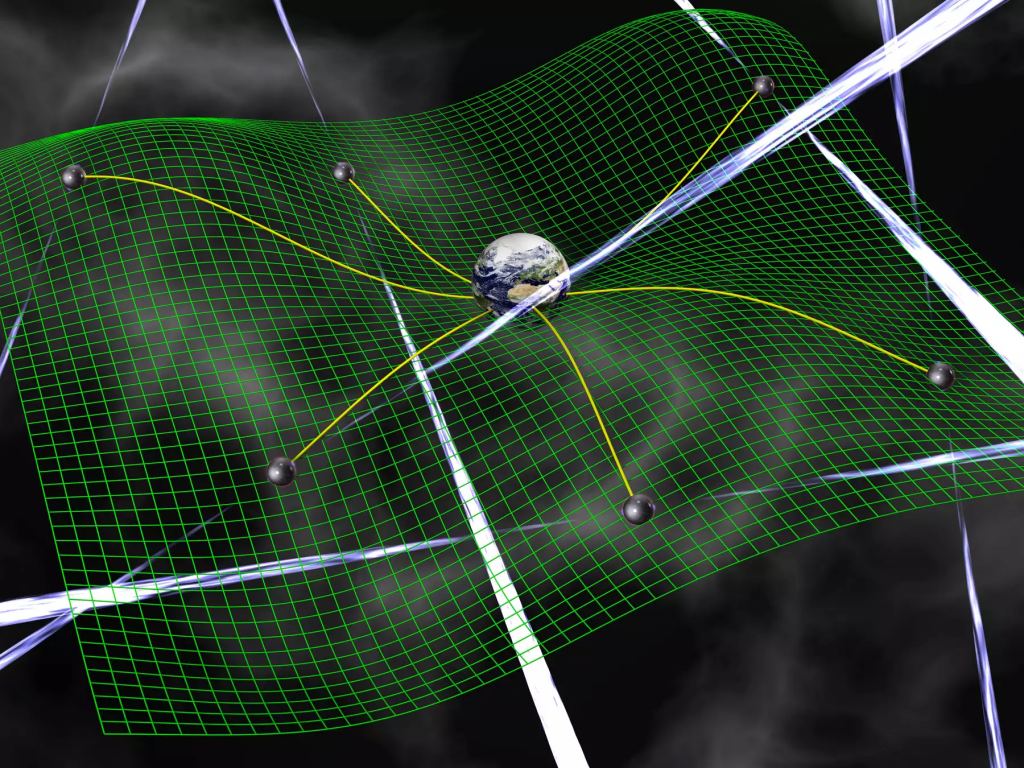
The gravitational wave background was first discovered in 2016. This was announced following the release of the first data set from the European Pulsar Timing Array. A second data set has just been released and along with the Indian Pulsar Timing Array, both studies confirm the existence of the background. The latest theory seems to suggest that we are seeing the combined signal of supermassive black hole mergers.
Gravitational waves are ripples in spacetime caused by violent processes in the universe. They were predicted by Einstein in 1916 as part of his general theory of relativity. The waves are thought to be created by accelerating masses such as merging black holes, colliding neutron stars and the like. They are expected to be able to travel through space largely unhindered. Their existence was first discovered in September 2015 by the Laser Interferometer Gravitational-Wave Observatory (LIGO). They are believed to have formed from a gravitational merger of two black holes 1.3 billion light-years away.
The Laser Interferometer Gravitational-Wave Observatory consists of two detectors, one in Livingston, Louisiana, and one near Hanford, Washington. The detectors use giant arms shaped like an “L” to measure tiny ripples in the fabric of the universe. Image credit: Caltech/MIT/LIGO Lab
The gravitational wave background is a random distribution of gravitational waves permeating the universe and was discovered in the European Pulsar Timing Array. The background is thought to consist of multiple superimposed gravitational waves, generated by black hole supermassive binary stars, for example. Observing the gravity wave background can provide us with a great opportunity to study the universe as a whole, similar to the cosmic background radiation. This success would not have been possible without the European Pulsar Timing Array, the Indian PTA, the North American Nanohertz Observatory and the Parkes PTA.
The full sky picture of temperature fluctuations (shown as color differences) in the cosmic microwave background, created from nine years of WMAP observations. These are the seeds of galaxies from a time when the universe was less than 400,000 years old. Photo credit: NASA/WMAP
A Pulsar Timing Array (PTA) consists of a network of galactic pulsars that are monitored and analyzed to detect patterns in their pulse arrival times on Earth. PTAs essentially act as galaxy-sized detectors. While pulsar timing arrays have various applications, they are best known for using an array of millisecond pulsars to detect and analyze the long-wave gravitational wave background.
The paper, written by a team led by J. Antoniadis of the Institute of Astrophysics in Greece, examines the effects of the common low-frequency signal observed in the latest data from the pulsar timing array systems. The team compiles data from the four different data sets and looks for a signal that contains only high-quality data.
The conclusion was clear, further evidence of a gravity wave background. Over time and with additional pulsar timing array projects, the low-frequency gravity wave background will become more apparent. The mission now is to interpret the details of all these signals to maximize the opportunity to explore the universe in this new way.
Source: The second data release from the European Pulsar Timing Array: IV. Implications for massive black holes, dark matter and the early universe
Like this:
Is loading…
