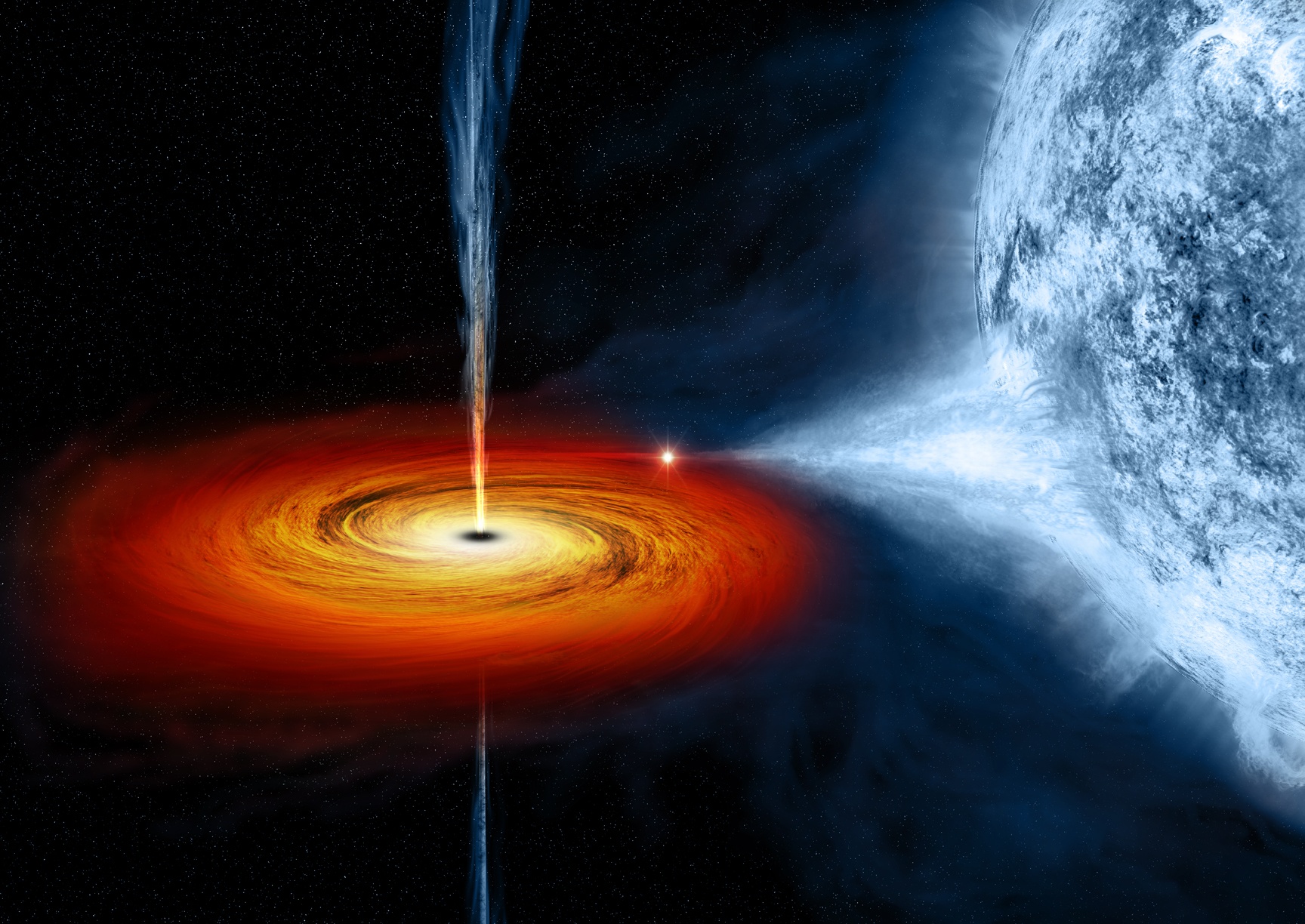
The physics surrounding black holes are just weird. A gravitational source so powerful that not even light can escape can do some pretty strange things to normal matter. Over the decades, many theories have been put forward about what these strange things might be. And now new work from physicists at the University of Oxford has proven that Einstein's theory of gravity was correct once again.
Their work focused on a “plunging region” just outside the black hole’s radius. In this region, matter “plunges” directly into the black hole rather than orbiting it according to the more familiar laws of orbital mechanics. One of the paper's authors, Dr. Andrew Mummery, equates it to watching a river turn into a waterfall. Matter flows beautifully along a clearly defined path and then seemingly falls off a cliff.
Theoretical work has been carried out on this region for decades. The idea of a crash originally came from Einstein's theory of gravity. It stated that if matter was close enough to a black hole, it would be driven into the black hole at almost the speed of light. However, no one had yet collected data and proven this theory.
Fraser celebrates the first direct image of a black hole.
However, data from NASA's Nuclear Spectroscopic Telescope Array (NuSTAR) and Neutron star Interior Composition Explorer (NICER) changes this. They collected X-ray data from a relatively small black hole located in a star system about 10,000 light-years away. This data showed that matter (which at this point consists entirely of plasma) moves rapidly into the interior of the black hole once it reaches a certain threshold.
This discovery is just the first step in a long-term plan in which researchers hope to use a much larger telescope to study much larger black holes. The Africa Millimeter Telescope is a planned new ground-based telescope to begin operations in Namibia. The project, originally proposed in 2016, is slowly approaching first light and has so far received funding of 10 million euros.
With this new telescope, Oxford physicists hope to take a look at one of the supermassive black holes at the center of our galaxy. You could potentially even capture video of it spinning – or at least the matter surrounding it. This would be a first for black hole astronomy and a major technical achievement in itself.
Fraser discusses another strange aspect of black hole physics – how cold are they?
Currently, many other smaller black holes can be analyzed using data from existing telescopes such as NuSTAR and NICER, as well as other platforms. The paper also analyzed data from the International Space Station. With new tools and a better understanding of what to look for, more discoveries about black holes undoubtedly await us in the data already collected.
Learn more:
University of Oxford – First evidence that “crashing regions” exist around black holes in space
Mummery et al. – Continuum emission from the immersion region of black hole disks
UT – New view reveals magnetic fields around our galaxy's giant black hole
UT – Black hole event horizons can grow so large that it's beyond your imagination
Mission statement:
Artistic illustration of a black hole.
Credit – NASA
Like this:
Is loading…
