

By Andy May and Marcel Crok
We were commissioned by Marty Rowland and the American Journal of Economics and Sociology (AJES) to write a literature review supporting the position of skeptics (also called “deniers”) regarding dangerous man-made climate change. Our article was fully peer-reviewed and presents what we believe to be the most compelling argument. Unfortunately, the article is pay-per-view, but the submitted version, which includes all the changes suggested by the reviewers, can be downloaded here.
When we planned the article, we called it the “Yes, But” paper. This meant: Yes, most scientists believe that human-caused CO2 is driving climate change and could be dangerous, but what about…? Other articles in this special climate issue of AJES explore other views on possible human-caused climate change and its potential dangers.
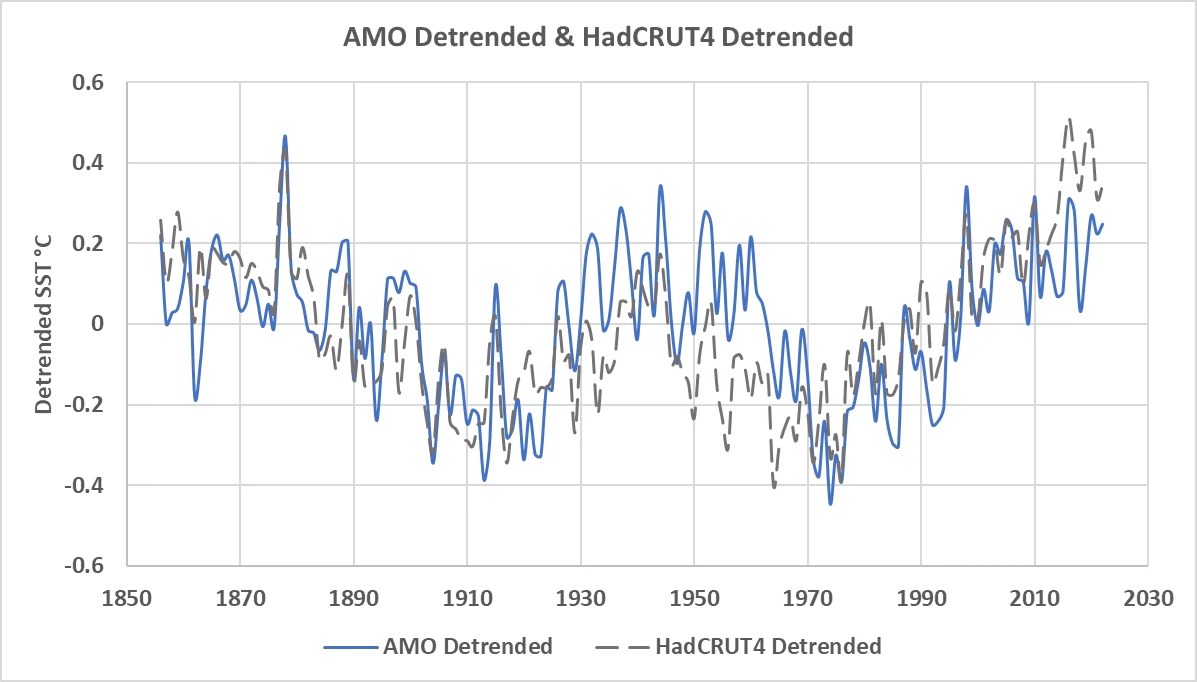
The image chosen for this post, also shown below, is part of Figure 2 from the article. It shows the Atlantic Multidecadal Oscillation (AMO) index compared to the detrended global average surface temperature record HadCRUT4 index. The similarity is obvious. The AMO is the detrended record of North Atlantic surface temperature. The AMO has been traced back to 1567 AD and is clearly a natural oscillation. The fact that it is seen in HadCRUT4 shows that at least some of the recent climate change is natural. This and other problems with the IPCC AR6 conclusions are discussed in the article.
Figure 1. Detrended North Atlantic sea surface temperatures (AMO) compared to detrended global average surface temperatures in HadCRUT4.
The argument that human greenhouse gas emissions (mainly carbon dioxide) control the climate, as claimed in the IPCC Sixth Assessment Report (AR6), or that the resulting climate change is dangerous, is very weak. See the IPCC AR6 Working Group II (WGII) quote below.
“Human-induced climate change … has caused widespread negative impacts and associated losses and damages to nature and people that exceed natural climate variability. … The increase in weather and climate extremes has led to some irreversible impacts as natural and human-induced systems are stressed beyond their adaptive capacity (high confidence).”
How do we show that this claim is weak? There are many ways. The AR6 WGI and WGII reports define climate change as global warming since 1750 or 1850. The period before these dates is generally referred to as the “pre-industrial period.” The Little Ice Age, a term rarely used in AR6, spans from about 1300 to 1850. It was a very cold and miserable time for humanity, with many well-documented weather extremes in the historical record throughout the Northern Hemisphere. It was also a time of frequent famines and pandemics. We show that today's climate is arguably better than it was then, not worse.
Nevertheless, the IPCC claims that extreme weather events are worse today than in the past. However, observations do not support this claim. Some extreme weather events, such as the land area suffering from extreme drought, are decreasing rather than increasing. Globally, the frequency of hurricanes shows no significant trend.
Observations show that neither extreme weather events nor global warming are increasing damage or endangering humanity today. Mitigating climate change, according to AR6, means limiting the use of fossil fuels, even though they are still plentiful and inexpensive. Since the current climate is arguably better than the pre-industrial climate and we are not seeing an increase in extreme weather events or climate-related mortality, we conclude that we can adapt to future changes. Unless a threat is identified, there is no reason to stop using fossil fuels.
Gray, ST, Graumlich, LJ, Betancourt, JL, & Pederson, GT (2004). A tree-ring-based reconstruction of the Atlantic Multidecadal Oscillation since 1567 AD. Geophys. Res. Lett., 31. doi:10.1029/2004GL019932
May, A., & Crok, M. (2024, May 29). Carbon dioxide and a warming climate are not problems. American Journal of Economics and Sociology, 1-15. doi:10.1111/ajes.12579
You can download further references here.
-
(Gray, Graumlich, Betancourt & Pederson, 2004) ↑
-
(IPCC, 2022, p. 9) ↑
-
The observations used to characterize the pre-industrial period are from 1850-1900, as these are the earliest global measurements available. (IPCC, 2021, p. 5, footnote 9) ↑
-
(IPCC, 2021, p. 295, footnote c) ↑
-
(Lomborg, 2020) ↑
-
(Lomborg, 2020) and (IPCC, 2013, p. 216) ↑
-
(Crok & May, The IPCC's Frozen Climate Views, An Analysis of AR6, 2023, pp. 140-161) and (Scafetta N., 2024) ↑
-
(IPCC, 2022b, pp. v, 6-13) and (Scafetta N. , 2024) ↑
Like this:
Is loading…

Comments are closed.