

Scientist Lee Seok Woo said a scene from the movie “Mission Impossible” inspired his latest invention: batteries for smart contact lenses.
In the fourth film in the series, an agent wears contact lenses that enable facial recognition and eye tracking. Lee wanted to make this lens a reality.
“I asked myself, 'How can I work in the field of smart contact lenses?'” the associate professor in the Department of Electrical and Electronic Engineering at Nanyang Technological University told CNBC's “The Edge.”
Lee's expertise in battery components served as a starting point for his foray into wearable technology. He realized that smart contact lenses would require safe and compact batteries, which would be critical to the continued development of these devices.
Contact lenses themselves are extremely thin at 0.5mm, so the size and flexibility of these batteries are crucial to avoid discomfort for the user.
“The thickness of our battery is about 0.2 mm, which is about twice the thickness of a human hair,” Lee said.
A demonstration of how a smart contact lens would fit on a human eye model.
Lauren Choo |
Lee and his team have invented a battery that can be powered by a biocompatible saline solution as an alternative to lithium-ion batteries that contain flammable materials.
This new battery can be charged using a traditional wire method or a chemical method. The battery is coated with glucose and when immersed in a salt solution, the glucose reacts with the sodium and chloride ions and charges it.
Scientists at NTU in Singapore demonstrate how the battery of a smart contact lens can be charged using the conventional cable method.
Lauren Choo |
After eight hours of chemical charging, the battery can reach 80% of its full capacity. It can then be used for several hours during the day.
However, there is another unusual way to power the battery.
“Tear solution also contains glucose, which means your tears can charge the battery even while you're wearing the contact lens,” Lee said.
“If you cry more, you can recharge your battery more.”
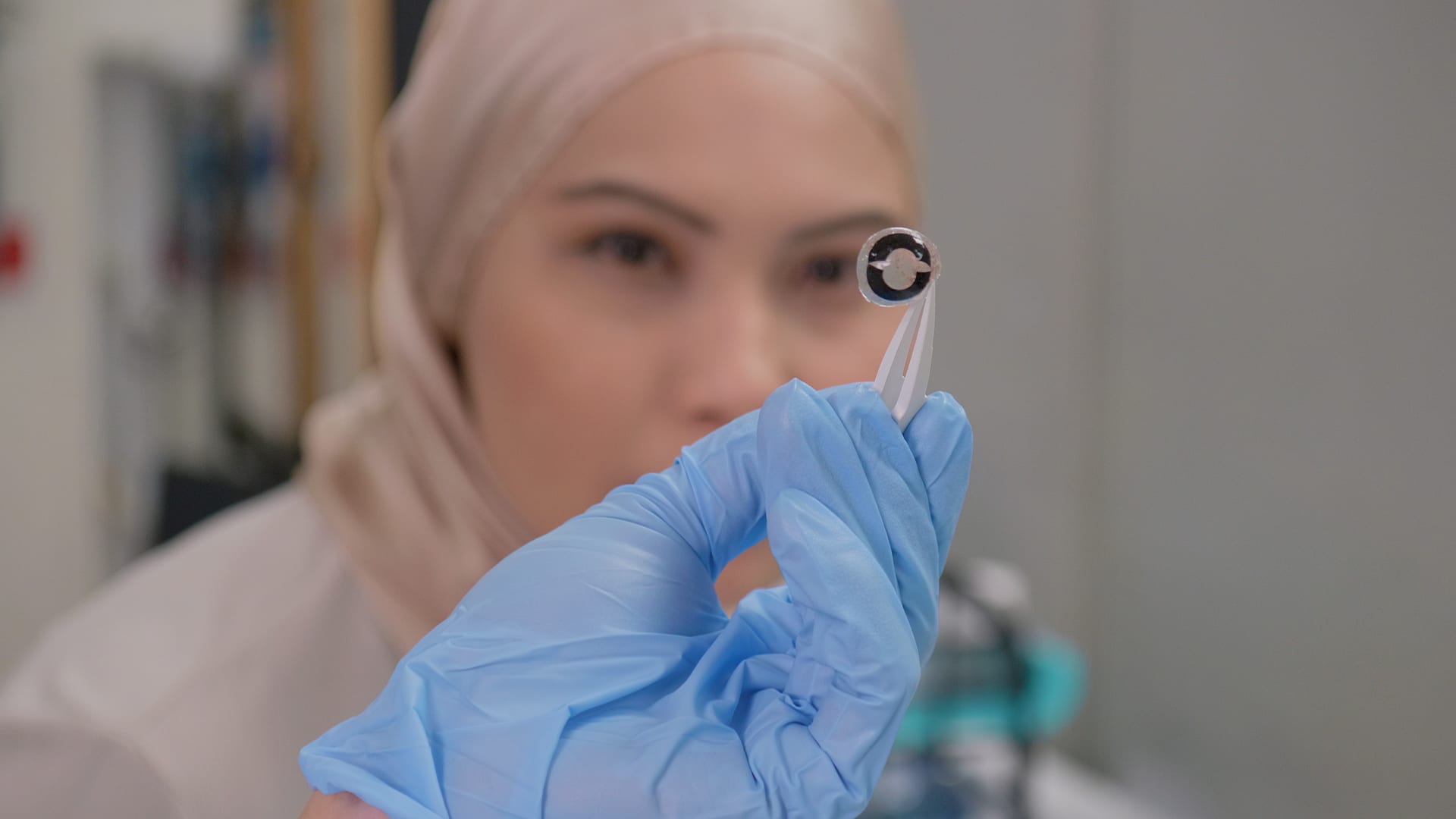
A scientist presents an intelligent contact lens equipped with a working prototype of a microbattery.
Lauren Choo |
Currently, the capacity and voltage of the battery are still very low. Using the two methods, the battery can only produce a voltage of about 0.3V – 0.6V. The standard voltage for an AA battery is 1.5V.
At this point, this power is not enough to power data storage or an internet connection, but the team is working on developing battery specifications.
Lee has identified a potential partner in the healthcare sector.
“We use glucose as biofuel. There are many diabetics who check their glucose levels daily,” Lee said.
“We investigated how we could measure glucose levels while the user is wearing the contact lens.”
Despite the potential promise of such innovation, Lee believes costs should be kept low given the capacity of the batteries.
“Once the product is in serious commercial use, the cost of the battery should be only a few dollars.”

Comments are closed.