

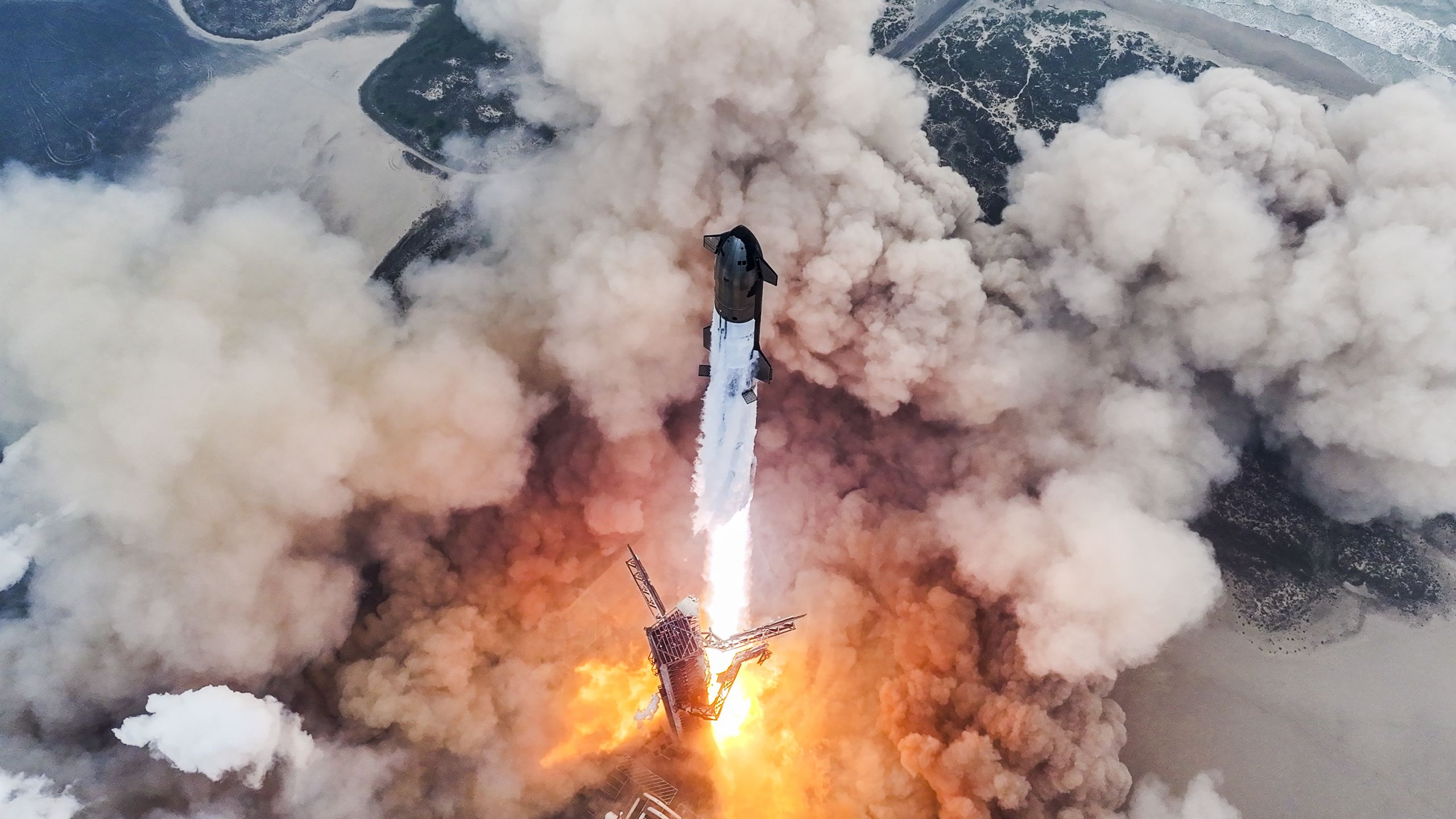
SpaceX's Starship today received top marks in its fourth unmanned flight test, making significant progress in developing a launch system that will land NASA astronauts on the moon as early as 2026.
The Super Heavy booster lifted off at 7:50 a.m. CT (5:50 a.m. PT) from SpaceX's Starbase complex in South Texas, taking to the skies using 32 of its 33 methane-fueled Raptor engines. Considered the world's most powerful launch vehicle, Super Heavy has 16.7 million pounds of thrust at liftoff.
A few minutes after launch, the rocket's upper stage – the so-called ship – separated from the first stage and ignited its own six Raptor engines. In the meantime, Super Heavy flew independently to a controlled splashdown in the Gulf of Mexico.
The soft splashdown was a new achievement for Starship. During the third flight test in March, only a few of the Super Heavy's engines were able to restart for a decisive landing. As a result, the booster hit the water with an uncontrolled splash.
SpaceX plans to have the super-heavy booster eventually fly back to its base on its own once its work is done.
The upper stage reached an orbit of over 200 kilometers, but reaching a full orbit was not part of today's plan. Instead, SpaceX planned to gently splash Ship itself down in the Indian Ocean.
Streaming video transmitted over SpaceX's Starlink satellite network showed the rocket's protective shell glowing from the heat of reentering the atmosphere. Burning debris broke off one of Ship's control fins, damaging the camera's lens — but the blurry view still confirmed that the spacecraft successfully hit the target. This was another step up from the third test, when Ship broke apart during its descent into the ocean.
“Despite the loss of many tiles and a damaged hatch, Starship made it to a soft landing in the ocean!” rejoiced SpaceX founder Elon Musk in a post on his social media platform X.
NASA Administrator Bill Nelson also congratulated X, noting that the successful test was a plus for the space agency's Artemis lunar program. “We are one step closer to returning humanity to the moon with Artemis – and then we look to Mars,” he wrote.
A modified version of Ship is planned to serve as the lunar lander for Artemis 3. This would be the first manned mission to the lunar surface since Apollo 17 in 1972. This mission is currently planned for 2026, but the timing depends in part on whether the Starship system is ready in time.
SpaceX's unmanned flight tests follow a phased plan to make Starship ready for a wide range of missions – including deploying hundreds of Starlink satellites, point-to-point travel between spaceports on Earth, and manned odysseys to the Moon, Mars and beyond.
In these early tests, the Starship rockets are still without a payload. “We've said it before and we'll say it 9,000 times: The data is the payload,” said SpaceX commentator Dan Huot during today's flight test.
But as the development program progresses, the scope of flight testing will expand to include multi-orbit operations, payload deployments and precision landings on landing pads. Ahead of today's test, SpaceX and the Federal Aviation Administration worked out an agreement to streamline the approval process for future flight tests.
Like this:
Is loading…

Comments are closed.