The search for life is one of the most debated questions in science. The question is: what do you look for? The lunar module Odysseus recently discovered signs of a technologically advanced civilization… on Earth! The lunar module is equipped with an instrument called ROLSES, which has been studying Earth's radio emissions as if it were an exoplanet to see if it can detect signs of life!
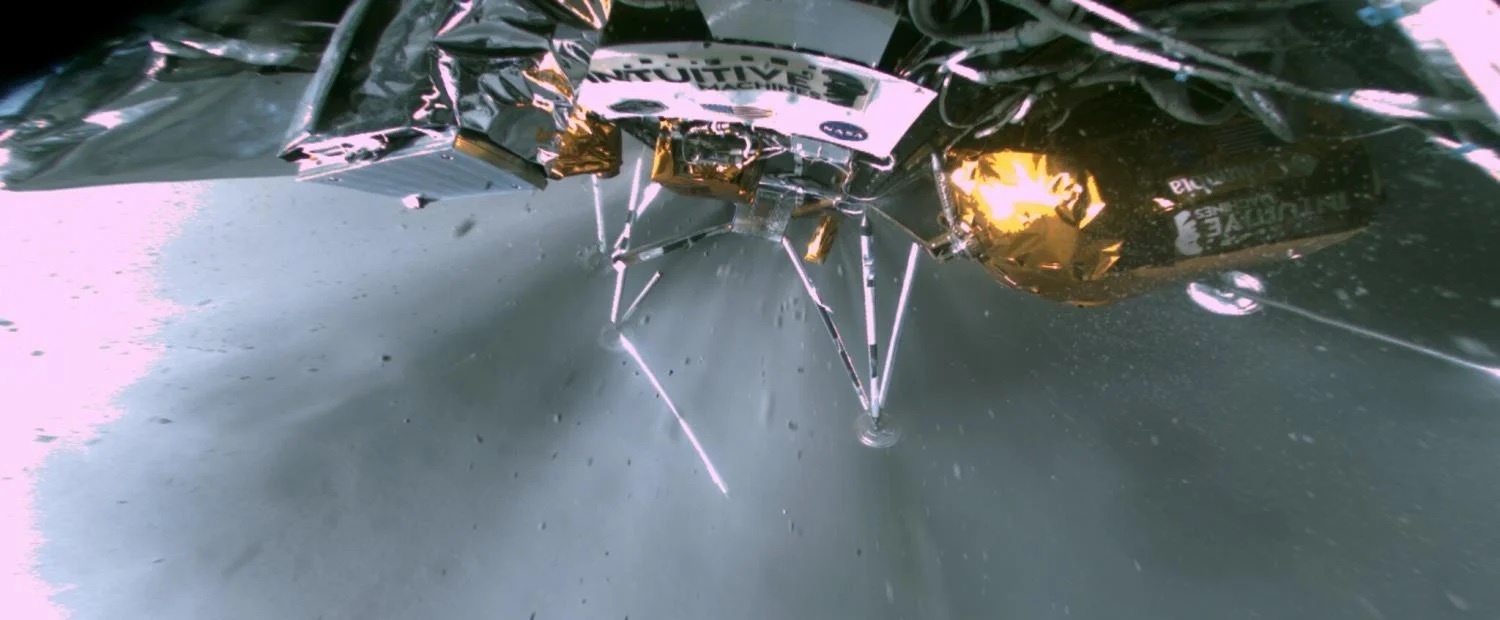
Odysseus was launched on February 15. It was Intuitive Machines' lunar module and landed in the Moon's solar polar region seven days later. Since then, it has been collecting valuable data from the region as a prelude to future human exploration. It was part of the Commercial Lunar Payload Services program, built entirely by private companies. Despite the landing mishap that caused Odysseus to tip onto its side, it still performed well.
There were other challenges along the way. The laser-guided navigation system, which was supposed to facilitate landing on the rocky surface, failed. Since Armstrong landed Apollo 11 manually in the last minutes, the ground crew had to conduct the landing using the optical camera system alone. The trip to the moon was not without incident either. One of the antennas of the ROLSES system overheated and came loose from its housing. During landing, an image showed the antenna sticking out.
Neil Armstrong and Buzz Aldrin raise the US flag on the lunar surface 45 years ago on July 20, 1969 during the Apollo 11 mission, the first human moonwalk in history. Image credit: NASA
On board Odysseus is the Radio Wave Observations at the Lunar Surface Photo Electron Sheath, or ROLSES for short, a radio experiment designed to study the properties of the Earth's atmosphere from the lunar surface. It was a unique opportunity to observe Earth in a completely different way and see if our approach to hunting for technologically capable extraterrestrial civilizations is correct.
The instrument was built at NASA's Goddard Space Flight Center in Maryland and included radio antennas and a device called a radio spectrometer. Its purpose was to record a wide range of radio emissions from the “radio-quiet” region of the moon. It turned out to be a small bonus, though, as it allowed the team to record radio waves from Earth for about an hour and a half.
NASA has selected three commercial lunar lander providers to deliver science and technology payloads as part of the Artemis program under the Commercial Lunar Payload Services (CLPS). Each commercial lander will carry NASA-provided payloads that will conduct scientific investigations and demonstrate advanced technologies on the lunar surface, paving the way for NASA astronauts to land on the lunar surface by 2024… The selections are: … • Pittsburgh-based Astrobotic has received $79.5 million and has proposed flying up to 14 payloads to Lacus Mortis, a large crater on the nearside of the Moon, by July 2021… • Houston-based Intuitive Machines has received $77 million. The company has proposed flying up to five payloads to Oceanus Procellarum, a scientifically fascinating dark spot on the moon, by July 2021…• Edison, New Jersey-based Orbit Beyond has received $97 million and proposed flying up to four payloads to Mare Imbrium, a lava plain in one of the moon's craters, by September 2020. …All three lander models were on display at the announcement of the companies selected to provide the first lunar landers for the Artemis program, Friday, May 31, 2019, at NASA's Goddard Space Flight Center in Greenbelt, Maryland. …Read more: https://go.nasa.gov/2Ki2mJo..Image credit: NASA/Goddard/Rebecca Roth
We have known for some time that all signals from cell phones and TV/radio stations slowly drift out into space (and have now reached a distance of just over 100 light years). All of these emissions are potentially detectable, but the farther away you are from Earth, the weaker the signal. Within these signals, the team was able to detect signs of an intelligent, technological civilization. Attention will now of course turn to detecting the same signals from exoplanets, but perhaps not from ROLSES; something bigger is needed.
Source: In a new experiment, scientists record Earth's radio waves from the moon
Like this:
Is loading…
