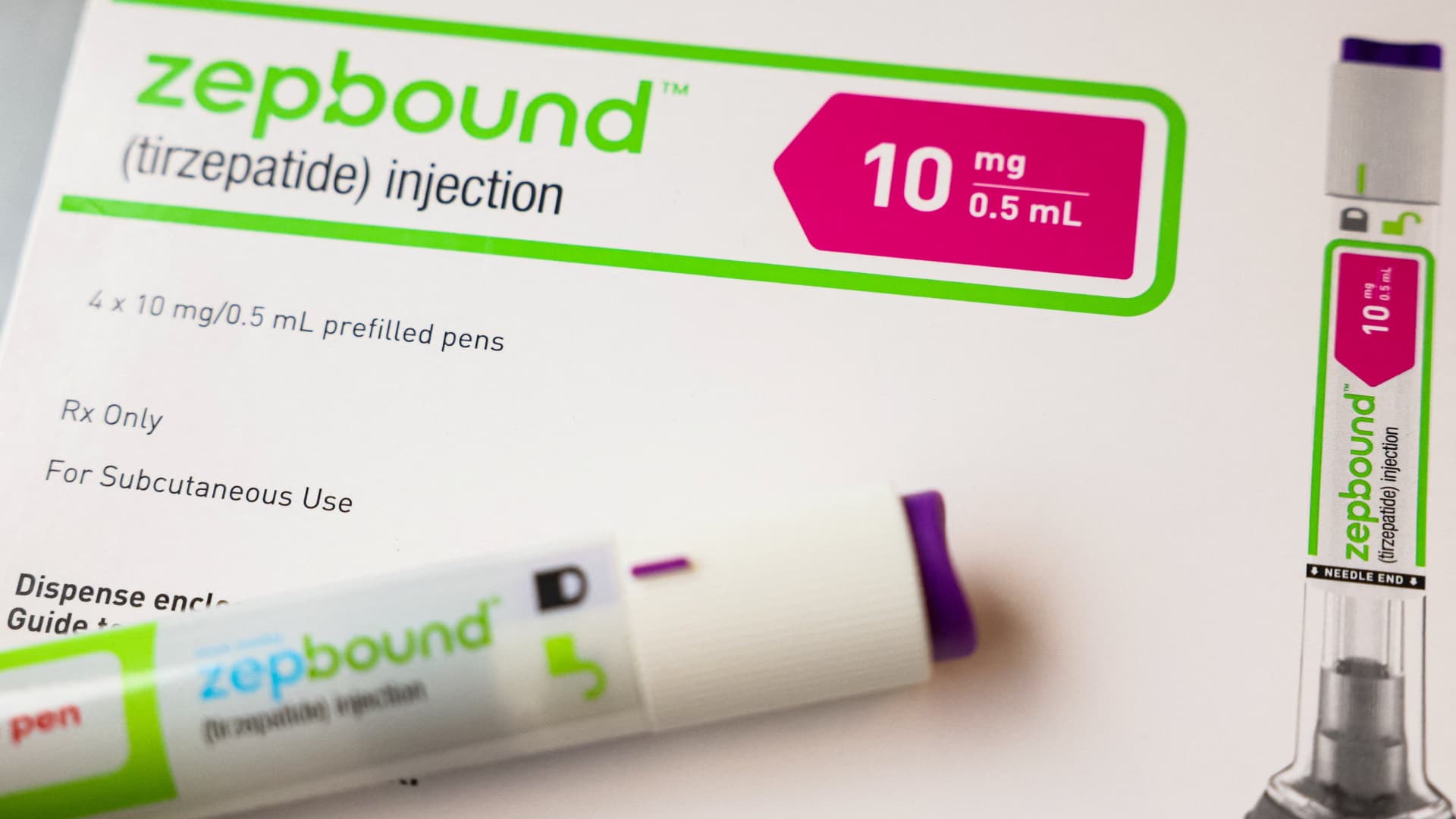
Eli Lilly announced on Friday that the company has applied for approval in the United States for its weight-loss drug Zepbound to treat the most common sleep-related breathing disorder and expects a decision from regulators as early as the end of the year.
If the company receives approval from the U.S. Food and Drug Administration (FDA), it plans to bring Zepbound to market for obstructive sleep apnea “as soon as possible” in early 2025, Patrik Jonsson, president of Eli Lilly Diabetes and Obesity, said in an interview.
Also on Friday, the company released additional data from two late-stage studies showing that Zepbound helped reverse obstructive sleep apnea (OSA) in nearly half of patients. Eli Lilly presented the new data from the studies on Friday at the American Diabetes Association's 84th Scientific Session in Orlando, Florida.
“We are absolutely thrilled. … I think it even exceeds the expectations of most outside experts,” Jonsson said of the new data showing that Zepbound can help cure the disorder in some patients.
This is further evidence that a group of weight-loss and diabetes drugs that surged in popularity and then fell into shortage in the U.S. last year may have other health benefits. The data also clears the way for Eli Lilly to seek broader insurance coverage for Zepbound, which, like other weight-loss drugs, is not covered by many insurers.
The pharmaceutical giant published initial results from the two studies in April, which showed that Zepbound was more effective than a placebo in reducing the severity of OSA in patients with obesity after one year.
OSA refers to pauses in breathing during sleep due to narrowed or blocked airways. An estimated 80 million patients in the United States suffer from the disease, Eli Lilly said in a press release. About 20 million of these people suffer from moderate to severe forms of the disease, but 85 percent of OSA cases remain undiagnosed, according to Jonsson.
OSA can cause loud snoring and excessive daytime sleepiness and contribute to serious complications such as stroke and heart failure. Patients with the condition have limited treatment options other than wearing masks connected to cumbersome machines during sleep that produce positive airway pressure (PAP) to facilitate normal breathing.
The first study evaluated weekly injection in adults with moderate to severe OSA and obesity who were not receiving PAP therapy. The second study tested Zepbound in adults with the same conditions but who were receiving PAP therapy and planned to continue that therapy.
The new results showed that 43 percent of participants in the first study and 51.5 percent of patients in the second study who took the highest dose of Zepbound achieved a “cure of disease,” according to a press release. By comparison, this was the case for 14.9 percent and 13.6 percent of patients who took a placebo in the two studies, respectively.
“This has a huge impact on patients' lives,” Leonard Glass, Eli Lilly's senior vice president of medical affairs, diabetes and obesity, told CNBC. “Imagine not having to use a PAP machine or worrying about waking up in the middle of the night, or worrying about your partners – you wouldn't have to live with someone who has this disease.”
The researchers came to these conclusions by examining something called the apnea-hypopnea index (AHI), which records the number of times per hour that a person's breathing shows a restricted or completely blocked airway. The index is used to assess the severity of obstructive sleep apnea and the effectiveness of treatments for the condition.
According to Eli Lilly, disease resolution in OSA is defined when a patient has fewer than five AHI events per hour. According to the company, it is also defined when a person has five to 14 AHI events per hour and meets a certain number on a standard survey measuring excessive daytime sleepiness.
Among other things, the company said that 62.3% of patients in the first study who took Zepbound experienced a greater than 50% reduction in AHI events, compared with 19.2% of patients on placebo. Meanwhile, 74.3% of people in the second study who took Eli Lilly's drug experienced a greater than 50% reduction in AHI, compared with 22.9% of participants who received a placebo.
Eli Lilly reiterated on Friday that Zepbound had achieved the study's primary goal of reducing AHI events.
Zepbound resulted in an average of 27.4 fewer AHI events per hour after 52 weeks in people not connected to PAP machines. This compares with an average reduction of 4.8 events per hour in those who received a placebo in the first study.
The drug also resulted in an average of 30.4 fewer AHI events per hour after 52 weeks in patients hooked up to PAP machines. This compared with an average reduction of six events per hour in people who received a placebo in the second study.
Eli Lilly had previously announced that the FDA had granted Zepbound Fast Track designation for patients with moderate to severe OSA and obesity. The designation ensures that drugs intended to both treat a serious or life-threatening condition and fill an unmet medical need are reviewed more quickly.
