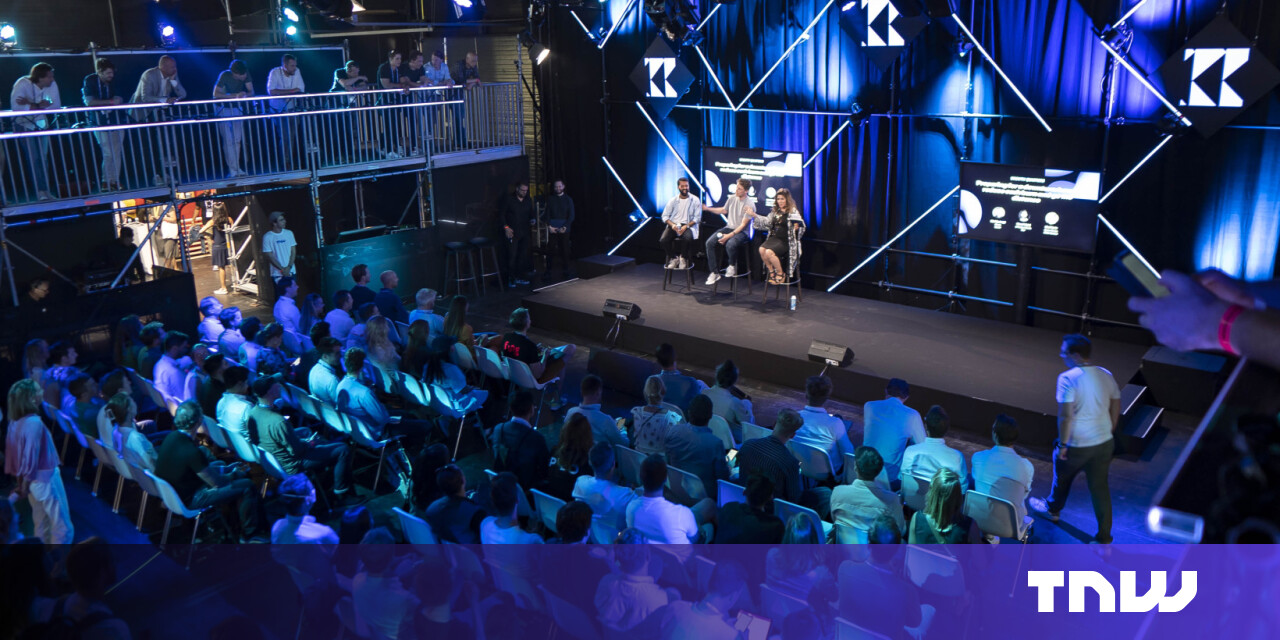
The TNW Conference grounds opened again this morning for Day 2. Many attendees came back for more (some not as fresh as others after last night's karaoke cruise), and there were new speakers and attendees joining us for the first time, adding some unique perspectives to the mix.
Here is a summary of five interesting conversations and ideas that came up throughout the day.
More than environmentally friendly products: Change the system, not just the design
In this insightful discussion, Bas van Abel, founder of Fairphone, Matthew Cockerill
The independent design innovation consultant and Linnea Ahlgren, senior editor at TNW, discussed the need for a cultural shift in our relationship with products.

The <3 of EU technology
The latest gossip from the EU tech scene, a story from our wise old founder Boris and questionable AI art. Free in your inbox every week. Sign up now!
As an example, Ahlgren asked: How many people have considered purchasing a new phone after hearing about the latest iPhone updates?
“Ultimately, the most sustainable phone is the phone you already have,” reiterated van Abel.
Cockerill pointed out that this responsibility does not only fall on consumers. He believes that companies should treat their products like their children. Rather than sending them out into the world to become orphans, companies should build a longer-term relationship with their products and bring their “children” (products) back home from time to time so they can be refreshed and sent back out into the world.
“It's stupid that we stop using products. We look at each product as a unit – when the battery is dead, we throw it away. But what are the different components?” said Cockerill.
One of the ideas discussed was the development of non-mining products, i.e. products made from existing materials and inputs without the need for newly mined materials.
Humanism: The philosophical debate on AI ethics
This panel brought together four AI experts to discuss how we can shift the conversation around AI from the technology itself to how it can actually benefit and serve humanity.
Ben Goertzel, CEO of SingularityNet and proponent of the idea that artificial general intelligence is imminent, said:
“We will probably have AIs that are as intelligent as humans in the next few years. Who owns and controls the AI and what the AI is used for is important. Will it be developed in the interests of everyone or a small group of people?”
Dr. Vivienne Ming, co-founder and executive chair of Socos Labs, provided some interesting food for thought:
“We should not only think about 'Am I better when I use technology?' but also 'Am I better after I use it?'” she said. As we become more reliant on apps designed to make our lives easier, the question is what the long-term consequences might be. As an example, she cited the impact our reliance on Google Maps might have on our ability to navigate spatially.
The balance between innovation and privacy and accessibility of data for all (large and small companies) were also discussed, among other possibilities that could help us develop more ethical uses of AI.
The loot from the fastest robbery in the world is laundered
Journalist Geoff White took the audience on a journey of mystery and intrigue as he discussed his investigation into the Lazarus heist – the fastest and arguably largest heist in the world, in which North Korean hackers stole $625,000,000 in 1 minute and 55 seconds.
But the cybercriminals were not completely lost. With millions of dollars in a digital wallet, the next challenge was to figure out how to launder such a large amount of crypto-based cash.
“Hackers don't necessarily know how international banking works – how to actually move the stolen money. That's where the money launderers come in,” he explained.
The hackers focused on Tornado Cash, a crypto tumbler that runs on Ethereum.
This led to a transatlantic investigation, a debate about free speech and privacy, and a prank involving unsuspecting celebrities like Jimmy Fallon and Shaquille O'Neal. Read more about it in White's book, The Lazarus Heist.
Fostering Champions: The Role of Ecosystems for Sustainable Growth
During this panel discussion, policymakers Janette Wiget (Merantix), Clara Chappaz (French Tech Mission), Margot Roose (City of Tallinn) and Pedro Lopes (Government of Cape Verde) discussed with TNW Media Director Andrii Degeler best practices and challenges in fostering startup growth and creating a thriving entrepreneurial environment.
Pedro Lopes, Secretary of State for Digital Economy in the Government of Cabo Verde, passionately shared his learnings from building the “Tech Islands of West Africa”. Attracting talent is key to developing a successful startup industry, and Cabo Verde is tackling this by promoting authenticity and creating a space where everyone feels comfortable and free.
Seismic tremors: Reality revealed
We have witnessed how the fusion of man and machine gave rise to a new creative force: the cyborg artist.
This is the world that Moon Ribas, who biohacks her body for her art, introduced us to. She is best known for implanting seismic sensors in her feet that vibrated when an earthquake shook the planet. These rocking rhythms then guided her dance routines.
On stage, Ribas beat a drum to the rhythm of the earthquakes. Such fusions with technology, she said, can strengthen our connection to nature.
“Now that I identify as a cyborg, I feel closer not to robots and machines, but to the Earth.”
Sustainability at TNW 2024
In keeping with our commitment to making the TNW conference as sustainable as possible, on-site catering offered all meatless options, from steaming mushroom-based dumplings to Moroccan msemen. All cups, plates and cutlery were made from recyclable materials.
And that's it. The team here at TNW is already working on putting together a list of inspiring speakers, timely topics, and fun side events for TNW 2025.
Stay tuned and see you next year!
