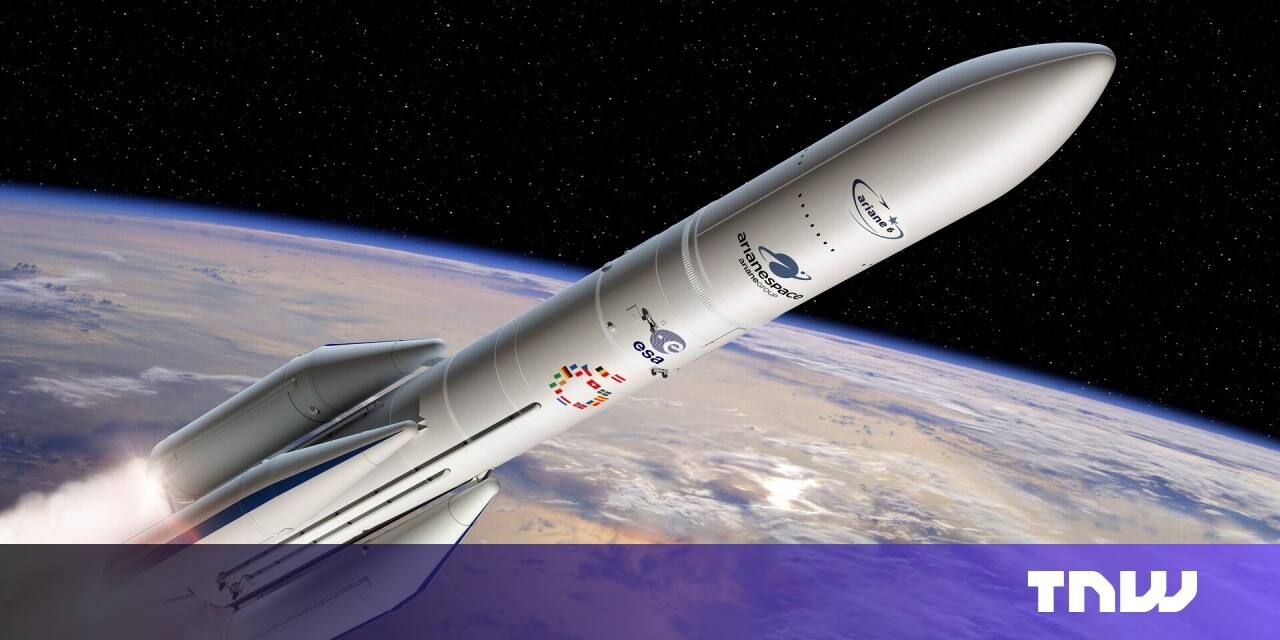
When Ariane 6 suffered a breakdown during its maiden flight, the mishap seemed strangely inevitable.
Almost half of all rockets fail on the first launch. After a difficult development and four years of delay, Ariane 6 seemed to be a hot candidate for this list.
The launch vehicle was commissioned to pave Europe's way into space. Since the Ariane 5 was decommissioned last July, the continent has had no independent access to space.
Thierry Breton, EU Commissioner for the Internal Market, described the problem as an “unprecedented crisis”. A failure of the launch on Tuesday would have made the situation even worse.
TNW Conference 2025 – Back to NDSM on June 19-20, 2025 – Save the date!
Having concluded our incredible 2024 edition, we are excited to announce our return to Amsterdam NDSM in 2025. Register now!
Fortunately, the setback was only minor.
Ariane 6 launched successfully and deployed research satellites into orbit. The problem occurred late in the flight when the last components of the rocket failed to leave orbit. Nevertheless, the mission was declared a success.
“It was a historic moment,” said Lucía Linares, head of the European (ESA), Head of Space Transport Strategy. “It's good for Europe. And it's good for the world too.”
The first commercial launch of Ariane 6 is now scheduled for December. Another six are planned for next year and eight more for 2026.
Stéphane Israël, CEO of rocket operator Arianespace, said the glitch would have “no consequences for future launches.”
His words brought welcome relief to the European space industry. The sector offers great opportunities but urgently needs new launch infrastructure.
The need for Ariane 6
Mark Boggett, CEO of investment firm Seraphim Space, waited with bated breath for the launch. He believes Ariane 6 can give a major boost to space technology.
“Improved access will undoubtedly accelerate the pace of innovation and deployment of new space technologies in Europe,” he tells TNW.
Boggett has big ambitions. He wants to use his company's investments to turn European startups into global industry leaders.
That plan had been stalled by the long delays to Ariane 6. While they waited, the companies relied on launch services in other regions – particularly SpaceX’s service in the US.
This bottleneck can now be eliminated by the rocket. European space travel is no longer exclusively dependent on foreign suppliers and has a path to strategic autonomy.
Ariane 6 was launched on Tuesday from the European spaceport in French Guiana. Photo credit: ESA/S.Corvaja and M.Pédoussaut
The new rocket can attract new orders from domestic and international customers. Ariane 6 can also reduce costs and waiting times for start-ups that want to deploy payloads. As long as the service proves to be reliable and affordable.
The first commercial launches cannot come soon enough. A new space race is underway and Europe is in danger of being left behind.
Hopes and fears for European space technology
The cosmos becomes fertile ground for business growth. McKinsey and the World Economic Forum expect the global space economy to grow from $630 billion last year to $1.8 trillion in 2035. “New Space is a growth market for several decades,” says Boggett.
The crisis in the European launch vehicle market is making access to this market more difficult. In 2023, the continent conducted only three successful orbital launches – the lowest number since 2004. The United States, on the other hand, recorded 109 successful launches – more than ever before by a single country.
“The US dominates commercial space launches, driven by private companies like SpaceX, which has revolutionised the industry with reusable rockets, significantly reduced costs and increased launch frequency,” Jarkko Antila, CEO of the Finnish satellite startup Image spacesays TNW.
Although the USA is the market leader, Chinese missiles are also enjoying increasing success. Last year the country carried out 66 launches.
China has also proven to be a lucrative location for financing space technologies, with the country leading the world in private investment this year, according to a new study by Seraphim, with the total amount raised to $1.7 billion, surpassing the US figure of $1.6 billion.
Last quarter, Chinese companies secured the two largest funding rounds in the world. The largest funding round went to start-up Space Pioneer, which raised $208 million. Satellite manufacturer Minospace came in second with $138 million.
In Europe, financing has not grown at the same pace. In 2021, the continent's investment exceeded that of all of Asia. But these positions have now reversed.
Asia has also quickly overtaken Europe in terms of the number of spacetech agreements. In the last quarter of this year, 150 contracts were signed on the continent, while 149 contracts were signed in Asia.
Startups hope Ariane 6 is triggering a new boom in investments in Europe. Current trends suggest that their wishes will come true.
Preparations for the launch
Boggett expects Ariane 6 to boost Europe's space economy. “The proximity to the launch sites allows for more integrated testing and iteration of new technologies,” he says.
European companies can also reduce their transport and logistics costs. In addition, the launch capacity can strengthen cooperation between launch providers, satellite start-ups and research institutions.
With the funding landscape recovering in general, startups are ready to seize the opportunities.
According to new data from Seraphim, the space industry has just experienced four consecutive quarters of investment recovery. Last quarter, a whopping $2.4 billion was invested and transaction volume reached an all-time high.
Europe's largest investments were a $100 million capital increase for British spacecraft builder Aalto and a $93 million financing round for ICEYE. a Finnish manufacturer of microsatellites.
A growing group of venture capitalists is contributing to the cash pool. Among them is Alpine Space Ventures, which is planning major investments in Europe. Just today, the company launched a new fund worth 170 million euros (185 million dollars).
Public investment is also increasing. ESA's budget for 2024 has grown to a record 7.79 billion euros (8.49 billion dollars) – 10 percent more than last year.
But any hopes that Ariane 6 could outshine the US rocket giants seem misplaced. Antila of Kuva Space warns that the disposable system cannot compete with SpaceX's reusable rockets.
“Although the European Space Agency and Arianespace developed Ariane 6 for low-cost launches, it is not fully reusable and can primarily only be used at the Guiana Space Centre in French Guiana,” he says.
Nevertheless, the rocket could give new impetus to European space technology. Boggett is convinced that the vehicle will have a big impact.
“I have no doubt that the availability of local launch capabilities will further promote innovation and accelerate the development of the European space sector,” he says.
The first commercial flights will give a taste of the potential. At the very least, they will open up a new path into space for European startups.
