Originally published at ClimateREALISM
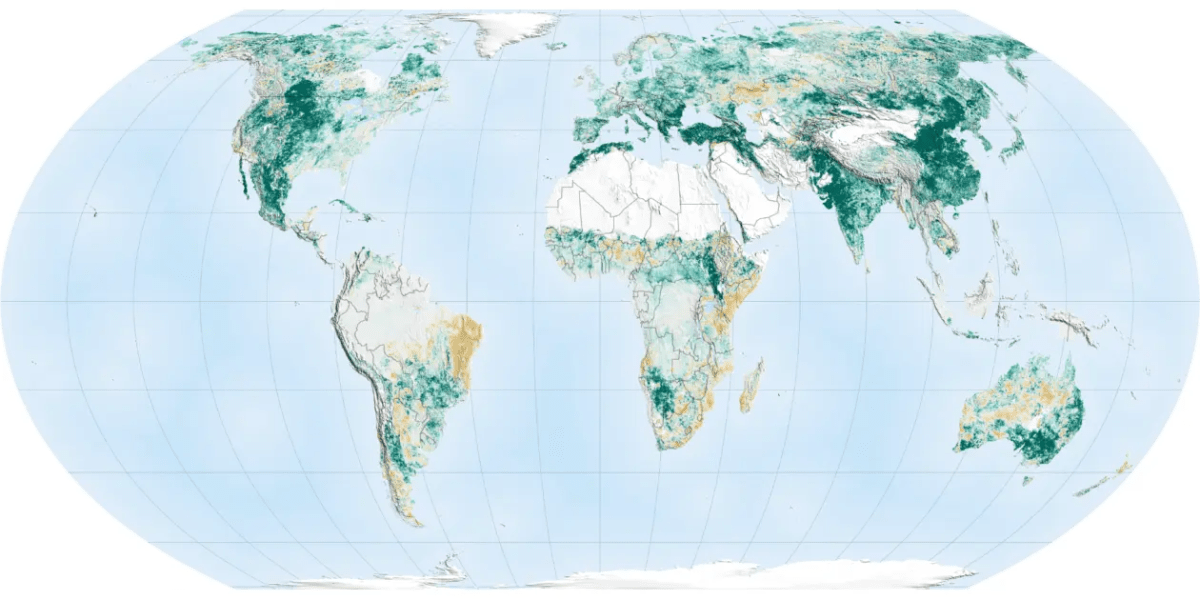
Image: Green areas showed growth in leaves from 2000 to 2017, while brown areas showed a decline. JOSHUA STEVENS / NASA EARTH OBSERVATORY
An article published on July 16 by Yale Environment 360 claims that global greening is not a positive thing, but rather a negative thing, because it will damage water supplies. This claim is amusing at best and misleading at worst. Although the author admits that many scientists see greening the Earth as beneficial due to rising CO2 levels, especially desert regions, he tries to portray this as a negative thing.
The article “As CO2 levels rise, the world's drylands are turning green” in the magazine Yale Environment 360 is amusing because its author, Fred Pearce, could not resist turning some very positive news into a negative one.
The subtitle of the article is:
Despite warnings that climate change could lead to large-scale desertification, many drylands are becoming greener as CO2 levels in the air rise – a trend that recent studies suggest will continue. But scientists warn that the increased vegetation could drain scarce water supplies.
First of all, we should commend Yale Environment 360 for spreading the good news about the effect of carbon dioxide (CO2) on greening the planet. The article adds:
What's going on here? The main reason, according to recent studies, is the 50 percent increase in carbon dioxide concentration in the atmosphere since pre-industrial times. This increased CO2 level is not only driving climate change, but also speeding up plant photosynthesis. By allowing plants to use scarce water more efficiently, the CO2-rich air fertilizes plant growth in even some of the driest places.
We have already reported on this greening due to increased CO2 levels here on Climate Realism. Data from satellite measurements show that the green area of the Earth increased by about 5% in the first 20 years of the 21st century. This is making the Sahara smaller. A 2018 study by Venter et al. found that the area of the Sahara has shrunk by 8% in the last three decades.
However, Pearce's claim is controversial: “Scientists warn, however, that the additional vegetation could drain scarce water supplies.”
That is simply wrong. In Africa, for example, trees make desert land fertile again:
There is finally some good news from Africa. Farmers are reclaiming the desert and transforming the barren wastelands of the Sahel zone on the southern edge of the Sahara into green, productive farmland.
Satellite images taken this year and 20 years ago show that the desert is receding thanks to reforestation, mainly with ana trees (Faidherbia albida), a type of acacia. Wherever the trees grow, agriculture can be resumed.
By planting trees, around three million hectares of land in Niger have been reforested, meaning that around 250,000 hectares can be used for agriculture again.
The key factor is evapotranspiration. Evapotranspiration, which is the combination of evaporation and plant transpiration (water from leaves into the air), is a key factor in desert formation. Deserts form when the amount of water evaporating from the ground is greater than the amount of rain or snow that falls. This is because deserts are arid, or dry, and receive no more than 10 inches of rainfall per year.
Evapotranspiration is an energy-driven process that increases with temperature, solar radiation, and wind. In deserts, the rapid heating and cooling of air creates strong winds that circulate hot, dry air, further increasing the rate of evaporation. In American deserts, for example, evaporation can range from 70 to 160 inches per year. At this rate of water loss, deserts remain deserts—they are locked in by the process of evaporation.
But in trees, this cycle is broken. Tree leaves reflect and absorb sunlight, reducing the amount of sunlight reaching the ground and lowering soil temperatures. At lower soil temperatures, the sun protection provided by tree canopies actually reduces evaporation, helping the desert to retain more groundwater.
Moderate warming has already led to slightly higher rainfall. In addition, plants use water more efficiently under higher CO2 conditions because they lose less moisture through transpiration, as Agronomy and Botany explains. So plants use water more efficiently and the increase in plants reduces moisture loss in dry regions. How terrible!
This has been known basic plant science for decades, reducing any claimed increase in water use, but Pearce has completely missed it. Or maybe he knows about it and prefers to keep the “CO2-related climate change is the cause of everything bad that's happening on Earth” narrative alive, no matter what the facts are.
Given the many examples we present here at Climate Realism each week of the media sticking to their narrative despite facts to the contrary, it is not surprising that Yale Environment 360 has attempted to turn good news about global greening into bad news. Shameful, but not surprising. For climate alarmists, maintaining the narrative seems more important than reporting the facts.
Anthony Watts
Anthony Watts is a senior fellow for environment and climate at the Heartland Institute. Watts has been in the weather business on and off camera since 1978 as a television meteorologist and currently produces daily radio forecasts. He has developed weather graphics presentation systems for television and specialty weather instruments and has co-authored peer-reviewed articles on climate issues. He runs the world's most visited climate website, the award-winning wattsupwiththat.com.
Like this:
Is loading…
