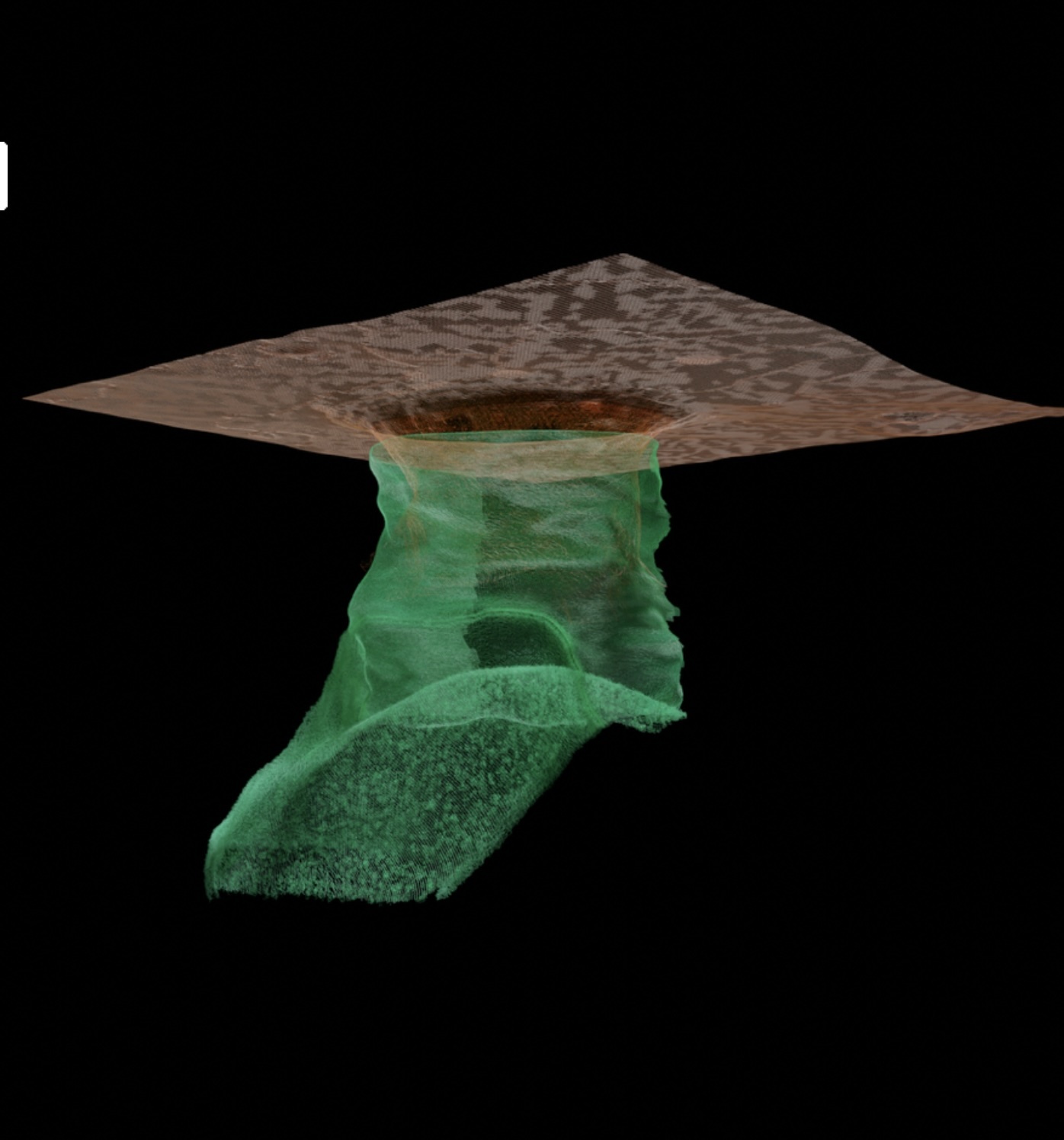
Craters are a familiar sight on the surface of the Moon and many rocky planets in the solar system. Other circular structures can be seen in orbiter images, but these pits are likely the collapsed roofs of lava tubes. A team of researchers has mapped one of these tubes using radar reflections and created the first 3D map of the tube's entrance. Places like these could be ideal locations for establishing research stations, protected from the harsh environment of an alien world.
Lava tubes have been hotly debated for 50 years. They are the result of ancient volcanic activity and are formed when the surface of a lava flow cools and hardens. Beneath, the molten lava continues to move and eventually drains away, leaving behind a hollow tunnel. Studying these tunnels can tell us more about the Moon's geological history through the record preserved in the rocks.
The lava tubes were studied by NASA's Lunar Reconnaissance Orbiter (LRO), which began its journey in 2009. Its goal was to collect information about the Moon's surface and environment, and to that end it had a wealth of scientific equipment. LRO has mapped the lunar surface with high-resolution images that capture temperature, radiation levels, and water ice deposits. All with the goal of identifying possible landing sites for future missions.
Artist's impression of the Lunar Reconnaissance Orbiter (LRO) in orbit. Image credit: ASU/LROC
A team of scientists from all over the world have worked together to make a breakthrough in the study of these tubes. The research was led by the University of Trento in Italy and the results published in Nature Astronomy. They have discovered the first confirmed tunnel just beneath the lunar surface, which appears to be an empty lava tube. Until now, their existence was just a theory, now they are a reality.
The discovery would not have been possible without the LRO and its miniature radio frequency instrument. In 2010, it surveyed Mare Tranquilitatis – the site of Apollo 11's historic moon landing in 1969 – and collected data including the region around a pit. This new research re-analyzed the data using modern complex signal processing techniques. The analysis revealed previously unidentified radar reflections that are best explained by an underground cave or tunnel. Perhaps intriguingly, this is an underground tunnel on the lunar surface, but it is also accessible.
Buzz Aldrin looks out over Tranquility Base during Apollo 11's moonwalk. Photograph by Neil Armstrong. Image credit: NASA
The discovery underscores the importance of continued analysis of historical data, including data from decades ago, to find hidden information that modern techniques can reveal. It also underscores the importance of further remote sensing and orbital lunar exploration to identify more lava tubes as potential safe havens for lunar explorers.
Travelers on the Moon can experience temperatures ranging from 59 degrees on the lit side to -79 degrees on the night side. Radiation from the Sun can reach – pardon the pun – up to 150 times the intensity here on Earth, and that's not even taking into account the threat of meteor strikes. Thanks to the atmosphere, we're protected from thousands of tons of that stuff, but there's no shield on the Moon. If we build structures on the Moon's surface, they'll have to be built to withstand such a hostile environment, but when you look at lava tubes, many of the problems naturally disappear, making it a far safer and more cost-effective way to establish a presence on the Moon.
Source: Existence of a lava tube cave on the moon proven
Like this:
Is loading…
