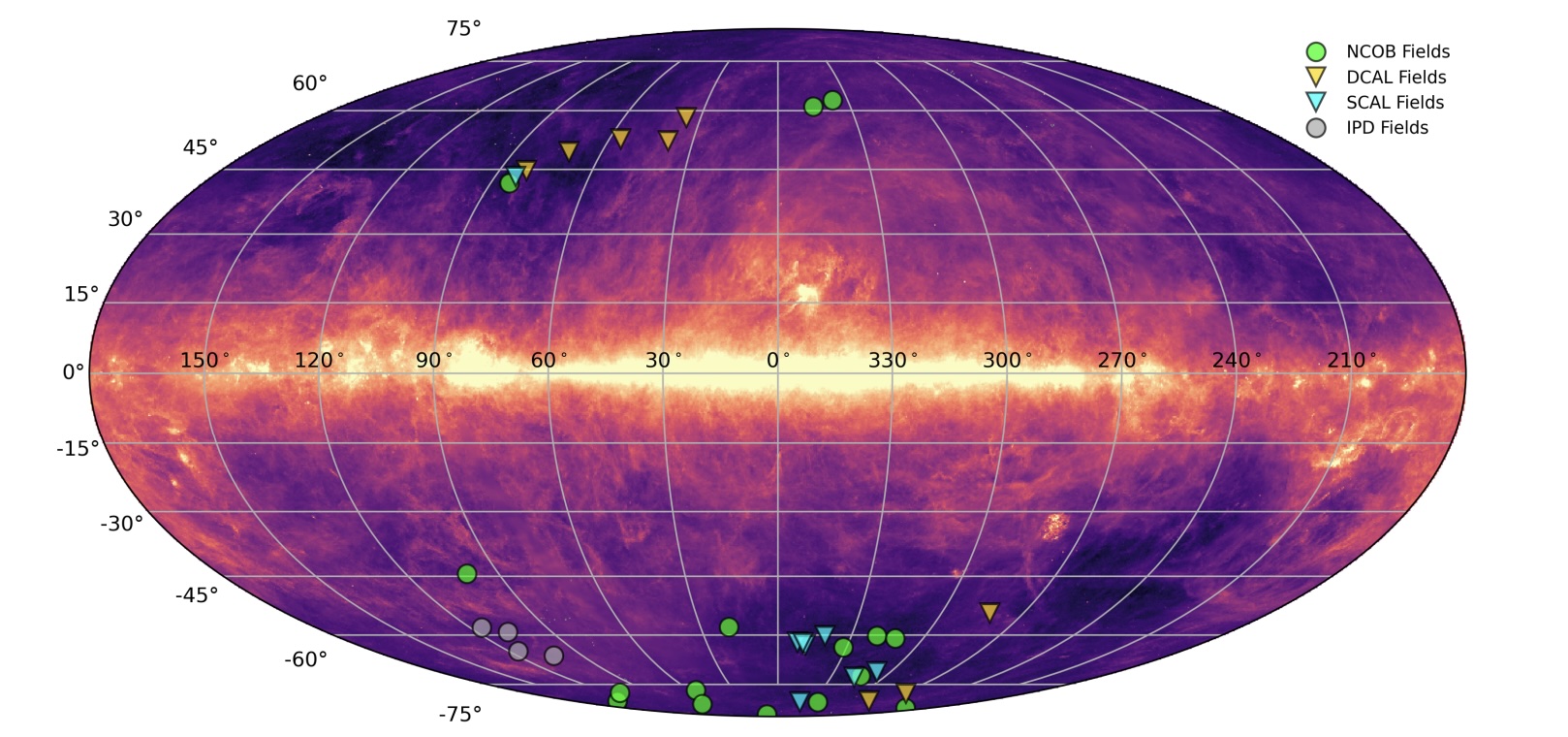
When you think of background radiation, most people immediately think of the cosmic optical background and stories of pigeon droppings during their discovery. But that's another story. It turns out that the universe has multiple background radiations, such as infrared and even gravitational wave backgrounds. NASA's New Horizons is now far enough from the solar system to be in the perfect place to measure the cosmic optical background (COB). Most of this light comes from the stars in galaxies, but astronomers have always wondered if there are other sources of light filling our night sky. New Horizons has an answer. No!
OK, let's talk about pigeon droppings. In 1965, two telecommunications engineers at Bell Laboratory were studying signal interference. Penzias and Wilson detected a faint “hum” in all directions and initially attributed it to pigeon droppings lodged in the horn of the radio receiver. But in fact they had discovered the cosmic background radiation, the faint glow that permeates the entire universe and is the thermal radiation left over from the Big Bang. By studying them, we can learn more about the universe when it was 380,000 years old.
The full sky picture of temperature variations (shown as color differences) in the cosmic microwave background radiation, created from nine years of WMAP observations. These are the seeds of galaxies from a time when the universe was less than 400,000 years old. Image credit: NASA/WMAP
In the late 1980s, another type of background radiation was discovered: the infrared background radiation. It consists of the diffuse infrared glow that fills the universe and comes from numerous sources throughout the history of the universe. It consists mainly of thermal emissions from dust grains heated by stellar radiation. In addition, there is the gravitational wave background radiation, but this has not yet been discovered.
Another hotly debated background is the cosmic optical background (COB), a diffuse light emitted by stars and galaxies that spans the entire visible spectrum. Its study has gained momentum, however, thanks to observations from the Hubble Space Telescope and the Spitzer Infrared Telescope. However, studies have shown that a large contribution to an overall optical background glow comes from faint, unresolved galaxies. Studying the COB allows us to explore the overall energy output of the universe, as well as the formation of galaxies and stars throughout the history of the cosmos.
However, detecting the COB is challenging because Earth-based instruments or even those in Earth's orbit are plagued by interference. Zodiacal light, for example, is caused by the scattering of sunlight by interplanetary dust. It is prevalent in the inner solar system and makes studying the COB difficult. The New Horizons probe is ideally positioned beyond Pluto's orbit, over 8 billion kilometers from interference. On board New Horizons is the Long Range Reconnaissance Imager (LORRI) camera, which has been identified as the ideal platform to begin a search.
The payload of the New Horizons instrument, which is currently conducting planetary science, heliospheric measurements, and astrophysical observations. Image credit: NASA/Johns Hopkins University Applied Physics Laboratory/Southwest Research Institute
Using images from the LORRI camera, a team of astronomers led by Marc Postman of the Space Telescope Science Institute attempted to measure the COB in the range of 0.4 to 0.9 micrometers. The images were taken from high galactic latitudes to ensure there was no diffuse light from the Milky Way or scattered light from bright stars. Isolating the COB's contribution to the sky's overall brightness required digitally subtracting the scattered light from bright stars and galaxies, as well as from faint stars within the field that were dimmer than that detected by LORRI. Interestingly, the results showed that, based on the estimated number of galaxies in the regions studied, the COB is the result of light from all galaxies within our observable region of the universe.
Source: New synoptic observations of the cosmic optical background with New Horizons
Like this:
Is loading…
