The temperature of the sun's corona is at least 100 times higher than that of the sun's surface, even though the corona is far less dense and also extends millions of kilometers from the sun's surface. But why is that? A recent study published in the Astrophysical Journal may now disprove a long-standing hypothesis about the processes responsible for the corona's extreme heat and help them better understand the sun's internal processes. This study could help scientists gain deeper insights into the formation and evolution of our sun, which could also lead to a better understanding of stars throughout the universe.
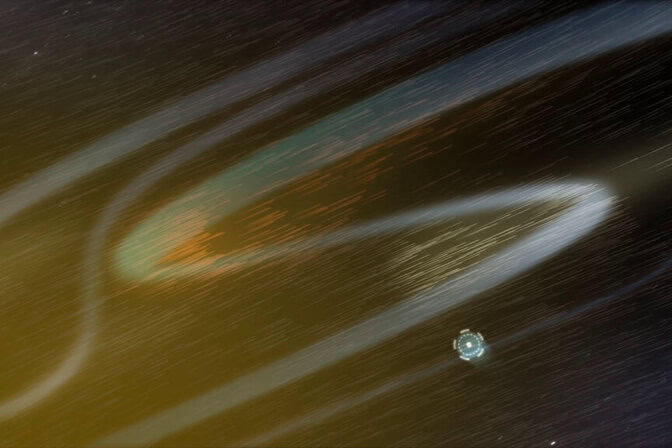
For the study, researchers analyzed data from the first 14 orbits of NASA's Parker Solar Probe around the Sun with the goal of figuring out how the magnetic field causes S-shaped bends, often called magnetic serpentines because they cause sudden reversals of the magnetic field's direction. The goal of the study was to determine the source of the serpentines, which are known to store energy from the magnetic field, to better understand how they could potentially heat the corona and solar wind.
“This energy has to go somewhere and could help heat the corona and accelerate the solar wind,” said Dr. Mojtaba Akhavan-Tafti, assistant scientist in climate and space science and engineering at the University of Michigan and lead author of the study.
The debate about the origin of the serpentines has been going on in the scientific community for some time, with scientists currently favoring two possible hypotheses: either the serpentines have their origin in the curvature of the magnetic field due to the extreme activity of the solar wind that occurs behind the corona, or they originate from the surface of the Sun.
The results of the study show that serpentines do not originate from the surface of the Sun, which the researchers attribute to the small number of serpentines within the corona. On the other hand, if the surface of the Sun were the origin of the serpentines, it is assumed that the number of serpentines within the corona would be much larger. The results of the study therefore rule out one of the two competing hypotheses regarding the origin of the serpentines in the Sun.
“Our theory could bridge the gap between the two schools of thought on S-shaped serpentine formation mechanisms,” said Dr. Akhavan-Tafti. “Although they must be formed outside the corona, there could be a triggering mechanism within the corona that causes the formation of serpentines in the solar wind.”
He adds: “The mechanisms that lead to the formation of the serpentines and the serpentines themselves could heat both the corona and the solar wind.”
The study of the reversal of the Sun's magnetic field dates back to the 1970s, when the two German-American Helios spacecraft, Helios-1 and Helios-2, observed this reversal behavior when Helios-2 was just over 43.432 million kilometers (26.99 million miles) from the Sun and Helios-1 was 3 million kilometers (1.9 million miles) behind. This distance record was broken by the Parker Solar Probe in October 2018, and has since reached a staggering distance of 7.26 million kilometers (4.51 million miles) from the Sun, reached in September 2023.
The Helios missions were followed by the first observations of serpentines by the NASA/ESA Ulysses spacecraft, which studied the southern and northern polar regions of the Sun in 1994 and 1995, respectively. More recently, remnants of serpentines were observed by the ESA/NASA Solar Orbiter spacecraft in September 2020, when the spacecraft was just over 146 million kilometers (91 million miles) from the Sun.
As mentioned above, discovering the origin of the serpentines could help scientists better understand the Sun's internal processes, particularly the behavior of the solar wind, which contributes to space weather and can cause massive damage to Earth-orbiting satellites and electronic ground stations.
What new discoveries will scientists make in the coming years and decades about the origins of the Sun's serpentine patterns? Only time will tell, and that's why we do science!
And as always, keep doing science and keep looking up!
Like this:
Is loading…
