
Scientists develop novel technique to detect supermassive black holes: Use smaller black holes!

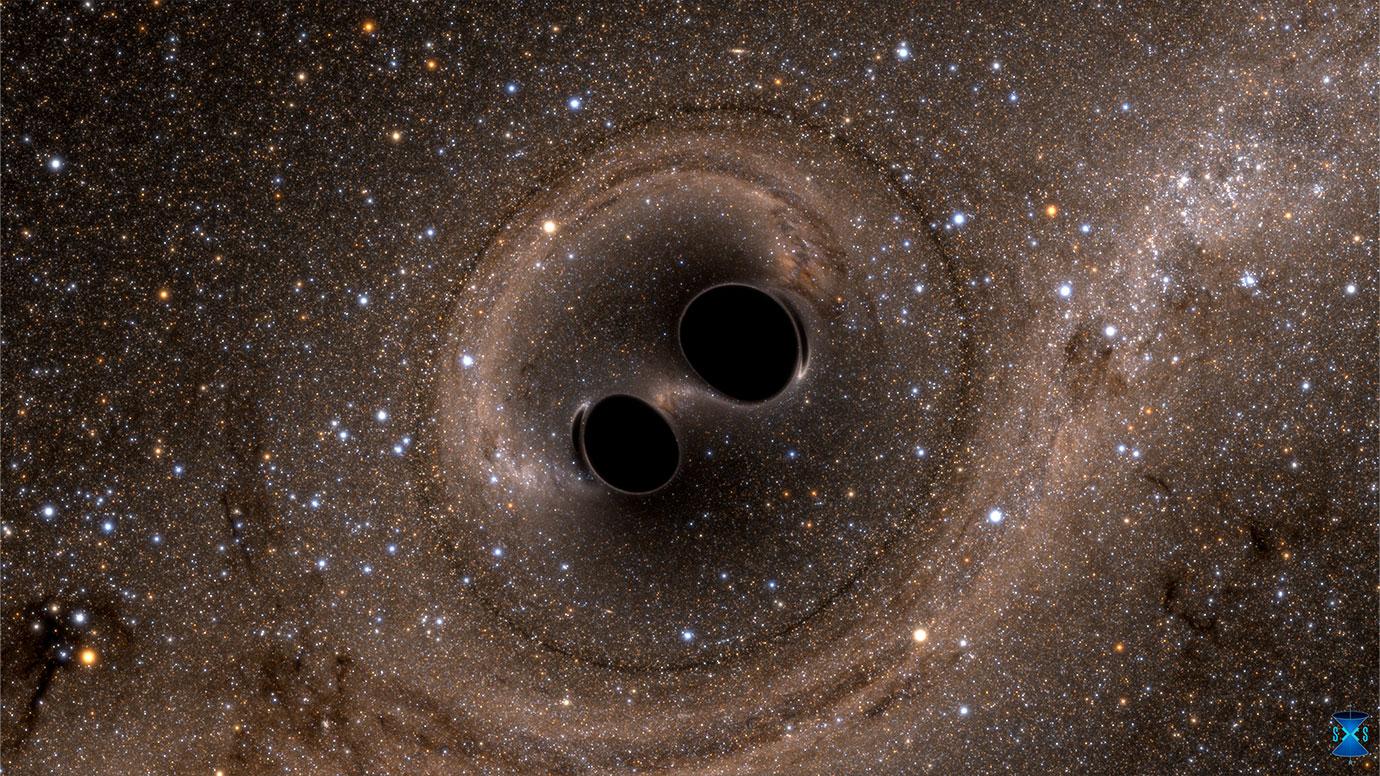
In 1974, astronomers Bruce Balick and Robert L. Brown discovered a powerful radio source at the center of the Milky Way. The source, Sagittarius A*, was later found to be a supermassive black hole (SMBH) with a mass of over 4 million suns. Since then, astronomers have found that SMBHs are located at the center of all galaxies with highly active central regions called active galactic nuclei (AGNs) or “quasars.” Despite what we have learned, the origin of these massive black holes remains one of astronomy's greatest mysteries.
The most common theories suggest that they could have formed when the universe was very young, or that they grew over time by consuming the matter around them (accretion) or by merging with other black holes. In recent years, research has shown that gravitational waves (GW) are released during mergers between such massive objects. In a recent study, an international team of astrophysicists has proposed a novel method to detect SMBH pairs: analyzing gravitational waves generated by binary systems of closely spaced small stellar black holes.
The study was led by Jakob Stegmann, a research associate at the Max Planck Institute for Astrophysics (MPA) and the Gravity Exploration Institute at Cardiff University. He was joined by researchers from the Niels Bohr Institute, the Center for Theoretical Astrophysics and Cosmology at the University of Zurich (CTAC-UTZ) and the California Institute of Technology (Caltech). The study describing the team's findings, “Imprints of massive black-hole binaries on neighboring decihertz gravitational-wave sources,” recently appeared in Nature Astronomy.
First detected in 2015 by scientists at the Laser Interferometer Gravitational-Wave Observatory (LIGO), gravitational waves (GW) are ripples in spacetime caused by the merging of massive objects such as white dwarf stars and black holes. While several signals have been detected involving binary pairs of merging black holes, no GW events have been detected involving SMBHs because current Earth-based detectors are not sensitive to the very low frequency these events emit. Similar to the problems faced by Earth-based observatories, scientists hope to remedy the situation by developing space-based instruments.
This includes the planned Laser Interferometer Space Antenna (LISA), an ESA-led mission scheduled for launch in 2035. Unfortunately, it will still be impossible to detect mergers of the largest black holes in the Universe. However, Stegmann and his colleagues propose that binary SMBHs can be detected by analyzing the gravitational waves produced by smaller binary stars. Their proposed method takes advantage of the subtle changes that SMBHs cause to the gravitational waves emitted by a pair of neighboring smaller black holes.
In this respect, binary stars of small black holes act as beacons that reveal the existence of larger pairs of merging black holes. Stegmann explained this in a recent UHZ press release:
“Our idea basically works like listening to a radio station. We propose to use the signal from pairs of small black holes, similar to how radio waves transmit the signal. The supermassive black holes are the music encoded in the frequency modulation (FM) of the detected signal. The novel aspect of this idea is to use high frequencies, which are easy to detect, to study lower frequencies that we are not yet sensitive to.”
Artist's impression of the Laser Interferometer Space Antenna (LISA). Image credit: ESA
However, the evidence provided by this proposed method would be indirect, coming from the background noise produced jointly by many distant binary stars. In addition, a deci-Hz gravitational wave detector is needed, which is far more sensitive than current instruments. For comparison, the LIGO detector measures gravitational waves in the range 7.0 kHz to 30 Hz, while the Virgo Observatory can detect waves in the range 10 kHz to 30 Hz. 1Range from 0 Hz to 10,000 Hz. By detecting the tiny modulations in the signals from small black hole binaries, scientists have been able to identify merging black binaries with masses ranging from 10 to 100 million solar masses, even at great distances.
Lucio Mayer, a black hole theorist at the University of Zurich and co-author of the study, added:
“With the path now set for the Laser Interferometer Space Antenna (LISA) following its adoption by ESA last January, the community needs to evaluate the best strategy for the next generation of gravitational wave detectors, in particular which frequency range they should target – studies like this provide a strong incentive to favor a deci-Hz detector design.”
Further reading: UZH, Nature Astronomy
Like this:
Load…

Comments are closed.