

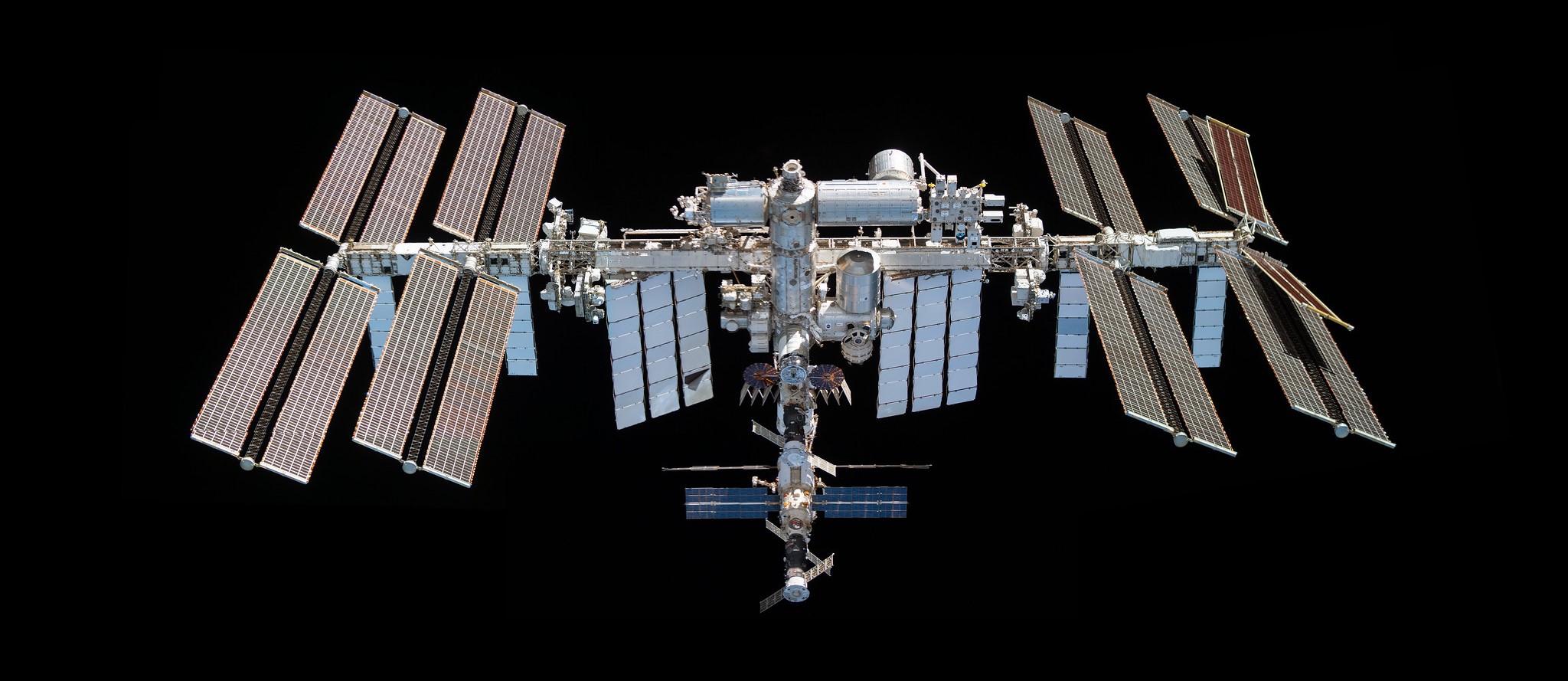
Since archaeology deals with human prehistory, it seems inappropriate to use its methods to study human behavior in space. But that is exactly what the astronauts on board the International Space Station are doing.
The ISS was designed with the goal of being tailored to specific tasks and needs. Living areas such as latrines, exercise rooms, and food preparation and dining areas are designed to make the space station an effective and pleasant place to work and live. But it's impossible to get these things right in any one facility. The people who end up working and living on the ISS will find their own ways to use the spaces, which may not be consistent with the intended purpose.
To understand how astronauts really use the spaces on the ISS, astronauts have adapted methods from archaeology. A team led by Justin Walsh of Chapman University in California had astronauts on the ISS take daily photographs to see how different areas of the station are really used. They published their results in a study titled “Archaeology in Space: The Sampling Quadrangle Assemblages Research Experiment (SQuARE) on the International Space Station. Report 1: Squares 03 and 05” in the journal PLOS One.
SQuARE is part of the International Space Station Archaeological Project (ISSAP).
“ISSAP aims to fill a gap in the social science study of the human experience of long-duration spaceflight. As the largest and most densely inhabited space station to date, with over 270 visitors from 23 countries during more than 23 years of continuous occupation, the International Space Station (ISS) is the ideal example of a new kind of space community – 'a micro-society in a mini-world,'” the authors explain.
“Our main goal is to find out how humans adapt to life in a new environment that our species is not designed for, an environment characterized by isolation, confinement and, above all, microgravity,” the researchers write. Microgravity is particularly interesting. Its advantages are the ability to work and move in 360 degrees and to conduct experiments that are impossible on Earth. The downside is that anything that is not constrained simply floats away.
According to the authors, this is the first time archaeological fieldwork has been conducted in space. SQuARE had four goals:
- The aim is to develop a new understanding of how humans adapt to life in an environmental context for which they are evolutionarily unsuited, using evidence from observation of material culture.
- Identifying discrepancies between planned and actual use of facilities on a space station;
- Developing and testing techniques that enable remote archaeological research; and
- The aim is to demonstrate the relevance of social science methods and perspectives for improving life in space.
SQuARE has adapted a method archaeologists use to investigate archaeological sites: the so-called shovel test pit. Shovel test pits are shallow pits dug in a grid over a site to see what artifacts might be underground. They are used in the first phase of an archaeological investigation and help scientists determine where to dig deeper in subsequent phases.
Of course, no one is digging actual holes in the space station. Instead, the ISS crew took photos of six locations on the ISS every day for 60 days – between January and March 2022 – to determine how they are being used. These images go beyond interviewing astronauts to see how they are adapting to such an unusual work/life situation. The human mind being what it is, interviews can leave out details that may seem irrelevant but are actually insightful.
The research article in PLOS One concerns two of the six areas: the latrines/training equipment area and the maintenance area.
This cross-sectional image of the International Space Station's U.S. orbital segment shows the locations of Square 03 (top center, in yellow) and 05 (bottom right, in orange). Square 03 is the maintenance area and Square 05 is the latrine/exercise area. Image credit: Walsh et al. 2024.
“Using the photographs and an innovative web tool, we identified 5,438 objects and labeled them by type and function,” the authors explain in their research article. The “artifacts” in the images included sticky notes, writing utensils, and an augmented reality headset. The research also includes activity reports from astronauts, which enabled chronological cross-referencing.
This image shows Square 03 in the starboard maintenance area of the International Space Station. On the right is an open crew station. Researchers developed an image analysis platform to process the images and identify artifacts. Image credit: Walsh et al. 2024.
The findings show that an area near the latrine/exercise room was used without an intended purpose for storing toiletries, resealable bags and a rarely used computer. The maintenance area was repurposed. No maintenance work was carried out there and the space was used primarily for storage.
This image shows square 05, the restroom/exercise area. The Advanced Resistive Exercise Device is located on the top right wall. The treadmill with Vibration Isolation Stabilization System is located outside of the image on the left. The waste and hygiene compartment is located directly behind the photographer. Image credit: Walsh et al. 2024.
“One of the project's goals is to understand cultural adaptations to microgravity,” the authors explain in their study. They were particularly interested in what they call “gravity surrogates,” simple objects used to keep things in place. On Earth, we can just put a pen on our desk and it stays there until we need it again. But in microgravity, astronauts have to adapt.
The image of Square 05 shows an example of how astronauts adapt to their environment in unforeseen ways. The blue bar is a metal handrail that helps astronauts move around the ISS. However, as NASA admits, “they also serve as convenient places to temporarily attach, fasten, or secure loose equipment and as attachment points for equipment.” The blue bar is just one of many examples of things with other uses that serve as restraints in microgravity.
This figure from research shows the number and type of artifacts in Square 03. Shackles are the most common objects. Image credit: Walsh et al. 2024.
SQuARE shows how spaces are being used for other purposes. Space 03 was intended for maintenance work, but is now being used for other purposes. “But most of the time no one worked here – a fact that cannot be seen in historical photos of the area because nothing happens there,” explain the authors.
Instead, it is used as a pegboard, the kind that would be mounted on a wall in a house. It is a handy place to store all kinds of items, some of which are not even used in the room because there are so many mounting points.
The authors say their work provides “insights into material culture” and that their results could be used in the design of future spacecraft. They could also help them study the remaining squares more effectively.
“The experiment is the first archaeological investigation ever conducted outside planet Earth. By applying a very traditional method of sampling in a completely new archaeological context, we show how the ISS crew uses different areas of the space station in ways that deviate from the designs and mission plans. Architects and planners of future space stations can gain valuable insights from this work,” the researchers concluded.
Like this:
Load…

Comments are closed.