

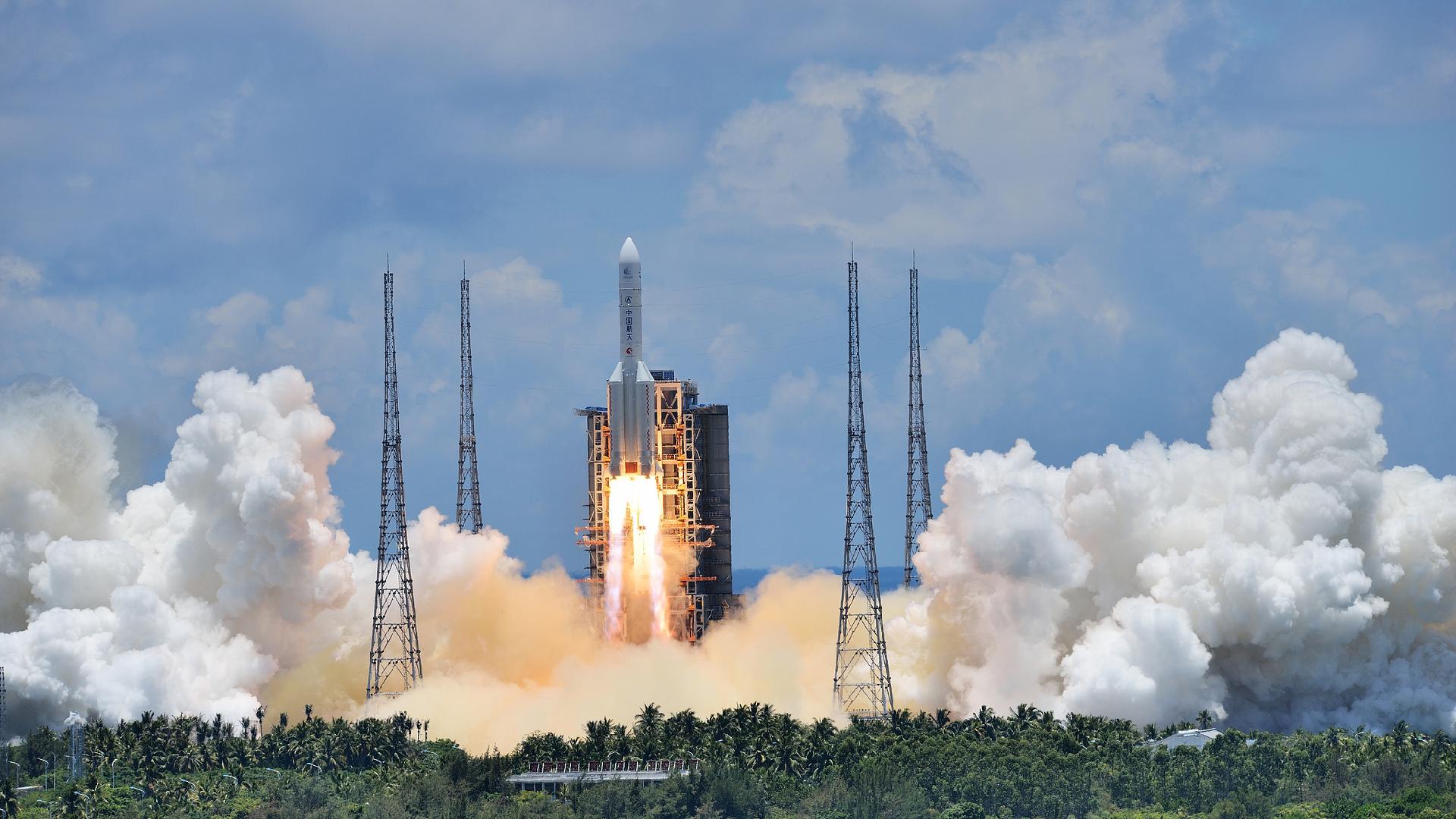
While NASA's Mars Sample Return mission has suffered a setback, China continues to move forward with its plans to bring a piece of the Red Planet home. This week, officials from the China National Space Administration (CNSA) announced that their sample return mission, called Tianwen-3, will launch to Mars in 2028. It will land on the surface, collect a sample, and then lift off and dock with a return vehicle in orbit. They also announced another mission, Tianwen-4, will head to Jupiter in 2030, and unveil a concept plan for China's first mission to test defenses against a near-Earth asteroid.
The announcements were made this week at the second International Deep Space Exploration Conference, also known as the Tiandu Forum, in China. China says the conference will promote international cooperation for future large-scale missions.
As reported by CGTN, the English-language news channel of state-run China Global Television Network, Mars sample return mission chief planner Liu Jizhong said the Tianwen-3 mission will include international payloads and China plans to share samples and data from the mission with scientists around the world. Liu also said the primary scientific goal of the Mars sample return mission will be to search for signs of life.
This “group photo” of China's Tianwen-1 lander and rover on the Martian surface was taken with a wireless camera. Image credit: China National Space Administration
China's first Mars exploration mission, Tianwen-1, reached Mars in February 2021 and included an orbiter, a lander and a rover named Zhurong. The orbiter photographed the entire surface of Mars and the rover found hydrated minerals likely associated with groundwater. With this achievement, China became the third nation to successfully land a spacecraft on the surface of Mars.
While coverage of Liu's speech did not reveal many details of the planned Mars mission, a paper published in fall 2023 by the China Academy of Space Technology proposed a quadcopter similar to NASA's Ingenuity that would be able to collect a sample weighing up to 100 grams and return it to a lander. Since the Zhurong rover mission is complete and failed to collect samples for return to Earth, the new Tianwen-3 mission would need to involve the entire collection of spacecraft that would land, collect and store the samples, then launch into orbit to return and dock with an orbiting spacecraft that would then return to Earth and somehow drop off or land the samples.
A Chinese flag flies next to the Chang'e-6 sample return capsule after its landing in Inner Mongolia. (Source: CCTV / CNSA via Weibo)
But China recently accomplished this feat on the moon with the Chang'e-6 mission launched in early May. It was the first robotic mission to land and take off from the far side of the moon, and the first mission to bring soil and rocks from the far side to Earth. With Chang'e-5, the lander also placed on the front side of the moon and brought back samples.
Meanwhile, NASA's proposal for a Mars sample return mission has been shelved for the time being as costs rose and the schedule became increasingly tight, leading to a budget crunch. NASA is now revising its plan for a simpler, less expensive and less risky alternative. The Perseverance rover has already collected and cached several samples for return.
This graphic shows China's lunar exploration program. Image credit: CASC
China has actively announced its plans for upcoming space missions, including the asteroid mission, the Mars sample return mission, and the mission to Jupiter. In addition to its ambitious robotic missions, the CNSA announced in 2021 that it plans to send its first manned mission to Mars in 2033, with the goal of sending regular missions to Mars and eventually establishing a base there. China also has the Tiangong space station, which currently hosts three astronauts for six-month stays.
However, Liu said efforts to include international payloads, share samples and data – as well as joint planning of future missions – “should enhance global synergy in the field of space exploration.”
China has approved four planetary exploration missions to be completed within 10 to 15 years. The Tianwen-2 mission to a currently unnamed asteroid is scheduled to launch around 2025, and Tianwen-4 to explore Jupiter is scheduled to launch around 2030.
Like this:
Load…

Comments are closed.