

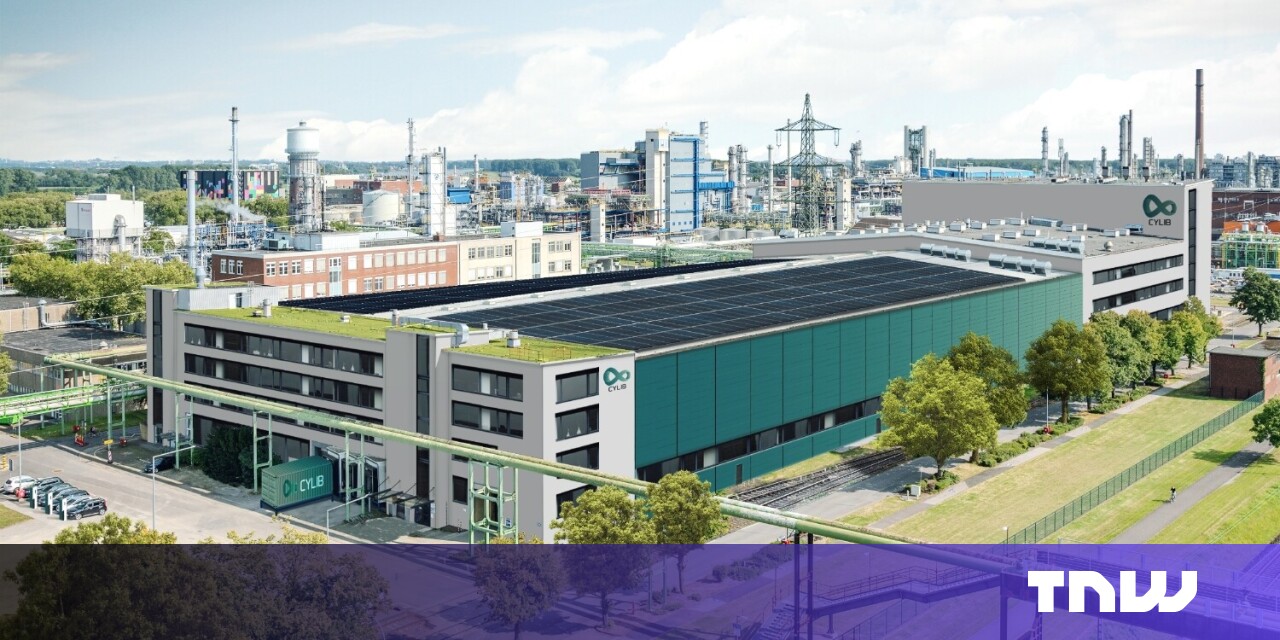
German startup Cylib has started building its first industrial-scale battery recycling plant, just months after raising €55 million in the largest funding round for a European battery recycling company.
The state-of-the-art facility in the Chempark on the outskirts of Düsseldorf, will cover the size of three football fields. Once the plant goes into operation in 2026, it is expected to recycle 30,000 tons of electric vehicle batteries annually.
For context: The average EV battery weighs about 500 kg, so Cylib's plant will be able to process about 60,000 EV batteries per year. That's far more than Europe's current largest plant of its kind, Hydrovolt in Norway – a joint venture between Northvolt and Norwegian renewable energy company Hydro – which has a capacity of 12,000 tonnes per year.
Founded in 2022, Cylib has developed an end-to-end battery recycling process that recovers all critical raw materials from EV and micromobility batteries. This includes key elements such as lithium, cobalt, nickel, aluminum and manganese, as well as scrap metal and black mass.

The
The latest gossip from the EU tech scene, a story from our wise old founder Boris and questionable AI art. Free in your inbox every week. Sign up now!
Batteries arriving at Cylib's new facility are discharged, disassembled and then undergo three treatments – mechanical, thermal and water-based – to separate all the important materials. This sets Cylib apart from competitors who usually only extract a few key elements from old batteries. By processing all of the batteries, Cylib can also sell them all.
The company's founders – Dr. Lilian Schwich, Paul Sabarny and Dr. Gideon Schwich – founded Cylib after a decade of battery recycling research at RWTH Aachen University. The partners claim that their battery recycling method uses 30% less energy than the competition.
Securing the EV battery supply chain
Cylib’s pitch was obviously strong enough to attract some big investors, including Porsche, Bosch Ventures and World FundIn May, the company raised €55 million in a Series A funding round, which it will use to build its new factory and expand its team of 70 employees.
In total, Cybil and its backers are investing more than 180 million euros in the facility, according to CNBC.
As Porsche's investment suggests, Cylib is targeting electric car manufacturers as its main customers. The company's plant could provide automakers in Europe with a local source of key metals they need to make new batteries, eliminating the need to mine new materials.
““Achieving industrial production of Cylib will be a key factor in building a robust European battery infrastructure,” said Schwich, the company’s CEO..
As Europe electrifies, battery recycling is becoming an increasingly important priority for policymakers. In May, the EU's draft Critical Raw Materials Act (CRMA) came into force. The law aims to ensure a sustainable supply of critical raw materials that is not dependent on foreign powers.
The CRMA includes provisions that will allow battery recycling companies easier access to financing, an accelerated approval process and the matching of off-takers. The European Commission is expected to award funds for the first projects by the end of 2024.

Comments are closed.