

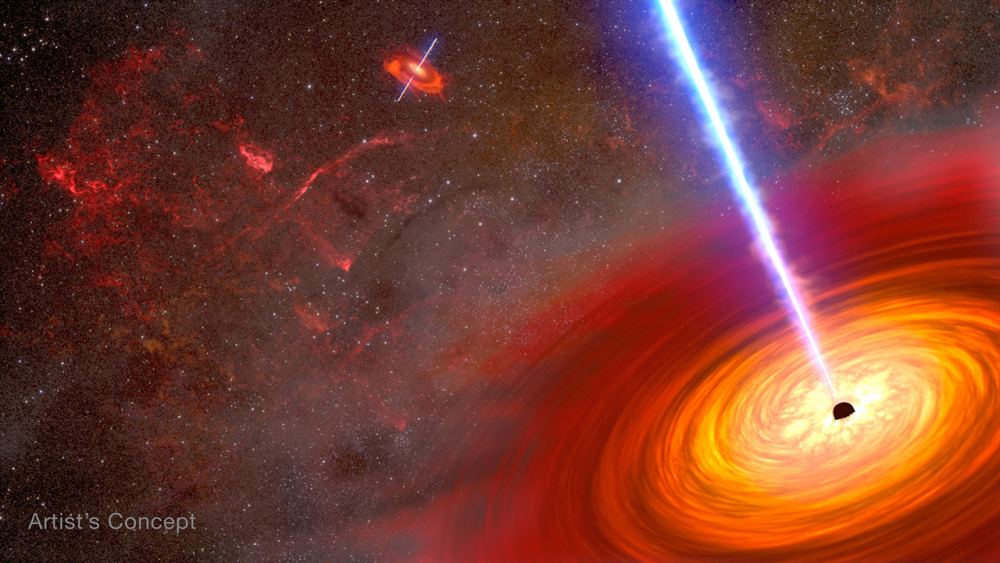
Galaxy collisions are fundamental events in the universe. They happen when two systems mix stars in a cosmic dance. They also cause spectacular mergers of supermassive black holes. The result is a very altered galaxy and a single, ultramassive black hole.
These colossal events are a major driving force for the evolution of galaxies. In this way, smaller galaxies merge to form ever larger ones. Such mergers have been occurring since the earliest epochs of cosmic time. Galaxy mergers are still ongoing today. Our Milky Way continues to devour smaller galaxies and will collide with the Andromeda Galaxy in a few billion years. When that happens, the supermassive black holes of both galaxies could also merge.
View of Milkdromeda from Earth “shortly” after the galactic merger of the Milky Way and the Andromeda Galaxy, in about 3.85 to 3.9 billion years. Image credit: NASA, ESA, Z. Levay and R. van der Marel (STScI), T. Hallas and A. Mellinger
We can't observe the entire process from start to finish, as it takes millions of years. But that doesn't stop astronomers from looking for – and finding – evidence of galaxy-supermassive black hole collisions. In the latest discovery, the Hubble Space Telescope (HST) spotted three bright, visible “hotspots” deep inside a colliding pair of galaxies. These targets are relatively close to us – only about 800 million light-years away. Astronomers followed this with Chandra observations and radio data from the Karl G. Jansky Very Large Array.
Usually, galaxies with bright nuclei, called “active galactic nuclei” (AGN), exist at very large distances. They are often visible earlier in cosmic time. The opportunity to study a galaxy and a pair of supermassive black holes in collision in the “modern” nearby Universe is a good time to study the mechanics of such an event.
Detecting incipient collisions of supermassive black holes
The discovery of a future cosmic collision came when the HST's Advanced Camera for Surveys spotted three optical diffraction spikes in the heart of a colliding galaxy called MCG-03-34-64. Two of these “hotspots” appear to be very close to each other – only about 300 light-years apart. They indicate the presence of oxygen gas in the core. It is being ionized by something very energetic, and the hotspots surprised astronomers. (The third hotspot is not yet well studied.) “We were not expecting to see anything like this,” said Anna Trindade Falcão of the Center for Astrophysics | Harvard & Smithsonian in Cambridge, Massachusetts. “This sight is not a common phenomenon in the nearby universe, and it showed us that there is something else going on inside the galaxy.”
HST image of the galaxy MCG-03-34-064 in visible light. Two of the three bright spots in the core are active galactic nuclei, which are sources of light and X-rays. They indicate two supermassive black holes about 300 light-years apart and moving ever closer. Image credit: NASA, ESA, Anna Trindade Falcão (CfA)
Falcão and her colleagues wanted to know what was causing these bright spots, so they used the Chandra X-ray Observatory to study what was happening. “When we looked at MCG-03-34-64 in X-rays, we saw two separate, powerful sources of high-energy radiation that coincided with the bright optical spots observed with Hubble. We put these pieces together and concluded that we were probably looking at two supermassive black holes that were close together,” said Falcão.
The team also found observations of these objects in archived radio telescope data. These strong radio emissions proved that the pair of black holes exists and is getting closer and closer. “When you see bright light in optical, X-ray and radio wavelengths, you can rule out a lot of things, so you conclude that these can only be explained by black holes being close to each other,” Falcão noted. “When you put all the pieces together, you get the picture of the AGN duo.”
The impending collision
These central supermassive black holes will collide in perhaps a hundred million years. Each one is located at the core of a single galaxy. As these galaxies move closer together, the black holes at their hearts will begin to interact. Eventually, they will merge in a massive event, emitting gravitational waves.
This image shows the merger of two supermassive black holes and the gravitational waves propagating outward as the black holes spiral toward each other. Image credit: LIGO/T. Pyle
Astronomers suspect (based on simulations and observations) that mergers of galaxies with supermassive black holes trigger high activity. As the collisions progress, interstellar gas flows toward the galactic centers. It is also compressed in other regions, and both activities trigger bursts of star formation. Some gas also accumulates on these central supermassive black holes, leading to increased emissions as the material spirals through the accretion disk.
Such mergers occur all the time in the Universe. Models of galaxy evolution and observational data suggest that many AGNs in the hearts of galaxies undergo mergers. Colliding pairs of supermassive black holes within these AGNs also suggest that these black holes grow by mergers.
Collisions of supermassive black holes and future discoveries
Understanding the merger of closely spaced AGNs like those in MCG MCG-03-34-64 provides a unique insight into the final stages of what astronomers call the “SMBH binary coalescence.” Such events remain an important way to measure the effects of these mergers and will provide a rich field of research with observatories sensitive across the spectrum of light, as well as with future gravitational wave detectors.
LISA will directly observe a passing gravitational wave created by the collision of two supermassive black holes by using its high-precision measurement system to measure the tiny changes in distance between freely falling proof masses inside the spacecraft. Image credit: AEI/MM/exozet
These discoveries will require advanced versions of the Laser Interferometer Gravitational-Wave Observatory (LIGO), which made its first discoveries just a few years ago. Gravitational waves created by the merger of supermassive black holes will be the target of future instruments such as LISA (short for Laser Interferometer Space Antenna), which will use three space-based detectors millions of kilometers away to detect the long-wavelength gravitational waves emitted when giant black holes like the one in MCG-03-34-64 collide. Since such mergers occur throughout the universe, this will be a rich area of research that will contribute significantly to our understanding of galaxy mergers as part of cosmic evolution.
More information
Hubble and Chandra discover duo of supermassive black holes
Resolution of a candidate for a dual active galactic nucleus with ~100 pc separation in MCG-03-34-64
Like this:
Load…

Comments are closed.