

The dwarf planet Ceres is the largest planetary body in the asteroid belt. For a long time, scientists believed that it formed in the outer solar system and then migrated to its current position. Some evidence for this origin is extensive surface deposits of ammonium-rich material on Ceres' surface.
Some of these bright white and whitish-yellow deposits have been found in impact craters on Ceres. Researchers suspect they are the remains of brine that seeped to the surface from a layer of fluid between the mantle and crust. When impacts struck the planet, they altered its surface, exposing and splashing material from the brine layer. Images and observation data from NASA's Dawn mission from an impact region called Consus Crater also show bright yellowish-white deposits. Thanks to a closer analysis of the Dawn data, their presence may now indicate Ceres' origin in the asteroid belt.
NASA's Dawn spacecraft captured this near-color image of Ceres in 2015 as it approached the dwarf planet. Dawn showed that some polar craters on Ceres contain ancient ice, but new research suggests the ice is much younger. Image credit: NASA / JPL-Caltech / UCLA / MPS / DLR / IDA / Justin Cowart
A look inside Ceres
Ceres is classified as a dwarf planet and its rocky composition is very similar to that of carbonaceous chondrite asteroids. At least a quarter of its mass is water ice. The surface is quite complex and consists of carbon-rich rocks and so-called ammoniacal phyllosilicates, minerals that include familiar substances such as talc and mica. There is also evidence of water ice in various surface regions.
This dwarf planet is an active world, with much of its activity driven by cryovolcanism. The surface was formed by impacts. The thick outer crust lies above a salty fluid (the brine layer) and a muddy mantle. There is much evidence that the concentration of ammonium is higher in deeper layers of the crust. The few places on Ceres' surface where these distinct yellowish-bright patches can be seen are in and near the Consus crater and in other deep craters.
Planetary scientists have long wondered where exactly Ceres formed. If it formed in the outer solar system, it must have migrated into place billions of years ago. If it formed in situ, the question is how it could have become enriched with the icy, ammonium-rich materials.
A cross-section image showing the surface and interior of the dwarf planet Ceres. Thick outer crust (ice, salts, hydrated minerals), salt-rich liquid (brine) and rocky mantle (hydrated rock). Courtesy: NASA/JPL-Caltech/UCLA/MPS/DLR/IDA
Notes on the birthplace of Ceres
Why are there different assumptions about where Ceres formed? To find an answer, let's take a closer look at these ammonium-rich deposits. They tend to form in very cold environments. That's why Ceres was thought to have formed in the outer solar system. That's where frozen ammonium ice is most stable. In warmer environments (like closer to the Sun) it evaporates. So it makes sense to assume that Ceres formed in a colder place and then somehow migrated into the asteroid belt.
However, if the ice were part of a rocky planetesimal, the location might not be so important. Inside the rock, the ice would be insulated from the sun's heat. Such world-building materials exist closer to the sun and certainly out in the asteroid belt. So if they coalesced in place to form Ceres, their trapped ice would have contributed to the subsurface brine layer that feeds cryovolcanism today. Impacts penetrating the surface would also release the brine.
Connecting the dots
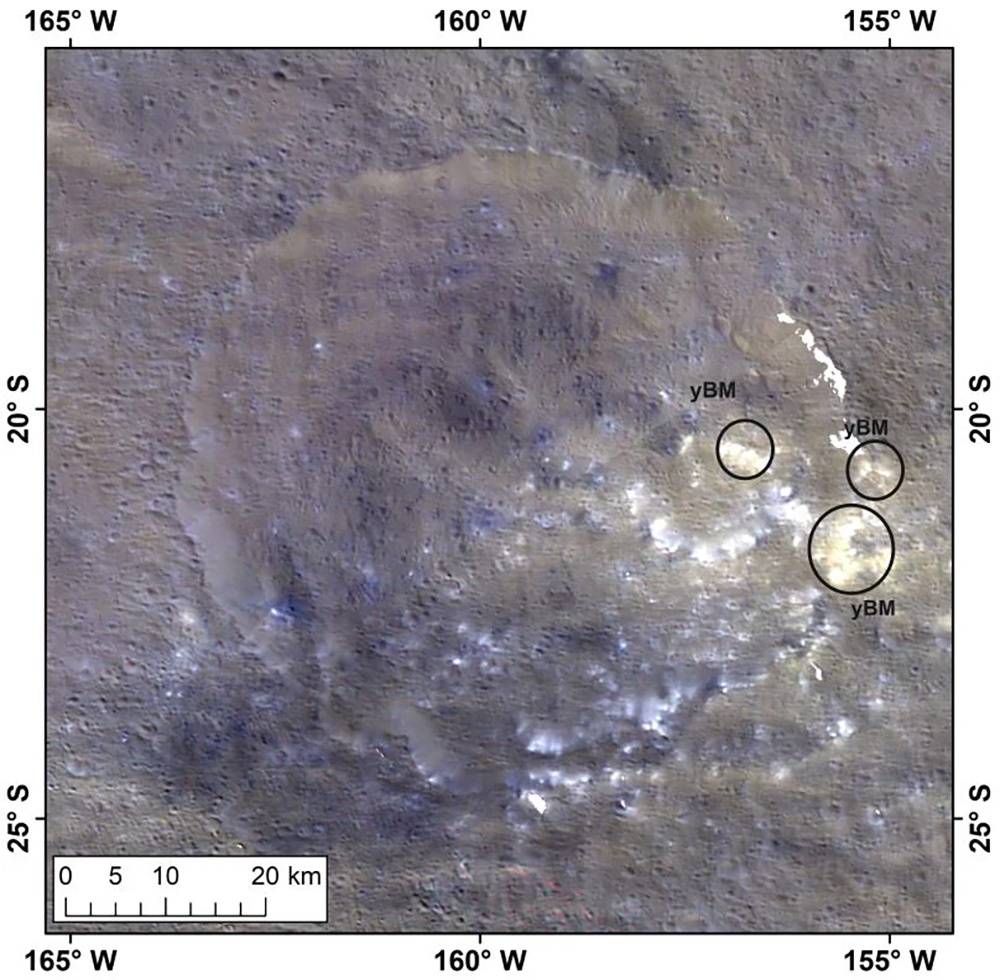
A team led by Andres Nathues and Ranjan Sarkar (both Dawn mission scientists) focused on materials sprayed over the surface in the area of Consus Crater. It lies in Ceres' southern hemisphere and extends for 64 kilometers. The crater walls are about 4.5 kilometers high and are partially eroded. Inside, on the eastern half of Consus, there is a smaller crater. Its rims appear to be “painted” with patches of bright yellow material that was also sprayed nearby.
Further analysis of the Dawn data links the ammonium on the surface to the salty brine from Ceres' interior. Cryovolcanic activity on this world carries the ammonium-rich brine to Ceres' surface. Once there, it seeps into the crust, said Andreas Nathues, former lead researcher on the Dawn mission. “The minerals in Ceres' crust may have soaked up the ammonium like a kind of sponge over many billions of years,” said Nathues.
Nathues and others argue that the dwarf planet's origin may not have been in the outer solar system, based solely on the presence of these ammonium-rich deposits. As mentioned above, they could have been part of the planetesimals in the asteroid belt that coalesced to form Ceres. After its formation, Ceres was subjected to impacts and cryovolcanism, and these actions produced the surface deposits we see today.
Evidence from the craters
Consus Crater itself was “excavated” by a massive impact 400 to 500 million years ago. This event exposed material from deep below, particularly the ammonium-rich layers beneath Consus Crater. A later impact about 280 million years ago created the smaller crater inside. The yellowish-bright patches east of the smaller crater are material ejected in the second event. If this material has always been present inside Ceres, then it supports the idea that this dwarf planet formed where it is today, rather than at the edge of the solar system. This is where the impacts become important, as this action exposed deeper layers, said Dawn researcher Ranjan Sarkar.
“At 450 million years old, the Consus crater is not particularly old by geological standards, but it is one of the oldest structures still in existence on Ceres,” says Sarkar. “Due to its deep cavity, it gives us insight into processes that have taken place inside Ceres over many billions of years and is thus a kind of window into the past of the dwarf planet.”
More information
Dwarf planet Ceres: origin in the asteroid belt?
Consus crater on Ceres: exchange of ammonium-enriched brines with phylosilicates?
Like this:
Load…

Comments are closed.