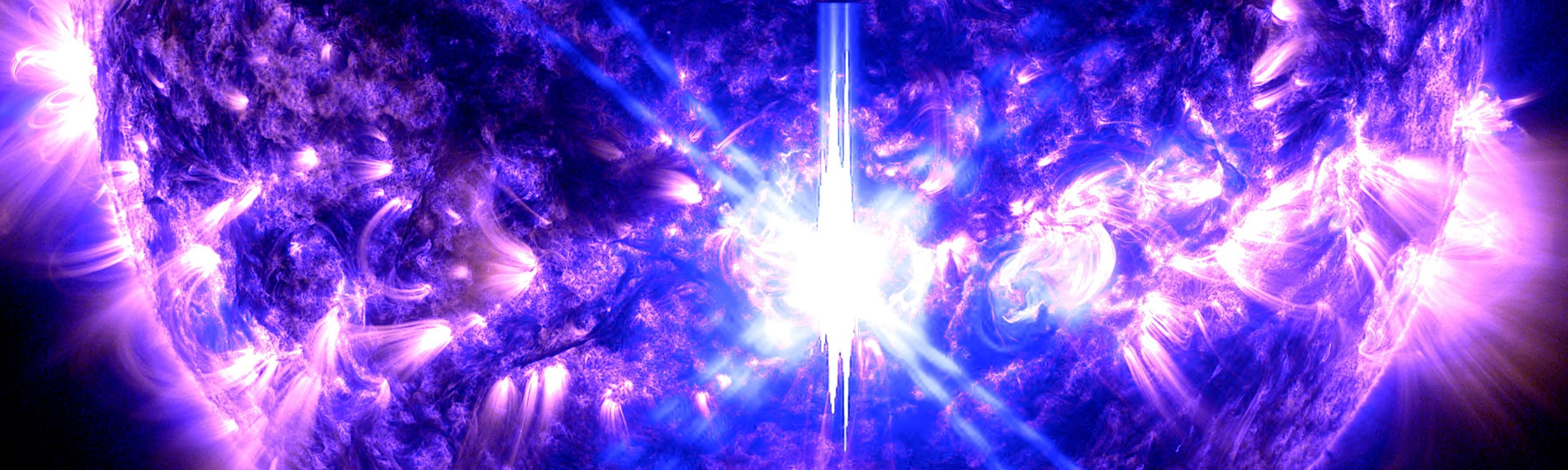
Yesterday the sun released a huge solar flare that is heading towards Earth! There's no need to worry as it's nowhere near as big as the Carrington event of 1859, but it's big enough to give us some amazing auroras.
Large solar flares occur at regular intervals. Literally, because the sun goes through an 11-year cycle of lower and higher activity. Right now the Sun is near the maximum of a cycle, so we are seeing lots of sunspots and solar flares. When astronomers first studied the cycle, they could only measure the number of sunspots at any given time. Solar flares were largely invisible to early telescopes. But now, with orbiting observatories like the Solar Dynamics Observatory, we can capture images of solar flares in real time. Astronomers now categorize the strength of solar flares based on the intensity of the X-rays they emit, called the x-class. The categories are numbered by ability level, with each category being twice as high as the previous one. For example, an X2 flare is twice as powerful as an X1 and half as powerful as an X3.
This latest flare is rated as X9, which is much stronger than most solar flares. But stronger events have reached Earth before. In 1989, an X15 event in Quebec triggered a regional blackout. In November 2003, the Sun released an X28 solar flare, but it mostly missed Earth. The Carrington event of 1859 occurred before astronomers developed the x-class classification, but is estimated to be around X45. While this outbreak is huge, it does not pose a serious threat to our electrical infrastructure.
What it will offer, however, is an aurora light show. When the charged particles released by the flare reach Earth's magnetosphere, many of them are captured by our magnetic field and spiral along the field lines to hit Earth's atmosphere in the polar regions. The impact triggers the subtle and beautiful light shows known as aurora. If you live far enough from the equator, you may be able to see them in the next few days. To find out your chances, you can take a look at the National Oceanic and Atmospheric Administration's Space Weather Prediction Center.
Like this:
Load…
