overview
In the early 17th century, Galileo pointed his primitive telescope at Jupiter and saw tiny specks of light with no discernible features. What a difference 400+ years can make, as today's backyard telescopes can resolve the disk of Europe surprisingly well. Europa is now considered one of the most complex and fascinating worlds in the solar system. Cracks, ridges and chaotic terrain in the moon's icy crust may provide access to one of the largest oceans in the solar system – and a possible habitat for aquatic life. NASA's Europa Clipper spacecraft, scheduled to launch in a week on October 10, will conduct a detailed exploration of the lunar surface to help plan future missions, including a lander and perhaps even a submarine. Europa Clipper's main scientific goal is to find out whether there are places beneath Europa's surface that could harbor life.
Discussion about Europe and mission
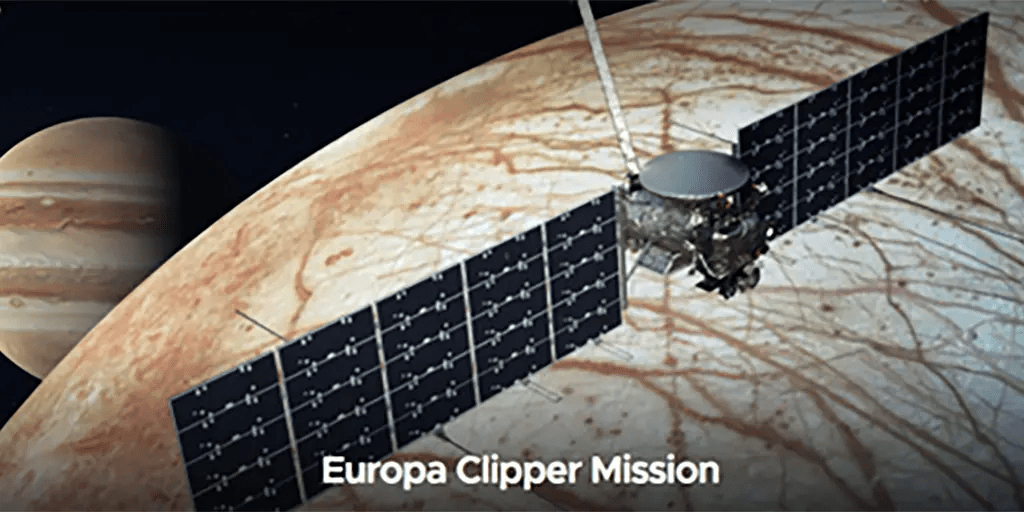
Europa is a world that shows clear evidence of an ocean of liquid water beneath its icy crust, which could well harbor favorable conditions for life. NASA will launch a high-performance, radiation-tolerant spacecraft called Clipper into a long orbit around Jupiter to conduct repeated flybys of the icy moon. In fact, the plan is to conduct 49 flybys of Europa at closest approach altitudes of just 16 miles, flying over a different location on each flyby to scan nearly the entire moon. With its massive solar arrays and radar antennas, Europa Clipper will be the largest spacecraft NASA has ever developed for a planetary mission. The spacecraft needs large solar arrays to collect enough light for its energy needs because it operates in the Jupiter system, which is more than five times farther from the sun than Earth. The spacecraft will be about 16 feet (5 meters) tall. With its arrays deployed, the spacecraft has a wingspan of more than 100 feet and a dry mass (no fuel in the tanks) of 7,145 pounds. The launch date for this spacecraft is currently set for Thursday, October 10, with arrival at Jupiter in April 2030.
Image credit: NASA/JPL-Caltech
Because Europa is bathed in radiation trapped in Jupiter's magnetic field, Europa Clipper's payload and other electronic equipment will be enclosed in a thick-walled vault. This strategy of armoring up to Jupiter with a radiation vault was first developed and successfully used by NASA's Juno spacecraft. The walls of the vault – made of titanium and aluminum – serve as a radiation shield against most high-energy atomic particles, significantly slowing the degradation of the spacecraft's electronics.
For Europe to be habitable, it needs the essential building blocks of life, including carbon, hydrogen, oxygen and sulfur. Liquid water is essential to the complex chemistry that makes life on Earth possible. Many scientists predict that beneath Europa's surface is a salty ocean that contains more water than all of Earth's oceans combined. While Jupiter's icy moon is far from the sun, Europa gets the energy to sustain life from Jupiter's strong gravity, which creates tides that stretch and tug on the moon, generating heat. One of the most important measurements from the Galileo mission, which previously explored Europa, showed how Jupiter's magnetic field was disturbed in the area around Europa. The measurement strongly suggested that in Europa a special magnetic field is created (induced) by a deep layer of an electrically conductive liquid (such as salt water) beneath the surface, which interacts with Jupiter's strong magnetic field.
The amazing work of Galileo
When Italian astronomer Galileo Galilei looked at the planet Jupiter through his newly improved homemade 20x telescope on January 7, 1610, he noticed three more points of light near the planet and initially believed they were distant stars. As he observed them over several nights, he noticed that they appeared to be moving in the wrong direction with respect to the background stars, remaining close to Jupiter but changing their positions relative to each other. He later observed a fourth star near the planet with the same unusual behavior. On January 15, Galileo correctly concluded that they were not stars at all but rather moons orbiting Jupiter, providing strong evidence for the Copernican theory that most celestial objects did not revolve around the Earth . In March 1610, Galileo published his discoveries of Jupiter's moons and other celestial observations in a book entitled Siderius Nuncius (The Starry Messenger).
Above: Two of Galileo's telescopes. Below: Page from Galileo's notebook about his observations of Jupiter's moons. Photo credit: National Geographic, gabrielevanin.it, University of Michigan Special Collections Library.
As their discoverer, Galileo had the naming rights to Jupiter's moons. He suggested naming them after his patrons, the Medici, and astronomers called them the Medici stars for much of the 17th century, although in his own notes Galileo referred to them in order of sequence with the Roman numerals I, II , III and IV denote distance from Jupiter. Astronomers still refer to the four moons as the Galilean satellites in honor of their discoverer. German astronomer Johannes Kepler suggested naming the satellites after mythological figures associated with Jupiter, namely Io, Europa, Ganymede and Callisto, but his idea failed to gain traction for over 200 years. Scientists did not discover additional satellites around Jupiter until American astronomer EE Barnard discovered Jupiter's fifth moon Amalthea in 1892, which was much smaller than the Galilean moons and orbited the planet closer than Io. It was the last satellite in the solar system to be found through visual observation – all subsequent discoveries were made through photography or digital imaging. To date, astronomers have identified 79 satellites orbiting Jupiter.
Meteorologist Paul Dorian
Arcfield
arcfieldweather.com
Follow us on Facebook, Twitter, YouTube
Like this:
Load…
