In the summer of 1969, Apollo 11 put humans on the lunar surface for the first time. Neil Armstrong and Buzz Aldrin spent just over two hours exploring the area near their landing site on foot. Only during Apollo 15, 16 and 17 did astronauts have a vehicle in which to travel.
Artemis astronauts on the moon will have immediate access to a vehicle, and NASA is beginning testing a prototype.
Despite some setbacks, momentum behind NASA's Artemis program is growing. Artemis astronauts will explore the moon far more thoroughly than Apollo astronauts, and the technology is behind the improvement. Surface mobility is a key element of Artemis. In April 2024, NASA selected three providers under its Lunar Terrain Vehicle Services contract.
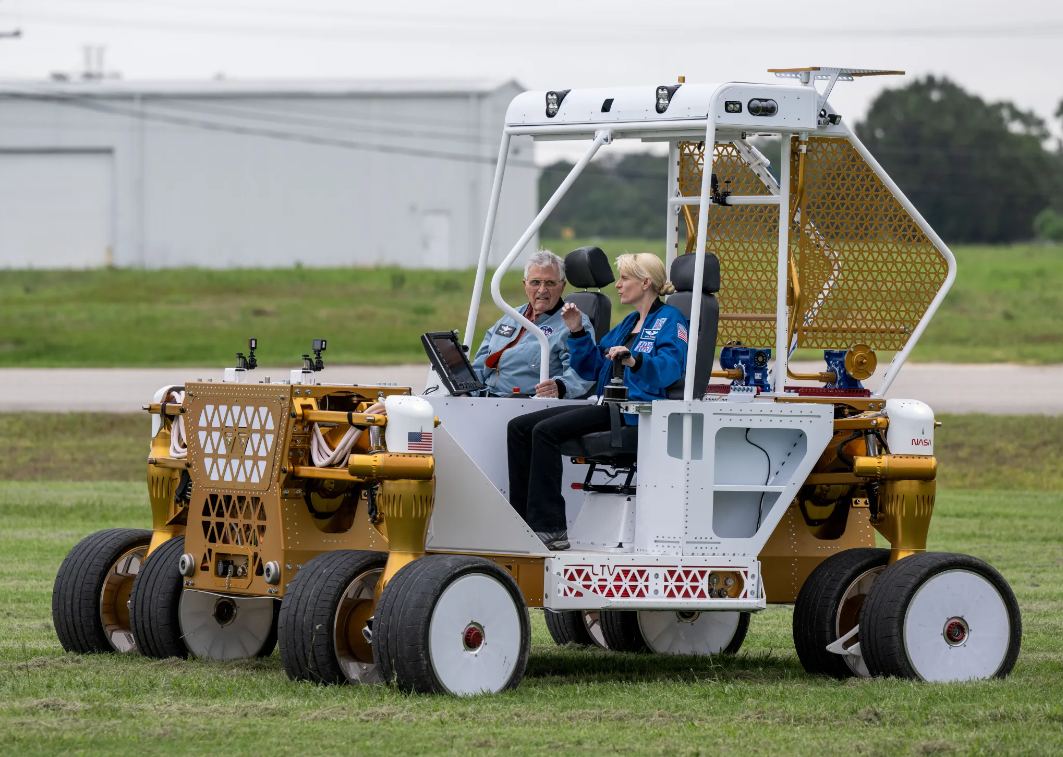
NASA engineers at Johnson Space Center are designing an unpressurized rover prototype known as the Ground Test Unit. It is a human-approved, unpressurized LTV (Lunar Terrain Vehicle). The unit will be designed and built as a platform to evaluate rover designs being developed by three private companies: Intuitive Machines, Lunar Outpost and Venturi Astrolab.
Intuitive Machines is known for its IM-1 mission with its Nova-C lander. They were the first private company to land a space probe on the moon.
Intuitive Machines' Nova-C lunar lander was the first private spacecraft to land on the Moon. Image source: From NASA Marshall Space Flight Center / Intuitive Machines Photo ID: IM_00309., Public Domain, https://commons.wikimedia.org/w/index.php?curid=145130774
Lunar Outpost is known for its MAPP (Mobile Autonomous Prospecting Platform) rover. MAPP will be used on Intuitive Machines' IM-2 and IM-3 missions and will demonstrate aspects of in-situ resource utilization.
Venturi Astrolab is known for developing extremely deformable wheels and batteries for lunar rovers. They are also developing their FLEX Rover, a larger vehicle that is modular in design to accomplish different objectives.
The LTV is used to test the technologies developed by these three companies. It is used to evaluate crew compartment design, rover maintenance, science payload and many other aspects of their rovers.
“The Ground Test Unit will help NASA teams in the field test and understand all aspects of rover operations on the lunar surface prior to Artemis missions,” said Jeff Somers, technical manager of the Ground Test Unit. “The GTU allows NASA to be a smart buyer, allowing us to test and evaluate rover operations while working with LTVS contractors and their hardware.”
Two engineers in suits sit on the prototype during testing at the Johnson Space Center. Image source: NASA/Bill Stafford
NASA has some requirements that the three selected companies must meet. The rover must support two crew members and be remotely controllable. Several control concepts can be used, such as: B. monitored autonomy, different driving modes and self-leveling.
NASA used its “Moon Buggy” or Lunar Roving Vehicle (LRV) on Apollo 15, 16 and 17 in 1971 and 1972. It could carry 440 kg, including two astronauts, and reached a top speed of 18 km/h. Although it offered range and mobility, it never traveled more than walking distance from the landers in the event of a breakdown. Image Source: By NASA/Dave Scott; Public domain, https://commons.wikimedia.org/w/index.php?curid=6057491
By providing the ground test unit, NASA is facilitating testing of the three companies' designs. It also helps build capacity in the private sector by enabling testing and iterative design without individual companies having to spend money on a GTU. Ground testing also allows for a safer testing environment.
An artistic illustration of astronauts at the lunar south pole. Photo credit: NASA
When Apollo 11 reached the moon, it was a pivotal moment for civilization. There was no reason to explore beyond the landing site, as it was as unexplored as the rest of the moon. But things are very different now.
Thanks to other missions and satellites orbiting the Moon, we have an almost encyclopedic knowledge of our natural satellite compared to the Apollo days. We know what questions we want answered, where we can do the best science, and where there are useful resources like water ice. The idea behind Artemis is to go to the moon and create infrastructure that allows us to maintain a presence there.
The Artemis lunar missions will rely on mobility to achieve their objectives. The LTV will be crucial to the success of Artemis as it allows each mission to explore and develop a larger area. NASA plans to deploy the new rovers starting with Artemis V, which will launch no earlier than 2030.
Like this:
Load…
