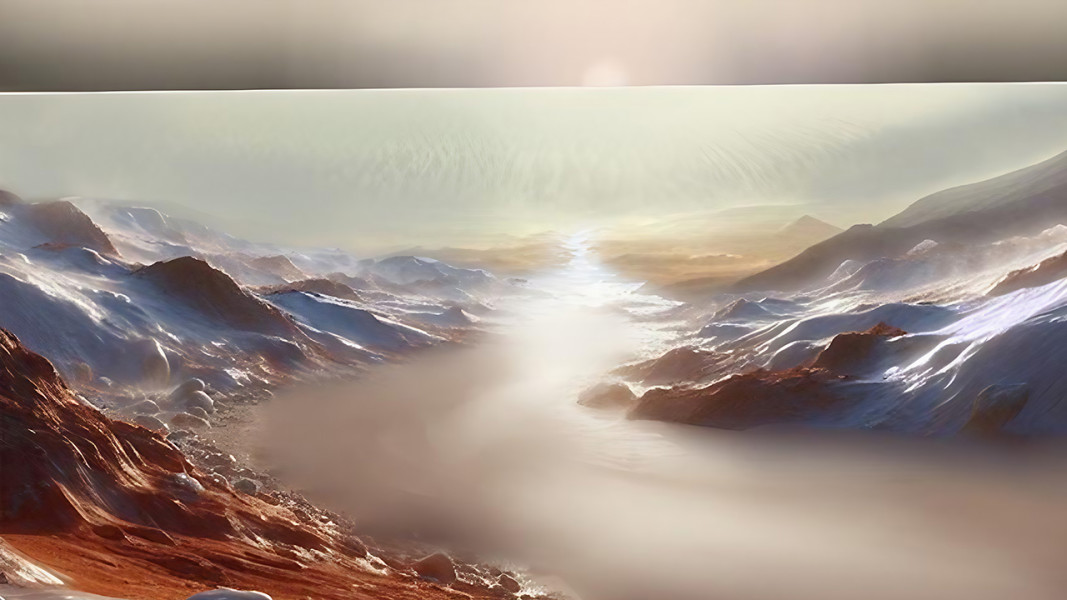
Mars' ancient climate is one of our solar system's most perplexing mysteries. The planet was once moist and warm; Now it is dry and cold. Whatever happened to the planet, it didn't happen all at once.
New research shows that on ancient cold Mars, layers of frozen carbon dioxide allowed rivers to flow and a sea the size of the Mediterranean to exist.
The climate change on Mars from warm and wet to cold and dry did not occur abruptly. There were no catastrophic impacts or other triggering events. Various climatic episodes occurred during its gradual shift.
The planet's surface has features that indicate the presence of water. River channels, impact craters, and basins that were once paleolakes illustrate Mars' complex climate history. Mars is very different from Earth, but both follow the same natural rules.
In Earth's cold climate, rivers can flow beneath thick, protective layers of ice. New research shows something similar happened on Mars. The research was published in JGR Planets and is titled “Massive ice sheet basal melt triggered by atmospheric collapse on Mars leads to the formation of a towering, ice-covered Argyre Basin paleolake fed by 1,000 km long rivers.” The lead author is Peter Buhler, a research scientist at the Planetary Science Institute.
The research examines a period about 3.6 billion years ago, when Mars likely transitioned from the Noachian period to the Hesperian period. According to the research, most of the surface water in the southern region of Mars was frozen into large ice sheets at that time. The planet's CO2 atmosphere suffered periodic collapses and sublimated from the atmosphere. These collapses created a 650-meter (0.4 mile) thick layer of CO2 that formed a massive ice cap over the South Pole. It isolated the 2.5 mile (4 km) thick layer of frozen water that made up the ice sheets.
This simple schematic from research shows how the proposed model works. As the CO2 atmosphere collapses and sublimates, it forms an insulating layer over the frozen water in Mars' southern polar regions. The meltwater is released and flows over the surface, isolated by a layer of frozen water. Photo credit: Bühler, 2024.
Bühler modeled how the CO2 cap acted as a thermal blanket and showed that it released huge amounts of meltwater from the frozen pole. This water flowed downstream, with the upper layers freezing and insulating the liquid water below.
“You now have the cap on top, a saturated water table underneath and permafrost on the sides,” Bühler said. “The only way for the water to flow is through the interface between the ice sheet and the underlying rock. That’s why on Earth you see rivers emerging from beneath glaciers rather than just flowing into the ground.”
According to Buhler's work, enough water was released to fill the Argyre Basin.
The Argyre Basin is one of the largest impact basins on the planet, measuring approximately 1,800 km (1,100 miles) in diameter. This massive impact basin was formed billions of years ago by a comet or asteroid that crashed into Mars. It drops about 5.2 km (3.2 miles) below the surrounding plains, making it the second deepest basin on Mars. Scientists have long assumed that the basin once contained water – as much as the Mediterranean Sea – and Bühler's work shows how it may have filled.
“Eskers are evidence that subglacial melting occurred on Mars at some point, and that is a big mystery,” Buhler said. Eskers are long, layered ridges of sand and gravel deposited by meltwater streams flowing beneath glaciers. They are common on Earth where glaciers once covered the surface. The eskers of Mars support the idea that the same thing happened on this planet.
These are Eskers in western Sweden. They were formed by flowing water under a glacier. When the glacier retreated, they were left behind as evidence. The same thing probably happened on Mars too. Image source: By Hanna Lokrantz – https://www.flickr.com/photos/geologicalsurveyofsweden/6853882122/in/album-72157625612122901/, CC BY 2.0, https://commons.wikimedia.org/w/index.php? curid=42848874
The subglacial rivers flowed beneath the ice, where they were insulated from the cold. As they left the glacier, they continued to seep until an ice cap thick enough to insulate them formed. Bühler says the ice would have become hundreds of feet thick and the water flowing beneath the ice caps would have been several feet deep. The water would have formed river channels thousands of kilometers long, and there are several of them, stretching from the polar ice cap to the Argyre Basin.
This illustration shows the polar cap, Argyre Crater, and the long winding channels that transported meltwater from the cap to the basin. Photo credit: Bühler 2024.
“People have tried to find processes that could make this possible, but nothing has really worked,” Buehler said. “The current best hypothesis is that there was an unspecified global warming event, but that was an unsatisfactory answer to me because we don't know what would have caused that warming. Eskers explains this model without pointing out global warming.”
The Argyre Basin is huge and voluminous, and explanations of how it was filled with water have been lacking. It has approximately the same volume as the Mediterranean Sea. Buhler's model shows that it took about ten thousand years for the basin to fill, and once it filled, the water poured out to plains about 8,000 km (5,000 miles) away.
This process occurred repeatedly over a period of one hundred million years, with each event millions of years apart.
“This is the first model to produce enough water to flood Argyre, which is consistent with decades-old geological observations,” Buhler said. “It is also likely that once the meltwater went downstream, it sublimated back into the atmosphere before returning to the south polar cap, maintaining a pole-to-equator hydrological cycle that may play an important role in Mars' enigmatic pulsation late stage.” hydrological activity. Furthermore, no late warming is required to explain this.”
Bühler's work is supported by other research. “Previous literature supports the existence of a CO2 inventory of ~0.6 bar (atmospheric), as used in the model, near the Noachian-Hesperian boundary,” he writes in his research. The history of atmospheric pressure on Mars is underpinned by cosmochemistry, mineralogy, isotope ratios of the atmosphere and gas trapped in meteorites, geomorphology, and extrapolations of modern atmospheric escape.
“There is therefore strong evidence that Mars had a sufficiently large mobile CO2 reservoir to drive the atmospheric collapse-induced melting scenario described in this manuscript, with the collapse occurring at a time consistent with the formation of the Valley Network during the intense late Noachian period of Mars. Early Hesperian final pulse of intense river activity,” Buhler writes.
This period of Mars' history is characterized by a distinct phase of geological activity, whereas changes in the earlier Noahic period were more gradual. Intensive valley network formation occurred in the late Noachian/early Hesperian. Many of these valleys are cut deeply into the landscape and often cut through older geological features. This suggests that the water flow was strong and erosive. This river activity also resulted in large sediment deposits, like those explored by NASA's Perseverance Rover in Jezero Crater.
Jezero crater on Mars. Scientists believe that the sediments in the crater could be a kilometer deep. Image credit: NASA/JPL-Caltech/ASU
Bühler's research is based in part on modern observations of Mars' atmospheric CO2 and its cycles. Much of it is actually frozen and bound to the regolith. The rotational tilt of Mars shifts over a period of 100,000 years. When it goes more straight up and down, the sun hits the equator and CO2 is released from the regolith into the atmosphere. It eventually reaches the poles, where it becomes frozen in the caps.
As Mars tilts, the poles warm and the CO2 sublimes and is released back into the atmosphere. It eventually reaches the now cooler regolith, which absorbs it. “The atmosphere is mostly just pleasant,” said Bühler. “It still functions today as a conduit for the real action, which is the exchange between the regolith and the southern polar ice cap.”
Bühler is continuing to work on its model and wants to test it more intensively. If it successfully survives further testing, our understanding of Mars will take a giant leap forward.
Like this:
Load…
