

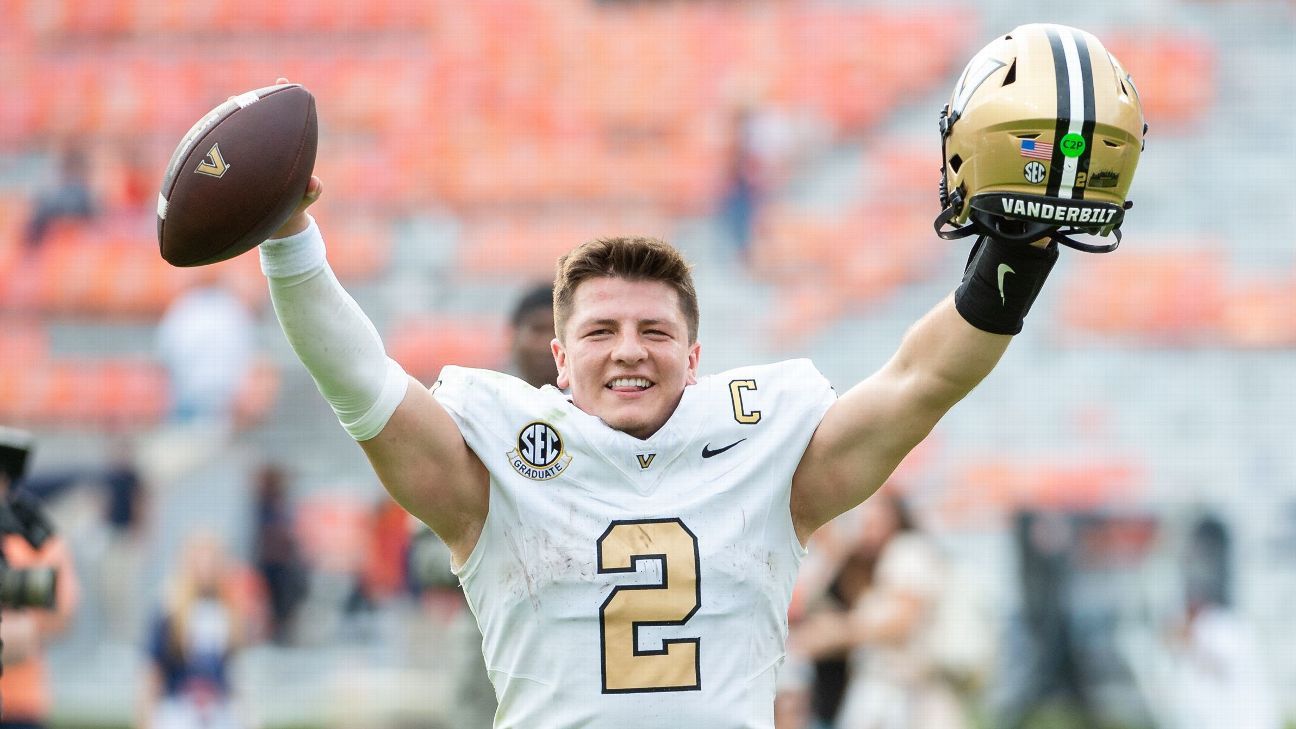
Vanderbilt quarterback Diego Pavia sued the NCAA in federal court on Friday, claiming that the organization's bylaws, which reduce the number of seasons that junior college players can play at Division I schools, are unlawful and the limited players' ability to make money from their name, image and likeness.
The lawsuit, filed in the U.S. District Court for the Middle District of Tennessee in Nashville, seeks an injunction that would prevent the NCAA from enforcing its statutes regarding limits on junior college players and grant Pavia two more seasons of eligibility to grant.
“The JUCO Eligibility Limitation Bylaws do not promote competition or benefit college athletes in light of their impact on individuals attending junior colleges before transferring to NCAA schools,” the lawsuit states. “These rules stifle competition in the job market for NCAA Division I football players, harm college athletes and degrade the quality of Division I football consumed by the public.”
“These damages are inconsistent with the defendant’s stated mission to promote the well-being of college athletes and are precisely the abuses that federal antitrust law seeks to remedy. Pavia and other former JUCO football players harmed by this unlawful restriction have a small window of time to compete in Division I football.”
The lawsuit argues that the NCAA and its member institutions “entered into an illegal agreement to restrict and suppress competition” in violation of the federal Sherman Act.
The lawsuit states that junior college transfers face eligibility restrictions that “do not apply to athletes who elect to delay entry to an NCAA Division I college in order to attend a prep school, to join the military.” serve or even compete professionally in another sport.”
Pavia, of Albuquerque, New Mexico, told ESPN last month that he was not offered a single FBS or FCS scholarship out of high school. Only two Division II schools – Western Colorado and Western New Mexico – gave him a chance to play quarterback.
He played two seasons at New Mexico Military Institute, a two-year junior college, before transferring to New Mexico State, where he played in 2022 and 2023. He enrolled at Vanderbilt in June, believing he would only be eligible to play for one season.
Pavia, 23, has helped revitalize Vanderbilt's once-failing program. The Commodores enter Saturday's game against South Carolina (4:15 p.m. ET, SEC Network/ESPN+) 6-3 after losing their last 10 games in 2023.
Pavia has passed for 1,677 yards with 15 touchdowns and three interceptions and leads the team in rushing with 563 yards and four touchdowns.
The Commodores upset then-No. 1 Alabama 40-35 on October 5th. They had lost each of their last 60 games to the top five teams in the Associated Press poll and had not beaten the Crimson Tide in 40 years.
The lawsuit also challenges the NCAA's statute that starts a player's eligibility clock when he enters a two-year school, even if he doesn't play, as well as the redshirt rule and the four-year eligibility limit.
“Because Pavia cannot relive his short college career, the harm caused by the JUCO Eligibility Limitations Bylaws is irreparable and permanent, and temporary and injunctive relief is necessary,” the lawsuit states. “Pavia brings this lawsuit to end the unjustified anti-competitive restrictions on universities seeking to compete for college athletes and to restore freedom of economic opportunity for itself and other college football players.”

Comments are closed.