

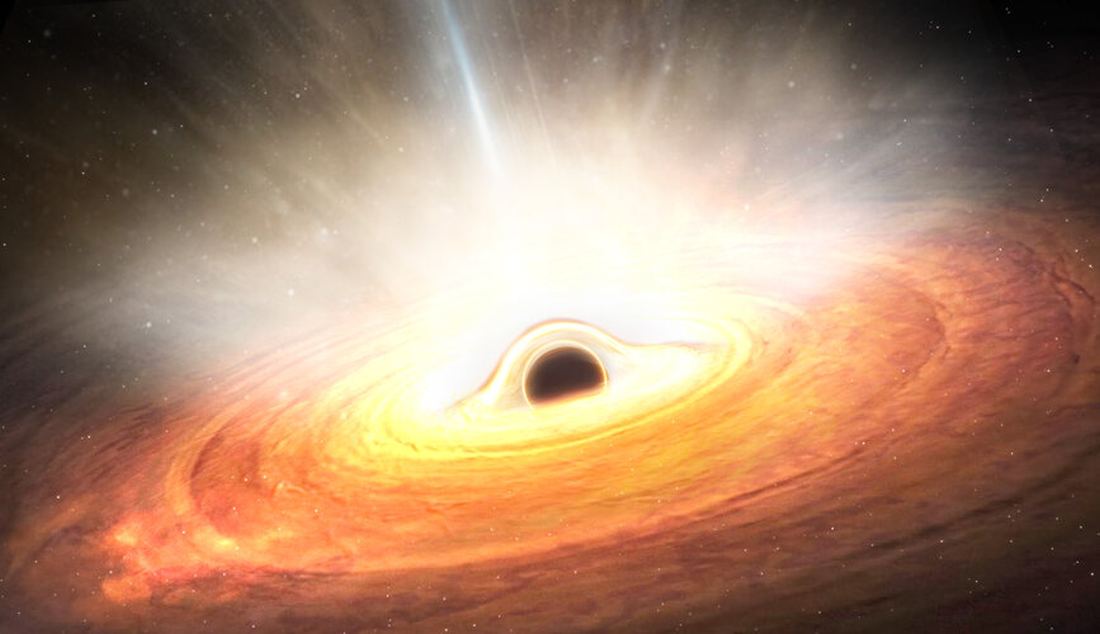
Supermassive black holes (SMBHs) can have billions of solar masses, and observational results suggest that all large galaxies have one at their center. However, the JWST has revealed a fundamental cosmic secret. The powerful space telescope, with its ability to observe ancient galaxies in the first billion years after the Big Bang, has shown us that SMBHs were extremely massive even then. This contradicts our scientific models that explain how these giants became so huge.
How could they become so massive so early?
Black holes of all masses are somewhat mysterious. We know that massive stars can collapse late in their lives and form stellar-mass black holes. We also know that pairs of stellar-mass black holes can merge, and we have detected the gravitational waves from these mergers. So it's tempting to think that SMBHs also grow through mergers when galaxies merge with each other.
The problem is that in the early universe there wasn't enough time for black holes to grow large enough and merge often enough to create the SMBHs. The JWST has shown us the flaws in our models of black hole growth by finding quasars powered by black holes of 1-10 billion solar masses less than 700 million years after the Big Bang.
Astrophysicists are busy trying to understand how SMBHs became so massive so quickly across the universe. New research titled “Primordial Black Holes as Supermassive Black Hole Seeds” seeks to fill the gap in our understanding. The lead author is Francesco Ziparo from the Scuola Normale Superiore di Pisa, a public university in Italy.
This artist's concept depicts a supermassive black hole (central black dot) at the core of a young, star-rich galaxy. Observational results indicate that all large galaxies have one. Image credit: NASA/JPL-Caltech
There are three types of black holes: stellar-mass black holes, intermediate-mass black holes (IMBHs), and SMBHs. Stellar-mass black holes have masses ranging from about five solar masses to tens of solar masses. SMBHs have masses ranging from hundreds of thousands of solar masses to millions or billions of solar masses. IMBHs lie in between and have masses in the range of about one hundred thousand to one hundred thousand solar masses. Researchers have wondered whether IMBHs could be the missing link between stellar-mass black holes and SMBHs. However, we only have indirect evidence that they exist.
This is Omega Centauri, the largest and brightest globular cluster known in the Milky Way. An international team of astronomers used more than 500 NASA/ESA Hubble Space Telescope images spanning two decades to discover seven fast-moving stars in the innermost region of Omega Centauri. These stars provide compelling new evidence for the existence of an intermediate-mass black hole. Image source: ESA/Hubble & NASA, M. Häberle (MPIA)
There is a fourth type of black hole that is largely theoretical, and some researchers believe it can explain why the early SMBHs were so massive. They are called primordial black holes (PBHs). Conditions in the very early universe were very different than today, and astrophysicists believe that PBHs could have been formed by the direct collapse of dense pockets of subatomic matter. PBHs formed before stars even existed and are therefore not limited to the rather narrow mass range of stellar-mass black holes.
Artistic illustration of primordial black holes. NASA's Goddard Space Flight Center
“The presence of supermassive black holes in the first cosmic gyr (gigayear) challenges current models of BH formation and evolution,” the researchers write. “We propose a novel mechanism for the formation of early SMBH seeds based on primordial black holes (PBHs).”
Ziparo and his co-authors explain that in the early universe, PBHs would have accumulated and formed in high-density regions, the same regions where dark matter halos formed. Their model accounts for PBH accretion and feedback, dark matter halo growth, and dynamic gas friction.
In this model, the PBHs have about 30 solar masses and are located in the central region of the dark matter (DM) halos. As the halos grow, baryonic matter settles into their depressions as cooled gas. “PBHs both accrete baryons and lose angular momentum due to dynamic friction on the gas, causing them to accumulate in the central region of the potential well and form a dense core,” the authors explain. Once they agglomerate, an out-of-control collapse occurs, eventually resulting in a massive black hole. Its mass depends on the initial conditions.
These seeds planted early enough may explain the early SMBHs observed by the JWST.
This research illustration illustrates how PBHs could form the seeds for SMBHs. (Left) As the gas cools, it settles at the center of the dark matter's gravitational potential and the PBHs become embedded in the center. (Middle) The PBHs lose angular momentum due to the dynamic friction of the gas and concentrate in the core of the DM halo. (Right) PBH binaries form and merge quickly due to their high density. The end result is a runaway merger process that lays the foundation for small and medium-sized businesses. Image source: Ziparo et al. 2024.
According to the authors, there is a way to test this model.
“During the runaway phase of the proposed seed formation process, PBH-PBH mergers are expected to emit abundant gravitational waves. “These predictions can be verified by future observations from the Einstein Telescope and used to constrain inflation models,” they explain.
The Einstein Telescope or Einstein Observatory is a proposal by several European research agencies and institutions for an underground gravitational wave (GW) observatory, building on the success of the Advanced Virgo and Advanced LIGO laser interferometric detectors. The Einstein Telescope would also be a laser interferometer, but with much longer arms. While LIGO has arms four kilometers long, Einstein would have arms 10 kilometers long. These longer arms, combined with new technologies, would make the telescope much more sensitive to GWs.
The Einstein Telescope was intended to open a GW window into the entire population of stellar and intermediate black holes throughout the history of the universe. “The Einstein Telescope will make it possible for the first time to explore the Universe through gravitational waves throughout its cosmic history into the cosmological Dark Ages and shed light on open questions in fundamental physics and cosmology,” says the Einstein website.
A comprehensive understanding of SMBHs is still a long way off, but their role in the universe means they are important to understand. They help explain the large-scale structure of the universe by influencing the distribution of matter on large scales. The fact that they appeared in the universe so much earlier than we thought possible shows that we still have a lot to learn about SMBHs and how the universe evolved to the state it is in now.
Like this:
Load…

Comments are closed.