

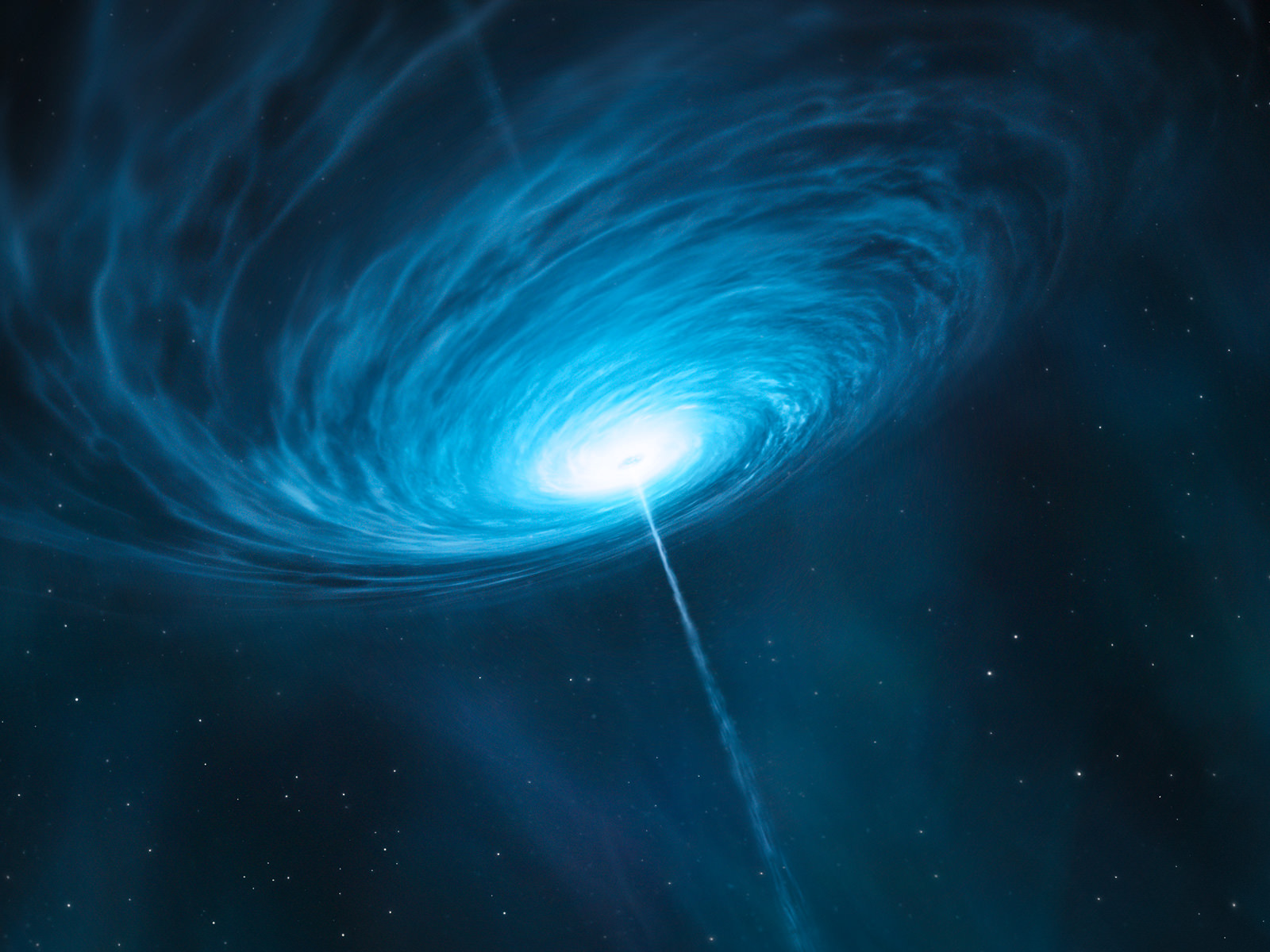
The existence of gigantic black holes in the very early universe challenges our assumptions about the formation and growth of black holes. New research suggests that these monsters may have originated in the earliest eras of the Big Bang.
For years, astronomers have been concerned about observations of full-grown supermassive black holes before the universe was even a billion years old. This is a challenge because, as far as we know, the only way black holes can form is through the death of massive stars. And the only way for them to grow is either through mergers or the accumulation of material. According to these known mechanisms, it is extremely difficult for the observed black holes, whose masses are hundreds of millions of times that of the Sun, to form so quickly.
And so astronomers have long tried to find another way to explain how these giant black holes arrive on the cosmic stage. In a new paper, a team of researchers points to a seemingly unlikely scenario: the first microseconds of the Big Bang.
In the 1970s, Stephen Hawking hypothesized that the turbulent epochs of the incredibly early universe would cause random fluctuations in matter to spontaneously collapse and form black holes. These original black holes may even persist to this day, and astronomers have even gone so far as to suggest that these black holes explain dark matter.
But observations have significantly limited the populations of primordial black holes. They simply cannot be a major component of the universe, otherwise we would have seen evidence of them by now.
However, in the new work, the researchers point out that they do not have to be common to form the seeds of supermassive black holes. They can be incredibly rare, making up less than 1% of the total mass in the universe. However, when they form in the early universe, they can slowly accumulate new material and merge together over time, especially in the first few hundred million years when galaxies first form.
This scenario would mean that giant black holes would form not after the first stars appeared, but parallel to them. When stars and galaxies appear, the black holes are already fully grown.
The researchers managed to find a scenario that could explain the observed population of giant black holes in the early universe. However, this is only the first step of the research. The next step is to refine these models and integrate them into more detailed simulations of the evolution of the early universe to see how plausible this scenario is.
Like this:
Load…

Comments are closed.