They are so extreme that they cannot be explained by global warming models!
From the Columbia Climate School and the “Have You Checked the Accuracy and Placement of Thermometers” and “Weather is Not Climate” departments comes this new study that is hilarious in its lameness. It's like these people have never heard of weather and they only exist in the climate headspace. – Anthony
Earth's hottest year was 2023, at 2.12 degrees Fahrenheit above the 20th century average. This exceeded the previous record from 2016. So far, the ten hottest annual average temperatures have been measured in the last decade. And with the hottest summer and hottest single day, 2024 is on track to set another record.
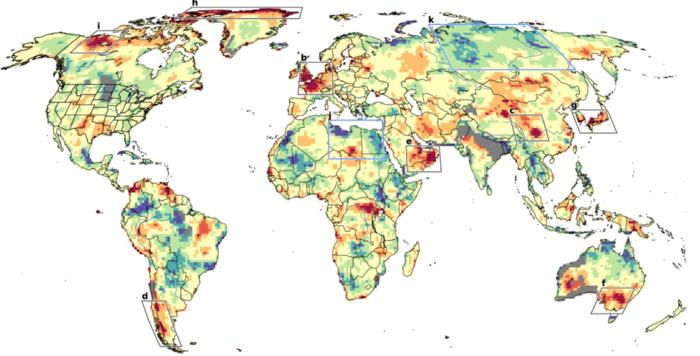
All of this may not be news to everyone, but amidst this rise in average temperatures, a striking new phenomenon is emerging: certain regions are experiencing repeated heatwaves so extreme that they go far beyond what any model of the global economy can predict can predict or explain warming. A new study provides the first global map of such regions, which appear like giant, angry patches of skin on every continent except Antarctica. In recent years, these heat waves have killed tens of thousands of people, destroyed crops and forests, and sparked devastating wildfires.
“The large and unexpected deviations by which recent regional extremes have exceeded previous records have raised questions about the extent to which climate models can provide adequate estimates of the relationships between global average temperature changes and regional climate risks,” the study says.
“This is about extreme trends that are the result of physical interactions that we may not fully understand,” said lead author Kai Kornhuber, an associate scientist at Columbia Climate School's Lamont-Doherty Earth Observatory. “These regions become temporary greenhouses.” Kornhuber is also a senior research scientist at the International Institute for Applied Systems Analysis in Austria.
The study was just published in the journal Proceedings of the National Academy of Sciences.
The study examines heat waves over the past 65 years and identifies areas where extreme heat is accelerating significantly faster than more moderate temperatures. This often results in maximum temperatures that are repeatedly exceeded by excessive, sometimes astonishing values. For example, a nine-day wave that swept across the Pacific Northwest and southwestern Canada in June 2021 broke daily records of 30 degrees Celsius, or 54 degrees Fahrenheit, in some places. This also included the highest temperature ever recorded in Canada, 121.3 degrees Fahrenheit, in Lytton, British Columbia. The next day, the city burned in a wildfire caused in large part by vegetation drying out in the exceptional heat. In Oregon and Washington state, hundreds of people died from heat stroke and other health problems.
Daily maximum temperature anomalies during recent record-breaking heatwaves and their temporal context. (A) Anomaly fields with daily maximum temperature (Tx) of 2 m averaged over the 2021 Pacific Northwest heat wave in North America. Regions where values reached record levels in the specified period (since 1950) are hatched. (B) Time series for 1950 to 2023 of the hottest annual average Tx anomaly in the region indicated by the panel in A (relative to 1981 to 2010, June–August). The record-breaking values of the regional mean Tx and their dates are highlighted in each time series (red dot). (C and D) as A and B, but for the Western European heat wave in July 2022, (E and F) for the heat wave in the Amazon basin in November 2023 (warm season September–November) and (G and H) the heat wave in southern Africa (warm season December–February) in January 2016.
These extreme heat waves have mostly occurred in the last five years or so, although some occurred in the early 2000s or earlier. The hardest-hit regions include populous central China, Japan, Korea, the Arabian Peninsula, eastern Australia and scattered parts of Africa. Others include Canada's Northwest Territories and its High Arctic islands, northern Greenland, the southern end of South America, and isolated parts of Siberia. Areas of Texas and New Mexico appear on the map, but are not at the extreme ends.
According to the report, the strongest and most consistent signal comes from northwestern Europe, where heat wave sequences resulted in about 60,000 deaths in 2022 and 47,000 deaths in 2023. These occurred in Germany, France, the United Kingdom, the Netherlands and other countries. Here, the hottest days of the year have been warming up twice as fast as average summer temperatures in recent years. One reason the region is particularly at risk is that, unlike countries like the United States, few people have air conditioning, as it has traditionally almost never been needed. The outbreaks continued; It was only in September of this year that new maximum temperature records were set in Austria, France, Hungary, Slovenia, Norway and Sweden.
The researchers refer to the statistical trends as “tail broadening” – that is, the anomalous occurrence of temperatures at or beyond the extreme upper end, anything that would be expected with simple upward shifts in mean summer temperatures. But the phenomenon does not occur everywhere; The study shows that maximum temperatures in many other regions are actually lower than models would predict. These include large areas in the northern United States and southern Canada, inland South America, large parts of Siberia, northern Africa and northern Australia. Heat is also increasing in these regions, but the extremes are increasing at a similar or slower rate than average changes suggest.
Rising overall temperatures make heat waves more likely in many cases, but the causes of the extreme heat outbreaks are not entirely clear. In Europe and Russia, a previous study conducted by Kornhuber attributed heat waves and droughts to fluctuations in the jet stream, a fast-moving stream of air that continuously circles the Northern Hemisphere. Bounded by historically freezing temperatures in the far north and much warmer temperatures further south, the jet stream is generally confined to a narrow band. But the Arctic is warming much faster on average than most other parts of the world, and this appears to be destabilizing the jet stream, causing it to develop so-called Rossby waves, which suck in hot air from the south and park it in temperate temperatures Regions that typically do not experience extreme heat for days or weeks.
This is just a hypothesis, and it doesn't seem to explain all the extremes. A study of the deadly 2021 heat wave in Pacific Northwest/Southwest Canada led by Lamont-Doherty doctoral student Samuel Bartusek (also co-author of the latest paper) found a confluence of factors. Some appeared to be related to long-term climate change, others to coincidence. The study identified a disturbance in the jet stream similar to the Rossby waves thought to be affecting Europe and Russia. It also found that decades of slowly rising temperatures had dried out regional vegetation, leaving plants with fewer water reserves to evaporate into the air during a hot spell, a process that helps moderate the heat. A third factor: a series of smaller atmospheric waves that collected heat from the surface of the Pacific Ocean and carried it eastward onto land. As in Europe, few people in this region have air conditioning because it is generally not needed, which is likely driving up the death toll.
The heat wave “was so extreme that it's tempting to call it a 'black swan,' something you can't predict,” Bartusek said. “But there is a line between the completely unpredictable, the plausible and the completely expected that is difficult to categorize. I would describe it more as a gray swan.”
Although the wealthy United States is better prepared than many other places, excessive heat still kills more people than all other weather-related causes combined, including hurricanes, tornadoes and floods. According to a study published last August, the annual mortality rate has more than doubled since 1999, with 2,325 heat-related deaths in 2023. This has recently led to calls for heat waves to be named similarly to hurricanes to increase public awareness and motivation Governments to prepare.
“Due to their unprecedented nature, these heatwaves typically involve a lot have serious impacts on health and can have disastrous consequences for agriculture. Vegetation and infrastructure,” said Kornhuber. “We are not made for them, and we might as well not being able to adapt quickly enough.”
The study was also co-authored by Richard Seager and Mingfang Ting of the Lamont-Doherty Earth Observatory and HJ Schellnhuber of the International Institute for Applied Systems Analysis.
# # #
Like this:
Load…
